Solar system voyage · Stop 2 of 10
Beyond the cloud veil
The bright clouds hide a rocky world. What you can see from orbit is not the surface a lander encounters.
0.72 AU from the Sun · mean distance, rounded
Investigate the sunlight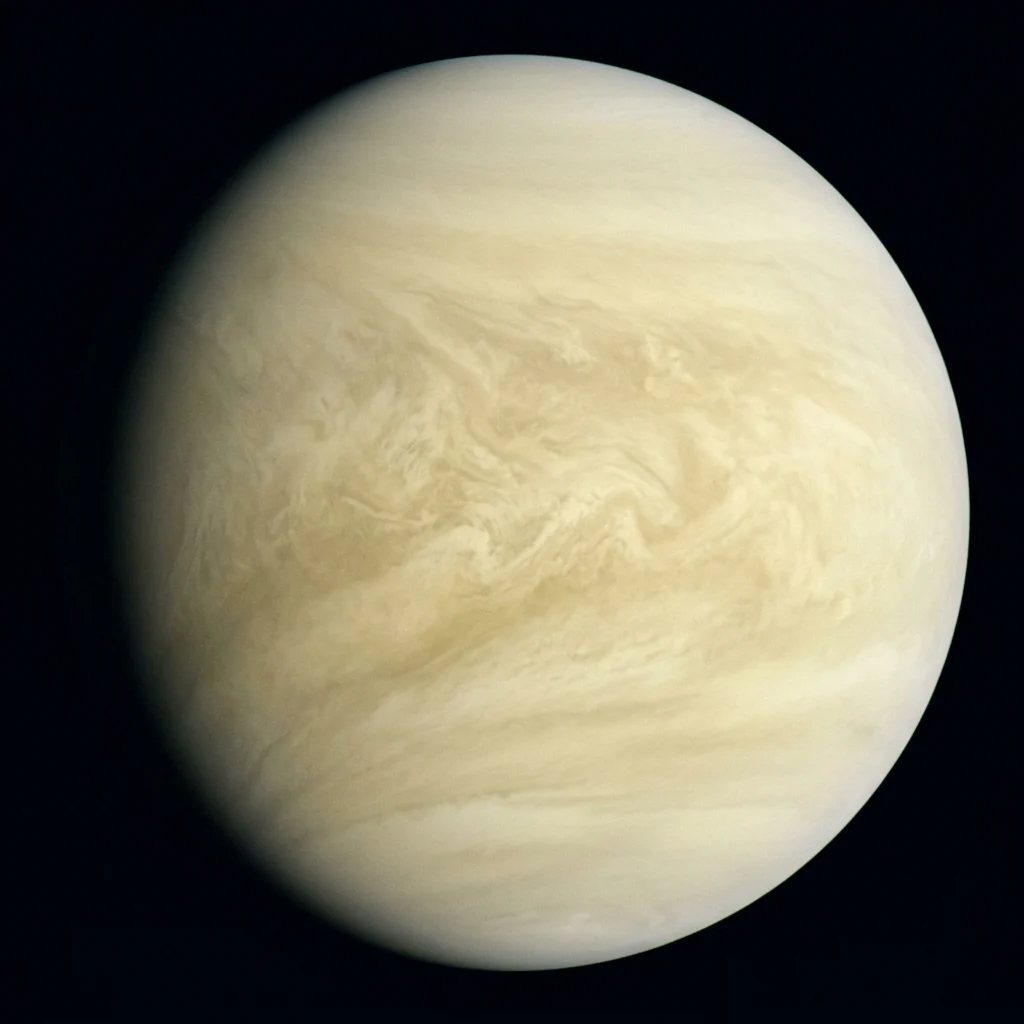
Spacecraft-inspired view. Images are not a live view; sizes and star positions are not to scale. Select an image to examine it with the class.
Carry sunlight across the solar system
Predict first: move twice as far from the Sun. How much light reaches the same area?
distance from the Sun
sunlight per m², compared with Earth
one-way light travel from the Sun
1 AU ≈ 150 million km. Model: sunlight ∝ 1 / distance²; light takes about 8.32 minutes per AU. These are Sun-to-location values, not Earth-to-spacecraft communication times. Atmospheres, temperature, and orbital eccentricity are not modeled. NASA solar system reference · NASA planetary distance table.
Your mission at Venus
Why is Venus hotter than Mercury even though it is farther from the Sun?
Reveal the explanation
Distance is only part of the story. Venus’s thick carbon dioxide atmosphere produces an intense greenhouse effect.
Explain your answer using one observation from the image or lesson and one measurement from the sunlight experiment.
Venus
The bright clouds hide a rocky world. What you can see from orbit is not the surface a lander encounters.
Overview
Venus is often called Earth's twin due to its similar size and mass, but it suffered a runaway greenhouse effect. Shrouded beneath unbroken cloud decks of concentrated sulfuric acid, its carbon dioxide atmosphere produces crushing surface pressures 92 times Earth's and furnace temperatures of 465°C (870°F).