Solar system voyage · Stop 7 of 10
A world framed in ice
From afar the rings look solid. Up close, countless separate icy particles follow their own paths around Saturn.
9.58 AU from the Sun · mean distance, rounded
Investigate the sunlight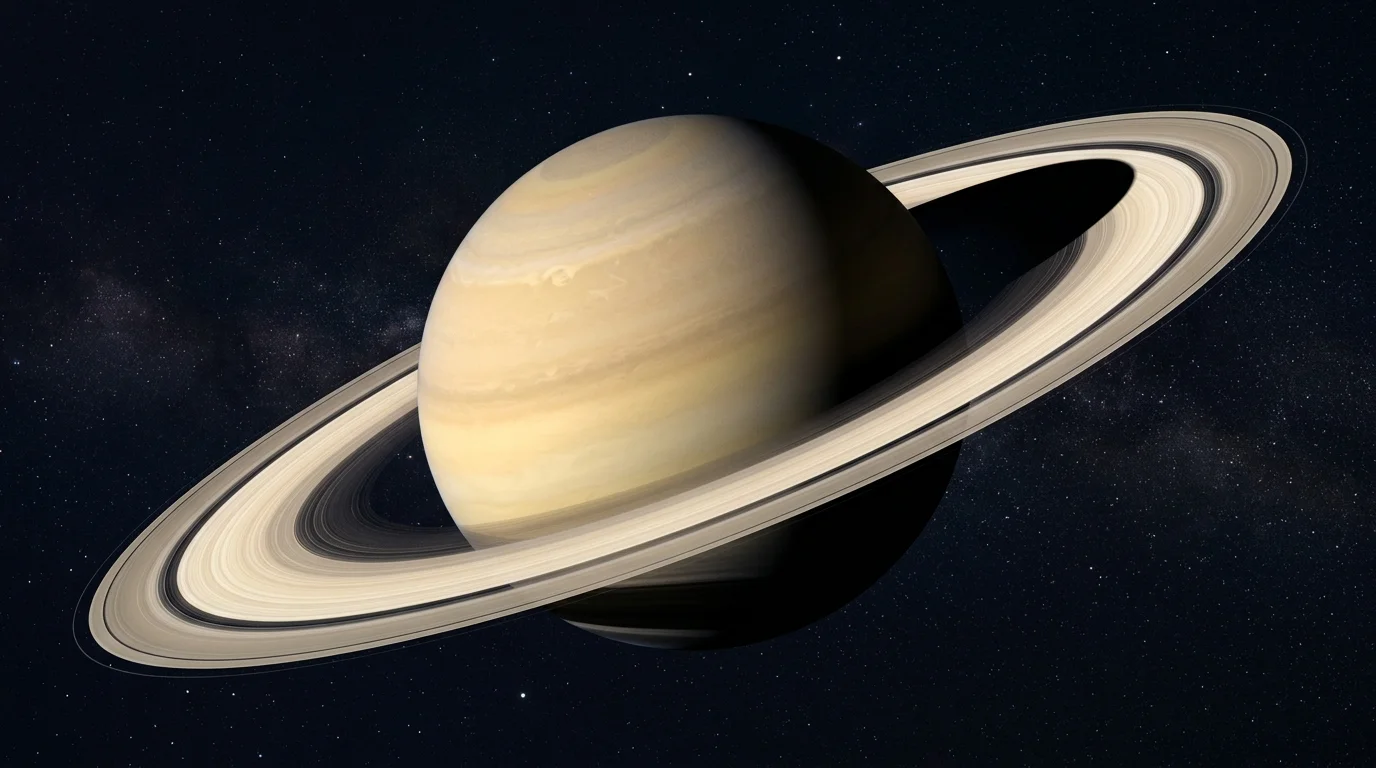
Spacecraft-inspired view. Images are not a live view; sizes and star positions are not to scale. Select an image to examine it with the class.
Carry sunlight across the solar system
Predict first: move twice as far from the Sun. How much light reaches the same area?
distance from the Sun
sunlight per m², compared with Earth
one-way light travel from the Sun
1 AU ≈ 150 million km. Model: sunlight ∝ 1 / distance²; light takes about 8.32 minutes per AU. These are Sun-to-location values, not Earth-to-spacecraft communication times. Atmospheres, temperature, and orbital eccentricity are not modeled. NASA solar system reference · NASA planetary distance table.
Your mission at Saturn
Why is a ring not a solid disk attached to Saturn?
Reveal the explanation
Each particle orbits under gravity. Particles at different distances have different orbital speeds; moons and resonances shape the ring structure.
Explain your answer using one observation from the image or lesson and one measurement from the sunlight experiment.
Saturn
From afar the rings look solid. Up close, countless separate icy particles follow their own paths around Saturn.
Overview
Saturn is the second-largest planet in the solar system, renowned for its majestic ring system. Composed of billions of fragments of almost pure water ice ranging in size from dust specks to house-sized boulders, the rings span 282,000 kilometers across yet average only about 10 meters thick.