Solar system voyage · Stop 8 of 10
The sideways world
A quiet-looking cloud deck conceals an unusual orientation. Uranus’s extreme tilt makes its seasons unlike ours.
19.2 AU from the Sun · mean distance, rounded
Investigate the sunlight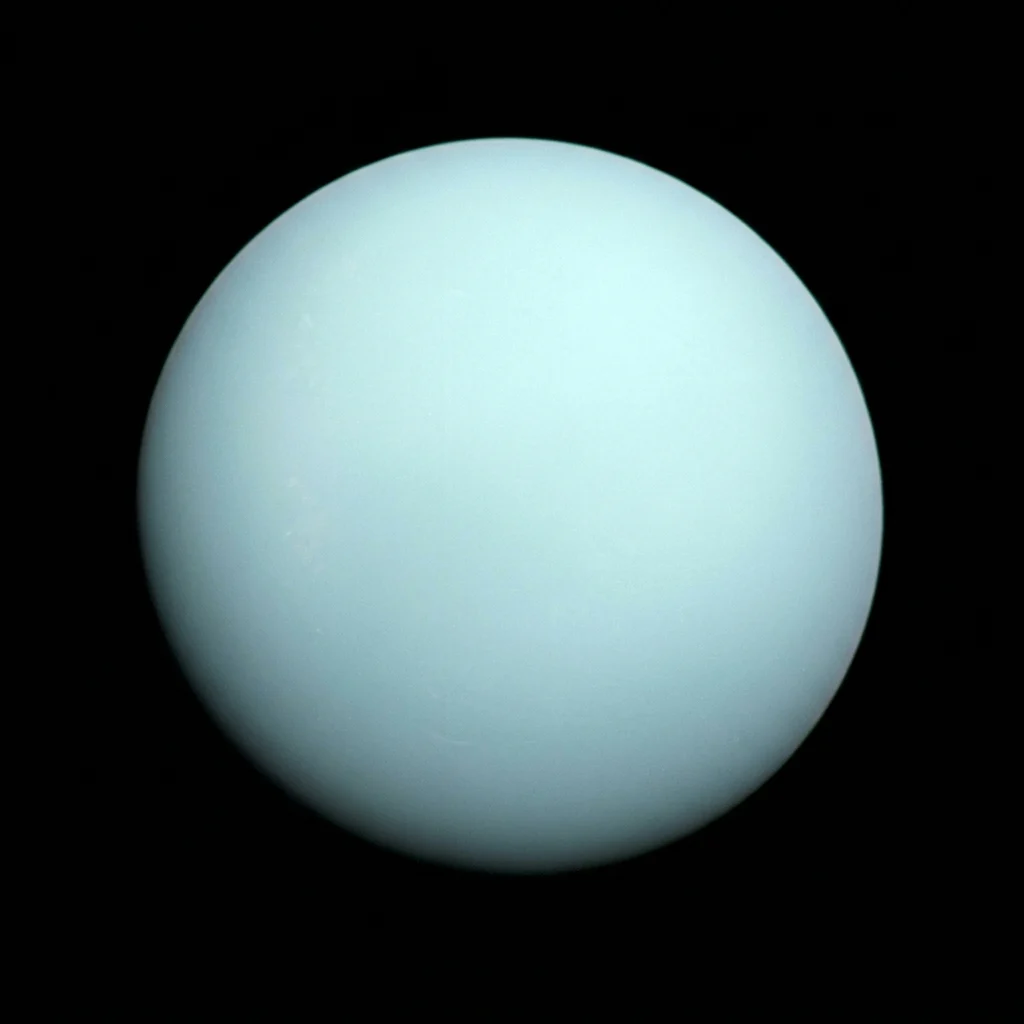
Spacecraft-inspired view. Images are not a live view; sizes and star positions are not to scale. Select an image to examine it with the class.
Carry sunlight across the solar system
Predict first: move twice as far from the Sun. How much light reaches the same area?
distance from the Sun
sunlight per m², compared with Earth
one-way light travel from the Sun
1 AU ≈ 150 million km. Model: sunlight ∝ 1 / distance²; light takes about 8.32 minutes per AU. These are Sun-to-location values, not Earth-to-spacecraft communication times. Atmospheres, temperature, and orbital eccentricity are not modeled. NASA solar system reference · NASA planetary distance table.
Your mission at Uranus
How could a pole spend years facing the Sun?
Reveal the explanation
Uranus’s rotation axis is tilted about 98 degrees. During part of its 84-Earth-year orbit, one pole points roughly toward the Sun.
Explain your answer using one observation from the image or lesson and one measurement from the sunlight experiment.
Uranus
A quiet-looking cloud deck conceals an unusual orientation. Uranus’s extreme tilt makes its seasons unlike ours.
Overview
Uranus is the seventh planet from the Sun and the solar system's first ice giant. Distinct from gas giants like Jupiter, its bulk composition consists of a dense, slushy mantle of water, methane, and ammonia ices above a rocky core, rotated sideways on an extreme 97.8° axial tilt.