Solar system voyage · Stop 1 of 10
At the edge of the sunlight
A cratered world races around the Sun. Look for the scars that remain when almost no atmosphere erases them.
0.39 AU from the Sun · mean distance, rounded
Investigate the sunlight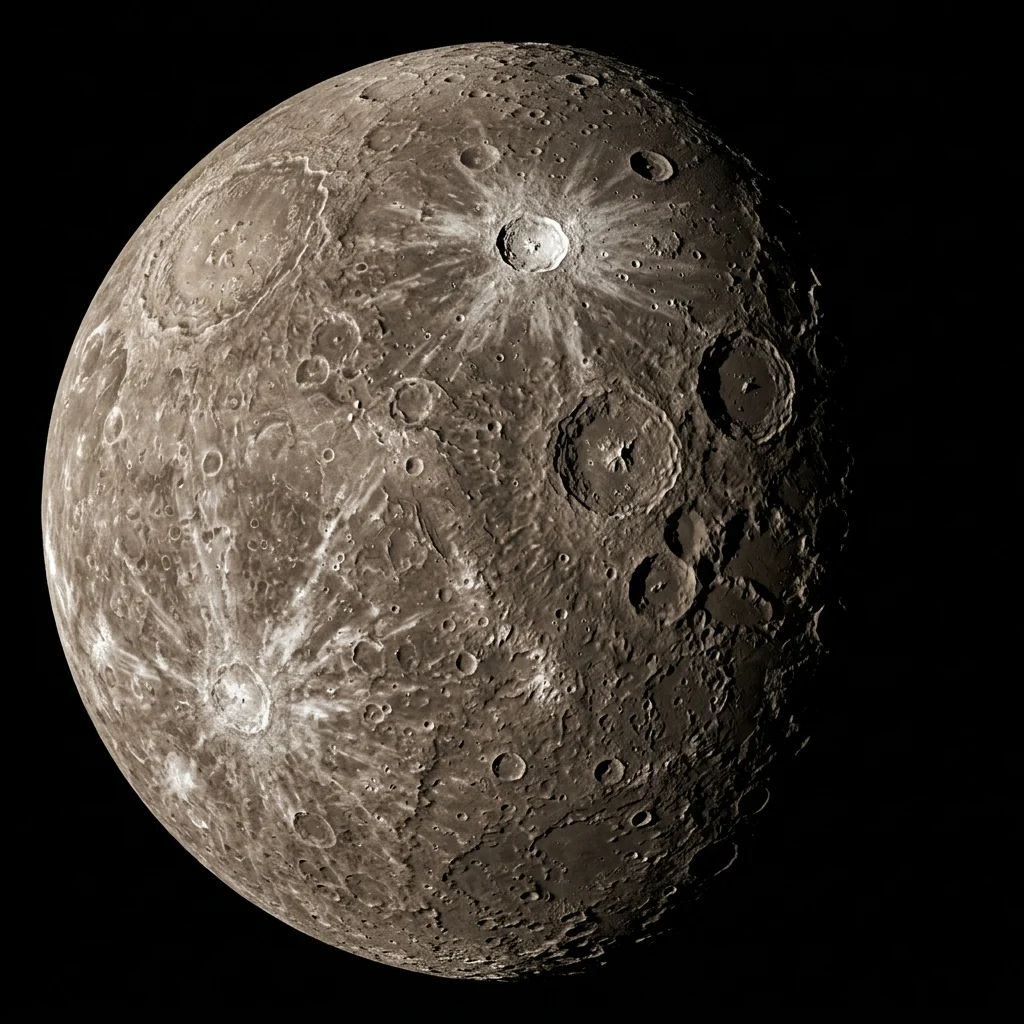
Spacecraft-inspired view. Images are not a live view; sizes and star positions are not to scale. Select an image to examine it with the class.
Carry sunlight across the solar system
Predict first: move twice as far from the Sun. How much light reaches the same area?
distance from the Sun
sunlight per m², compared with Earth
one-way light travel from the Sun
1 AU ≈ 150 million km. Model: sunlight ∝ 1 / distance²; light takes about 8.32 minutes per AU. These are Sun-to-location values, not Earth-to-spacecraft communication times. Atmospheres, temperature, and orbital eccentricity are not modeled. NASA solar system reference · NASA planetary distance table.
Your mission at Mercury
Why can the closest planet to the Sun still have an extremely cold night?
Reveal the explanation
Without a substantial atmosphere to redistribute and retain heat, the surface loses energy during its long night.
Explain your answer using one observation from the image or lesson and one measurement from the sunlight experiment.
Mercury
A cratered world races around the Sun. Look for the scars that remain when almost no atmosphere erases them.
Overview
Mercury is the smallest planet in the solar system and closest to the Sun. With virtually no atmosphere to trap heat or weather the landscape, its ancient surface preserves billions of years of impact craters and dramatic lobate scarps caused by planetary cooling and shrinking.