Spacecraft-inspired view. Images are not a live view; sizes and star positions are not to scale. Select an image to examine it with the class.
Carry sunlight across the solar system
Predict first: move twice as far from the Sun. How much light reaches the same area?
distance from the Sun
sunlight per m², compared with Earth
one-way light travel from the Sun
1 AU ≈ 150 million km. Model: sunlight ∝ 1 / distance²; light takes about 8.32 minutes per AU. These are Sun-to-location values, not Earth-to-spacecraft communication times. Atmospheres, temperature, and orbital eccentricity are not modeled. NASA solar system reference · NASA planetary distance table.
Your mission at Asteroid belt
Would a spacecraft need to weave constantly between asteroids?
Reveal the explanation
No. Objects are usually separated by enormous distances. Dense illustrations help show the population but exaggerate how crowded space is.
Explain your answer using one observation from the image or lesson and one measurement from the sunlight experiment.
Space Science · Lesson 09
The Asteroid Belt
Between Mars and Jupiter is a broad ring of rocky leftovers from the early Solar System. It is not a crowded movie-style danger zone. It is mostly empty space, shaped by gravity, collisions, and Jupiter's enormous influence.
LocatePlace the main belt in the Solar System.
ExplainConnect Jupiter's gravity to gaps and disrupted growth.
ClassifyDistinguish asteroids, meteoroids, meteors, and meteorites.
Mars to JupiterCeresKirkwood GapsMeteorites
Orbital Belt Lab Click named objects or change the view in the side panel.
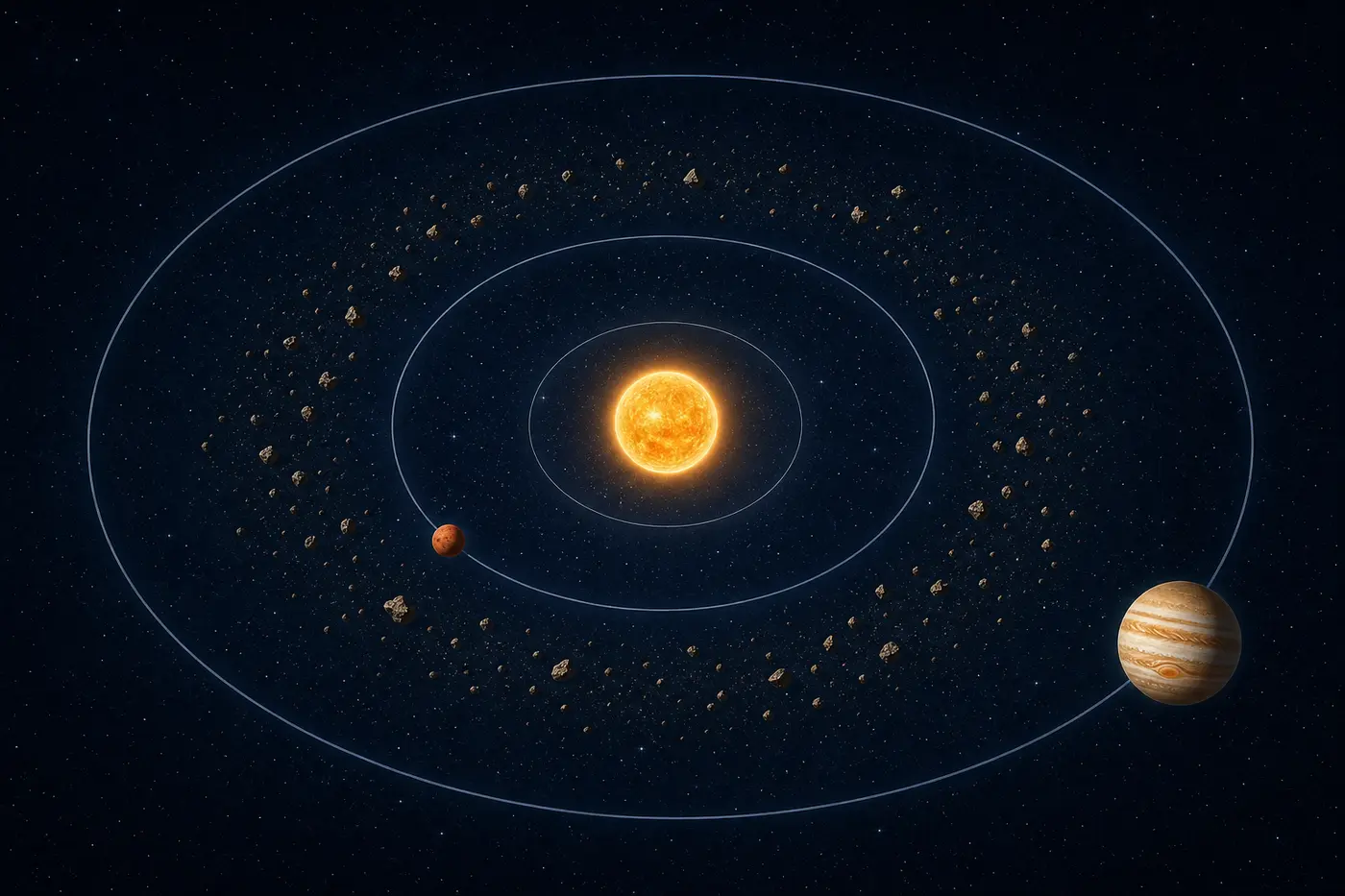
The main asteroid belt sits roughly between 2.1 and 3.3 astronomical units from the Sun.
AsteroidsResonance gapsMarsJupiter
What Is the Asteroid Belt?
The asteroid belt is a region of millions of rocky and metallic bodies orbiting the Sun between Mars and Jupiter. Most are small, irregular fragments, but a few are large enough to be worlds in their own right.
The belt is not the remains of an exploded planet. It is mostly material that never successfully became a planet because Jupiter's gravity stirred up the region, making collisions too fast and disruptive for easy growth.
2.1-3.3 AU A useful classroom range for the main belt; its boundaries are not sharp.
Ceres The largest object in the belt and classified as a dwarf planet.
Mostly Empty Spacecraft cross the belt safely because objects are widely separated.
Old Material Asteroids preserve clues from about 4.6 billion years of Solar System history.
Figure 1The main belt occupies a broad region between Mars and Jupiter. The rocks and planets are enlarged enormously for visibility; sizes and spacing are not to scale.Select to enlarge.
!
Movie myth: pilots do not weave through a wall of rocks. The belt is so spread out that spacecraft can cross it without dodging asteroid after asteroid. The dots in the model are enlarged enormously so you can see them.
Where Is It?
An astronomical unit (AU) is the average Earth-Sun distance. Mars orbits at about 1.5 AU, the main belt spans roughly 2.1-3.3 AU, and Jupiter orbits at about 5.2 AU.
Mars 1.5 AU
Belt begins 2.1 AU
Belt ends 3.3 AU
Jupiter 5.2 AU
Positions are proportional within this Mars-to-Jupiter interval; object sizes are not.
Ceres, Vesta, Pallas, Hygiea
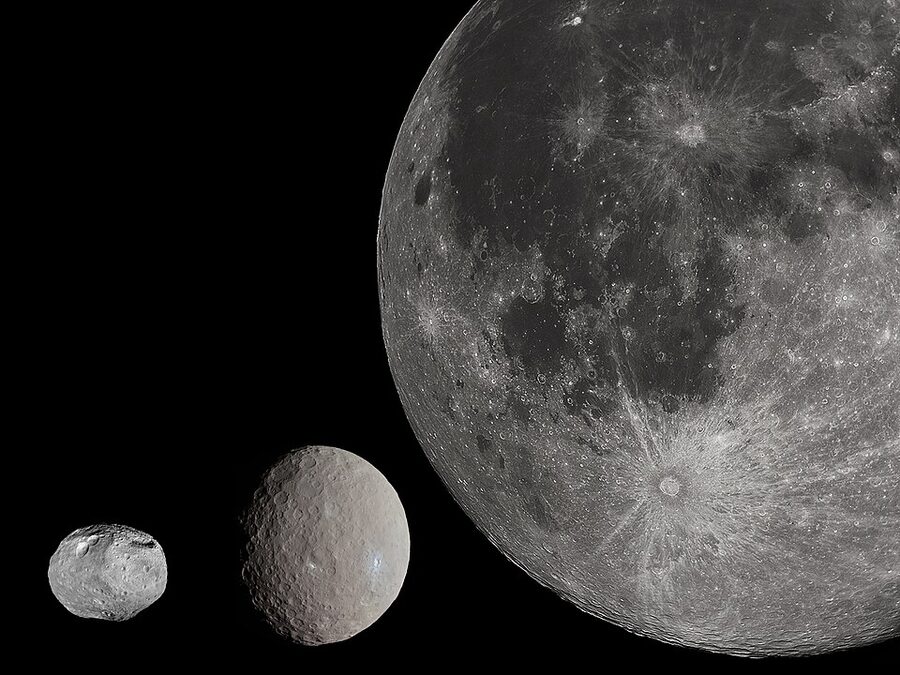
Figure 2Ceres and Vesta compared with the Moon. NASA/JPL-Caltech/UCLA/MPS/DLR/IDA.
Ceres is the belt's largest object and the only dwarf planet in the inner Solar System. NASA estimates it holds about a quarter of the belt's total mass and may be about 25% water by mass.
Vesta is rocky and differentiated into crust, mantle, and core. Its giant Rheasilvia impact basin launched debris; matching minerals link Vesta to HED meteorites found on Earth. Pallas and Hygiea are also among the belt's largest bodies.
Why Didn't a Planet Form?
The young Solar System contained countless building blocks called planetesimals. In many regions, gentle collisions helped them combine into planets. Conditions in the future asteroid belt were different.
Jupiter perturbs orbitsThe giant planet's gravity repeatedly changes the paths of nearby planetesimals.
Collisions speed upObjects meet at higher relative speeds instead of gently sticking together.
Growth stallsMany collisions chip, crack, or scatter material, leaving a population of leftovers.
Important nuance: Jupiter did not simply “hold the belt apart.” Its resonances and gravitational stirring changed orbits over time, while collisions and migration also reshaped the population we see today.
How Kirkwood Gaps Form
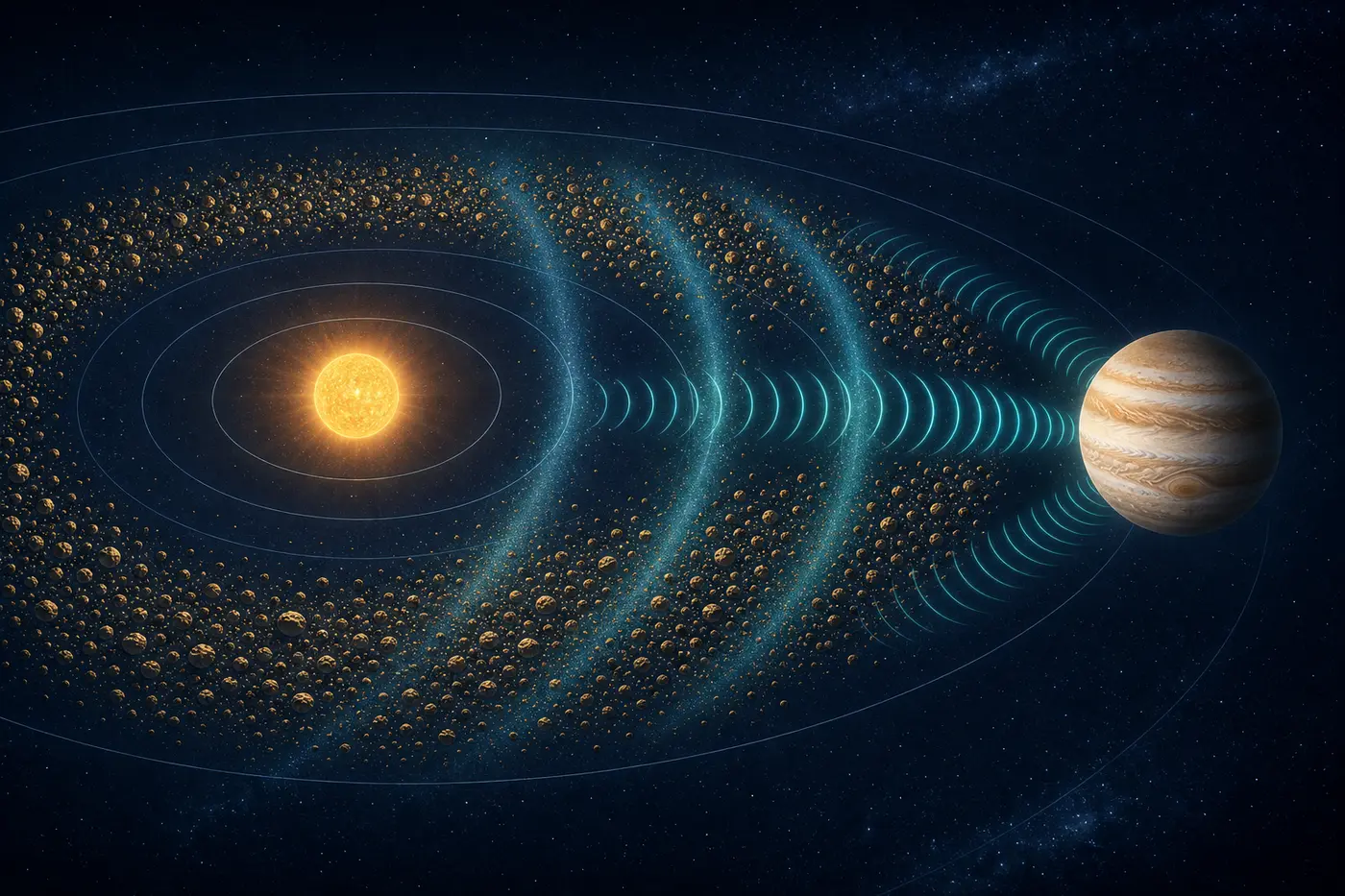
An asteroid in a mean-motion resonance completes a simple number of orbits while Jupiter completes another—for example, 3 asteroid orbits for every 1 Jupiter orbit.
Because the gravitational tugs repeat at similar points, small changes can accumulate. At several resonances, asteroid orbits become unstable, producing underpopulated distances called Kirkwood gaps.
Figure 3A conceptual view of resonance: repeated gravitational effects accumulate while some orbital distances become less populated. The turquoise waves visualize gravity; they are not physical beams.Select to enlarge.
Try it: choose “Kirkwood Gaps” in the View panel. The highlighted rings mark the approximate 3:1, 5:2, and 7:3 resonances.
Asteroids, Meteoroids, Meteors, Meteorites
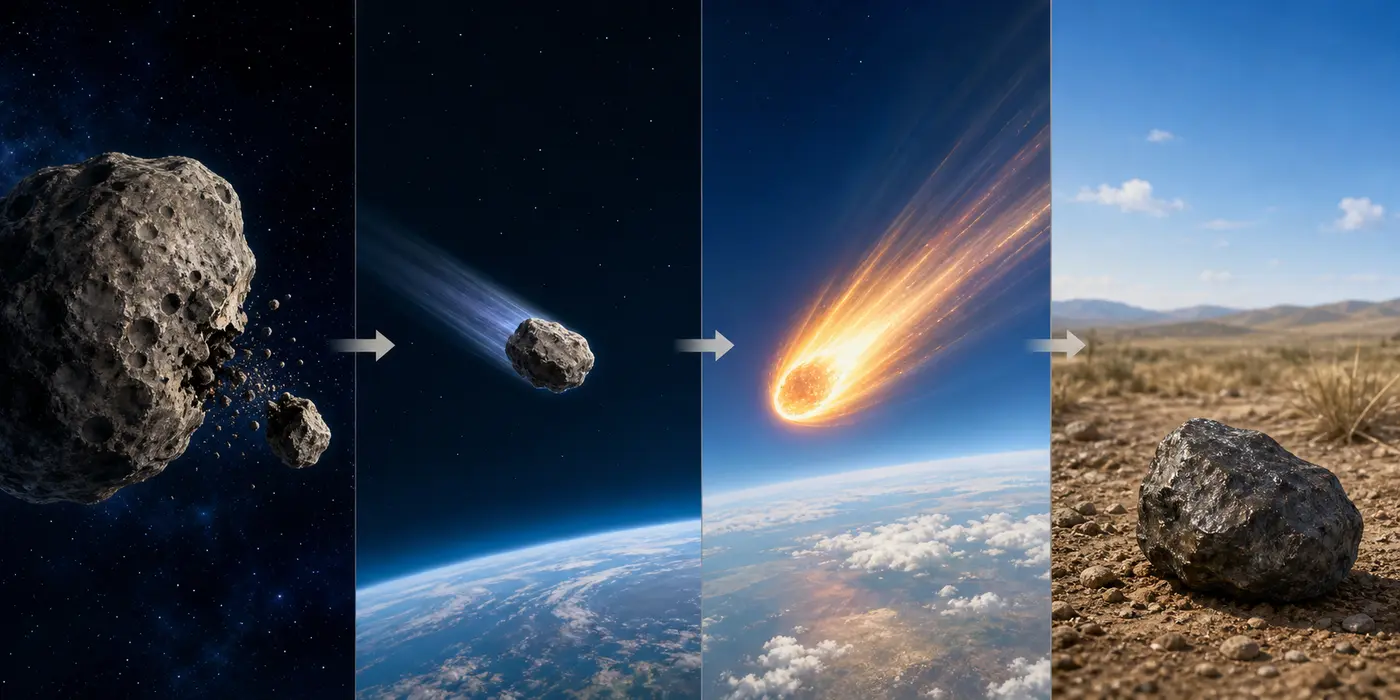
AsteroidA rocky or metallic small body orbiting the Sun.
MeteoroidA much smaller natural object moving through space.
MeteorThe streak of light produced as a meteoroid heats the atmosphere.
MeteoriteMaterial from a meteoroid that survives to reach the ground.
Figure 4One piece of material can receive different names as its situation changes: asteroid fragment, meteoroid, meteor, and finally meteorite if any material reaches the ground.Select to enlarge.
Practice Check
Evidence from Spacecraft
NASA's Dawn mission orbited Vesta and then Ceres, turning points of light into mapped worlds. It revealed Vesta's battered rocky surface and evidence of ice, salts, and recent geological activity on Ceres.
Sample-return missions such as Hayabusa2 and OSIRIS-REx visited near-Earth asteroids rather than main-belt objects, but their laboratory samples help scientists test ideas about ancient Solar System materials.
Big idea: Asteroids are small, but their minerals, craters, and orbits preserve an enormous history.