← Music Music Theory · Reading & Writing Notation Piano triads →

01 · Trainer

Sheet Music Trainer

Choose a familiar level. Try an identification drill first, then its construction partner to practice writing what you can read. Change levels any time; your scores stay on this device. Use Full screen for a dedicated practice workspace.

Now showing:

Recommended next step

Build a five-question learning set

Begin with note identification, then use its construction partner.

Read pitch from the note’s line or space. These drills test pitch: sequences use quarter notes, and stacks use whole notes.

Music Theory · Reading & Writing Notation · PreK to College

Read it. Write it. Hear it.

Start with a single note. Find its name, hear its pitch, then place it on the staff yourself. Choose your level to move from colored desk bells to key signatures, intervals, scales, chords, and college theory.

02 · Decode a score

Music notation answers four questions at once

A note head gives you pitch and duration, but fluent readers also scan the meter, expression marks, and the shape of the phrase. Read in layers instead of trying to decode every symbol at the same time.

A sound can make a picture

Watch, count, feel, follow

Pitch
Color and height show which bell rings and whether the sound moves up or down.
Time
Four boxes make four steady turns. Point once in each box while you count.
Expression
Start with a tiny sound and let each bell become a little stronger.
Direction
The upward arrow groups the bells into one musical thought.

Guided score scan

Find the four clues before reading the explanation

Say or point to the clef and key, count the meter, notice expression, then trace the route.

No clues revealed yet.

Before the first note

  1. Locate the clef.It establishes the pitch map.
  2. Scan the key signature.Carry its sharps or flats through the measure.
  3. Count the meter.Find the beat unit and the number of beats.
  4. Preview the route.Notice leaps, repeated patterns, rests, and expressive changes.

This trainer focuses on pitch and harmony. Pair it with Drums & Percussion to practice pulse, meter, and rhythmic subdivision.

03 · Desk bells

One color, one note, one name

Desk bells and handbells are color-coded so a whole class can play a song together: each child holds one or two bells and rings when their color appears. Tap a bell to hear it, then find the same color on the staff.

Here Do is always C (fixed-do). The staff shows eight bells climbing from middle C to the C above: a step is the next line or space, a skip jumps over one.

04 · Levels

How the trainer grows with you

LevelNotes & clefsKey signaturesIntervalsScalesChords
PreK
Desk bells
Do Re Mi Fa Sol, colored bells, treble clefLocked until 3rd gradeHigher, lower, or the sameBell stairs: up or downHow many bells ring together; stack Do–Mi–Sol
K–2
Colored notes
Letter names A–G with colors and solfege, treble clefLocked until 3rd grade2nd to 5th: steps and skipsC major and A minorC, F and G chords
3–5Treble and bass, ledger lines, sharps and flatsCount the sharps and flats (up to 4)2nd to octave, by numberMajor and natural minor, up to 2 accidentalsMajor and minor triads
6–8Wider range, bell colors optionalName the major key (up to 4)Major, minor and perfectPlus harmonic and melodic minor, pentatonicsMajor, minor, diminished, augmented
9–12Up to 3 ledger linesAll 15 keys, major and minorPlus augmented and diminishedPlus the seven modes, blues, whole toneSeventh chords and inversions
CollegeAlto clef, 4 ledger lines, double sharps and flatsAll 15 keys in three clefsCompound: 9th to 13thPlus double harmonic and chromaticSus chords, minor-major 7th, all inversions

05 · Practice

Turn correct answers into fluent reading

Accuracy is the first milestone, not the last. Use short, repeatable rounds that move from recognition to notation, sound, and explanation.

Changing this also changes the trainer level, so the printed plan and activities stay matched.

  1. 1

    Decode

    Complete five identification questions slowly. Say the clef, line or space, and note name aloud before answering.

    Goal: 4 of 5 correct without a hint
  2. 2

    Construct

    Switch to the matching construction drill. Place the notation from memory, then compare the answer’s spelling.

    Goal: explain every accidental
  3. 3

    Hear

    Use Hear it, sing or hum the pitch, then find it on bells, piano, guitar, or another instrument.

    Goal: connect symbol, name, and sound
  4. 4

    Transfer

    Find the same idea in a real score. Circle its context: key, interval, scale fragment, or chord function.

    Goal: one discovery in real music

Five-minute warm-up

One level, one topic: three identification questions, two construction questions, then play or sing the last answer.

Fifteen-minute study

Complete the full four-step cycle. Finish by writing one sentence about the rule that made the answer correct.

Ensemble challenge

One student reads, one constructs, and one performs. Rotate roles after each question so notation becomes shared language.

06 · Reference

A reader’s pocket reference

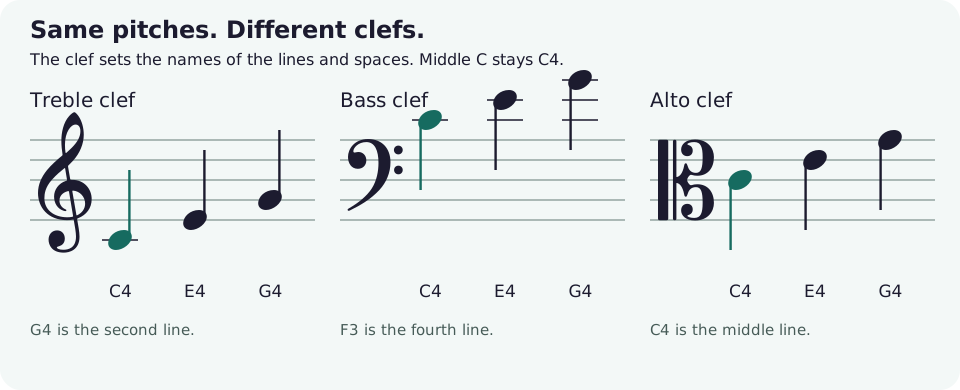
C4, E4, and G4 shown on treble, bass, and alto staves. Middle C is below treble, above bass, and on alto’s middle line.
The same pitches sit in different places when the clef changes. Treble circles G4, bass dots surround F3, and alto centers on C4. Enlarge to compare. Diagram: ClassroomOS; engraved symbols: Bravura by Steinberg, SIL Open Font License 1.1.

Treble clef

Lines (bottom to top): E G B D F, as in “Every Good Boy Does Fine.” Spaces spell F A C E.

Bass clef

Lines: G B D F A, “Good Boys Do Fine Always.” Spaces: A C E G, “All Cows Eat Grass.”

Alto clef

The middle line is middle C. Violas commonly read alto clef; trombones usually read bass clef and sometimes tenor clef.

Sharps & flats

Sharps arrive F C G D A E B. Flats arrive B E A D G C F. Last sharp, up a half step = the key. Second-to-last flat = the key.

Interval recipe

Count letters for the number, count half steps for the quality. Perfect: 0, 5, 7, 12. Major 2nd 2, 3rd 4, 6th 9, 7th 11. Minor is one less.

Scale patterns

Major: W W H W W W H. Natural minor: W H W W H W W. In these seven-note scales, each letter name appears once before the closing octave.

Chord recipes

Major 4+3, minor 3+4, diminished 3+3, augmented 4+4 (half steps, stacked). A seventh chord adds one more third.

Spelling matters

C♯ and D♭ sound the same but are different notes. A 3rd above C always uses the letter E (E, E♭ or E♯), never F♭.

07 · For teachers

Using it in class

  • Project it. The staff is large and high-contrast; the Hear it button lets the room check each answer by ear.
  • Mix levels. Different students can run different levels side by side; progress is saved per level in each browser.
  • Keyboard friendly. In Note Identification type C D E F G A B to answer. When constructing, use the up and down arrows to move the note on the staff, Enter to place it, Backspace to remove it.
  • Pair with the lab. After Intervals, try the triads in The Piano; after Scales, the Modes lesson.
  • Ask for reasoning. A correct answer shows recognition; a spoken explanation reveals whether the student used the clef, counted letter names, or recognized a pattern.
  • Separate fluency from speed. Build accuracy with hints available, then repeat without color or solfege before adding a timer.
  • Notation font. Clefs and accidentals use the open-licensed Noto Music font, bundled with the site so they draw the same on every device.

Next in Music

The Piano: History, Keys & Chords

Move from reading notation on paper to the 88 keys of the keyboard: hear Cristofori's whisper-to-roar invention, build triads, and play I–ii–V–I arpeggio routes.

Go to The Piano →