What was the unit?
The Greeks built scales from tetrachords, groups of four notes that span a perfect fourth. Medieval singers used a final note and a range. Modern musicians use a full scale on a tonic.
Music history lab · Grades 7–12 · About three class periods
Greek theorists, medieval monks, and jazz players all used the word Dorian, but the name described different musical systems. In this lesson you play reconstructed Greek scales on a piano, hear the notes that fall between its keys, and see how the names moved between Greece and today.
Same notes, different framework: medieval and modern Dorian can both use D–D. A chant mode also involves range and melodic habits; modern Dorian is a movable interval pattern. These synthesized examples are demonstrations, not historical performances.
Sound plays only after you press a button. Use Esc or the Stop button to stop all audio.
Start here · a 5-minute listening experiment
Both phrases use the same rhythm, instrument, and D drone. Predict: which scale degree changes between D Dorian and D Aeolian (natural minor)?
Listen twice, then compare with your prediction.
Degree 6 changes: B in Dorian → B♭ in Aeolian. Both have F (a minor third) and C (a minor seventh). Dorian’s sixth is a semitone higher. The tonic stays D, so this comparison isolates the interval pattern.
Dorian: D E F G A B C D
Aeolian: D E F G A B♭ C D
Explain: “I heard ___ when degree 6 changed. My evidence is ___.” Mood words are personal responses; the changed interval is something we can check.
Explore all seven modern patterns →Without audio: compare the note lists using “Explain the difference.” For one class period, do this experiment, sections 06 and 11, then the exit ticket.
Timeline
The big idea
Today a mode usually means one of seven scales you get by starting a major scale on a different note. The modern seven-mode teaching system developed from a longer history; it is not simply the ancient Greek system. The names Dorian, Phrygian, and Lydian are about 2,500 years old. Over that time the names were attached to scales several times, and each time they were attached in a different way. Keep three questions in mind:
The Greeks built scales from tetrachords, groups of four notes that span a perfect fourth. Medieval singers used a final note and a range. Modern musicians use a full scale on a tonic.
Greek theorists usually listed scales from high to low. Medieval and modern theory lists them from low to high. Reading direction matters when comparing interval lists, but reversing a scale does not by itself explain the historical reassignment of names.
Greek theorists described intervals as whole-number ratios or as “parts” of a tone. A modern piano divides the octave into 12 equal semitones. Some Greek notes have no key on the piano.
Octave 2:1, fifth 3:2, fourth 4:3. Tradition credits Pythagoras, but his followers did most of the work.
Gives whole-number ratios for the diatonic, chromatic, and enharmonic genera.
Argues about which harmoniai (Dorian, Phrygian, Lydian…) belong in a well-run city.
Discusses the moral and emotional character (ethos) of each harmonia, and disagrees with Plato about Phrygian.
Says the ear should judge intervals, not ratios. Measures the fourth as 30 equal “parts.”
Name the seven octave species and define the tonoi (keys). This is the system we reconstruct on the piano.
Summarizes Greek theory in Latin. For about 1,000 years this is the West’s main music textbook.
Eight chant modes, organized under Byzantine influence, receive Greek names, and the names land on different notes.
Adds Ionian (C) and Aeolian (A) to make 12 modes. The B mode, later called Locrian, is rejected as unusable.
Chords that pull toward a tonic (the V → I cadence) become the engine of European music, and most modes fade from concert and church music, though they live on in folk song.
Composers such as Debussy and Vaughan Williams, who collected English folk songs, bring modal melodies back into concert music.
Miles Davis’s “So What” is built on Dorian. The seven modes become a standard tool for improvisers.
Turn and talk: If a word keeps its spelling but its meaning drifts (like awful, which once meant “full of awe”), is it still the same word? Ask the same question about “Dorian” as you work through the lesson.
Genera
The building block: the tetrachord
A Greek tetrachord spans a perfect fourth. The two outer notes are fixed (in our lab, E and A). The two inner notes are movable, and where you place them sets the genus (plural: genera):
About semitone, tone, tone, as on the white keys E F G A. Its step pattern is closest to the familiar major-scale collection. Ancient genera are not the same thing as modern uses of the words “chromatic” and “enharmonic.”
Semitone, semitone, then a leap of a minor third: about E F F♯ A. Compare its two small steps and large remaining leap.
Two steps of about a quarter tone each, then a leap of a major third: E, E↑, F, A. Aristoxenus considered it the most refined genus. A piano cannot play it.
The pins above the keys show where the Greek notes really fall. The highlighted keys are the nearest notes a piano can play.
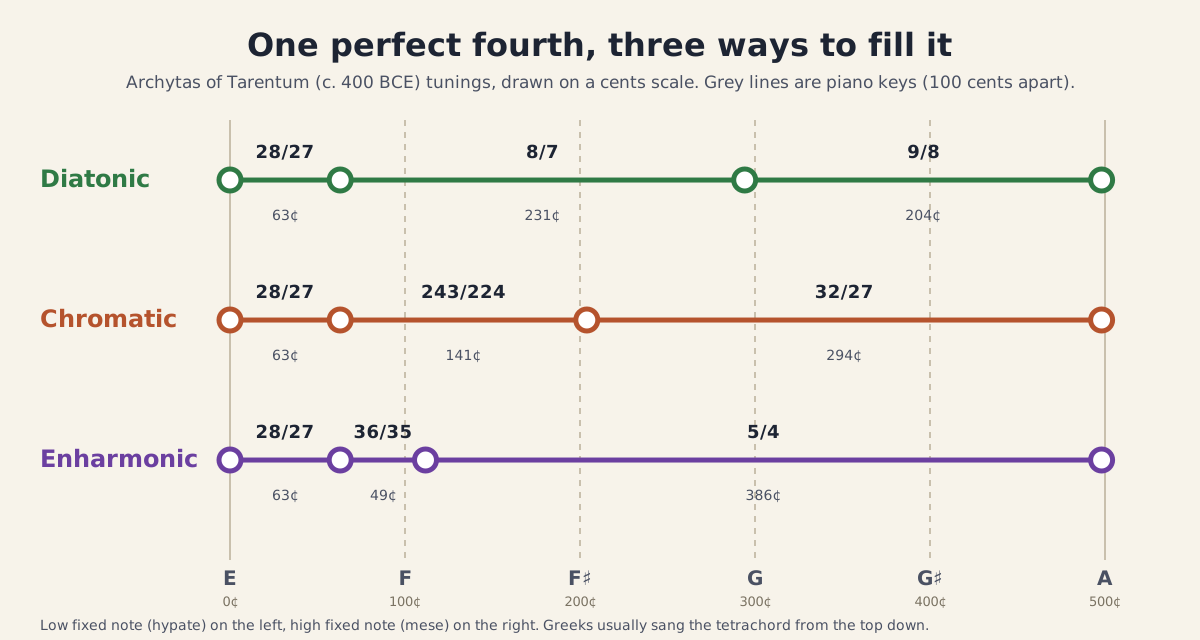
Try it: Switch to Enharmonic and press Note by note. Count how many different pitches you hear in the Greek version and in the piano version. Then switch the tuning to Aristoxenus. Which genus comes out exactly on piano keys in his system? Why does that happen? (Hint: compare his “parts” with semitones.)
Octave species
From tetrachords to octaves
Join tetrachords end to end and you get the Greeks’ Greater Perfect System, two octaves from A to a′. An octave species is any one-octave window cut from that system. Each window contains the same notes but starts in a different place, so its pattern of steps is different. Cleonides named the seven windows. In the modern reconstruction, played on white keys, Greek Dorian runs from E to E, which modern musicians call Phrygian.
Read this as a reconstruction. Greek note names did not stand for fixed pitches. We place the system on white keys because its diatonic step pattern matches theirs, not because a Greek musician would have played “E.” We also tune the Greek version in ratios, so most of its notes differ slightly from the piano’s notes.
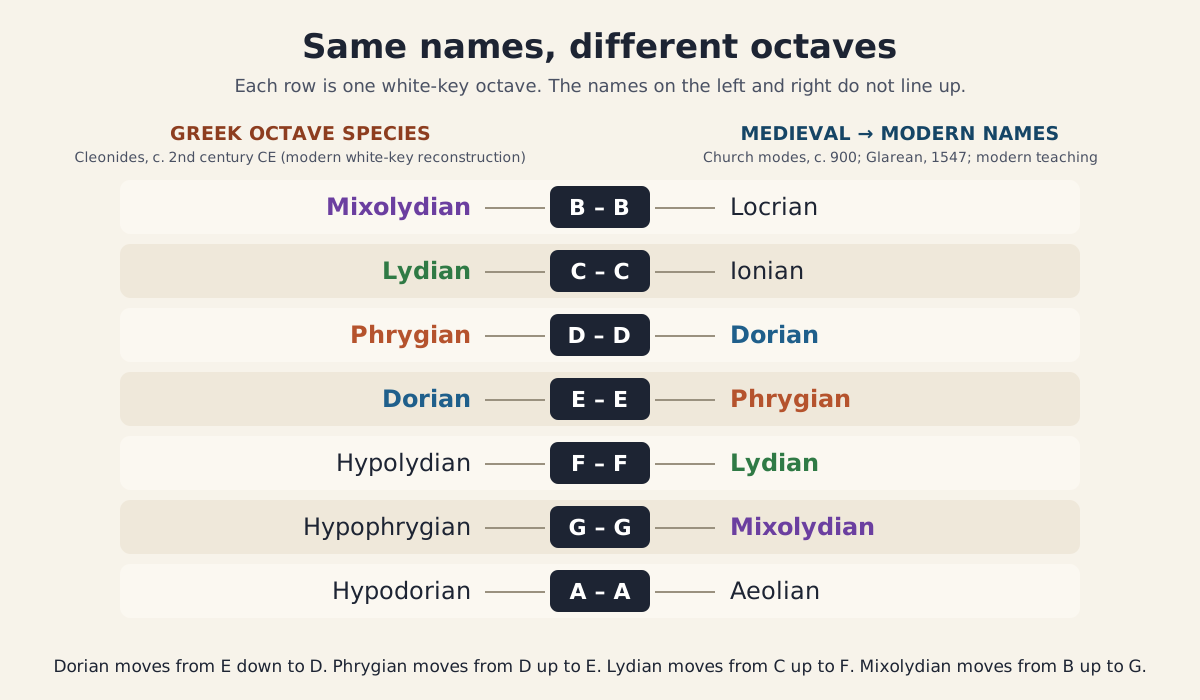
Comparison task: For Dorian, Phrygian, Lydian, and Mixolydian, write the Greek white-key octave, the modern white-key octave, and how many letters the name moved. Then pick Enharmonic Dorian. Which two piano keys would each have to hold two different Greek notes?
Ethos & places
Harmoniai, peoples, and character
The early harmoniai discussed by Plato and Aristotle were probably more than scales. Each was a recognizable regional style, which could include a tuning, a register, an instrument, rhythms, and typical melodic turns. Greek writers believed each one shaped the listener’s character (ethos). That is why philosophers argued about which ones young citizens should hear.
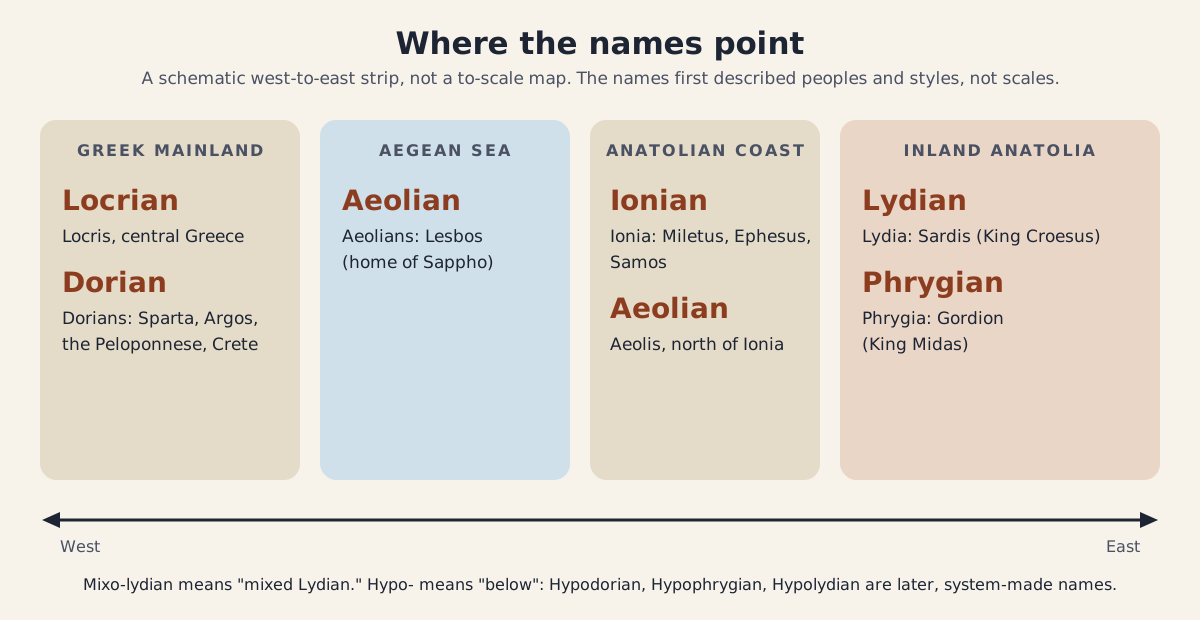
Be a skeptical listener. Ethos claims were philosophical and political arguments, not lab results. Plato wanted music that would train soldiers and guardians. Aristotle, his student, disagreed with him about Phrygian. And because the modern Dorian is a different scale, playing a “Dorian” track today does not test Plato’s claim.
Debate prompt: Play the Greek Dorian and Greek Phrygian octaves (section 03), then today’s Dorian. Does any of them sound “brave” or “enthusiastic” to you? How much of that impression comes from the scale, and how much from tempo, rhythm, instrument, and what you already expect?
Boethius
How the names crossed into Latin, and moved
Boethius (c. 480–524) was a Roman statesman who wrote De institutione musica, a Latin summary of Greek music theory drawn mainly from Nicomachus and Ptolemy. It became the standard music text of the medieval quadrivium. For Boethius, music was a mathematical subject about ratios. He separated musica mundana (the music of the cosmos), musica humana (harmony of body and soul), and musica instrumentalis (actual sounding music).
Boethius described the Greek modi mainly as transposition keys (tonoi) that rise from Hypodorian at the bottom to Hypermixolydian at the top. Church musicians, meanwhile, sorted chant into eight modes with four finals (D, E, F, G), a system shaped by the Byzantine oktōēchos. Around 900, Carolingian treatises (especially the group called Alia musica) attached the Greek names to those modes, in rising order.
EPhrygian DLydian CMixolydian Bnames step downDPhrygian ELydian FMixolydian Gnames step upThe names are in the same order in both lists, but the notes they sit on run in opposite directions. Historians still debate exactly why. Part of the cause is that Greek keys (tonoi) and Greek scale shapes (species) were confused, and part is that Greek theory listed scales from the top down while Latin theory listed them from the bottom up.
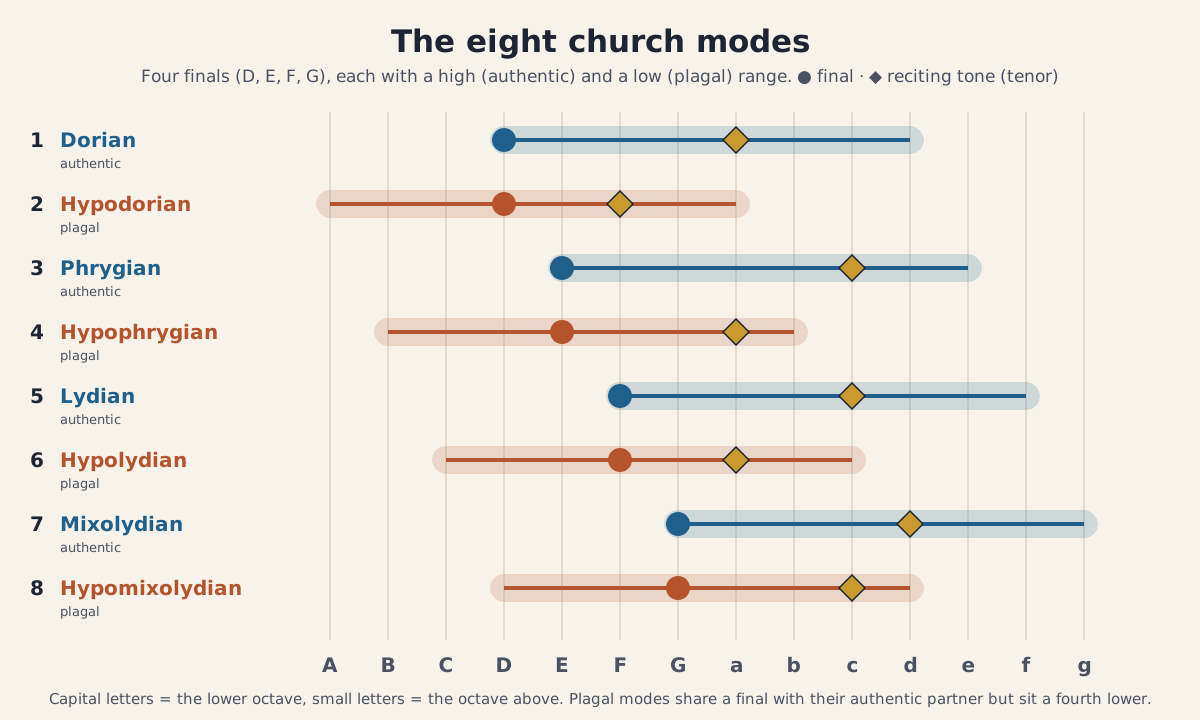
A church mode was identified by its final (the note the chant ends on), its range, and its reciting tone, the note psalm verses are chanted on. Starting from a different note was not the point.
Medieval theory allowed one movable note: B could be lowered to B♭ to avoid the tritone F–B. Lydian with B♭ sounds just like F major, more than 500 years before Glarean named “Ionian.”
Heinrich Glarean added Aeolian (final A) and Ionian (final C), with plagal partners, because real music already used them. He rejected the B mode because its fifth, B–F, is diminished. The name Locrian was attached to it later.
Seven modes
The modern system
Explore relative modes on the circle of fifths → Keep the same notes and change the tonic there; keep the tonic and change the notes here.
Modern musicians treat a mode as a scale on a tonic that can be moved to any key. The fastest way to hear the seven modes is to keep the tonic fixed (play them in parallel) and change one note at a time. Going down the list, each mode lowers exactly one note of the mode above it. Each mode is recognized by its characteristic note, the note that separates it from plain major or minor.
| Modern mode | Modern white keys | Formula vs. major | Greek species with this name | Medieval meaning |
|---|---|---|---|---|
| Ionian | C–C | 1 2 3 4 5 6 7 | None. Ionian/Iastian was an old harmonia and later a key name. | Not used until Glarean (1547) |
| Dorian | D–D | 1 2 ♭3 4 5 6 ♭7 | E–E (= modern Phrygian) | Mode 1, final D |
| Phrygian | E–E | 1 ♭2 ♭3 4 5 ♭6 ♭7 | D–D (= modern Dorian) | Mode 3, final E |
| Lydian | F–F | 1 2 3 ♯4 5 6 7 | C–C (= modern Ionian) | Mode 5, final F, often with B♭ |
| Mixolydian | G–G | 1 2 3 4 5 6 ♭7 | B–B (= modern Locrian) | Mode 7, final G |
| Aeolian | A–A | 1 2 ♭3 4 5 ♭6 ♭7 | A–A as Hypodorian, reportedly once called “Aeolian” | Not used until Glarean (1547) |
| Locrian | B–B | 1 ♭2 ♭3 4 ♭5 ♭6 ♭7 | Cleonides used “Locrian” for A–A (= modern Aeolian) | Rejected as a mode |
Pattern hunt: Starting on Lydian, each step down the ladder lowers one note. Write the note that changes at each step on D. (Lydian → Ionian lowers G♯ to G. What comes next?) Why does the ladder have to stop at Locrian?
In the wild
Modes in real music
Working musicians rarely think “I am playing a scale.” They pick a chord or two that keep the tonic in charge, then let the characteristic note ring over it. That repeating chord pattern is a vamp. Pick a mode, hear its signature vamp, then try to break it.
Choose a mode and press Play the vamp.
D Dorian and C major are relative: the same seven notes, different home. D Dorian and D major are parallel: the same home, different notes. To hear a mode, compare it with its parallel major or minor. To find its notes quickly, use the relative key (circle of fifths).
Dorian does use C major’s notes, but if your chords keep returning to C, your ear hears C major. A mode needs its own tonic chord to be the center of gravity: Dm, not C.
In tonal music a chord built on degree 5 (with a raised 7th) pulls toward the tonic. That pull is the point of major and minor. Modal music leaves it out and holds still, so the color note gets the spotlight. Press “Spoil it” and listen for the note that changes.
| Mode | Signature vamp | Hear it in | Listen for |
|---|---|---|---|
| Lydian | I – II | The Simpsons theme (Danny Elfman, 1989); Fleetwood Mac, “Dreams” (often analyzed as Lydian) | The ♯4 floating above the tonic chord |
| Ionian | I – IV – V – I | Most nursery rhymes, hymns, and pop hooks | The leading tone (7) pulling up to the tonic |
| Mixolydian | I – ♭VII | The Beatles, “Norwegian Wood” (verses); Lynyrd Skynyrd, “Sweet Home Alabama”; the fiddle tune “Old Joe Clark” | A major tonic with a ♭7 where you expected a leading tone |
| Dorian | i – IV | Miles Davis, “So What” (1959; D Dorian, then E♭ Dorian for eight bars); Santana, “Oye Como Va”; the folk song “Scarborough Fair” | The natural 6th over a minor chord |
| Aeolian | i – ♭VI – ♭VII | R.E.M., “Losing My Religion”; many pop and film minor-key tunes | A heavier ♭6 than Dorian |
| Phrygian | i – ♭II | Flamenco guitar and metal riffs | The ♭2, one half step above the tonic, like a door slightly ajar |
| Locrian | i° – ♭II | Rare. Björk’s “Army of Me” bass riff is often cited | A ♭5 that makes the tonic chord itself unstable |
Detective task: Pick one song you know well. Find its tonic by humming the note that feels like home. Then find the note that separates its scale from plain major or minor (is the 6th natural or flat? is the 7th flat?). Name the mode, and write one sentence of evidence that someone could check by ear. Does your song contain a V → I cadence? If it does, how modal is it really?
Tuning limits
The honest fine print
Most modern pianos use 12-tone equal temperament (12-TET): every semitone is exactly 100 cents, and every interval except the octave is slightly out of tune with its simple ratio. The compromise lets you play in every key. But each time this lesson “plays a Greek scale on piano,” the piano is rounding the Greek pitches. Here is what gets lost.
Play each sustained C–E dyad and listen for beats, a slow wobble in loudness. Beats come from the 5th harmonic of C clashing with the 4th harmonic of E.
Stack 12 pure 3:2 fifths and drop back down 7 octaves. You do not land on the C you started from. You land about 23.5 cents sharp. Equal temperament hides this gap by narrowing every fifth by about 2 cents.
STEAM connection: The cents formula is 1200 × log₂(ratio). Use it to check the 3:2 fifth (≈ 701.96¢) and the 5:4 third (≈ 386.31¢). How far is each from the piano’s 700¢ and 400¢? See Physics of Music for harmonics and beats.
Listen
Ear training
Every round plays a fresh example. Listen for the characteristic note over the drone, not for whether the scale sounds happy or sad.
Press New round to hear an example.
Score: 0 / 0
Play
Hands on the keys
Pick an exercise, then play it on the keyboard below. Click the keys, or use your computer keys: A is middle C, the row A S D F G H J K L ; plays white keys, and W E T Y U O P play black keys. A real piano works too. Use the on-screen keys to check your notes.
Comparison task: Play “Drunken Sailor” in D Dorian, then in D Aeolian. Only one note changes (B to B♭), and only in line 3. Describe the difference in one sentence without using “happy” or “sad.”
Compose
Composition studio
Rows are scale degrees 1 to 8, not fixed pitches. Write a melody once, then change the mode: the same shape takes on the steps of the new scale. Try the Greek octave species in the chromatic or enharmonic genus to hear sounds a piano cannot make.
Write an 8-beat phrase that starts and ends on degree 1. Land on degree 5 at the halfway point.
Choose a modern mode and put its characteristic note (Dorian 6, Lydian 4, Phrygian 2, Mixolydian 7) on a strong beat. Does the mode come through more clearly?
Play your phrase in modern Dorian, then in Greek Dorian. Change Greek Dorian to the enharmonic genus. Write two sentences on what changed and why.
Check
Exit ticket
The Greek labs calculate pitches from the ratios and equal-part models identified in their controls. Letter names, absolute pitch, synthesized timbre, and demonstration phrases are classroom choices. Aristoxenus’s equal “parts” are modeled here as equal cents; this is not evidence that ancient instruments used modern equal temperament.
Aristotle, Politics VIII (primary text in translation) discusses musical ethos. It documents an ancient philosophical position, rather than proving a universal emotional effect of today’s modes.
Written exit ticket: In 3–5 sentences, explain to a guitarist friend why the “Dorian” they solo in is not Plato’s Dorian. Use at least three of these words: octave species, genus, final, Boethius, equal temperament.
The takeaway
“Dorian” referred to a people, then a style, then a Greek octave species (E–E), then a chant mode on D, and now a movable scale with a raised 6th. Each time you meet a mode name, ask who is using it and in which century.