Composer arrangement studio
Louis Armstrong
Listen to “What a Wonderful World” ↗ Louis Armstrong · Verve Records
Arranging with care
A source staff is not always the melody: in an orchestral score, find the staff carrying the theme. A two-part piano study pairs your selected voice with a source bass; it is not a concert reduction and wide leaps may need redistribution. Saxophone notation is transposed while playback stays at concert pitch. Violin parts stay at concert pitch and are moved by octaves to sit above the open G string. Guitar tab preserves pitch and rhythm but may need a different octave or fingering. Chords are prepared for the Ode to Joy theme only; classical harmony elsewhere requires score study rather than automatic chord guesses. Original ensembles are available only where the source contains those parts. Piano reductions and original classroom studies retain their source identities.
Recordings: Nicholaus P. Brosowsky’s Tonejs-Instruments sample collection, CC BY 3.0; VSCO 2 Community Edition, CC0. Sample credits and processing.
Music · Jazz · Phrasing & Swing
About Louis Armstrong
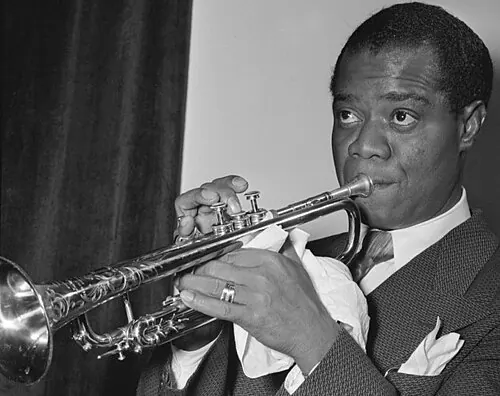
Louis Armstrong (1901–1971) grew up poor in New Orleans, learned the cornet in a home for boys, and became the musician who turned jazz into a soloist’s art. His trumpet and his gravelly voice bent rhythm the same way, leaning a little behind or ahead of the beat so that a melody seemed to speak. In fifty years he went from riverboats and Chicago dance halls to number-one records and tours around the world.
Who Was Louis Armstrong?
Louis Armstrong was born in New Orleans on August 4, 1901, and grew up in deep poverty in a rough neighborhood known as the Battlefield. He sang on street corners for coins and worked from a young age, selling coal and hauling junk. After he fired a pistol into the air on New Year’s Eve 1912, he was sent to the Colored Waif’s Home for Boys. There he joined the band and learned to play the cornet properly.
Back on the streets, he found a mentor in the cornetist Joe “King” Oliver. When Oliver moved north in 1918, Armstrong took his place in Kid Ory’s band, and he also played on Mississippi riverboats, where he learned to read music. In 1922 Oliver sent for him to play second cornet in his Creole Jazz Band in Chicago. There Armstrong met the pianist Lil Hardin, who became his wife in 1924 and pushed him to step out on his own.
After a year in New York with Fletcher Henderson’s orchestra, he returned to Chicago, and from 1925 to 1928 he made the Hot Five and Hot Seven recordings. Solos such as the opening of West End Blues (1928) showed that one improviser could carry a whole performance. On Heebie Jeebies (1926) he sang wordless syllables and helped make scat singing popular.
He became one of the most famous entertainers in the world: in films, on Broadway, and from 1947 at the head of a small band called the All Stars. Tours abroad, some sponsored by the U.S. government, earned him the nickname “Ambassador Satch.” He lived through segregation and often played for audiences he was not allowed to sit among; in 1957 he publicly condemned President Eisenhower’s slow response when Black students were blocked from Central High School in Little Rock. In 1964 his Hello, Dolly! knocked the Beatles off the top of the American charts. He died at his home in Queens, New York, on July 6, 1971.
A Life in Swing
- 1901 Born August 4 in New Orleans.
- 1913 Enters the Colored Waif’s Home for Boys and learns the cornet in its band.
- 1918 Takes King Oliver’s place in Kid Ory’s band.
- 1922 Joins King Oliver’s Creole Jazz Band in Chicago as second cornet.
- 1923 Records with Oliver’s band, including Dippermouth Blues.
- 1925 Accompanies Bessie Smith on St. Louis Blues; begins the Hot Five recordings.
- 1926 Heebie Jeebies helps make scat singing popular.
- 1928 Records West End Blues.
- 1947 Forms the All Stars.
- 1957 Speaks out about school segregation in Little Rock.
- 1964 Hello, Dolly! reaches No. 1.
- 1971 Dies July 6 at home in Queens, New York.
Swing and Phrasing: Timing That Speaks
Every piece of music has a beat, the steady pulse you tap your foot to. Smaller subdivisions sit between the beats. In much written music, two eighth notes split a beat into equal halves. In swing, players usually make the first note of each pair longer and the second shorter, so the rhythm rocks: long–short, long–short.
Phrasing is how a musician shapes a melody in time: where it starts, which notes it leans on, where it breathes. Armstrong often placed notes slightly behind or ahead of the beat while the band kept steady time underneath. The pulse never changed, but the melody seemed to talk over it. He phrased the same way whether he played trumpet or sang, which is why his singing and his playing sound like the same person.
The 2 : 1 ratio is a classroom model. Real swing changes with tempo and player: fast tunes swing almost straight, slow ones more deeply.
What is scat singing?
Cornet or trumpet?
What is call and response?
How can timing make a melody speak?
Phrasing shapes the timing, emphasis, and space within a melody. Swing often gives paired subdivisions unequal lengths, but the balance varies with tempo and performer. Compare equal subdivisions with a simplified long–short pattern while the beat remains steady.
Predict: Will a long–short subdivision change the pulse or the spacing between notes?
Ready. Audio starts only when you press Play.
Original synthesized classroom exercise; these tones are not historical recordings or realistic instrument sounds.
Explain the comparison
The beat and pitches stay fixed; the spacing between notes changes. This 2:1 long–short model is a teaching approximation, not a universal swing rule or an imitation of Armstrong. Real phrasing also involves breath, accents, tone, and subtle timing.
Hear Armstrong’s Early Records
These two records were made in 1923 and 1925, so they are now in the public domain in the United States. Both come from before the Hot Five, when Armstrong was still a sideman in other musicians’ bands. Listen for how he fills the spaces someone else leaves.
- In St. Louis Blues, notice when Armstrong plays: mostly in the gaps after Bessie Smith finishes a line. That is call and response.
- His cornet answers bend and slide like a voice. Compare them with the steady, even chords of the reed organ.
- In Dippermouth Blues, the famous muted solo is King Oliver’s, not Armstrong’s. Listen for the second cornet in the ensemble: the 21-year-old student playing beside his teacher.
Later recordings
Teacher: for these later records, choose an authorized recording through your school’s library or the collections linked in Sources. Play a short passage twice. First identify a feature; then note a timestamp and describe what you actually hear. A different performance may make different choices.
- West End Blues — listen to the opening trumpet passage and the space between phrases.
- Heebie Jeebies — listen for scat singing and its rhythmic character.
- What a Wonderful World — contrast vocal phrasing with the earlier jazz recordings; written by Bob Thiele and George David Weiss.
Compare the recording with the experiment: what can the simple model show, and what does it leave out? Recordings, compositions, and arrangements have separate rights. U.S. recordings made from 1926 on are still under copyright, so this lesson does not reproduce these.
Play it yourself: W. C. Handy’s St. Louis Blues and When the Saints Go Marching In, a tune Armstrong made famous, are in the Fake Book, along with the chord practice chart for King Oliver’s 12-bar blues West End Blues (1928). Play the melody straight, then again with the delayed, swung timing from the experiment.
Armstrong’s Key Contributions
His Hot Five and Hot Seven records (1925–28) made the improvised solo, not only the ensemble, the heart of a jazz performance.
Heebie Jeebies (1926) made wordless, horn-like singing popular, and jazz singers have scatted ever since.
His relaxed timing changed how both instrumentalists and singers shaped a melody. Billie Holiday named him as one of her models.
He played higher, with a bigger tone and more daring rhythm than most trumpeters of his day, and later players measured themselves against him.
Tours in the 1950s and ’60s, some sponsored by the U.S. government, carried his music to audiences across Africa, Europe, Asia and South America.
From his 1920s records to Hello, Dolly! (1964) and What a Wonderful World (1967), he kept reaching new listeners.
Armstrong’s Legacy Today
Nearly every jazz musician since the 1920s has learned from Armstrong, directly or through someone he influenced. Trumpeters study his solos note by note, and singers such as Billie Holiday took up his way of shaping a line; Ella Fitzgerald recorded three albums with him. Duke Ellington called him “the epitome of jazz.”
His house in Corona, Queens, is now the Louis Armstrong House Museum, which keeps his trumpets, his home tape recordings and the collages he made from photographs and clippings. What a Wonderful World, recorded in 1967, is one of the best-known recordings of the twentieth century.
Jazz grew through African American musical communities and exchange among many traditions. Morton, Armstrong, Ellington and Parker show different musical choices; their careers do not form a simple ladder in which one style replaces another.
Sources and collections
Separate historical claims supported by these sources from your own listening observations.
Practice Problems
Review: Biography · The musical idea · Listen.
Use the biography, the musical idea and the two recordings above.
Easy1. In what city was Louis Armstrong born?
Easy2. Where did Armstrong learn to play the cornet properly?
Medium3. What is scat singing?
Medium4. In swing rhythm, how is a pair of eighth notes usually played?
Medium5. Armstrong was born in August 1901 and joined King Oliver in Chicago in the summer of 1922. How old was he when he joined? (His birthday had already passed.)
Medium6. In St. Louis Blues (1925), what does Armstrong’s cornet mostly do?
Challenge7. In a 2 : 1 swing model at 100 beats per minute, one beat lasts 0.6 seconds. How long does the long note of a swung pair last, in seconds?
Challenge8. Why did Armstrong’s 1957 comment about Little Rock matter?
Create and reflect
- Keep a steady pulse and clap or sing a four-beat original idea.
- Change one feature explored above. Have a partner identify the change without seeing your plan.
- Explain the evidence: which notes, spaces, entrances, or accents did your partner notice?
Grades 6–8: describe one audible difference using everyday words. Grades 9–12: connect the difference to texture, chord tones, or rhythmic subdivision, and explain the model’s limits.
Your response stays on this page and is not submitted or saved.
Compare with Duke Ellington, Charlie Parker.