Composer arrangement studio
Duke Ellington
Listen to “It Don’t Mean a Thing (If It Ain’t Got That Swing)” ↗ Duke Ellington and His Orchestra with Ivie Anderson
Choose from four historical works: Black and Tan Fantasy, Black Beauty, Jig Walk and Ring Dem Bells. Black and Tan Fantasy uses the first-violin introduction from Eddie Powell’s 1927 band arrangement; the other selections pair a melody with selected source bass. These are excerpts, with their scope and omissions identified in the player. Compare the printed pages below, or try the separate original classroom call-and-response exercise.
Arranging with care
A source staff is not always the melody: in an orchestral score, find the staff carrying the theme. A two-part piano study pairs your selected voice with a source bass; it is not a concert reduction and wide leaps may need redistribution. Saxophone notation is transposed while playback stays at concert pitch. Violin parts stay at concert pitch and are moved by octaves to sit above the open G string. Guitar tab preserves pitch and rhythm but may need a different octave or fingering. Chords are prepared for the Ode to Joy theme only; classical harmony elsewhere requires score study rather than automatic chord guesses. Original ensembles are available only where the source contains those parts. Piano reductions and original classroom studies retain their source identities.
Recordings: Nicholaus P. Brosowsky’s Tonejs-Instruments sample collection, CC BY 3.0; VSCO 2 Community Edition, CC0. Sample credits and processing.
Music · Jazz · Orchestral Color
Duke Ellington · portrait and context
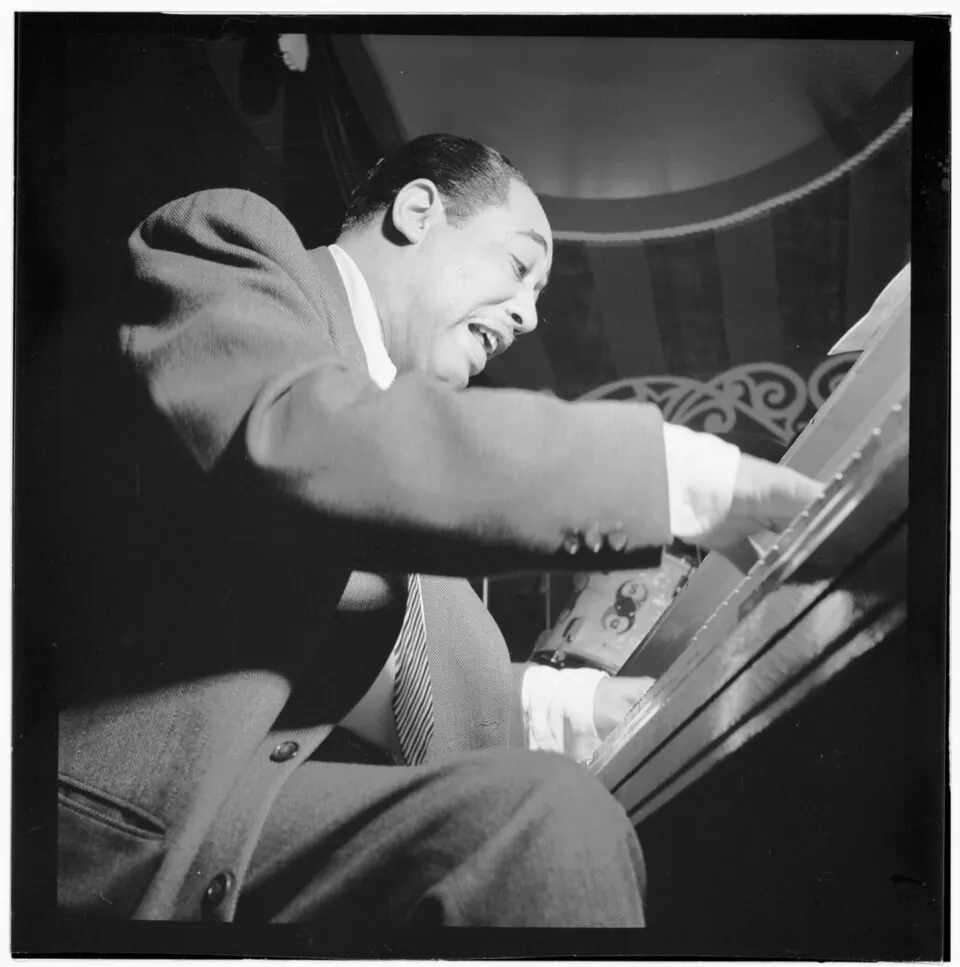
Duke Ellington (1899–1974) led his orchestra for about fifty years and treated it the way a painter treats a palette. He wrote for the particular sound of each musician, so a melody might be shared between a growling trumpet, a sweet alto saxophone and a low clarinet. He wrote well over a thousand compositions, from three-minute dance records to concert suites and sacred music.
Black and Tan Fantasy · historical repertoire
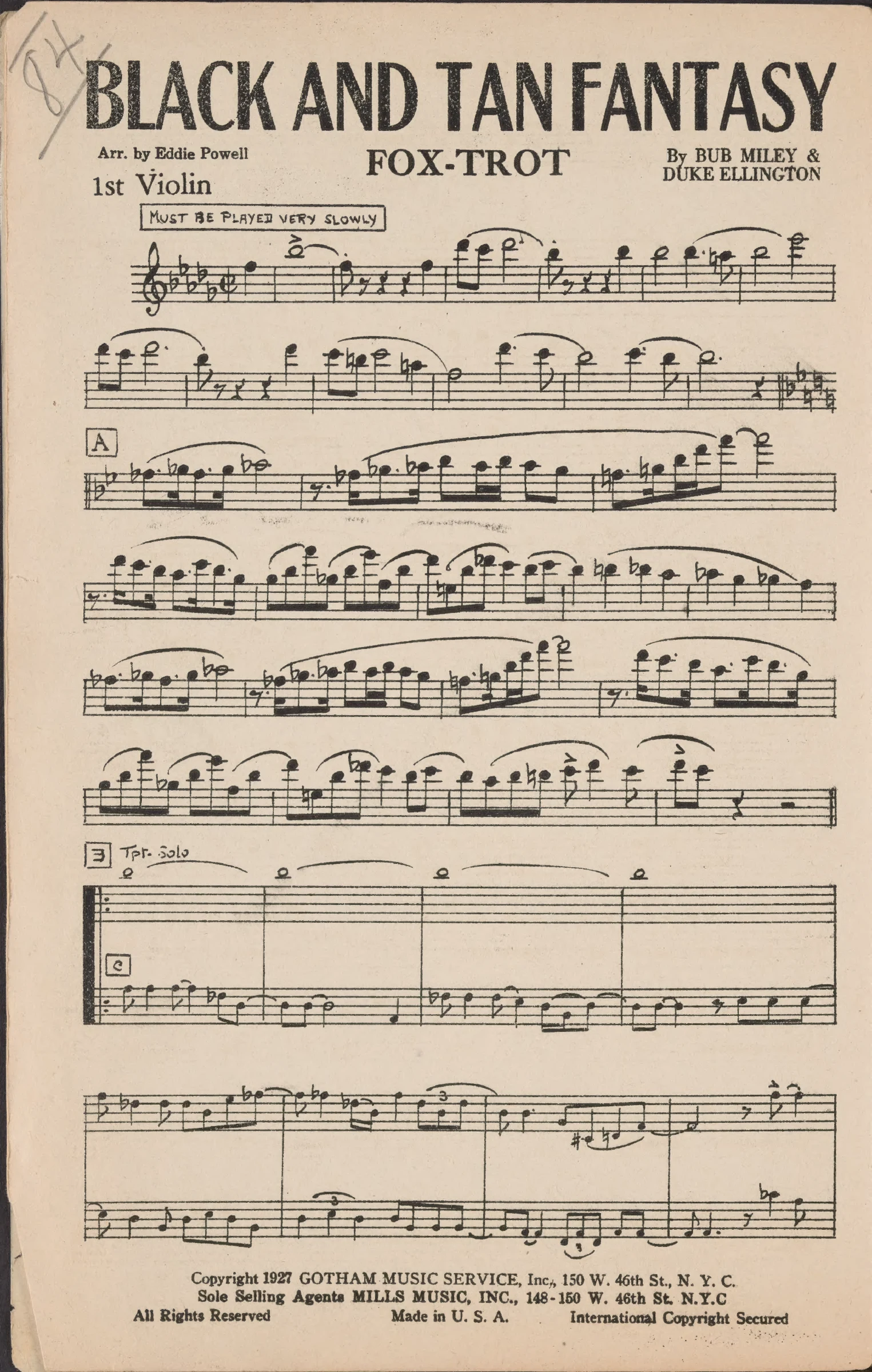
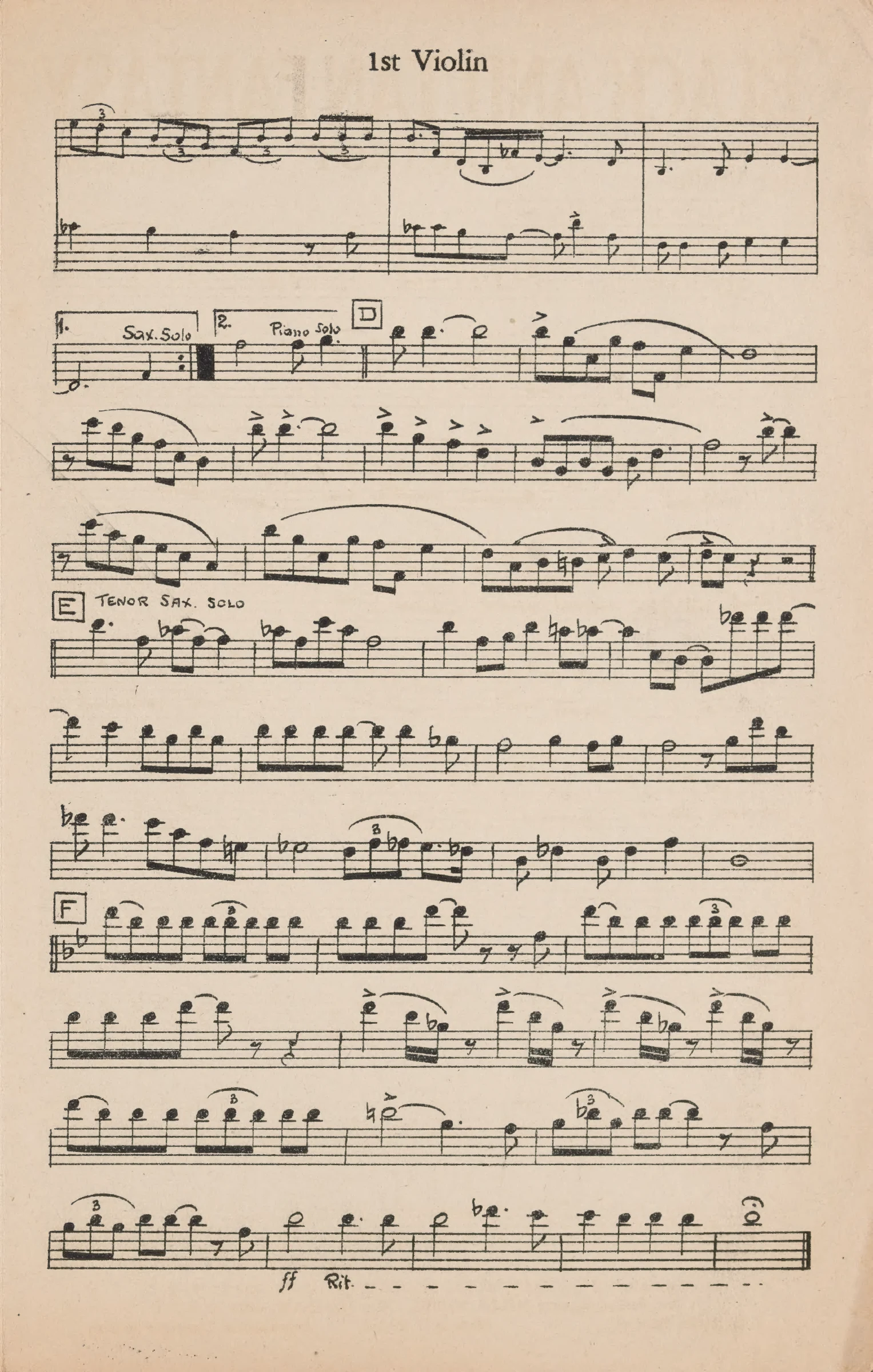
Composed by Duke Ellington and Bubber Miley; arranged by Eddie Powell. The player presents the first violin introduction, including the printed short opening bar. These two pages show the complete first violin part; the source link provides all surviving parts in this edition. A violin part does not reproduce the band’s harmony, rhythm section or distinctive brass timbres.
Three more works · compare melody, rhythm and bass
Select these titles in the sheet music workspace above to play, arrange or print the studies. Each eight-bar selection comes from the historical edition shown here; the full-score links include the music beyond the excerpt. The new studies retain selected melodic and bass notes, while leaving out inner chords and other accompaniment voices.
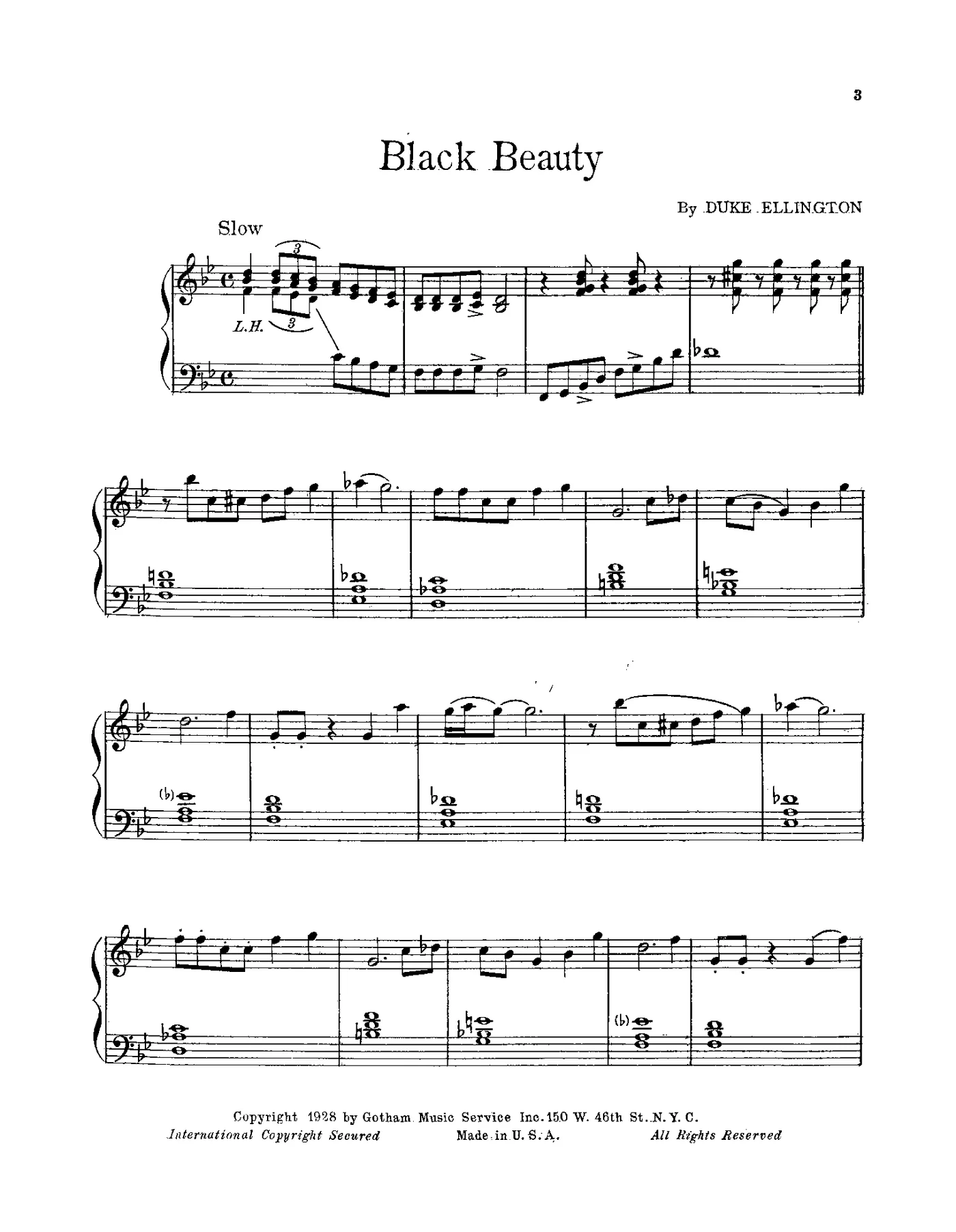
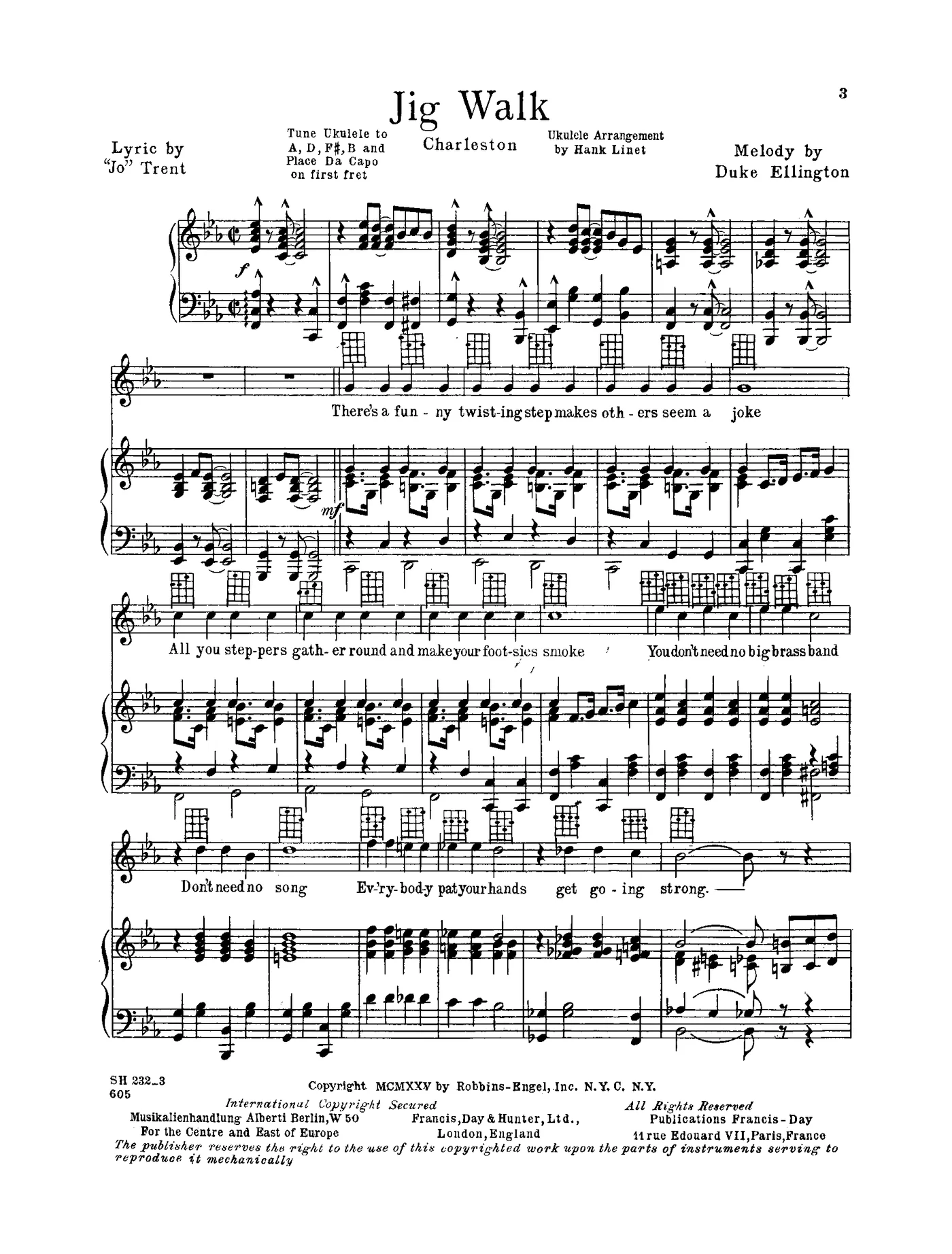
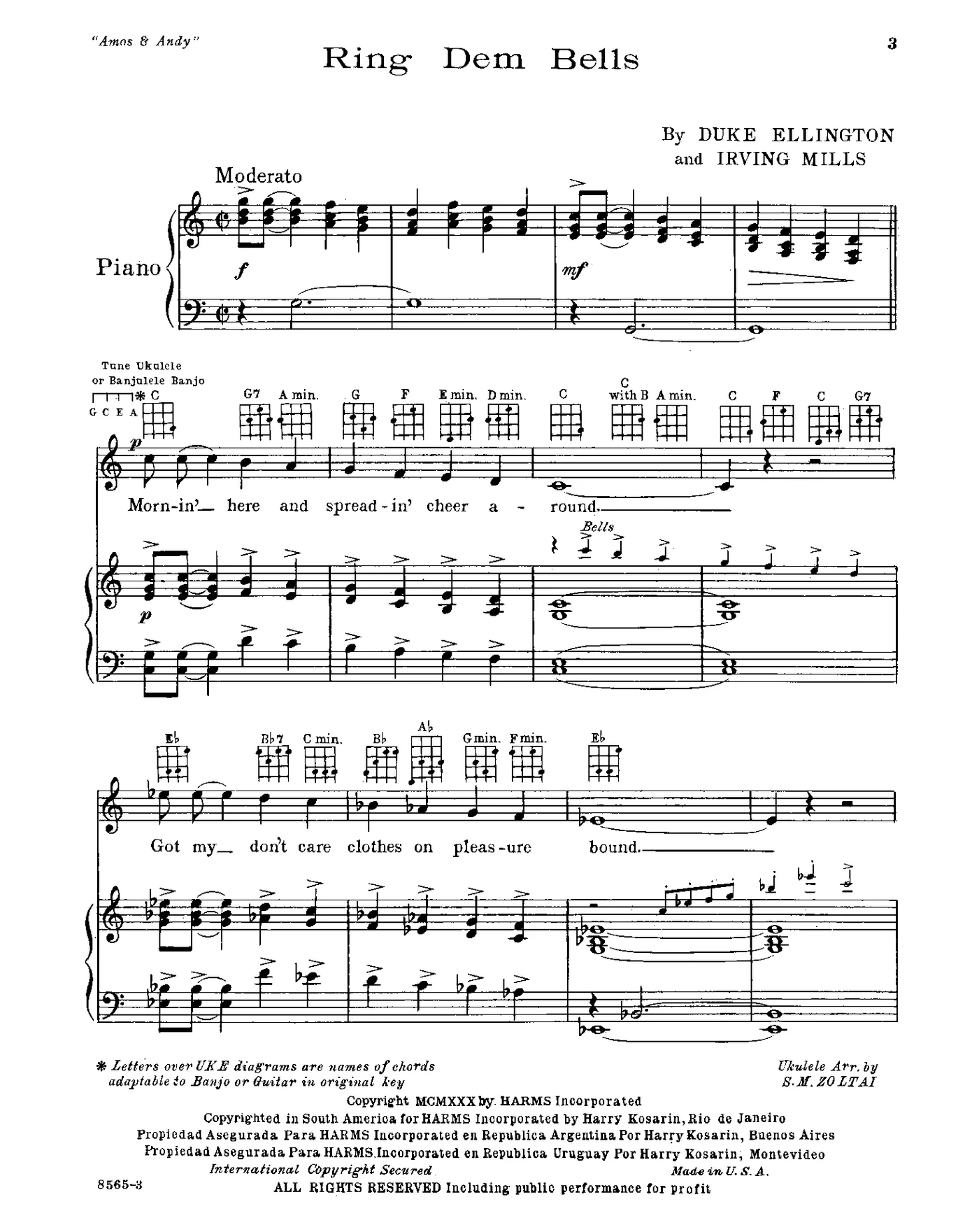
Ring Dem Bells appeared in the 1930 film Check and Double Check, associated with Amos ’n’ Andy and racist stereotypes. This study focuses on Ellington and Mills’s music; discuss the historical framing critically when consulting the original edition.
Who Was Duke Ellington?
Edward Kennedy Ellington was born in Washington, D.C., on April 29, 1899. Both of his parents played the piano, and they raised him to have fine manners; a childhood friend nicknamed him “Duke” for his elegant clothes and bearing. He started piano lessons at about seven but cared more about baseball and drawing. As a teenager, hearing ragtime pianists around Washington drew him back to the keyboard. He was soon leading his own small bands, and he turned down an art scholarship to keep playing music.
In 1923 he moved to New York with a band called the Washingtonians, and within a year he was its leader. In December 1927 his orchestra began a residency at Harlem’s Cotton Club, a nightclub where Black performers entertained whites-only audiences. Radio broadcasts from the club made Ellington famous across the country. Hits such as Mood Indigo (1930) showed his gift for unusual blends of instruments.
Ellington kept many of the same players for years, sometimes for decades, and wrote parts to fit their individual sounds. In 1939 the young composer and pianist Billy Strayhorn joined him. Strayhorn wrote Take the “A” Train, which became the orchestra’s theme song, and the two worked so closely that it can be hard to tell who wrote which bars. Ellington also wrote longer works, such as Black, Brown and Beige, a musical history of Black Americans that premiered at Carnegie Hall in 1943.
When big bands faded after World War II, Ellington kept his orchestra going, partly paying for it with his songwriting royalties. A thrilling performance at the 1956 Newport Jazz Festival renewed his fame. In his later years he toured the world and wrote three Sacred Concerts. He received the Presidential Medal of Freedom in 1969 and died in New York on May 24, 1974.
Fifty Years at the Head of the Band
- 1899 Born April 29 in Washington, D.C.
- c. 1914 Writes his first piece, Soda Fountain Rag, as a teenager.
- 1923 Moves to New York with the Washingtonians.
- 1927–31 Residency at the Cotton Club; radio broadcasts spread his music nationwide.
- 1930 Records Mood Indigo.
- 1933 First tour of Europe.
- 1939 Billy Strayhorn joins as composer and arranger.
- 1941 Take the “A” Train becomes the orchestra’s theme.
- 1943 Black, Brown and Beige premieres at Carnegie Hall.
- 1956 A celebrated performance at the Newport Jazz Festival.
- 1965 First Sacred Concert, in San Francisco.
- 1969 Awarded the Presidential Medal of Freedom.
- 1974 Dies May 24 in New York.
Orchestral Color: Writing for Sounds, Not Just Notes
Timbre (TAM-ber) is tone color: the quality that lets you tell a trumpet from a clarinet even when they play the same pitch. Texture is how many layers sound at once and how they relate: one melody alone, a melody with accompaniment, or several lines answering each other.
Most arrangers of his day wrote by section: all the saxophones together, all the trumpets together. Ellington often mixed instruments from different sections and wrote for particular people: Johnny Hodges’s smooth alto saxophone, or the “growl” of trumpeters Bubber Miley and Cootie Williams, who used a rubber plunger mute to make the horn sound almost like a voice. He wrote for those sounds, not just for “a trumpet.”
In Mood Indigo he gave a three-note chord to muted trumpet, muted trombone and clarinet, and turned the usual order upside down: the clarinet sits at the bottom in its low register, and the trombone plays high in its range. The blend sounds like a single new instrument.
His band kept many of the same musicians for years, so he could plan music around sounds he knew well.
Who wrote Take the “A” Train?
What is a plunger mute?
Who carries the melody?
An arrangement distributes musical ideas among instruments. Timbre is tone color: two instruments can play the same pitches and still sound different. Compare a melody alone with a melody supported by a lower answering voice.
Predict: Will adding a second voice change the melody or mainly change the texture?
Ready. Audio starts only when you press Play.
Original synthesized classroom exercise; these tones are not historical recordings or realistic instrument sounds.
Explain the comparison
Texture changes; the lead melody stays the same. The low answer occupies the gaps. Real orchestration involves individual musicians, articulation, dynamics, and instrument combinations; these electronic tones demonstrate only the placement of parts.
Listen for Evidence
Teacher: choose an authorized recording through your school’s library or the linked collections. Play a short passage twice. First identify a feature; then note a timestamp and describe what you actually hear. A different performance may make different choices.
- Mood Indigo — listen for blended instrumental colors.
- Take the “A” Train — credit Billy Strayhorn; listen for ensemble passages and solo space.
- C Jam Blues — notice how a small melodic idea supports varied performances.
Compare the recording with the experiment: what can the simple model show, and what does it leave out? Recordings, compositions, and arrangements have separate rights; the historical 1927 score excerpt above is separate from these later listening examples.
Play it yourself: practice over the chord charts for It Don’t Mean a Thing (1931) and In a Sentimental Mood (1935) alongside Take the “A” Train (Strayhorn) and Satin Doll (Ellington and Strayhorn) in the Fake Book. Trace the chromatic inner voices in the chords and switch band voicings to compare the ensemble texture.
Ellington’s Key Contributions
He wrote well over a thousand compositions: dance tunes, popular songs, film scores, suites and sacred music.
He built pieces around the sounds of particular musicians, so his band sounded like no other.
Billy Strayhorn said that Ellington played the piano, but his real instrument was his orchestra.
Works such as Black, Brown and Beige (1943) and his later suites stretched jazz into long concert forms.
His nearly thirty-year partnership with Billy Strayhorn produced some of the most admired music in jazz.
From 1965 he wrote three concerts of religious music, which he called the most important things he had ever done.
Ellington’s Legacy Today
Ellington’s songs, including Sophisticated Lady, In a Sentimental Mood and It Don’t Mean a Thing (If It Ain’t Got That Swing), are jazz standards that musicians still play every night somewhere in the world. In 1999, a hundred years after his birth, he received a special Pulitzer Prize citation.
High school bands across North America compete in Jazz at Lincoln Center’s Essentially Ellington program, playing his original arrangements. Washington, D.C., named its Duke Ellington School of the Arts after him, and he appears on the District of Columbia’s 2009 quarter.
Jazz grew through African American musical communities and exchange among many traditions. Morton, Armstrong, Ellington and Parker show different musical choices; their careers do not form a simple ladder in which one style replaces another.
Sources and collections
Separate historical claims supported by these sources from your own listening observations.
Practice Problems
Review: Biography · The musical idea · Try it.
Use the biography, the musical idea and the experiment above.
Easy1. In what city was Duke Ellington born?
Easy2. Where did Ellington’s orchestra play a famous residency that was broadcast on radio?
Medium3. What is timbre?
Medium4. Who composed Take the “A” Train?
Medium5. The Cotton Club residency began in 1927. Billy Strayhorn joined in 1939. How many years later did Strayhorn join?
Medium6. In Mood Indigo, which instrument did Ellington put at the bottom of the three-note chord?
Challenge7. Ellington took over as leader of his band in 1924 and led it until his death in 1974. About how many years is that?
Challenge8. Why did Ellington keep many of the same players for years?
Create and reflect
- Keep a steady pulse and clap or sing a four-beat original idea.
- Change one feature explored above. Have a partner identify the change without seeing your plan.
- Explain the evidence: which notes, spaces, entrances, or accents did your partner notice?
Grades 6–8: describe one audible difference using everyday words. Grades 9–12: connect the difference to texture, chord tones, or rhythmic subdivision, and explain the model’s limits.
Your response stays on this page and is not submitted or saved.
Compare with Charlie Parker, Louis Armstrong.