Composer arrangement studio
Charlie Parker
Listen to “Now’s the Time” ↗ Charlie Parker · Savoy Records
Arranging with care
A source staff is not always the melody: in an orchestral score, find the staff carrying the theme. A two-part piano study pairs your selected voice with a source bass; it is not a concert reduction and wide leaps may need redistribution. Saxophone notation is transposed while playback stays at concert pitch. Violin parts stay at concert pitch and are moved by octaves to sit above the open G string. Guitar tab preserves pitch and rhythm but may need a different octave or fingering. Chords are prepared for the Ode to Joy theme only; classical harmony elsewhere requires score study rather than automatic chord guesses. Original ensembles are available only where the source contains those parts. Piano reductions and original classroom studies retain their source identities.
Recordings: Nicholaus P. Brosowsky’s Tonejs-Instruments sample collection, CC BY 3.0; VSCO 2 Community Edition, CC0. Sample credits and processing.
Music · Jazz · Bebop & Improvisation
About Charlie Parker
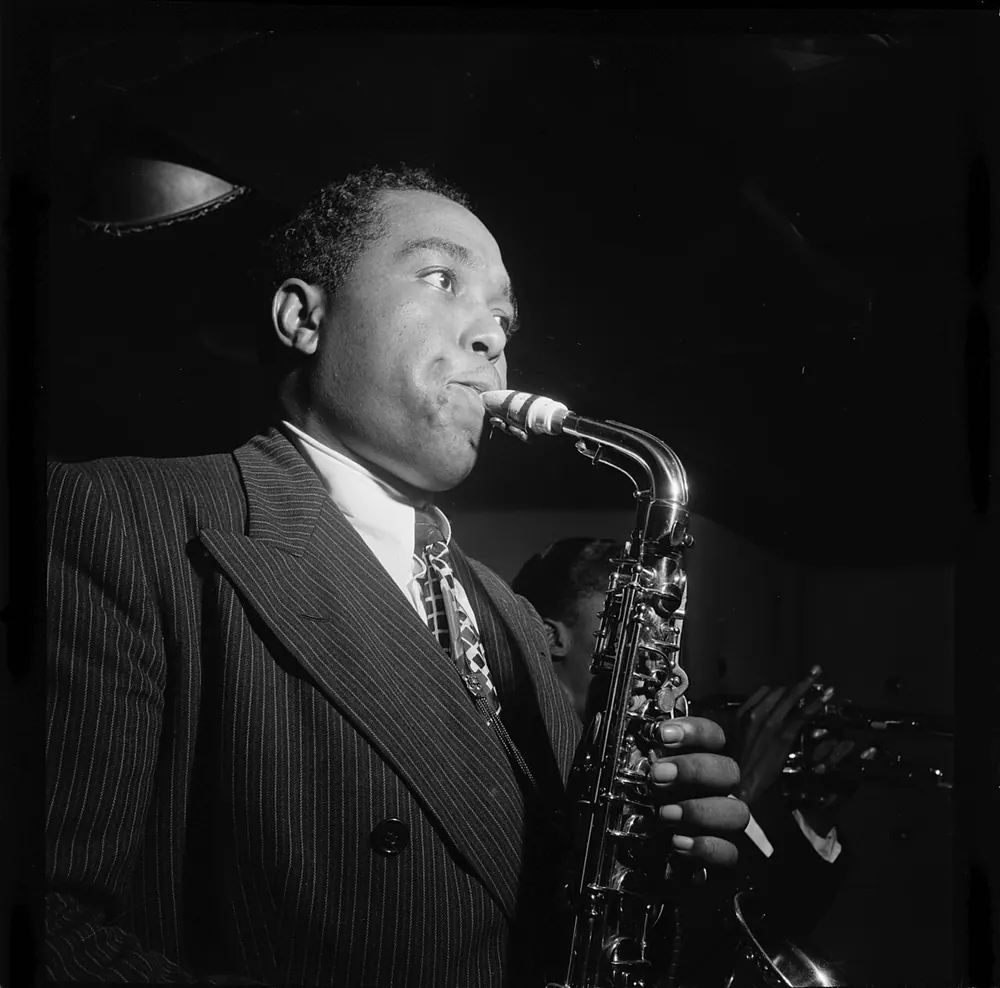
Charlie Parker (1920–1955), nicknamed “Bird,” played the alto saxophone with a speed, precision and harmonic imagination that changed jazz in a few short years. With Dizzy Gillespie and other young musicians in 1940s New York, he helped create bebop: fast, complex jazz made for listening rather than dancing. He lived only 34 years, but nearly every jazz musician since has studied his solos.
Who Was Charlie Parker?
Charles Parker Jr. was born on August 29, 1920, in Kansas City, Kansas, and grew up across the river in Kansas City, Missouri. In the 1930s that city was full of nightclubs where bands such as Count Basie’s played the blues late into the night. Parker took up the alto saxophone as a boy, left school in his mid-teens and began playing professionally.
His start was rough. At a jam session around 1936 he lost his place in the harmony in the middle of a solo, and the drummer Jo Jones threw a cymbal at his feet to stop him. Parker went away and practiced for hours a day: he learned the blues and popular songs in every key and memorized saxophonist Lester Young’s solos from records. By the late 1930s he was playing in Jay McShann’s band, which recorded him in 1940 and 1941.
In New York he met the trumpeter Dizzy Gillespie. In late-night jam sessions at clubs such as Minton’s Playhouse in Harlem, they and other young musicians developed bebop. In 1945 Parker and Gillespie made a series of recordings together, and that November Parker recorded Now’s the Time and Ko-Ko under his own name. Bebop surprised many listeners: it was fast, full of new harmonies, and meant for close listening.
Parker also struggled with drug and alcohol addiction for most of his adult life. In 1946, in Los Angeles, his health collapsed, and he spent about six months in Camarillo State Hospital. He recovered enough to make some of his finest records, to record with a string orchestra in 1949 and to play a famous concert at Toronto’s Massey Hall in 1953, but his health kept failing. He died in New York on March 12, 1955, at the age of 34. A New York jazz club named Birdland, after him, had opened in 1949.
A Short, Brilliant Life
- 1920 Born August 29 in Kansas City, Kansas.
- c. 1936 A failed jam-session solo sends him home to practice for hours a day.
- 1938 Joins Jay McShann’s band in Kansas City.
- 1939 Moves to New York; starts building melodies from the higher notes of chords.
- 1942–43 Plays in Earl Hines’s band alongside Dizzy Gillespie.
- 1945 Records with Gillespie; Now’s the Time and Ko-Ko under his own name.
- 1946 His health collapses in Los Angeles; months in Camarillo State Hospital.
- 1947 Records Relaxin’ at Camarillo.
- 1949 Records with strings; the Birdland club opens in New York.
- 1953 Plays the Massey Hall concert in Toronto.
- 1955 Dies March 12 in New York, aged 34.
Bebop: Chord Tones and Approach Notes
Jazz musicians improvise over a chord progression, a repeating series of chords. Every chord has chord tones: a C-major chord is built from C, E and G. Notes on those pitches sound stable, like a place to land. Other notes create tension that wants to move to a chord tone.
Bebop players treated chord tones as destinations and filled the space before them with routes: scale steps, leaps and approach notes. An approach note is usually a half step above or below the target, such as B leading up to C. Parker later recalled that around 1939 he found he could build melodies from the higher notes of each chord (the 9th, 11th and 13th), which gave his lines their fresh, complex sound.
Bebop musicians also wrote new melodies over the chords of familiar songs. Parker’s Ko-Ko is built on the chords of the swing-era hit Cherokee, and Ornithology, written with trumpeter Benny Harris, on those of How High the Moon. Musicians call a piece like that a contrafact.
Speed alone does not make bebop. What matters is where each phrase lands and how it gets there.
Why was he called “Bird”?
Did bebop replace swing?
How does a line find its destination?
A chord tone belongs to the underlying chord. An approach note leads toward a destination pitch. Listen to a simple rising line, then a version with extra approach notes. Both end on the same pitch; the journey changes.
Predict: Will extra notes change the final destination or the route taken to reach it?
Ready. Audio starts only when you press Play.
Original synthesized classroom exercise; these tones are not historical recordings or realistic instrument sounds.
Explain the comparison
Both phrases end on C. The second adds connecting notes, including a chromatic approach from B to C. This original exercise isolates one melodic device; it is not a Parker transcription and does not reproduce bebop’s full harmony or rhythmic language.
Listen for Evidence
Teacher: choose an authorized recording through your school’s library or the linked collections. Play a short passage twice. First identify a feature; then note a timestamp and describe what you actually hear. A different performance may make different choices.
- Now’s the Time — follow the blues form and separate the theme from improvisation.
- Ko-Ko — listen for rapid lines, accents, and the interaction of soloist and rhythm section.
- Ornithology — compare the composed theme with a solo; co-written with Benny Harris.
Compare the recording with the experiment: what can the simple model show, and what does it leave out? Recordings, compositions, and arrangements have separate rights; this lesson does not reproduce their audio or scores.
Play it yourself: the Fake Book has lead sheets for Parker’s blues head Billie’s Bounce and Sippin’ at Bells (Miles Davis wrote it while playing in Parker’s quintet). Play the head, then try the chord tones and approach notes from the experiment over its changes.
Parker’s Key Contributions
With Dizzy Gillespie, Thelonious Monk, Kenny Clarke and others, he helped shape a new style of jazz built for listening.
His bright tone, speed and precision made the alto saxophone a leading solo instrument. Alto players still begin by studying him.
Bebop melodies such as Ko-Ko and Ornithology borrowed the chords of popular songs, a practice jazz musicians still use.
Building lines from the 9ths, 11ths and 13ths of chords widened the harmonic vocabulary of every improviser after him.
He wrote many blues tunes, such as Now’s the Time and Billie’s Bounce, that remain standard material at jam sessions.
His 1949 recordings with a string orchestra showed that a bebop soloist could also shine in a lush, orchestral setting.
Parker’s Legacy Today
Bebop became the shared language of modern jazz. Students still learn Parker’s solos from transcriptions, collected in books such as the Charlie Parker Omnibook, and practice them in every key, the way he once learned Lester Young’s solos.
After he died, fans wrote “Bird Lives” on walls around New York. The club named after him, Birdland, still operates in Manhattan, and Kansas City has a memorial to him in its historic jazz district at 18th and Vine. His life is also a sobering story: addiction cut short one of the most gifted musicians of the century.
Jazz grew through African American musical communities and exchange among many traditions. Morton, Armstrong, Ellington and Parker show different musical choices; their careers do not form a simple ladder in which one style replaces another.
Sources and collections
Separate historical claims supported by these sources from your own listening observations.
Practice Problems
Review: Biography · The musical idea · Try it.
Use the biography, the musical idea and the experiment above.
Easy1. What instrument did Charlie Parker play?
Easy2. Which trumpeter worked with Parker to develop bebop?
Medium3. Which notes are the chord tones of a C-major chord?
Medium4. What is an approach note?
Medium5. Parker first recorded with Jay McShann in 1940 and died in 1955. How many years long was his recording career?
Medium6. Ko-Ko is built on the chords of which earlier song?
Challenge7. A phrase ends on C. Which note is a chromatic approach from below?
Challenge8. Which statement about bebop does this lesson support best?
Create and reflect
- Keep a steady pulse and clap or sing a four-beat original idea.
- Change one feature explored above. Have a partner identify the change without seeing your plan.
- Explain the evidence: which notes, spaces, entrances, or accents did your partner notice?
Grades 6–8: describe one audible difference using everyday words. Grades 9–12: connect the difference to texture, chord tones, or rhythmic subdivision, and explain the model’s limits.
Your response stays on this page and is not submitted or saved.
Compare with Duke Ellington, Louis Armstrong.