Composer arrangement studio
Django Reinhardt
Listen to “Minor Swing” ↗ Django Reinhardt and Stéphane Grappelli · Arkadia Records
Arranging with care
A source staff is not always the melody: in an orchestral score, find the staff carrying the theme. A two-part piano study pairs your selected voice with a source bass; it is not a concert reduction and wide leaps may need redistribution. Saxophone notation is transposed while playback stays at concert pitch. Violin parts stay at concert pitch and are moved by octaves to sit above the open G string. Guitar tab preserves pitch and rhythm but may need a different octave or fingering. Chords are prepared for the Ode to Joy theme only; classical harmony elsewhere requires score study rather than automatic chord guesses. Original ensembles are available only where the source contains those parts. Piano reductions and original classroom studies retain their source identities.
Recordings: Nicholaus P. Brosowsky’s Tonejs-Instruments sample collection, CC BY 3.0; VSCO 2 Community Edition, CC0. Sample credits and processing.
Music · Jazz Manouche · Guitar
About Django Reinhardt
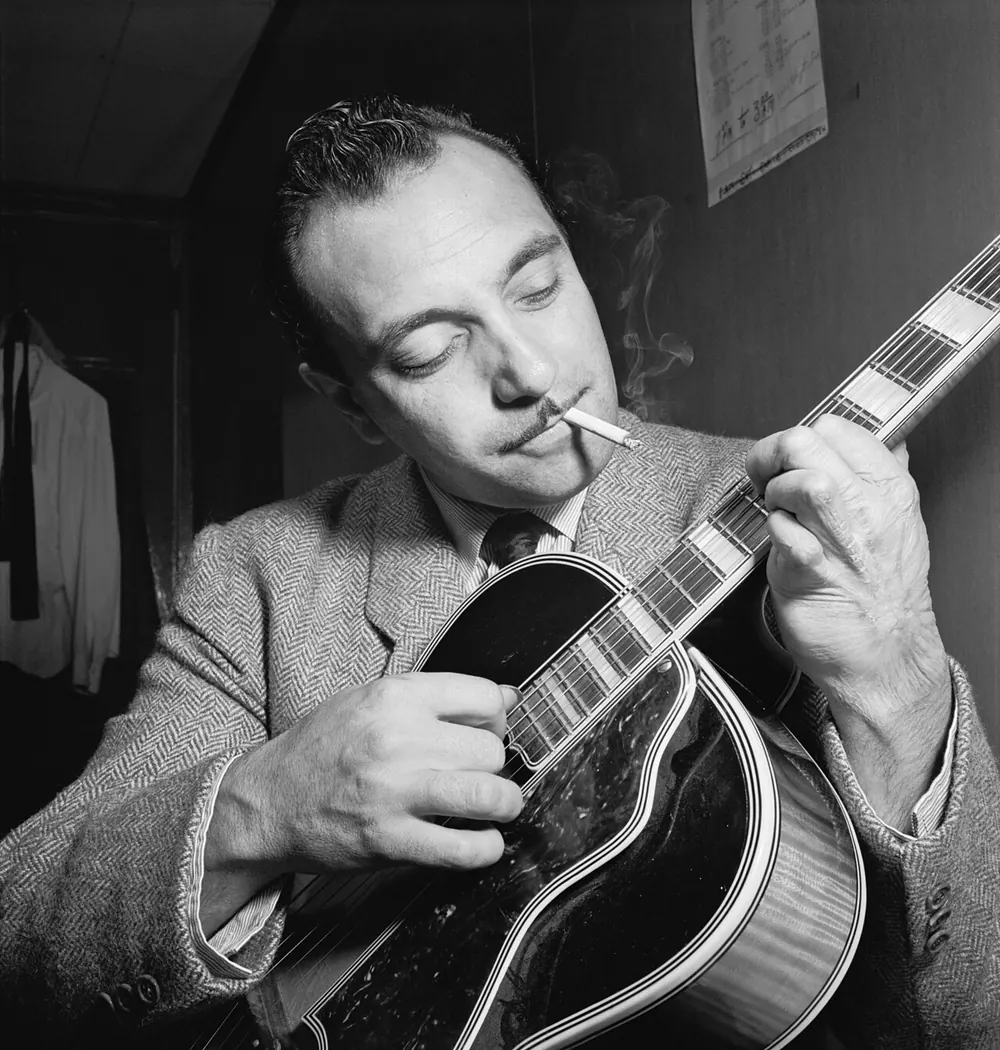

Born in Belgium in 1910 into a Sinti musical family, Reinhardt grew up in a travelling community and later lived near Paris. He played banjo-guitar before becoming a leading jazz guitarist. His music brought American jazz into conversation with the sounds and skills of musicians around him.
Meet Django Reinhardt
Born in Belgium in 1910 into a Sinti musical family, Reinhardt grew up in a travelling community and later lived near Paris. He played banjo-guitar before becoming a leading jazz guitarist. His music brought American jazz into conversation with the sounds and skills of musicians around him.
A caravan fire in 1928 badly injured his left hand. He developed new ways of fingering melodies and chords. His artistry came from musical imagination, practice, and collaboration; his injury alone does not explain his sound.
In 1934 he and violinist Stéphane Grappelli formed the Quintette du Hot Club de France with two rhythm guitarists and a double bassist. Its string-band sound became central to Jazz Manouche, also called Sinti swing. The historical label “Gypsy jazz” is common in record catalogs, but “Gypsy” can be offensive when used for people.
A life in music
- 1910 Born in Liberchies, Belgium.
- 1928 A fire injures his hand; he adapts his playing technique.
- 1934 Forms the Quintette du Hot Club de France with Grappelli.
- 1937 The quintet records Minor Swing, credited to Reinhardt and Grappelli.
- 1940 Records Nuages during the war years.
- 1953 Dies in France; his compositions and recordings continue to inspire guitarists.
A solo can travel while the harmony stays clear
A chord tone belongs to the chord sounding underneath a melody. Over A minor, A, C, and E are chord tones. Play those notes one at a time and you have an arpeggio. An improviser can connect them with other notes, repeat a small idea, leave space, and aim for a chord tone when the harmony changes.
In the quintet, rhythm guitars supply short chord strokes known as la pompe (“the pump”), while the double bass grounds the pulse. Guitar and violin can take turns leading. A steady accompaniment gives the soloist room to stretch a phrase without losing the shared beat.
Swing often makes a pair of eighth notes unequal: longer, then shorter. The balance changes with tempo and performer. A fixed long–short ratio is a useful classroom comparison, not a rule that describes every jazz performance.
Keep the chord, change the timing
Hear an original eight-note A-minor arpeggio over four steady chord strokes. Change only the subdivision: can you keep tapping the same four beats?
Read and play the tablature
Standard tuning, low to high: E–A–D–G–B–e. The top line is the thinnest, highest string. Numbers are frets, not fingers; 0 means an open string. Read left to right. Use the audio to hear rhythm: spacing in this tab is a reading aid, not standard rhythmic notation.
e|--5---8---12--17--12--8---5---12--|
B|----------------------------------|
G|----------------------------------|
D|----------------------------------|
A|----------------------------------|
E|----------------------------------|
    A   C   E   A   E   C   A   E
For the accompaniment, strum the middle four strings once per beat: x–0–2–2–1–x from low E to high e (A–E–A–C). An x means do not play that string. The melody uses the first string and shifts up to fret 17; play it slowly or sing the pitches if your guitar’s upper frets are hard to reach.
This classroom pattern and tablature are original CC0 teaching materials; they are not a transcription of Minor Swing or a Reinhardt solo.
Ready. Press Play to hear the pattern.
The swing version places the second note of each pair two-thirds of the way through the beat. Real players vary this timing. These synthesized plucks illustrate rhythm, not Reinhardt’s recorded tone.
Read the notes and timing
- Tap four even beats while a partner claps the eight melody notes. Switch versions without changing your tapping.
- Sing A–C–E–A, then invent a different order using only those notes. Leave a rest and repeat one idea.
- Discuss: which part gives the phrase its forward motion—the steady chords, the uneven melody, or both?
Watch Django play
Watch Reinhardt and Stéphane Grappelli with the Quintette du Hot Club de France in the archival film Jazz “Hot”. Follow the rhythm guitars’ steady pulse, then watch how Reinhardt shapes his solo with his fretting hand.
Discuss: How do the accompaniment and solo divide the work? Describe one movement you can see and one musical choice you can hear.
Watch the idea in tablature
Watch the melody move through A-minor chord tones, then compare straight and swung timing. The active fret number lights up as its note sounds. Pause or use full screen to study a fingering.
Video description and transcript
At 0:00 the first pattern is introduced; it plays from 0:02 to 0:06. The comparison pattern is introduced at 0:06.5 and plays from 0:07 to 0:11. The video plays A–C–E–A–E–C–A–E over four A-minor chord strokes, first evenly, then with a long–short subdivision. Six lines show guitar strings, with the thinnest string at the top. Fret numbers highlight in time with the sound. There is no speech.
Listen like an arranger
Use the publisher’s Reinhardt: Nuages recording page to find Minor Swing and Nuages. Playback availability may depend on the service and region. The browser experiment above is an original teaching pattern, not either composition.
- Minor Swing — Reinhardt and Grappelli. First listen for the rhythm guitars and bass. Then follow the lead instrument: where does a short idea repeat or get answered? Write one observation about accompaniment and one about the solo.
- Nuages — Reinhardt. Compare its lyrical melody with the energy of Minor Swing. Hum a short contour without copying every decoration. Does a slower phrase still need a clear pulse?
- Compare performances. Record the performer and recording date you actually hear. Different recordings of the same tune may have different instrumentation and solos.
Play the changes yourself: practice improvising over the chord-only charts for Minor Swing and Nuages in the Fake Book, or play the full 1918 standard After You’ve Gone from the Quintette’s repertoire.
A lasting musical voice
Reinhardt helped establish the guitar as a powerful jazz solo voice. His partnership with Grappelli also shows how a band’s sound grows from relationships between players. Jazz Manouche remains a living tradition, with musicians learning the repertoire and making new music.
Compare Louis Armstrong’s phrasing and Charlie Parker’s chord-tone lines. Then visit Francisco Tárrega: how does a solo guitarist supply the support that Reinhardt’s band supplies?
Practice and reflection
Use the listening experiment to support your answers.
0 / 3
Compose and explain
Create a four-beat phrase from A, C, and E. Mark one rest, a repeated idea, and a note you want to emphasize. Explain how a rhythm guitarist could support it.
Teacher discussion guide
Ask students to name the part they changed and the part they kept steady. Accept different phrases when students can explain their choices using pulse, pitch, texture, or balance. Replay a short example to test their explanation.
Sources and further exploration
- Ilsen About: Jean “Django” Reinhardt, Encyclopaedia of the Nazi Genocide of the Sinti and Roma in Europe — historical context and career.
- Bibliothèque nationale de France: L’inoubliable — recording catalog, titles, and credits.
- Library of Congress: Reinhardt portrait — photograph and collection context.