Physics · History of Science
Nikola Tesla
Born in Serbia in 1856, Nikola Tesla reimagined how electricity could move across the world. His alternating current system powers every outlet on the planet. His Tesla Coil demonstrated resonant wireless energy transfer a century before smartphones used it to charge wirelessly.
Who Was Nikola Tesla?
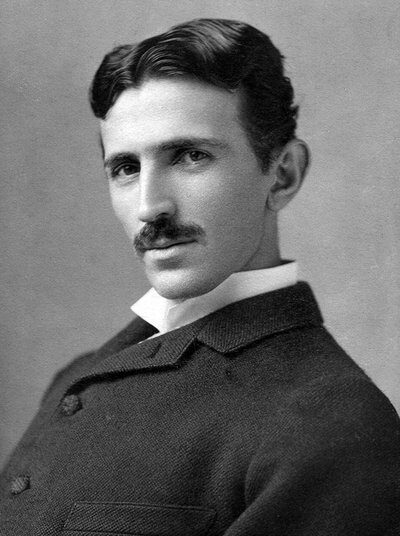
Nikola Tesla (July 10, 1856 – January 7, 1943) was born in Smiljan, Serbia — then part of the Austrian Empire. From a young age he displayed a photographic memory and a remarkable ability to visualize complex machines entirely in his mind before ever building them, often completing designs in his head before committing anything to paper.
Tesla studied electrical engineering at the Graz University of Technology and later at the University of Prague. In 1884 he emigrated to America with four cents in his pocket and a letter of introduction to Thomas Edison. He worked briefly for Edison, impressing him with his engineering precision, but left when Edison refused to pay him a promised bonus for improving his DC generators.
After a stint digging ditches to survive, Tesla partnered with industrialist George Westinghouse to champion alternating current (AC) against Edison's entrenched direct current (DC) empire. Their victory in the "War of Currents" — culminating in powering the 1893 Chicago World's Fair and the first commercial AC generators at Niagara Falls in 1895 — established the global electrical standard we use today.
Despite his colossal contributions, Tesla died alone on January 7, 1943, in Room 3327 of the Hotel New Yorker in New York City, nearly bankrupt. He left over 300 patents spanning AC motors, the Tesla Coil, radio, remote control, and early wireless energy transmission. The SI unit of magnetic flux density — the tesla (T) — is named in his honor.
A Life in Invention
- 1856 Born in Smiljan, Serbia (then Austrian Empire) to a Serbian Orthodox priest and an inventor's daughter.
- 1884 Arrives in New York City; joins Edison Machine Works and impresses Edison with his electrical expertise.
- 1887 Invents the AC induction motor, demonstrating that rotating magnetic fields can drive a rotor without physical contact — revolutionizing industrial machinery.
- 1891 Invents the Tesla Coil, a resonant air-core transformer capable of producing extremely high voltages at high frequencies. Becomes a naturalized US citizen.
- 1893 AC power illuminates the Chicago World's Columbian Exposition. Westinghouse, using Tesla's system, defeats Edison's DC bid — 27 million visitors witness the future of electricity.
- 1895 Niagara Falls AC generators designed by Tesla and Westinghouse go online, transmitting power to Buffalo, New York — the first large-scale AC transmission system in history.
- 1898 Demonstrates a radio-controlled boat at Madison Square Garden — the world's first remotely operated vehicle, predating modern remote control by decades.
- 1899 In his Colorado Springs laboratory, Tesla produces artificial lightning bolts measuring 135 feet — the longest man-made electrical discharge at the time.
- 1901 Construction begins on Wardenclyffe Tower on Long Island — Tesla's dream of a global wireless energy and communication system. Funding is withdrawn by J.P. Morgan before completion.
- 1943 Tesla dies in New York. Later that year, the US Supreme Court rules that Tesla's radio patents predated those of Guglielmo Marconi, posthumously crediting Tesla as a co-inventor of radio.
The War of Currents: AC vs DC
Edison backed direct current (DC); Tesla and Westinghouse championed alternating current (AC). This was not just a scientific debate — it was a battle for the future of American industry, fought with patents, lobbying, and dramatic public demonstrations.
- Current flows in one direction only; does not change direction
- Cannot be stepped up or down with a transformer
- Power lost rapidly over distance due to I²R heating losses
- Required a power station approximately every one mile in a city
- Safer at low voltages and simpler for early electrical devices
- Current alternates direction 60 times per second (60 Hz in North America)
- Transformers can step voltage up for long-distance transmission, then step it down safely for homes
- Travels thousands of miles with minimal energy loss
- A single power plant can serve entire cities and regions
- Won the War of Currents and became the universal global standard
Interactive Tesla Coil Simulator
A Tesla Coil is an air-core resonant transformer. The primary LC circuit resonates at the same frequency as the secondary, causing dramatic voltage amplification. Sparks leap from the toroid as the voltage exceeds air's breakdown threshold (~3 MV/m).
Tesla's Key Inventions
Rotating magnetic fields drive a rotor without physical contact between stator and rotor. Powers refrigerators, fans, pumps, HVAC systems, and every modern electric vehicle today.
A resonant air-core transformer that generates extremely high voltages at high frequencies. Used in early radio research, neon sign power supplies, and wireless energy demonstrations.
Tesla demonstrated wireless signal transmission in 1893. In 1943, the US Supreme Court posthumously ruled that Tesla's radio patents predated Marconi's, crediting Tesla as a co-inventor.
The complete system of AC generation, transmission, and distribution — patented, licensed to Westinghouse, and still the global standard powering every home and business on Earth.
Demonstrated a radio-controlled boat in Madison Square Garden — the world's first remotely operated vehicle, using radio signals to steer and control the craft from a distance.
A 57-metre tower on Long Island designed to transmit electricity and communications wirelessly across the globe. Never completed after J.P. Morgan withdrew funding in 1903.
Tesla's Legacy Today
Tesla's contributions were so foundational that they permeate nearly every aspect of modern electrical and electronic life, even when his name is not attached to them.
Practice Problems
Use f = 1/(2π√LC) for resonant frequency, V₂ = (N₂/N₁) × V₁ for transformer voltage.
Easy1. Which type of current does a Tesla Coil produce at its output — AC or DC?
Easy2. What is the standard AC frequency used in North American homes and businesses?
Medium3. A transformer's primary coil has 100 turns connected to 120 V. The secondary coil has 2,000 turns. Use V₂ = (N₂/N₁) × V₁ to find the secondary voltage in volts.
Medium4. A Tesla coil LC circuit has L = 25 mH and C = 10 nF. Calculate the resonant frequency using f = 1/(2π√LC). Give your answer in kHz (round to one decimal place).
Challenge5. Why can AC be transmitted over long distances more efficiently than DC?
Innovator Profile · See Also