Chemistry · Physics · History of Science
Marie Curie
Born Maria Skłodowska in Warsaw in 1867, Marie Curie became the first person — and still the only woman — to win the Nobel Prize twice, in two different sciences. Her discovery of polonium and radium, and her foundational work on radioactivity, transformed our understanding of the atom and launched nuclear physics and modern medicine.
Who Was Marie Curie?
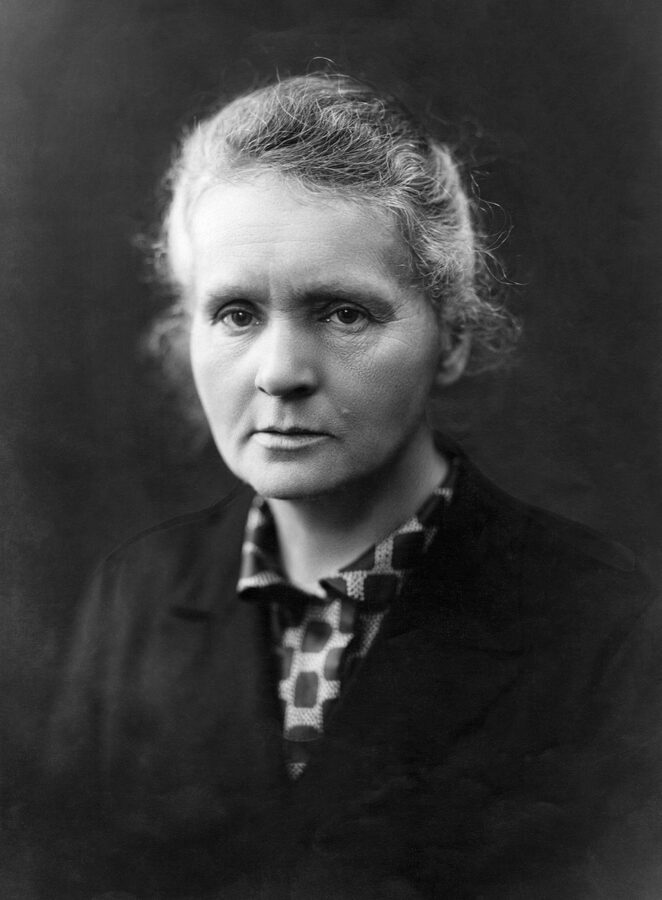
Born November 7, 1867, in Warsaw, Poland — then under Russian rule — Maria Skłodowska grew up in a society that barred women from higher education. Forbidden from attending university in Poland, she made a deal with her sister Bronya: each would fund the other's education abroad in turn. Maria worked as a governess for years to pay for Bronya's medical studies, then in 1891 moved to Paris, enrolled at the Sorbonne, and graduated first in her physics degree despite arriving knowing very little French and with almost no money.
She met Pierre Curie in 1894, a brilliant physicist who had himself made significant discoveries in crystallography and piezoelectricity. They married in 1895, forming one of the most productive scientific partnerships in history. Together they investigated uranium rays first observed by Henri Becquerel. Marie made a transformative insight: she coined the term "radioactivity" and demonstrated that radiation was an intrinsic property of the atom itself — not a result of molecular interaction. This was a revolution. The classical model of the indivisible, inert atom could not survive her evidence.
In 1898 she discovered two new elements: polonium (named after her occupied homeland Poland, as an act of national pride) and radium. To isolate one gram of radium, she and Pierre processed over one tonne of pitchblende ore — an extraordinary feat of physical and chemical labor. In 1903 she and Pierre shared the Nobel Prize in Physics with Becquerel. After Pierre was killed in a 1906 street accident — struck by a horse-drawn cart — Marie took over his professorship at the Sorbonne, becoming the first female professor in the university's 650-year history.
In 1911 she won a second Nobel Prize, this time in Chemistry, for the isolation of pure radium and the study of its properties. During World War I she designed and personally operated 20 mobile radiological units — called petites Curies — which performed X-rays on wounded soldiers in field hospitals. She trained 150 women as X-ray technicians and the units are estimated to have served over one million soldiers. She died July 4, 1934, from aplastic anemia caused by decades of radiation exposure. Her personal notebooks from the 1890s remain radioactive to this day and are stored in lead-lined boxes at the Bibliothèque nationale de France.
A Life of Discovery
- 1867 Born Maria Skłodowska on November 7 in Warsaw, Poland — then under Russian imperial rule.
- 1891 Moves to Paris and enrolls at the Sorbonne; graduates top of her class in physics despite language barriers and poverty.
- 1894 Meets Pierre Curie in a Paris laboratory; he becomes her scientific collaborator and closest ally.
- 1895 Marries Pierre Curie; begins systematic investigation of uranium rays discovered by Henri Becquerel.
- 1897 Daughter Irène born — who will herself win a Nobel Prize in Chemistry in 1935.
- 1898 Discovers polonium (July) and radium (December), and coins the term "radioactivity."
- 1903 Awarded the Nobel Prize in Physics jointly with Pierre Curie and Henri Becquerel for research on radioactivity — first woman to win a Nobel Prize.
- 1906 Pierre is killed by a horse-drawn cart in Paris. Marie accepts his professorship at the Sorbonne — first female professor in the university's history.
- 1911 Awarded the Nobel Prize in Chemistry for the discovery and isolation of radium and polonium — first person ever to win two Nobel Prizes.
- 1914 Develops 20 mobile X-ray vehicles (petites Curies) for WWI; personally trains 150 women as radiological technicians.
- 1934 Dies July 4 from aplastic anemia caused by decades of radiation exposure. Her notebooks remain radioactive today.
What Is Radioactivity?
Radioactivity is the spontaneous emission of particles or energy from an unstable atomic nucleus. When a nucleus has too many protons, too many neutrons, or too much energy, it rearranges itself by releasing radiation — transforming into a more stable configuration, sometimes into a completely different element in a process called nuclear decay.
Three Types of Radiation
Marie Curie and her contemporaries identified three fundamental types, named after the first three letters of the Greek alphabet:
- Alpha (α) particles — helium nuclei (2 protons + 2 neutrons, charge +2). Low penetrating power: stopped by a sheet of paper or a few centimetres of air. Dangerous if inhaled or ingested.
- Beta (β) particles — fast-moving electrons (β⁻) or positrons (β⁺). Medium penetration: stopped by a few millimetres of aluminium. Emitted when a neutron converts to a proton or vice versa.
- Gamma (γ) rays — high-energy electromagnetic photons. High penetration: requires several centimetres of lead or metres of concrete for effective shielding. Often emitted alongside α or β decay.
The Decay Equation
Radioactive decay is a random process — any individual nucleus may decay at any instant — but large samples follow a precise exponential law:
Half-Life Examples
The half-life (t½) is the time required for exactly half of a radioactive sample to decay. It is a fixed constant for each isotope — unaffected by temperature, pressure, or chemical bonding.
- Polonium-210: t½ = 138 days — highly radioactive; decays by alpha emission
- Radium-226: t½ = 1,600 years — alpha emitter; used in early cancer treatment
- Carbon-14: t½ = 5,730 years — beta emitter; used in radiocarbon dating of organic material
- Uranium-238: t½ = 4.47 billion years — approximately the age of Earth; very slow decay
Radioactive Decay Chain Simulator
Watch atoms decay over time. Adjust the half-life and sample size to see exponential decay in action. Each dot represents a group of atoms — when it flashes and changes color, that group has decayed.
Key Discoveries & Contributions
Coined the term; proved radiation is an atomic property, not a chemical reaction. This insight launched nuclear physics and disproved the classical model of the indivisible, passive atom.
New element discovered in pitchblende, named after Poland. Atomic number 84. Used today in anti-static devices, neutron sources, and was the subject of the 2006 Litvinenko poisoning.
Isolated from tonnes of pitchblende ore; 1,600-year half-life. Its spontaneous glow confirmed that atoms hold internal energy. Used in early cancer brachytherapy and luminescent watch dials.
Designed, built, and personally operated 20 battlefield radiological vehicles in WWI, training 150 women as X-ray technicians. Estimated to have served over one million wounded soldiers.
After Pierre's death, Marie accepted his chair in physics — breaking a 650-year barrier at one of the world's oldest universities. She lectured to a standing-room audience on her very first day.
Physics (1903) for radioactivity research; Chemistry (1911) for discovery and isolation of radium and polonium. No other person has won Nobel Prizes in two different sciences.
Marie Curie's Legacy Today
The curie (Ci) was the original unit of radioactivity — named in honor of both Marie and Pierre Curie — defined as 3.7 × 10¹⁰ disintegrations per second, the activity of exactly one gram of radium-226. Today the SI unit is the becquerel (Bq), equal to one decay per second. One curie = 37 billion becquerels.
Radiation therapy for cancer traces directly to Marie Curie's observation that radium destroyed tumor tissue faster than healthy tissue. The Curie Institute (Institut Curie), which she founded in Paris in 1920, remains one of Europe's leading cancer research and treatment centers. Modern radiotherapy treats millions of cancer patients annually.
Daughter Irène Joliot-Curie won the 1935 Nobel Prize in Chemistry alongside her husband Frédéric Joliot-Curie for their synthesis of new radioactive elements — making the Curies the only mother-daughter Nobel Prize pair in history. Irène had been trained by Marie herself on the WWI mobile X-ray units from the age of 18.
Nuclear medicine — including PET scans, thyroid scintigraphy, and bone scans — uses radioactive isotopes whose behavior was first systematically understood through Curie's work. The global cancer screening and treatment industry built on radioactive tracers owes its foundations to her discoveries.
The element curium (Cm, atomic number 96) was synthesized in 1944 by Glenn Seaborg and Albert Ghiorso at the University of California, Berkeley, and named in honor of both Marie and Pierre Curie in recognition of their pioneering contributions to radioactivity research.
Practice Problems
Use N(t) = N₀ · e−λt, t½ = ln(2)/λ, and A = λN. ln(2) ≈ 0.693.
Easy1. What term did Marie Curie coin to describe the spontaneous emission of particles or energy from atomic nuclei?
Easy2. Which two elements did Marie Curie discover?
Medium3. Radium-226 has a half-life of 1,600 years. If you start with N₀ = 800 atoms, how many atoms remain after 3,200 years? (3,200 years = 2 half-lives.)
Medium4. A sample has λ = 0.0866 s⁻¹ (t½ = 8 s). Starting with N₀ = 1000 atoms, use N(t) = 1000 × e−0.0866 × 16 to find the number of atoms remaining at t = 16 s. Round to the nearest whole number.
Challenge5. Why do Marie Curie's notebooks from the 1890s remain radioactive today?