Music pioneer · Romantic · Composer arrangement studio
Edvard Grieg
Choose “Morning Mood”, then press Play. Listen for a short pentatonic tune passed back and forth, like birdcalls, while the music grows brighter and louder, as if the sun were rising. Playback uses sampled or synthesized instruments; consult the linked edition for fingering, bowing, pedaling, and expressive detail.
Arranging with care
A source staff is not always the melody: in an orchestral score, find the staff carrying the theme. A two-part piano study pairs your selected voice with a source bass; it is not a concert reduction and wide leaps may need redistribution. Saxophone notation is transposed while playback stays at concert pitch. Violin parts stay at concert pitch and are moved by octaves to sit above the open G string. Guitar tab preserves pitch and rhythm but may need a different octave or fingering. Original ensembles are available only where the source contains those parts. Piano reductions and original classroom studies retain their source identities.
Recordings: Nicholaus P. Brosowsky’s Tonejs-Instruments sample collection, CC BY 3.0; VSCO 2 Community Edition, CC0. Sample credits and processing.
Music pioneer · Romantic · 1843–1907
About Edvard Grieg
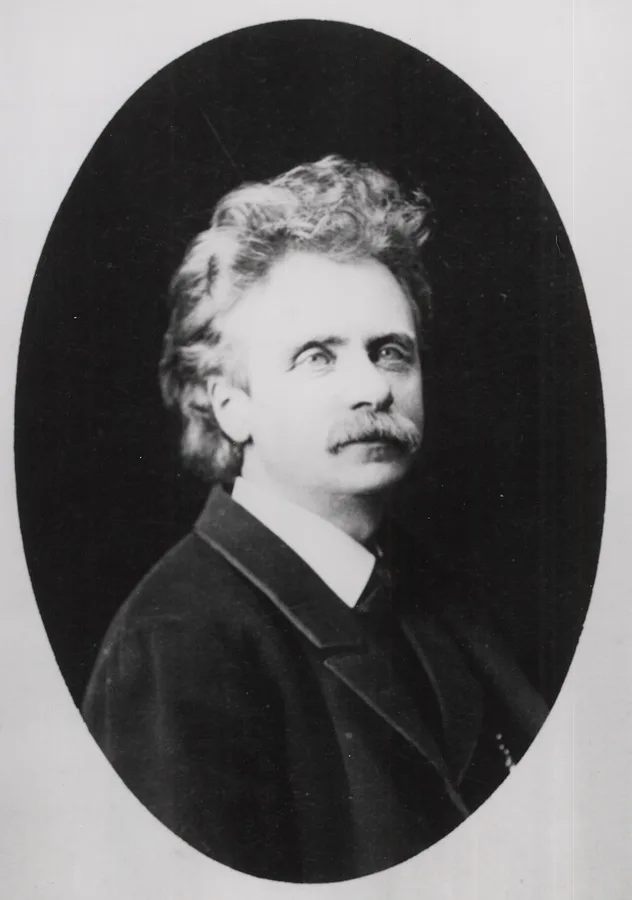
Edvard Grieg (1843–1907) gave Norway a musical voice. He drew on the dances and folk songs of his country, and his music for Henrik Ibsen’s play Peer Gynt includes two of the most famous tunes ever written: “Morning Mood” and “In the Hall of the Mountain King”.
Life and context
Grieg was born in Bergen, on Norway’s west coast, on 15 June 1843. His mother, a pianist, gave him his first lessons. The famous Norwegian violinist Ole Bull heard the fifteen-year-old play and persuaded his parents to send him to the Leipzig Conservatory in Germany.
Back in Scandinavia, he met the young composer Rikard Nordraak, who inspired him to write music that sounded Norwegian rather than German. In 1867 he married his cousin, the soprano Nina Hagerup, who sang many of his songs, and in 1868 he wrote his Piano Concerto in A minor, his breakthrough work.
In 1874 the playwright Henrik Ibsen asked him for music for Peer Gynt, a fantastical play about a boastful young man who wanders the world. It opened in Christiania (now Oslo) in 1876. “Morning Mood” begins Act IV, which takes place at dawn in the Moroccan desert, not in a Norwegian valley, even though most listeners picture fjords. Grieg later arranged the best numbers into two orchestral suites.
He wrote 66 short Lyric Pieces for piano, many songs, and the Holberg Suite. From 1885 he lived at Troldhaugen, a villa near Bergen, and toured Europe as a pianist and conductor despite poor health. He died in Bergen on 4 September 1907, a national hero.
Edvard Grieg: a timeline
- Born in Bergen, Norway, on 15 June.
- Begins study at the Leipzig Conservatory.
- Marries the soprano Nina Hagerup; publishes his first Lyric Pieces.
- Composes the Piano Concerto in A minor.
- Ibsen’s Peer Gynt opens with Grieg’s music.
- Writes the Holberg Suite.
- Moves into his villa, Troldhaugen.
- Publishes the first Peer Gynt Suite, Op. 46.
- Dies in Bergen on 4 September.
Musical nationalism and tone painting
Tone painting means using music to describe a scene. In “Morning Mood”, a short tune built on the five-note pentatonic scale is passed between instruments like birdsong, and the music grows louder and fuller as the light grows.
Musical nationalism was a movement in the 1800s in which composers used the folk songs, dances and stories of their own countries. Grieg’s drones (held bass notes), folk-dance rhythms and modal melodies made his music sound unmistakably Norwegian.
Music pioneer · Romantic
Sound experiment: tone painting and Norwegian nationalism
Version A plays a tune alone. Version B plays the same tune over a drone, a held low note like a folk fiddle or bagpipe. Which version sounds more like folk music?
This is an original classroom demonstration of a musical idea, not an excerpt or recording of the composer’s work.
Choose a version, then press Play.
Guided listening
Choose a performance of one of these works. Listen once for its overall character, then again for the detail in the prompt.
- “Morning Mood”: listen for the tune being handed from one instrument (or hand) to another, and for the moment of greatest brightness.
- “In the Hall of the Mountain King”: hear one short tune repeat faster and louder until it explodes.
- Piano Concerto in A minor, opening: listen for the dramatic falling figure that starts the piece.
Practice and reflection
- Find the opening tune. Which five different notes does it use?
- Follow the score to the loudest bar. How has the texture changed since the beginning?
- Choose a time of day other than sunrise. Describe how you would paint it in music: tempo, register, loudness and instruments.
Check your listening
The opening tune uses only the notes of a pentatonic scale, which gives it a simple, folk-like sound. The piece grows by adding instruments, register and volume, like a sky filling with light. A useful answer names a feature you can hear and explains its effect. More than one interpretation is possible.
Use the heart | save pill to keep these notes in this browser, or copy them before leaving.