Composer arrangement studio
George Gershwin
Arranging with care
A source staff is not always the melody: in an orchestral score, find the staff carrying the theme. A two-part piano study pairs your selected voice with a source bass; it is not a concert reduction and wide leaps may need redistribution. Saxophone notation is transposed while playback stays at concert pitch. Violin parts stay at concert pitch and are moved by octaves to sit above the open G string. Guitar tab preserves pitch and rhythm but may need a different octave or fingering. Chords are prepared for the Ode to Joy theme only; classical harmony elsewhere requires score study rather than automatic chord guesses. Original ensembles are available only where the source contains those parts. Piano reductions and original classroom studies retain their source identities.
Recordings: Nicholaus P. Brosowsky’s Tonejs-Instruments sample collection, CC BY 3.0; VSCO 2 Community Edition, CC0. Sample credits and processing.
Music · Broadway · Jazz Standards · Song Form
About George Gershwin
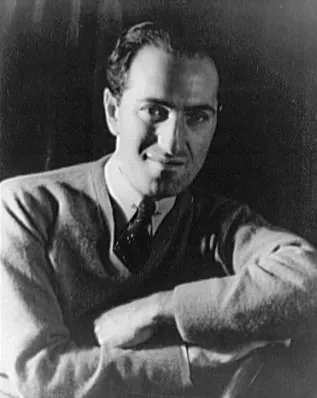
George Gershwin (1898–1937) started as a teenage song plugger on New York’s Tin Pan Alley and became the composer who brought Broadway, jazz and the concert hall together. With his brother Ira writing the words, he wrote songs that jazz musicians still play. On his own he wrote Rhapsody in Blue, An American in Paris and the opera Porgy and Bess. He died at 38.
Who Was George Gershwin?
George Gershwin was born in Brooklyn on September 26, 1898, the son of Russian-Jewish immigrants. When he was about twelve, his family bought a secondhand piano meant for his older brother Ira, but George was the one who sat down and played it. His teacher Charles Hambitzer introduced him to classical music. At fifteen he left school to work as a song plugger on New York’s Tin Pan Alley, playing publishers’ songs for customers who might buy the sheet music. That job trained his ear for memorable melodies and taught him the business of selling songs.
His 1919 song Swanee, with lyrics by Irving Caesar, became a huge hit for the singer Al Jolson. George and Ira then began a lasting partnership: George composed the music, while Ira shaped the words. Their 1924 musical Lady, Be Good! included Fascinating Rhythm. Their songs became material that jazz performers could reinterpret through phrasing, harmony and improvisation.
Gershwin also wrote concert music. Rhapsody in Blue premiered in February 1924 at a New York concert led by the bandleader Paul Whiteman, with Gershwin at the piano; An American in Paris followed in 1928. He drew on Black American musical traditions while working within commercial theater and concert institutions. Studying those influences means recognizing the musicians and communities who developed blues and jazz, as well as Gershwin’s own work as a composer.
He later composed Porgy and Bess (1935), with a libretto by DuBose Heyward and lyrics by Heyward and Ira. In 1936 he moved to Hollywood to write songs for films. He died there of a brain tumor on July 11, 1937, aged 38. Porgy and Bess and its song Summertime are still under copyright in the United States, so they are not among this lesson’s scores.
A Life from Tin Pan Alley to the Concert Hall
- 1898 Born September 26 in Brooklyn, New York.
- 1910 The family buys a piano, and George is the one who plays it.
- 1914 Leaves school to work as a Tin Pan Alley song plugger.
- 1919 Swanee, with Irving Caesar, becomes his breakthrough song.
- 1924 Rhapsody in Blue premieres in February; Lady, Be Good! opens in December with Fascinating Rhythm.
- 1926 Oh, Kay! includes Someone to Watch Over Me.
- 1928 An American in Paris premieres, taxi horns and all.
- 1930 Girl Crazy includes I Got Rhythm.
- 1931 Of Thee I Sing opens; it becomes the first musical to win the Pulitzer Prize for Drama.
- 1935 Porgy and Bess premieres.
- 1937 Dies July 11 in Los Angeles, aged 38.
A Melody Can Travel
A jazz standard is a tune that many musicians return to and reinterpret. The composition supplies material; a performance adds choices about tempo, phrasing, accompaniment, and improvisation. George and Ira’s songs often begin with a theatrical verse before the familiar refrain. Find both in the original score rather than assuming the opening is the tune you know.
Predict: Will a repeated melody feel the same if its accents change? Clap four steady beats, then clap a short pattern between those beats. Repeat the pattern while your partner keeps the pulse. Test: move one accent onto a beat. Explain: which version creates more rhythmic tension?
Many jazz choruses use AABA: a returning idea, its repeat, a contrasting bridge, and a return. Map the refrain of I Got Rhythm into those sections. The original song’s ending extends the final section; the common 32-bar jazz “rhythm changes” form is a performance convention, not an exact copy of every original bar.
4 sections × 8 bars = 32 bars. Gershwin’s original I Got Rhythm stretches its last section; the even 32-bar version is how jazz musicians usually play it.
What is syncopation?
What are “rhythm changes”?
Read & Play: Three Gershwin Songs
Choose a song from the display above. Each player holds the complete refrain as a piano arrangement, the vocal melody in the right hand over a simplified left hand built on the original’s harmony: use the song map to jump between the A sections and the bridge, Shift-click to loop a phrase, and follow the measure-by-measure guide. Each song also has its original sheet-music pages, which enlarge for class discussion.
The left hand is a classroom reduction, not Gershwin’s exact notes; each caption and source note says how it was made. The original scores are public domain in the United States; rights vary by country.
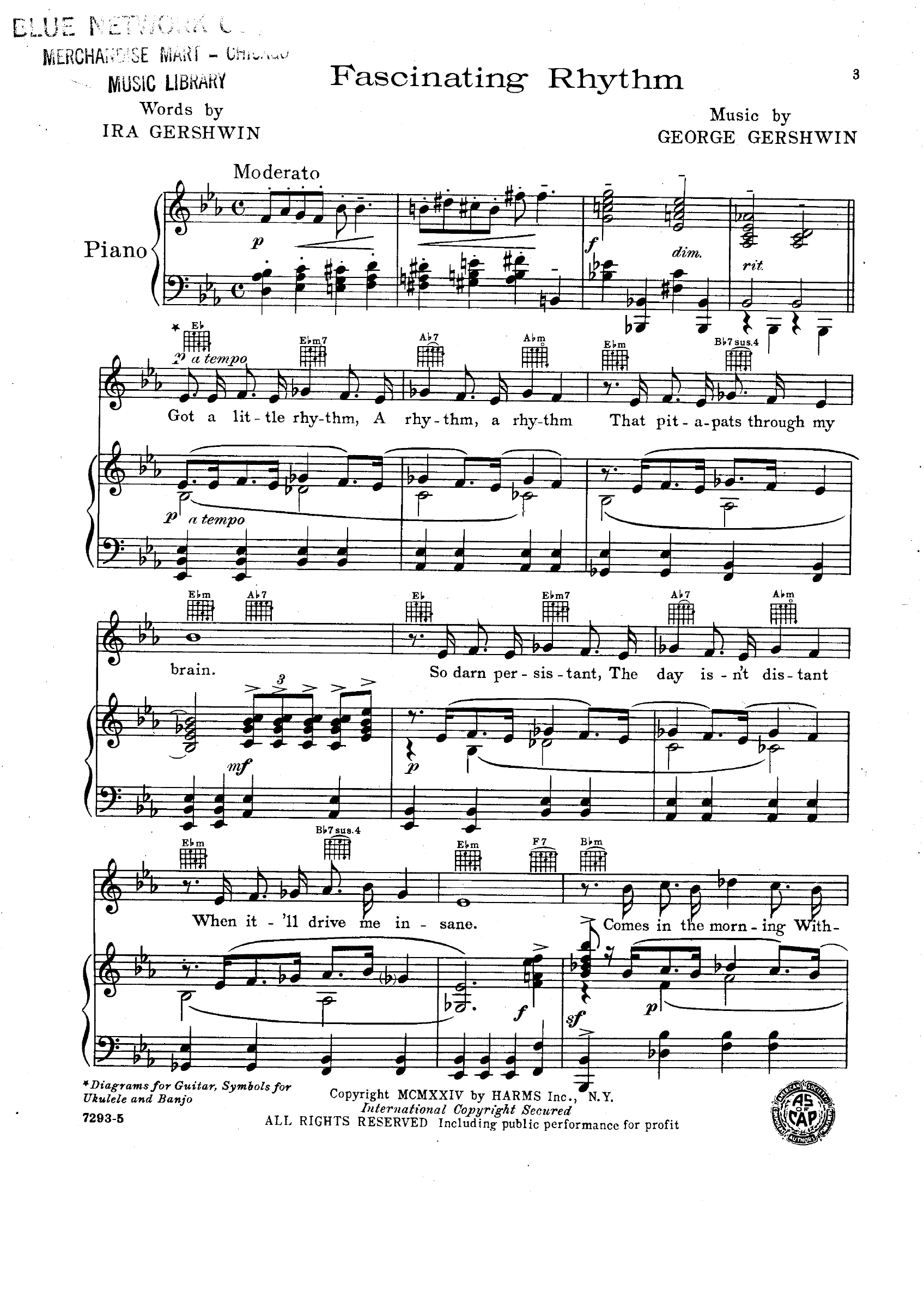
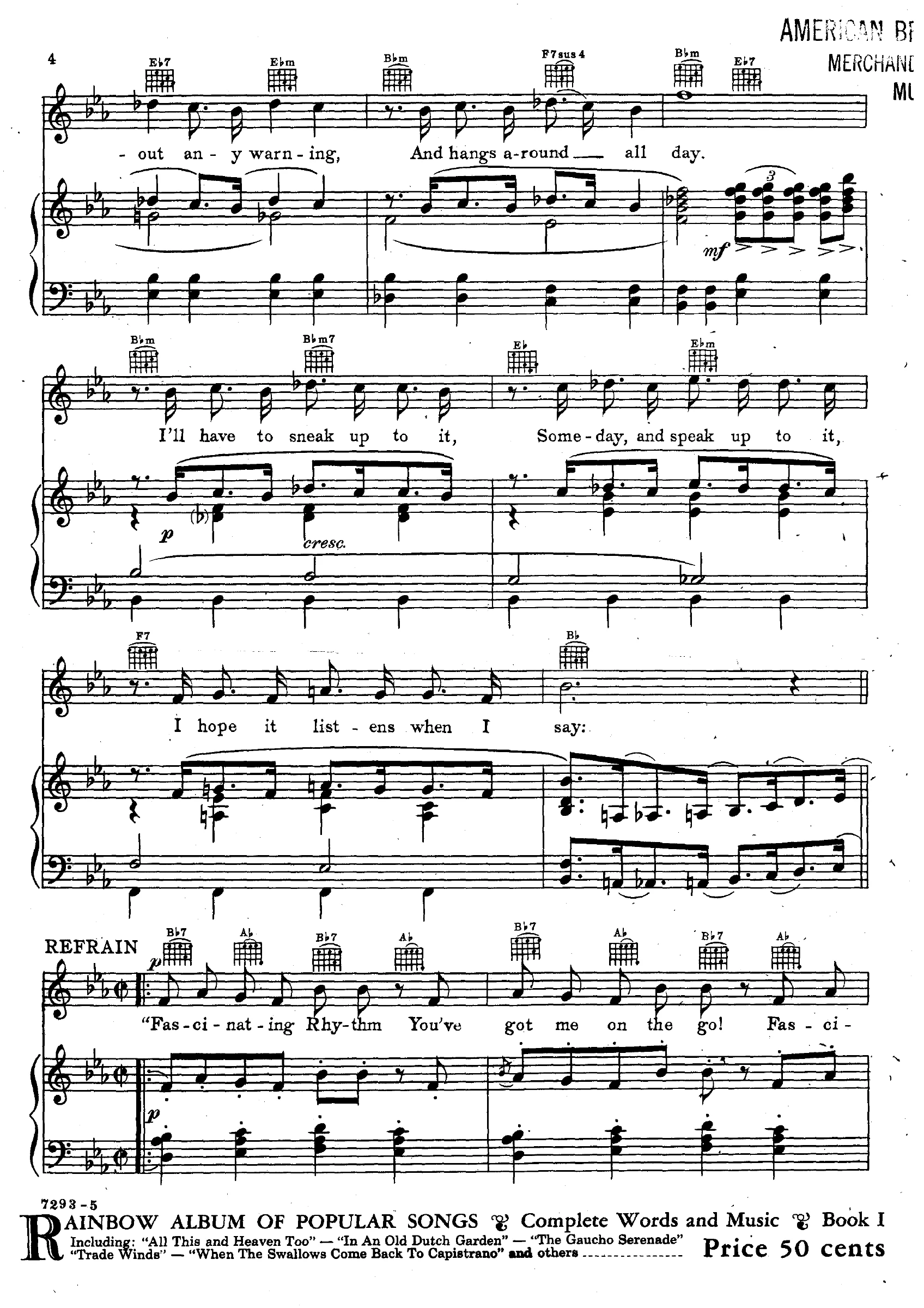
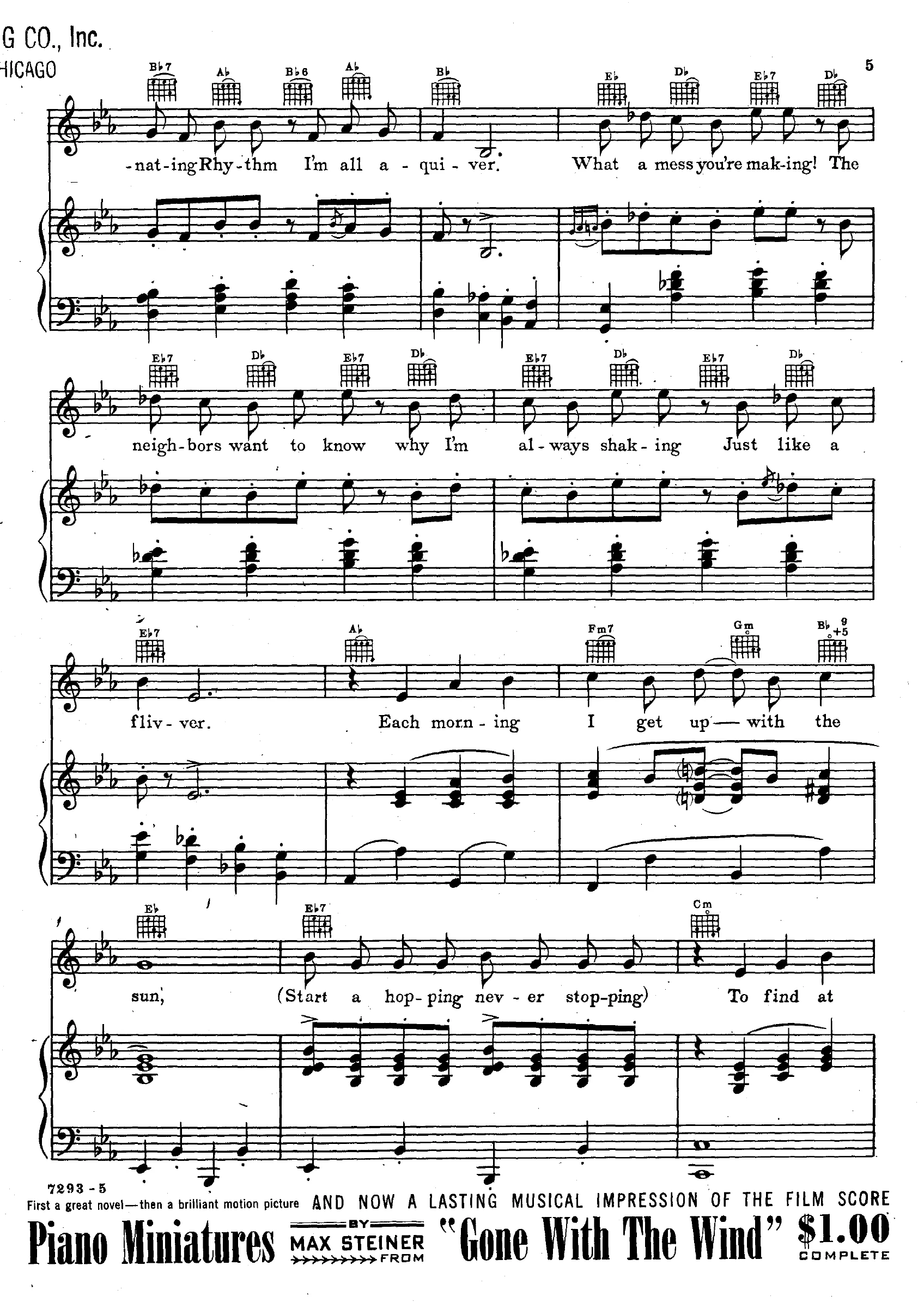
Fascinating Rhythm · complete refrain
Watch the accents move between the beats while the short melody keeps returning.
Read the complete original sheet music
Click a page to enlarge it. Use the arrow keys to step through this work; Escape closes the viewer. The player above performs the refrain as a piano arrangement.
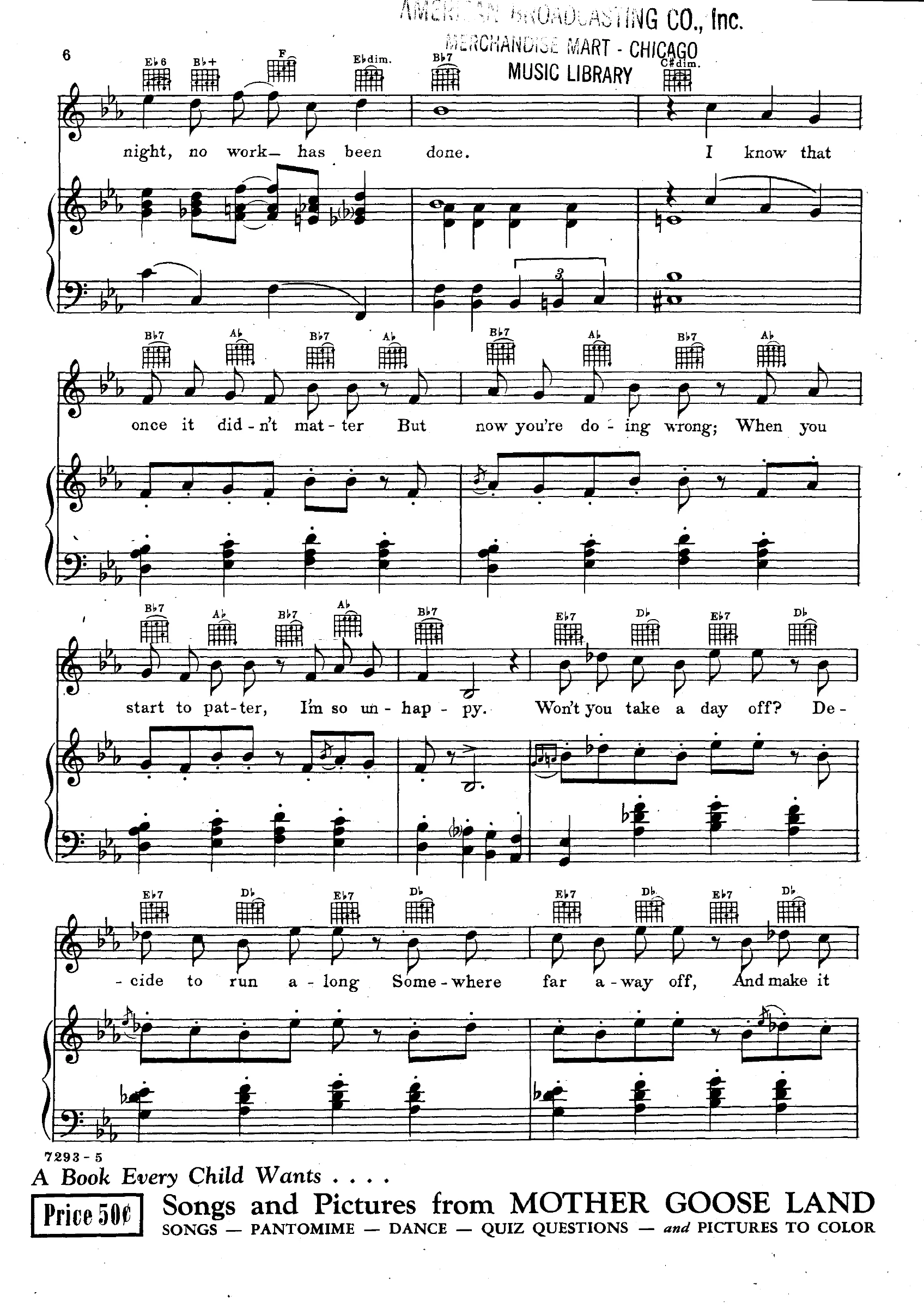
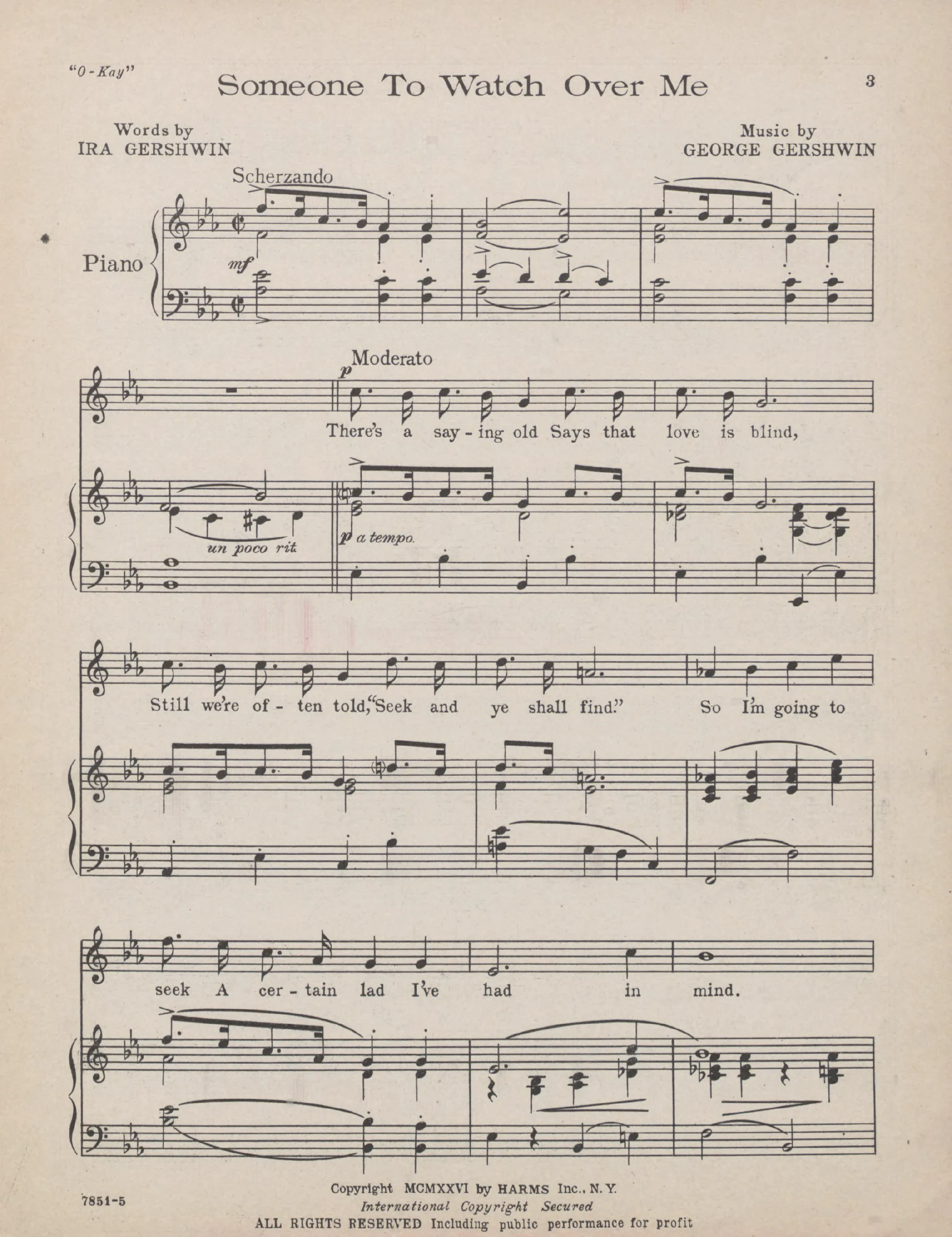
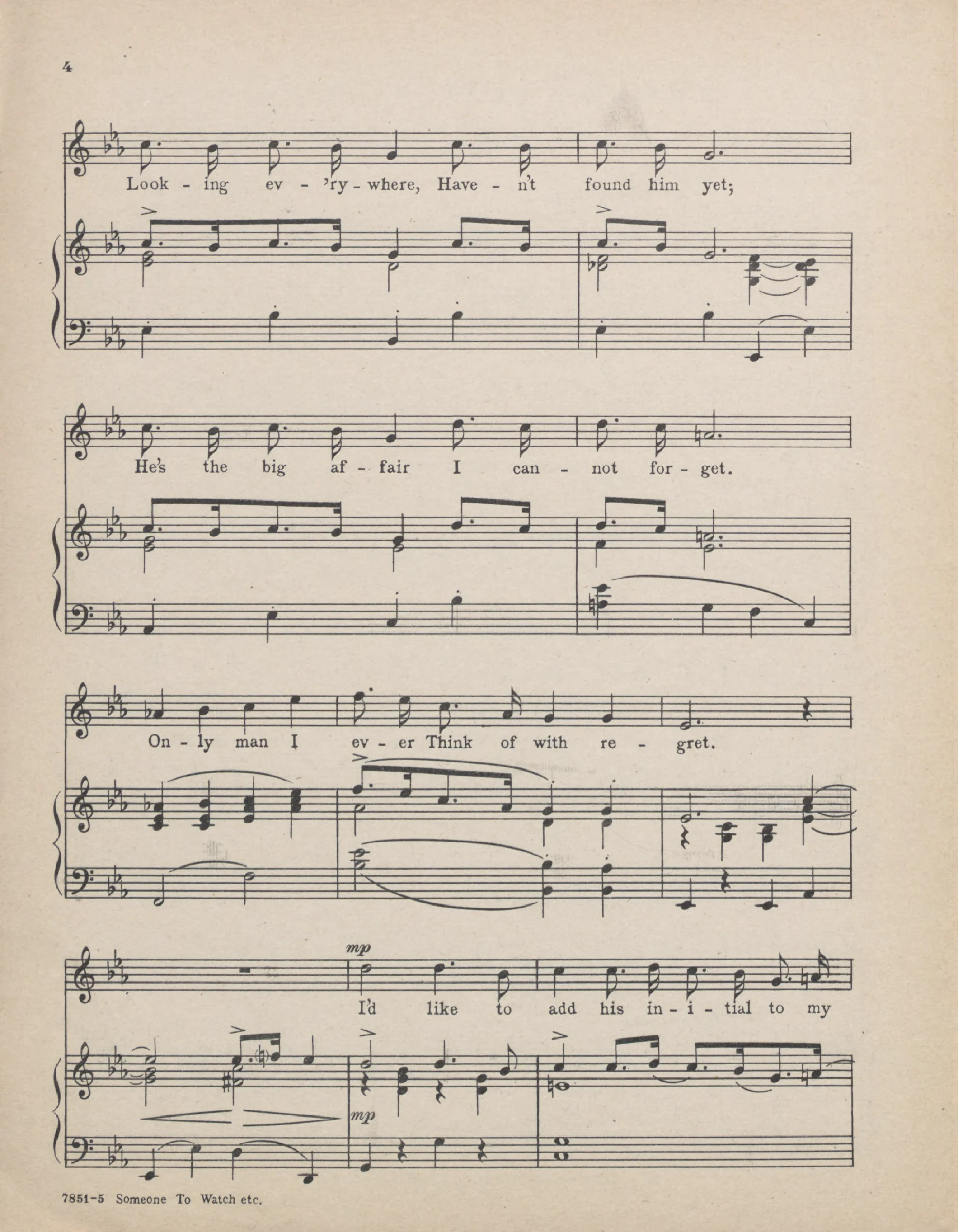
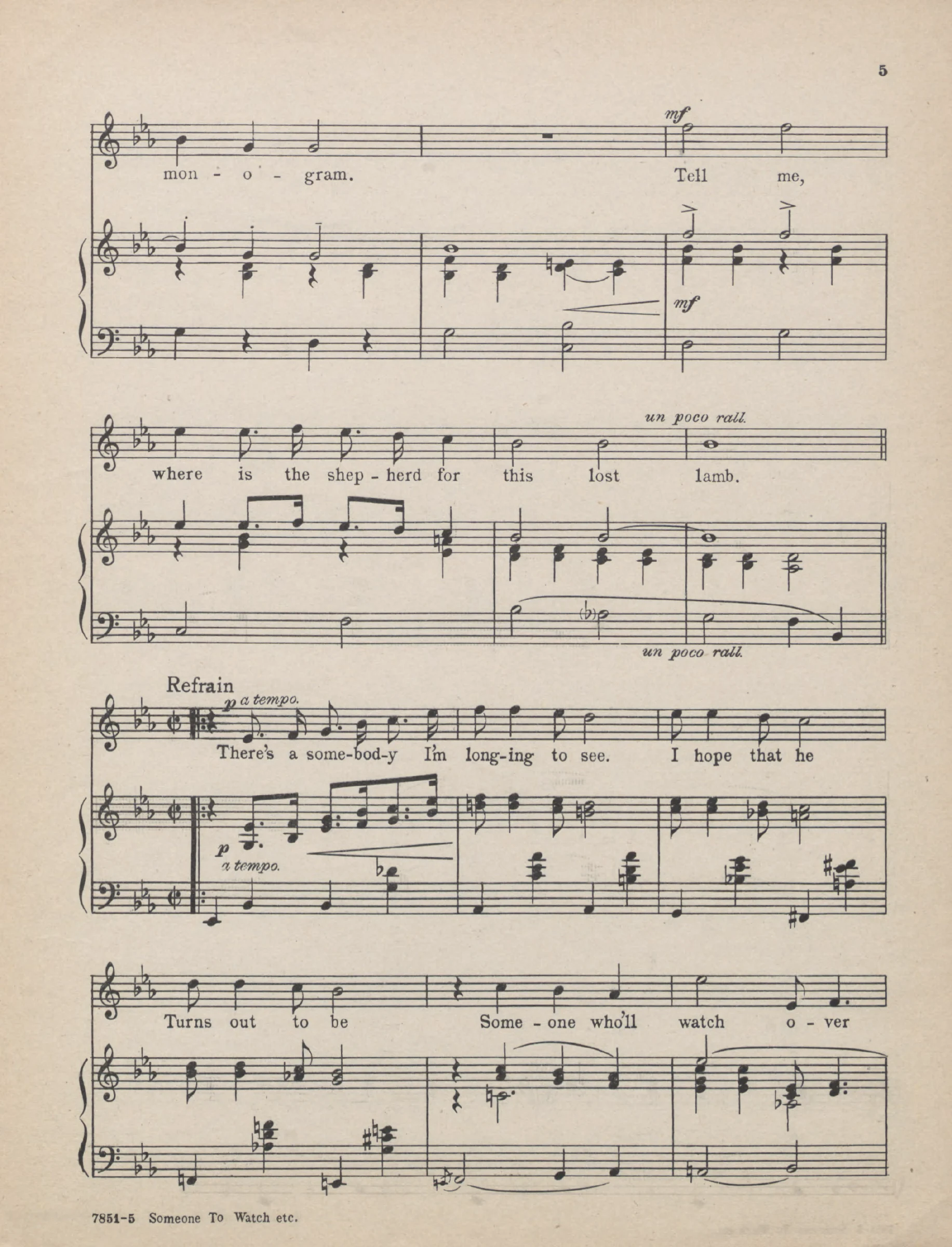
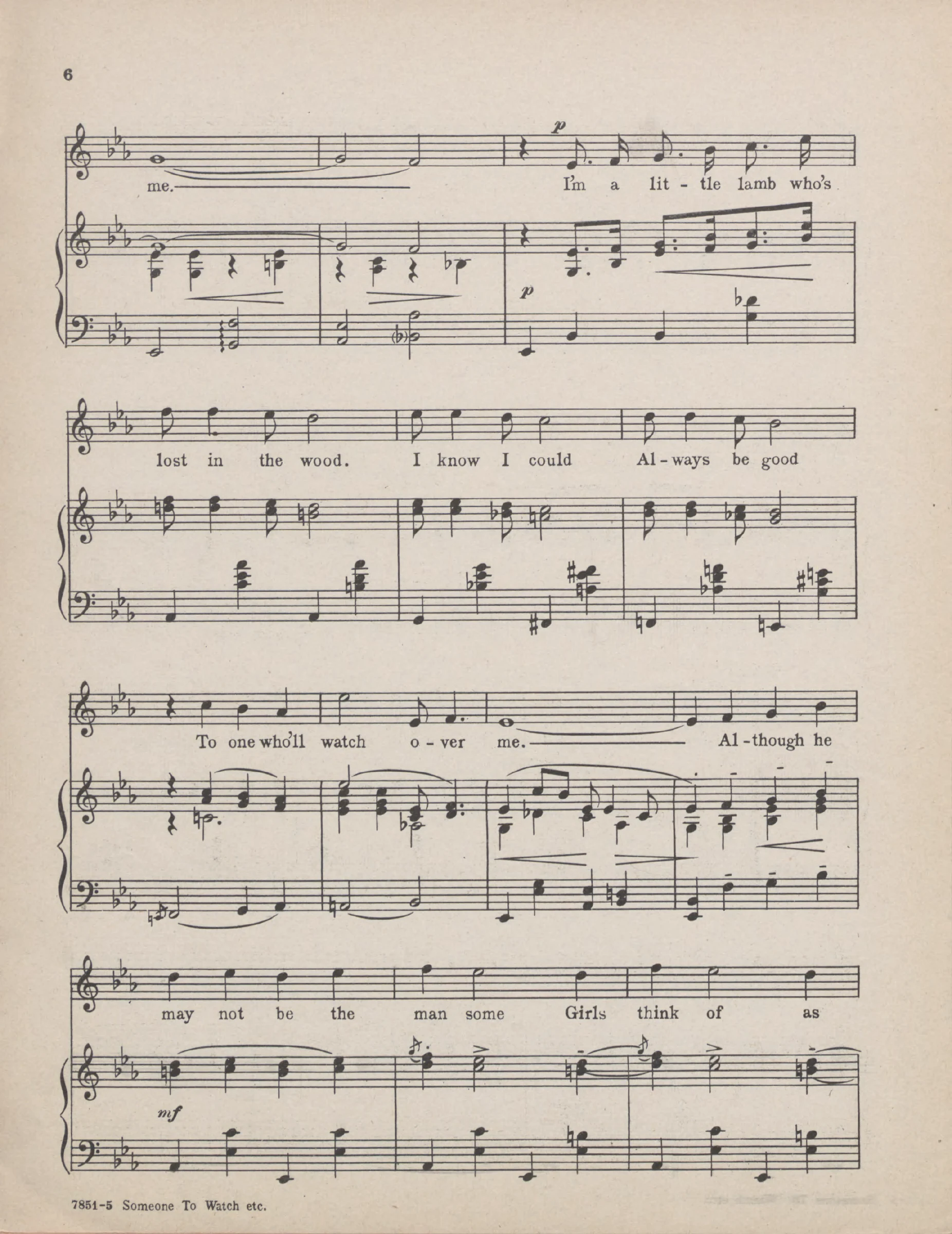
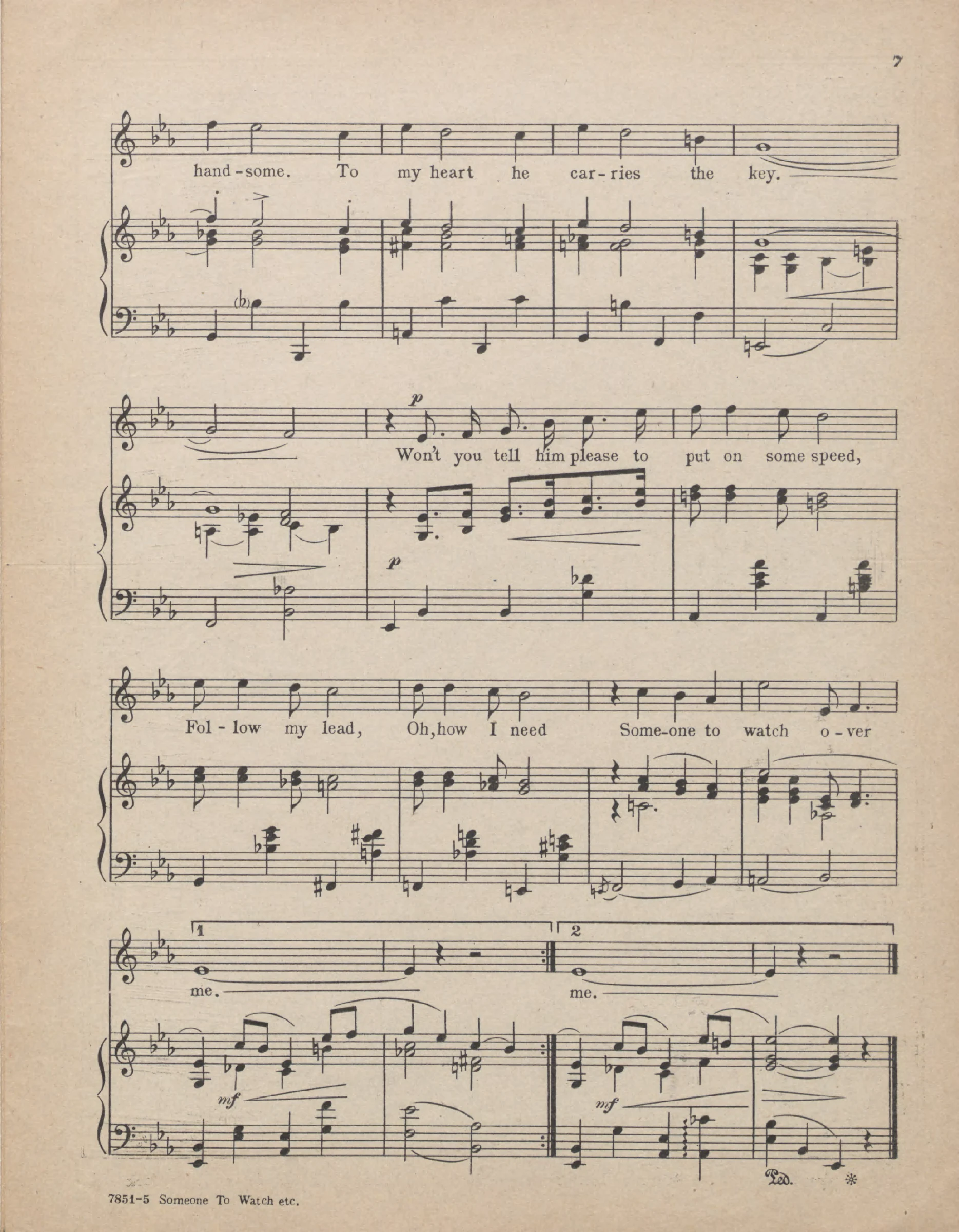
Someone to Watch Over Me · complete refrain
Follow the rising first bar, then hear the longer notes answer it.
Read the complete original sheet music
Click a page to enlarge it. Use the arrow keys to step through this work; Escape closes the viewer. The player above performs the refrain as a piano arrangement.
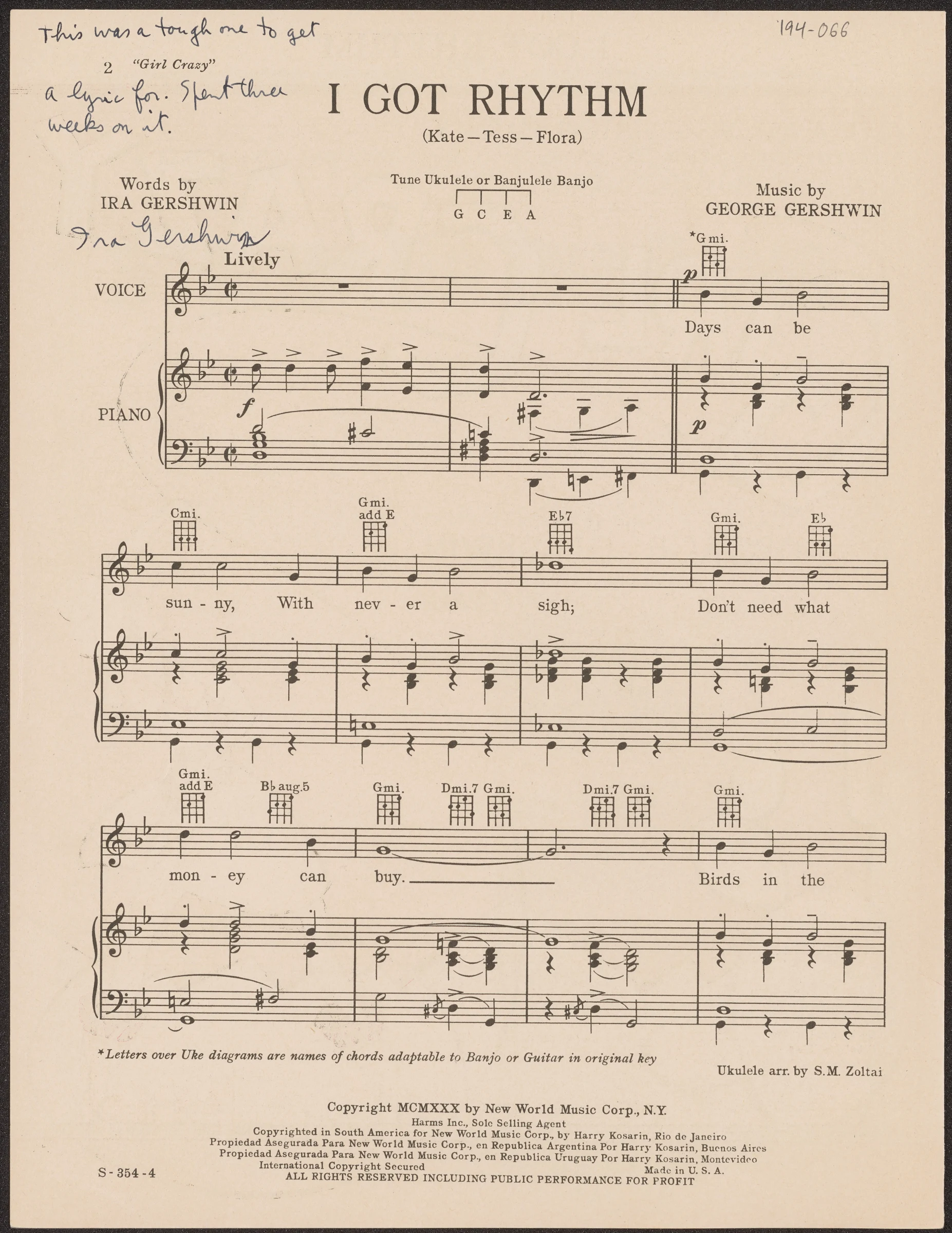
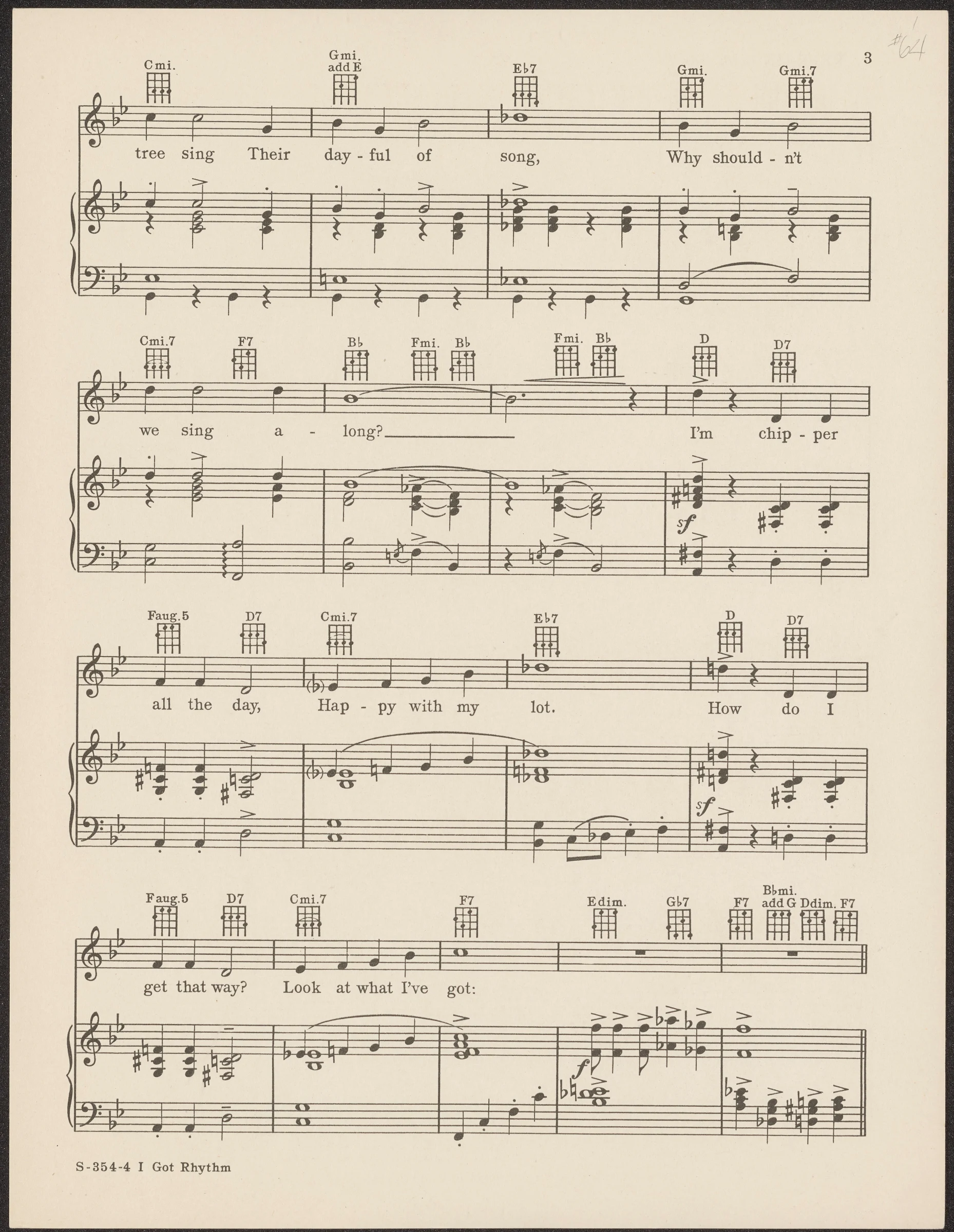
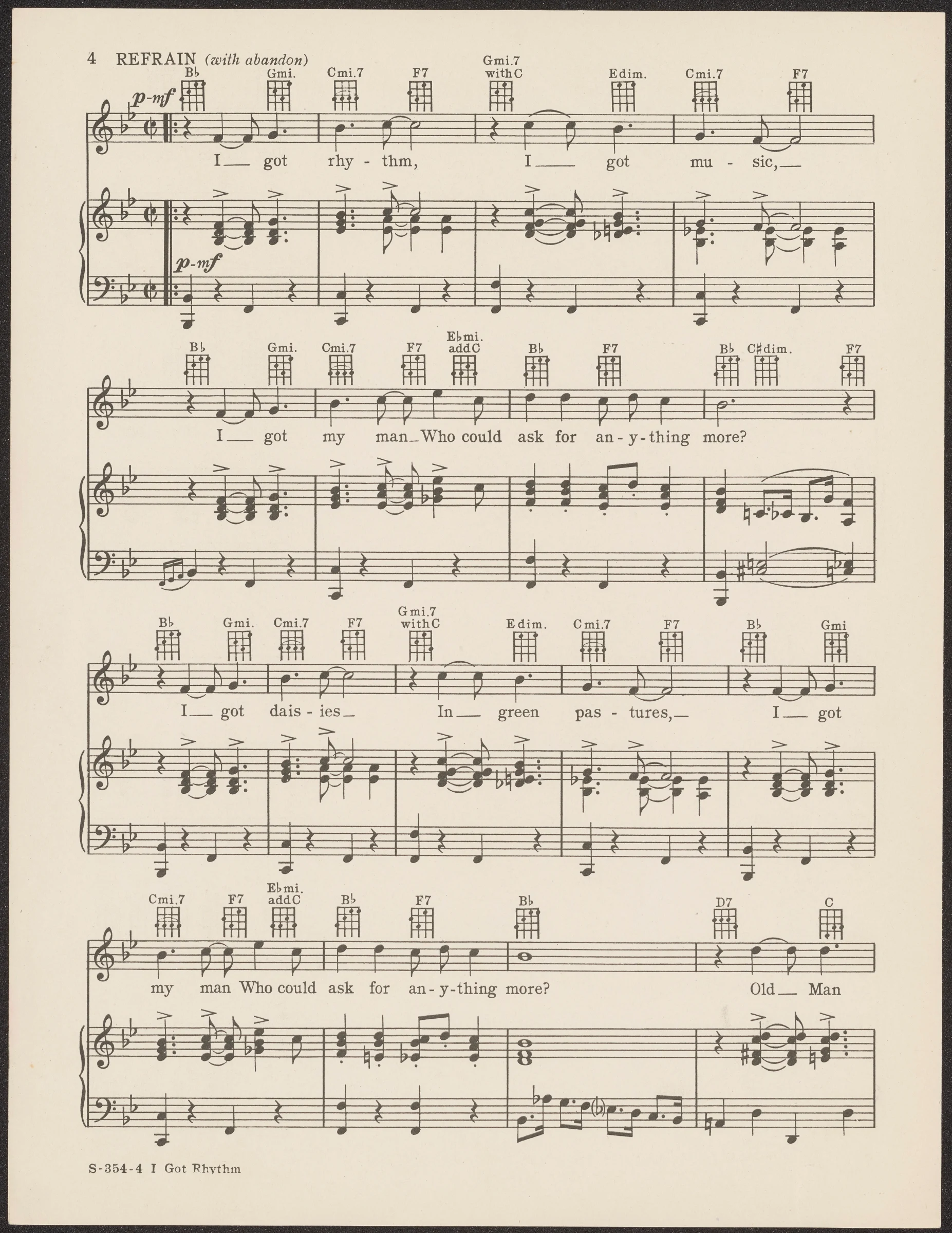
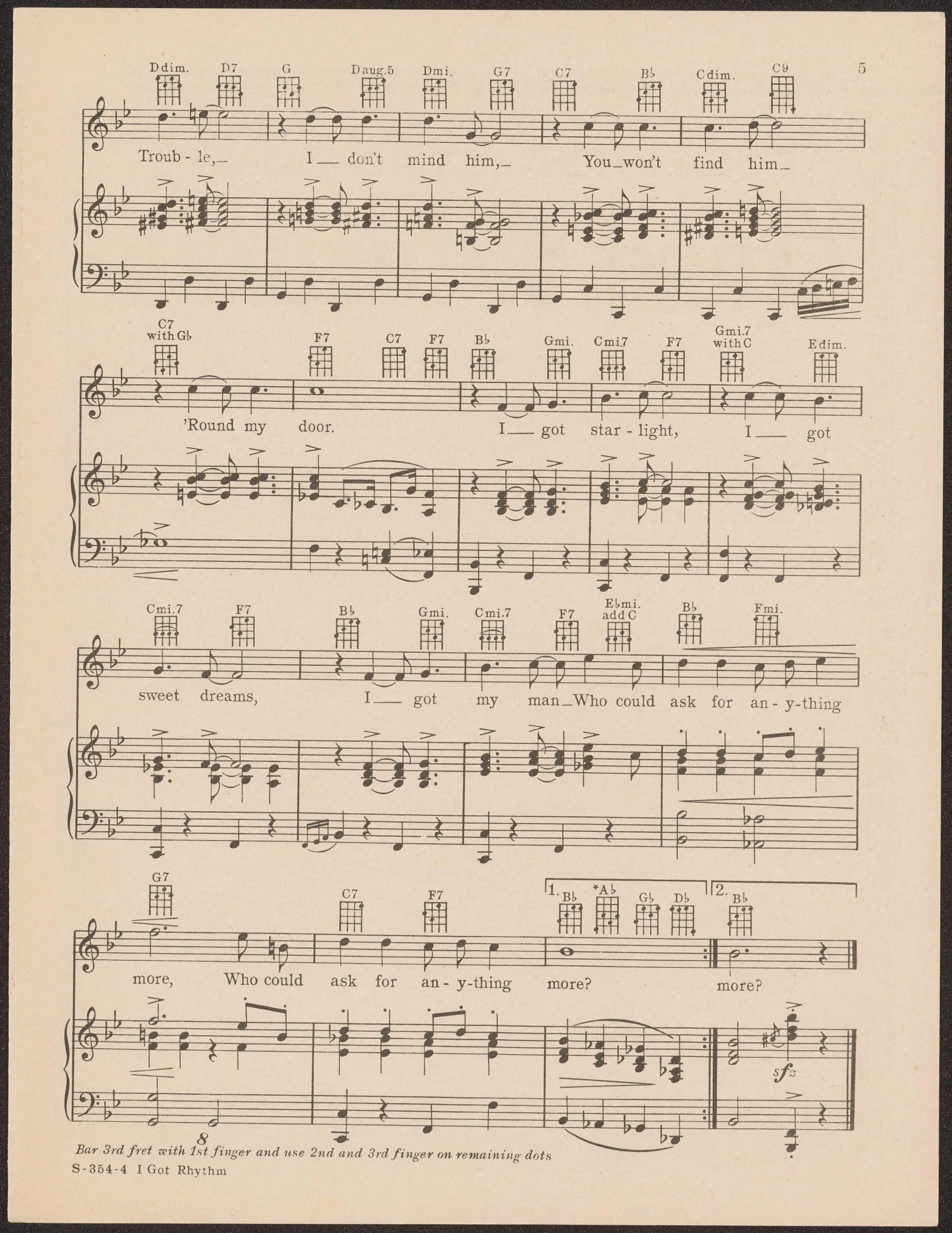
I Got Rhythm · complete refrain
Find the ties that hold a note across a beat, then compare the two four-bar phrases.
Read the complete original sheet music
Click a page to enlarge it. Use the arrow keys to step through this work; Escape closes the viewer. The player above performs the refrain as a piano arrangement.
Hear Gershwin Play
In June 1924, four months after the premiere, Gershwin and Paul Whiteman’s orchestra recorded a shortened Rhapsody in Blue on the two sides of a 78 rpm record. Gershwin himself is the pianist. The recording has been in the public domain in the United States since 2025.
- The opening clarinet slide (a glissando) was not in Gershwin’s first draft. According to the usual story, clarinetist Ross Gorman played it as a joke in rehearsal, and Gershwin kept it.
- Listen for blue notes and syncopated rhythms borrowed from jazz and the blues, set inside a concert piece for piano and orchestra.
- This is an acoustic recording, made by playing into a large horn rather than a microphone, so the orchestra is small and the sound is thin. What can you still hear clearly?
Play it yourself: open Fascinating Rhythm (1924), Someone to Watch Over Me (1926), I Got Rhythm (1930), But Not for Me (1930), and Embraceable You (1930) in the Fake Book, plus the chord practice chart for Summertime (1935).
Gershwin’s Key Contributions
Rhapsody in Blue (1924) brought the sounds of jazz and the blues into a piece for piano and orchestra and became one of the best-known American concert works.
With Ira he wrote songs such as Fascinating Rhythm, Someone to Watch Over Me, I Got Rhythm and Embraceable You for Broadway and film.
The chords of I Got Rhythm became one of the most-used progressions in jazz; musicians simply call them “rhythm changes.”
An American in Paris (1928) paints a walk through Paris, with real taxi horns in the orchestra.
Porgy and Bess (1935) blends opera with blues, spirituals and jazz. Gershwin wanted it performed by Black singers, and his estate still requires that for U.S. stage productions.
George wrote the music and Ira the words. Their teamwork shows how much a song owes to both composer and lyricist.
Gershwin’s Legacy Today
Gershwin’s songs became jazz standards, recorded by Ella Fitzgerald, Billie Holiday and countless others; Miles Davis recorded a whole album of music from Porgy and Bess in 1958. Bebop musicians wrote dozens of new tunes over the chords of I Got Rhythm.
Since 2007 the Library of Congress has awarded the Gershwin Prize for Popular Song to songwriters who carry on that tradition. Rhapsody in Blue entered the U.S. public domain in 2020, and the Gershwins’ later 1920s songs have followed year by year, which is why this lesson can show complete original scores.
Sources and further listening
Use these collection essays to investigate the biography and musical context. Archival recordings illustrate performances; their rights are separate from the scores above.
Practice Problems
Review: Biography · The musical idea · Read and play.
Use the biography, the musical idea, the scores and the recording above.
Easy1. Who wrote the words to most of George Gershwin’s songs?
Easy2. What job did Gershwin have as a teenager on Tin Pan Alley?
Medium3. In AABA song form, what is the B section usually called?
Medium4. An AABA refrain has four sections of 8 bars each. How many bars long is it?
Medium5. Which instrument plays the famous slide that opens Rhapsody in Blue?
Medium6. Rhapsody in Blue was published in 1924. In what year did it enter the U.S. public domain?
Challenge7. What does syncopation do?
Challenge8. A jazz musician says a new tune uses “rhythm changes.” What does that mean?
Create and reflect
- Choose one score. Identify its meter, key signature, and one repeat or contrasting section.
- Perform a short phrase twice: first as written, then with one deliberate rhythmic change. Keep the pulse steady. Explain what changed.
- What stays recognizable when a performer changes a song’s rhythm? Use a specific phrase from one score as evidence.
Who wrote the lyrics to these three songs?
Exit ticket: name one observation you can support with the score and one historical claim you can support with a source.
Continue with Sheet Music Trainer, Fake Book (Fascinating Rhythm · Someone to Watch Over Me · I Got Rhythm), or Jelly Roll Morton.