Beethoven Score Studio
A first listen · “Ode to Joy”
- Press Play in the score above and follow the highlighted notes through bar 8.
- Use the Bar box to compare bars 4 and 8. The first phrase ends on E and the second settles on D. Which sounds like a question?
- Choose Guitar · chord accompaniment under Arrangement. Play the melody again and follow the bass notes in the table beneath the score.
Use Piece to browse 23 scores or explore the guided score collection.
Arranging with care
A source staff is not always the melody: in an orchestral score, find the staff carrying the theme. A two-part piano study pairs your selected voice with a source bass; it is not a concert reduction and wide leaps may need redistribution. Saxophone notation is transposed while playback stays at concert pitch. Violin parts stay at concert pitch and are moved by octaves to sit above the open G string. Guitar tab preserves pitch and rhythm but may need a different octave or fingering. Chords are prepared for the Ode to Joy theme only; classical harmony elsewhere requires score study rather than automatic chord guesses. Original ensembles are available only where the source contains those parts. Piano reductions and original classroom studies retain their source identities.
Recordings: Nicholaus P. Brosowsky’s Tonejs-Instruments sample collection, CC BY 3.0; VSCO 2 Community Edition, CC0. Sample credits and processing.
Bonn & Vienna · Heroic & Romantic Era · Physics of Vibration
Ludwig van Beethoven
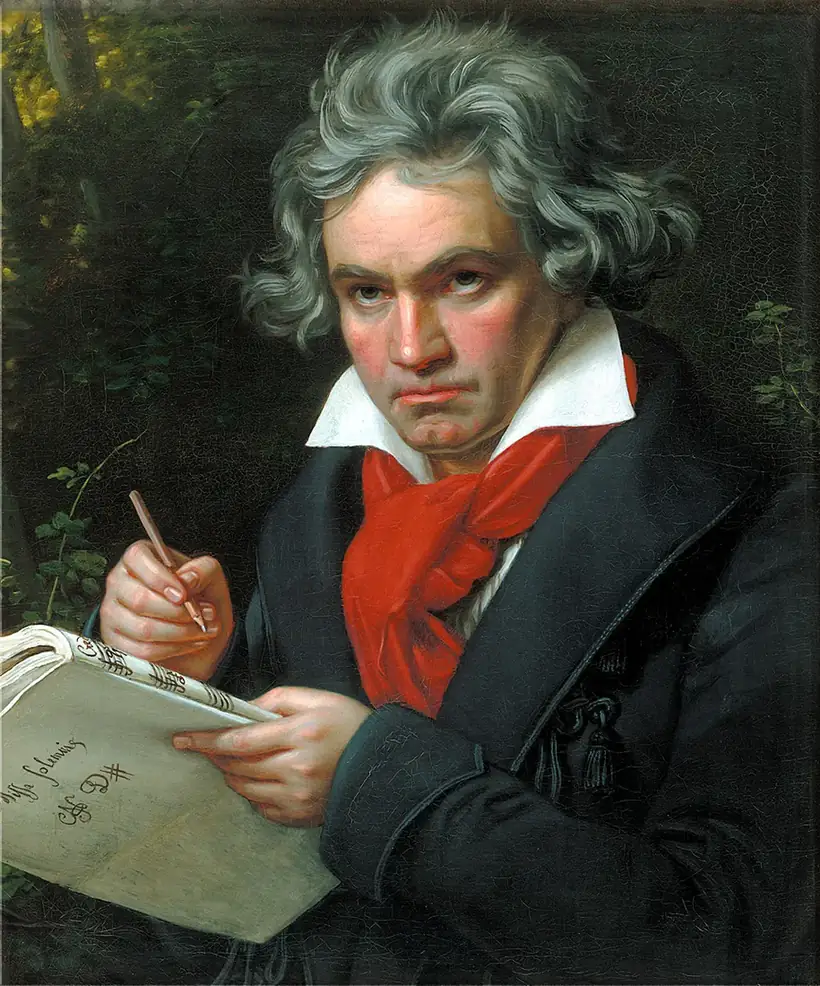
Ludwig van Beethoven (1770–1827) was a German composer and pianist who transformed music while losing the very sense his art depended on. As his hearing failed over two decades, he kept composing, conducting, and performing — leaning on the physics of vibration, including bone conduction, to keep working after sound itself had gone silent for him.
Who Was Ludwig van Beethoven?
Beethoven was baptized on December 17, 1770 in Bonn, Germany; his exact birth date was never recorded, but it is generally accepted as December 16, 1770, the day before his baptism. His father, a musician in the court chapel, recognized the boy's talent early and pushed him hard — sometimes harshly, waking him at night for lessons — hoping to market him as a prodigy in the mold of Mozart.
Around 1792, Beethoven moved to Vienna, then the center of the musical world, to continue his studies, reportedly taking lessons for a time from the elder composer Joseph Haydn. Through the 1790s he built a reputation as a formidable piano virtuoso and an increasingly bold composer, dazzling Viennese audiences with his improvisations and his forceful playing.
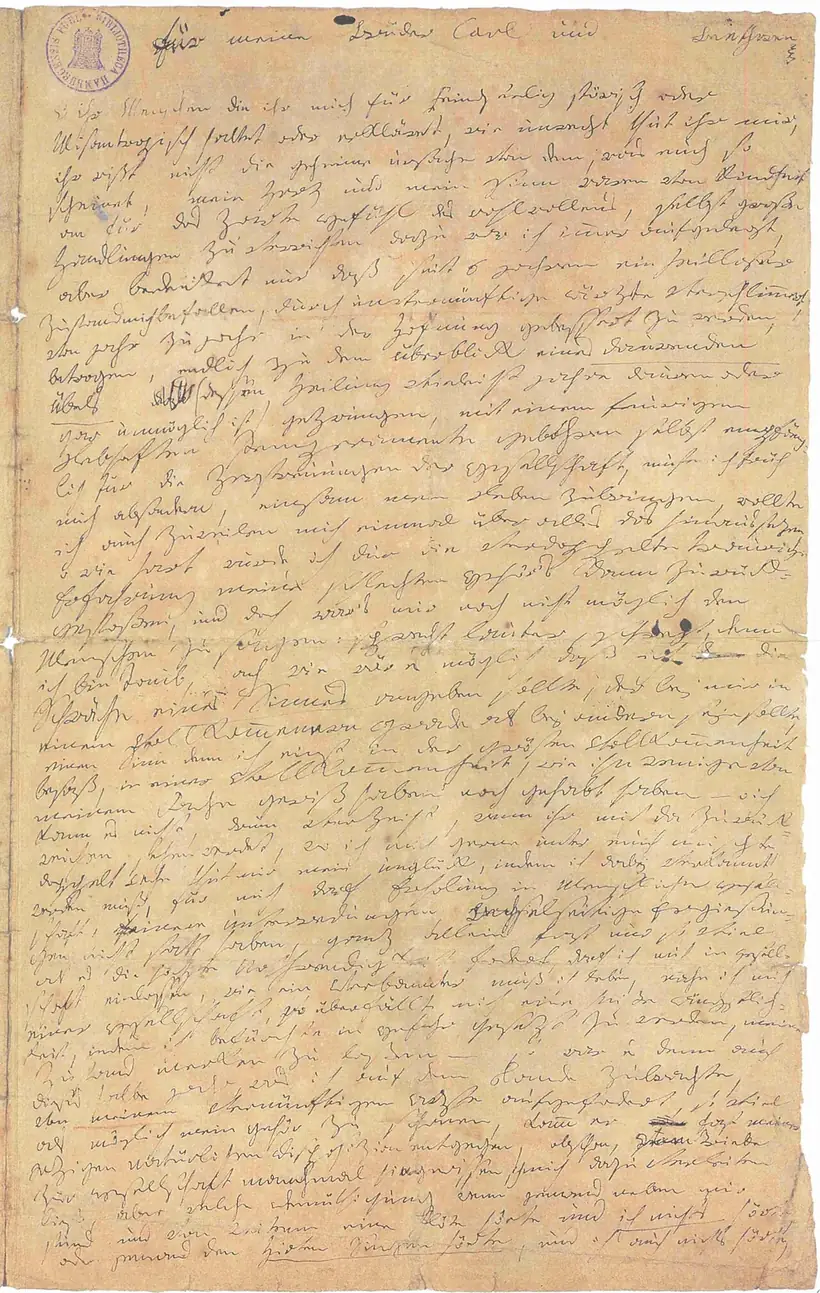
In his mid-to-late twenties, around 1798, Beethoven began noticing his hearing was failing. He wrote about it privately with growing despair, and in 1802 poured out his anguish in the "Heiligenstadt Testament," a letter to his brothers describing suicidal thoughts brought on by his encroaching deafness. In it he ultimately resolved to keep living for his art rather than surrender to it.
Beethoven kept composing, conducting, and performing for roughly two more decades as his hearing worsened, becoming essentially completely deaf in his later years. He is reported to have bitten down on a rod or stick connected to the piano's soundboard to feel its vibrations through the bones of his jaw and skull, and to have composed at a piano with the lid removed, pressed close to the instrument to feel it vibrate. His Ninth Symphony, including its choral "Ode to Joy" finale, premiered in 1824 after he was profoundly deaf — he reportedly had to be turned around by a performer to see the audience applauding, since he could not hear it. Across his career he produced 9 symphonies, 32 piano sonatas, 16 string quartets, and many other works spanning the Classical and early Romantic styles. Beethoven died on March 26, 1827, in Vienna, at age 56.
Beethoven’s Confession and His Manuscripts
A confession and a page of music in his own hand: two primary sources that put the biography in front of the class.
A Life Composed Against the Odds
- 1770 Baptized December 17 in Bonn; birth generally accepted as December 16.
- 1770s–80s Trained harshly by his musician father, who hoped to promote him as a prodigy.
- c. 1792 Moves to Vienna to study composition and build his career.
- 1790s Studies briefly with Joseph Haydn and rises as a celebrated piano virtuoso.
- 1790s Establishes himself in Vienna as a bold, forceful composer and performer.
- c. 1798 First notices his hearing beginning to fail, in his mid-to-late twenties.
- 1801 Writes the “Moonlight” Sonata, and tells his friend Wegeler that his ears “whistle and buzz continually.”
- 1802 Writes the Heiligenstadt Testament, confronting despair over his deafness.
- 1804 Finishes the “Eroica” Symphony, longer and bolder than any symphony before it, and scratches out its dedication to Napoleon when Napoleon crowns himself emperor.
- 1808 Premieres the Fifth Symphony and its famous four-note opening in a four-hour concert on December 22.
- 1814 Gives his last public performance as a pianist, in the “Archduke” Trio.
- 1818 Begins using conversation books: visitors write their side of the talk, and he answers aloud.
- 1824 Premieres the Ninth Symphony and "Ode to Joy" while almost completely deaf.
- 1827 Dies in Vienna on March 26 at age 56.
How Beethoven Could "Hear" Without Hearing
Sound is vibration. Normally, a sound wave travels through air, arrives at the outer ear, and shakes the eardrum, which passes the vibration through three tiny bones to the fluid-filled inner ear, where it's converted into nerve signals. Beethoven's hearing loss damaged parts of this air-conduction pathway, gradually cutting off sound arriving through the air.
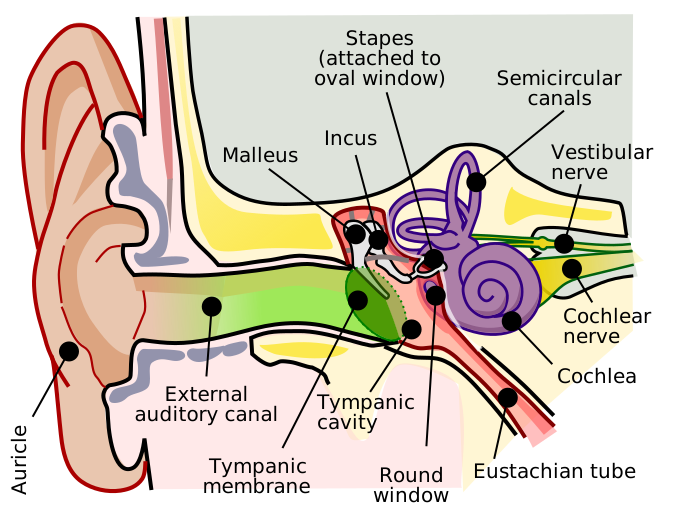
But air is not the only way vibration can reach the inner ear. Solid materials — wood, metal, bone — conduct vibration too, often more efficiently than air. Beethoven is reported to have used this directly: biting down on a rod pressed against the piano's soundboard let the instrument's vibrations travel up through his jawbone and skull straight to his inner ear, bypassing the damaged outer and middle ear entirely. Composing at a piano with the lid removed, leaning in close, worked the same way — letting him feel the instrument's vibration through touch and bone rather than through hearing in the ordinary sense.
The other half of the story is what Beethoven carried inside his head. Decades of training in harmony, counterpoint, and orchestration meant he could read a page of musical notation and mentally "hear" exactly how it would sound — the same way a practiced reader can picture a scene vividly from words on a page without seeing it acted out. That internal, imagined hearing let him keep composing increasingly ambitious works even after his ears could no longer do the job.
Two different physical pathways for the same vibration to reach the inner ear — one through air and the eardrum, one through solid bone that skips them entirely.
What Beethoven worked with: 1796 to 1827
Beethoven’s hearing didn’t switch off. It faded over about thirty years, and the high sounds went first. In 1801 he wrote to his friend Franz Wegeler that his ears “whistle and buzz continually, day and night” (tinnitus) and that he could no longer hear the high notes of instruments or voices from across a room. Press play, then drag the year forward, and read what he did at each stage. The model works like a low-pass filter: it removes sounds above a cutoff pitch and turns the rest down. It can’t show the whole experience. Real hearing loss also distorts sound, and people adapt to it over years, the way Beethoven did.
Through the air he hears up to about 18 kHz. The bar runs from low pitches (left) to high pitches (right). No sound needed: watch the bar and read the notes as the year changes.
Recordings: Für Elise by JMC Han, CC BY-SA 4.0; Symphony No. 5, public domain; both via Wikimedia Commons. This is a model, not a medical record: no one measured Beethoven’s hearing, so the curve is an estimate built from his letters and what witnesses wrote down.
Teacher note: running this respectfully
Frame it as “what Beethoven worked with,” not “what it’s like to be deaf.” A short filter clip can leave students feeling pity instead of understanding, so always finish on the adaptations and the reflection question above.
Students who are deaf or hard of hearing may have their own experience to share, or may not want to; never ask one to demonstrate or explain. Offer the vibration activities below (a hand on a speaker, a balloon held near it, the tuning fork) as an equal way in, and the bar and notes work without sound.
Try it: feel sound through bone
- Hum one steady note with your mouth closed. Then press your fingers into both ears and keep humming. Does the hum get quieter or louder?
- Lightly tap a ruler or pencil held between your teeth (gently, no biting). Listen with your ears plugged.
- If your teacher has a tuning fork: strike it, listen in the air, then press the handle to the bone behind your ear.
Plugging your ears blocks the air path, but the vibration of your own voice still reaches the cochlea through your skull, and with less outside noise it seems louder. That is bone conduction, the same path Beethoven’s rod used.
Did Beethoven really bite a stick attached to his piano?
How could he compose music he couldn't hear performed?
Read & Play: Beethoven’s Scores
Beethoven could hear these in his head from the page alone. Press Play and follow the lit-up notes, then try reading a bar before the player reaches it: the same inner hearing Beethoven relied on.
Each player holds a complete piece. Use the song map or the Bar box to jump anywhere, click a note to hear it, and Shift-click a second bar to loop a passage. The measure-by-measure guide under each score follows the music as it plays; mute a hand or a part to hear one line alone. Every player links to the complete printed score for printing.
Für Elise · complete
Ode to Joy · the complete theme
Symphony No. 7 · Allegretto · complete movement, full orchestra
“Moonlight” Sonata · I. Adagio sostenuto · complete
“Moonlight” Sonata · II. Allegretto · complete, with the Trio
“Moonlight” Sonata · III. Presto agitato · complete
Symphony No. 5 · I. Allegro con brio · complete movement, full orchestra
Piano Sonata No. 8 in C minor, Op. 13 (“Pathétique”) — I. Grave – Allegro di molto e con brio · complete movement
Piano Sonata No. 8 in C minor, Op. 13 (“Pathétique”) — II. Adagio cantabile · complete movement
Piano Sonata No. 8 in C minor, Op. 13 (“Pathétique”) — III. Rondo: Allegro · complete movement
Piano Sonata No. 17 in D minor, Op. 31 No. 2 (“Tempest”) — I. Largo – Allegro · complete movement
Piano Sonata No. 17 in D minor, Op. 31 No. 2 (“Tempest”) — II. Adagio · complete movement
Piano Sonata No. 24 in F-sharp major, Op. 78 (“Für Therese”) — I. Adagio cantabile – Allegro ma non troppo · complete movement
Piano Sonata No. 24 in F-sharp major, Op. 78 (“Für Therese”) — II. Allegro vivace · complete movement
Piano Sonata No. 19 in G minor, Op. 49 No. 1 — I. Andante · complete movement
Piano Sonata No. 19 in G minor, Op. 49 No. 1 — II. Rondo: Allegro · complete movement
Piano Sonata No. 20 in G major, Op. 49 No. 2 — I. Allegro ma non troppo · complete movement
Piano Sonata No. 20 in G major, Op. 49 No. 2 — II. Tempo di menuetto · complete movement
Piano Sonata No. 25 in G major, Op. 79 (“Cuckoo”) — I. Presto alla tedesca · complete movement
Piano Sonata No. 25 in G major, Op. 79 (“Cuckoo”) — II. Andante · complete movement
Piano Sonata No. 25 in G major, Op. 79 (“Cuckoo”) — III. Vivace · complete movement
Bagatelle in A major, Op. 119 No. 10 · complete piece
Bagatelle in B-flat major, Op. 119 No. 11 · complete piece
The Bridge: From Mozart’s World to the Romantic Era
Beethoven learned the rules of the Classical style from Haydn and from studying Mozart: balanced phrases, clear forms like sonata form, and a moderate-sized orchestra. Then he stretched every one of those rules. Put a Mozart symphony beside Beethoven’s Ninth and the change is easy to measure.
Listen for the difference yourself. Mozart’s Eine kleine Nachtmusik opens with a phrase that answers itself neatly. Beethoven’s Fifth opens with four notes, stops, repeats them lower, and builds a whole movement out of that one cell. Compare the Mozart score below with the Beethoven scores above.
Mozart · Eine kleine Nachtmusik, 1st movement (for comparison)
Hear Beethoven's Music
You have heard the four-note idea several times already. Which instruments played it first? Is it louder or softer each time?
Listen for the four-note rhythm hidden underneath, in the low strings or timpani. Where is it now?
Play a few of the works discussed above. Notice how differently the quiet, intimate Für Elise and Moonlight Sonata sit next to the full orchestral force of the Fifth and Ninth Symphonies — all written by the same composer, decades apart, as his hearing declined.
Beethoven's Key Contributions
Beethoven's music moved from the balanced forms of Haydn and Mozart toward the more personal, emotionally intense style that defined the Romantic era.
Premiered in 1824, it was among the first major symphonies to add a full chorus and vocal soloists to the orchestra in its finale.
Beethoven wrote some of his most ambitious, enduring works after he could no longer hear them performed at all.
He pushed dynamics, tempo, and mood to new extremes, giving orchestral music a rawer, more dramatic emotional vocabulary.
His piano sonatas remain a foundational part of the piano repertoire, studied and performed by pianists at every level today.
Beethoven wrote for larger orchestras and longer symphonic forms, expanding what a symphony could be in length and ambition.
Beethoven's Legacy Today
Beethoven stands as the hinge between two musical eras: the formal, balanced Classical style of Haydn and Mozart that shaped his early training, and the deeply personal, expressive Romantic era his later works helped launch. Composers who followed treated music as a vehicle for individual emotion and struggle largely because Beethoven showed it could be.
The "Ode to Joy" theme from his Ninth Symphony has taken on a life far beyond the concert hall — it is the official anthem of the European Union, a piece of music chosen specifically for its message of universal brotherhood. And Beethoven's own life has become a widely cited case study in adapting technique around a profound physical limitation rather than giving up: instead of stopping when his hearing failed, he found new physical pathways — vibration, bone conduction, internal musical imagination — to keep creating.
Musicians who hear with their whole body
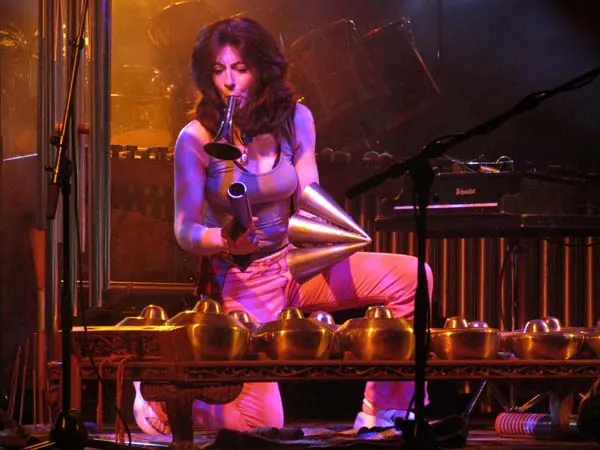
Beethoven’s story isn’t only history. Evelyn Glennie became one of the first people in the world to work full-time as a solo percussionist, playing with orchestras everywhere and performing at the opening of the 2012 London Olympics. She describes hearing as a kind of touch: she feels low notes in her legs and feet and higher ones in her face and chest. She asks to be called a musician, not a “deaf musician”: her hearing is part of how she listens, not the headline.
Deaf and hard-of-hearing people make and enjoy music in many ways: through vibration, sign-language performance of songs, visual rhythm, and hearing technology. Beethoven’s rod on the piano was one early version of an idea musicians are still exploring.
Myth or fact? Check the source
Famous people collect stories. For each one, ask: who wrote it down, and when?
“Beethoven was born deaf.”
“At the Ninth’s premiere, someone had to turn him around to see the applause.”
“He tore up the Eroica’s dedication to Napoleon.”
“Für Elise was really written for a woman named Therese.”
Find the Complete Sheet Music
Beethoven's music is in the public domain, so complete scores and orchestral parts are free to download, study, print, and play. The movements above were transcribed from these standard editions.
- Für Elise, WoO 59 ↗IMSLP — complete autograph and engraved editions
- Symphony No. 9 in D minor, Op. 125 ↗IMSLP — full orchestral score & choral finale
- Symphony No. 7 in A major, Op. 92 ↗IMSLP — full score of the Allegretto
- Piano Sonata No. 14 "Moonlight", Op. 27 No. 2 ↗IMSLP — complete three movements
- All of Beethoven on IMSLP ↗Complete works catalogue by opus and WoO number
Compare complete scores
Practice Problems
Review: Biography · Inner hearing and sound · Read and play · Classical to Romantic · Listen.
Think about music, physics, and Beethoven's life.
Easy1. In what year was Beethoven baptized in Bonn?
Easy2. What private 1802 letter did Beethoven write, expressing despair over his encroaching deafness?
Medium3. Beethoven first noticed his hearing loss around 1798. His Ninth Symphony premiered in 1824. How many years passed between the two?
Medium4. What technique let Beethoven feel his piano's vibrations directly through the bones of his jaw and skull?
Medium5. In normal air-conduction hearing, a sound wave passes through the eardrum and middle-ear bones before reaching which structure?
Challenge6. Beethoven's "Ode to Joy," from his Ninth Symphony, later became the official anthem of which organization?
Medium7. Beethoven composed 9 symphonies and 32 piano sonatas. How many more piano sonatas than symphonies did he write?
Challenge8. Why is Beethoven often cited as a case study beyond music, in fields like engineering and accessibility?
Easy9. Listen to the playlist above. Which of these works did Beethoven write while he was profoundly deaf?
Medium10. In the “What Beethoven worked with” model, which sounds disappear first as the years go by?
Medium11. Why does a solid rod carry a piano’s vibration to the inner ear better than air does?
Challenge12. Beethoven was born on about December 16, 1770. The Fifth Symphony premiered on December 22, 1808. How old was he that night?
Challenge13. Which change did the Ninth Symphony make that a Classical symphony like Mozart’s 40th did not have?
Reflect14. In the Heiligenstadt Testament, Beethoven wrote that only his art held him back from giving up. Think of something hard you kept working at. What helped you keep going, and what did Beethoven change about how he worked instead of stopping?