Read, play, or arrange 23 Mozart selections. Explore K. 331’s theme and variations as separate studies, its minuet and trio, the complete K. 457 sonata, and the D-minor Fantasia with its traditional added ending.
Arranging with care
A source staff is not always the melody: in an orchestral score, find the staff carrying the theme. A two-part piano study pairs your selected voice with a source bass; it is not a concert reduction and wide leaps may need redistribution. Saxophone notation is transposed while playback stays at concert pitch. Violin parts stay at concert pitch and are moved by octaves to sit above the open G string. Guitar tab preserves pitch and rhythm but may need a different octave or fingering. Chords are prepared for the Ode to Joy theme only; classical harmony elsewhere requires score study rather than automatic chord guesses. Original ensembles are available only where the source contains those parts. Piano reductions and original classroom studies retain their source identities.
Recordings: Nicholaus P. Brosowsky’s Tonejs-Instruments sample collection, CC BY 3.0; VSCO 2 Community Edition, CC0. Sample credits and processing.
Salzburg & Vienna · Classical Era · Balance & Form
Wolfgang Amadeus Mozart · the person
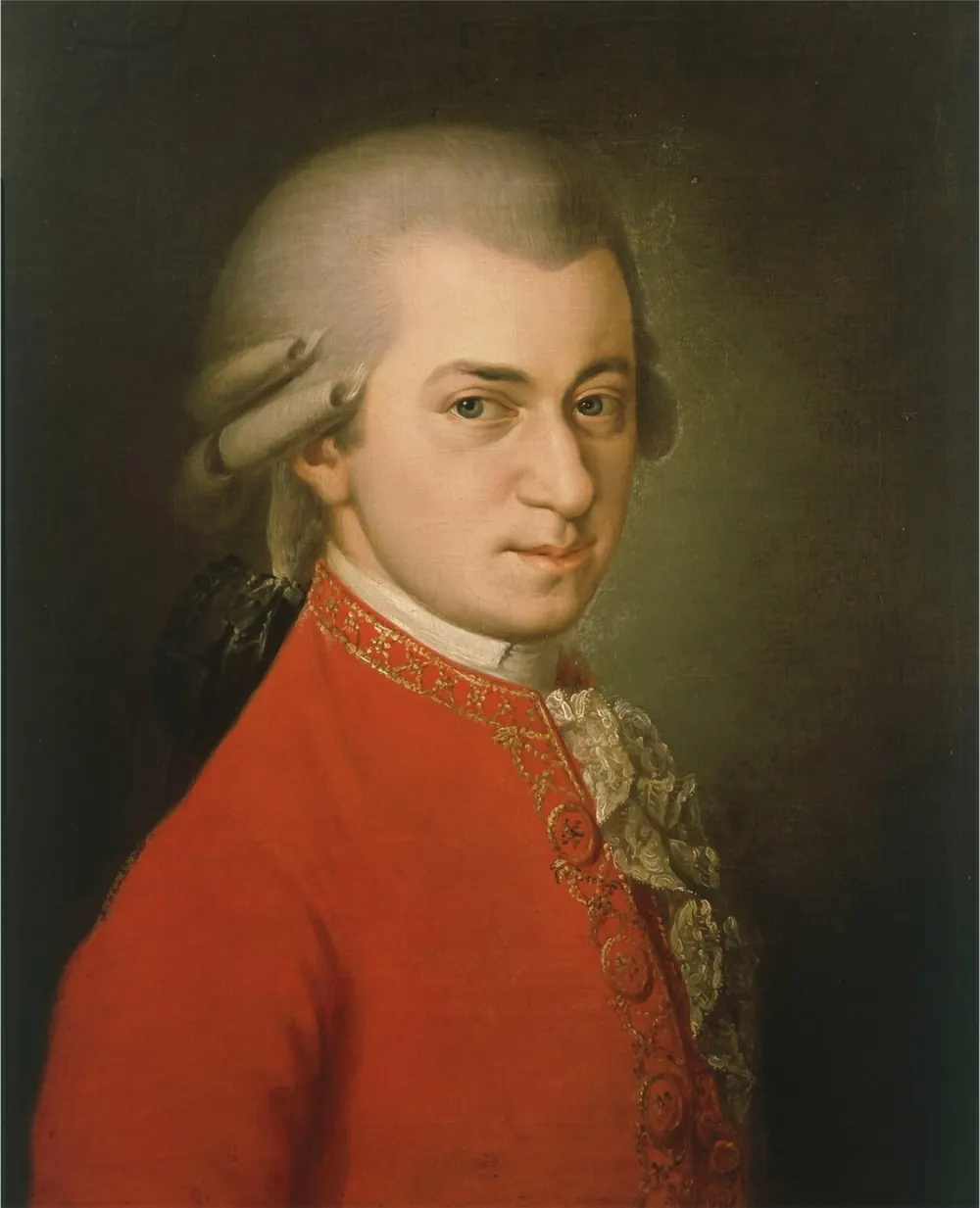
Mozart, painted in 1819Painted by Barbara Krafft 28 years after Mozart died, working from earlier portraits — a reminder that famous images are not always from life. Barbara Krafft, Public domain, via Wikimedia Commons.
Wolfgang Amadeus Mozart (1756–1791) toured the courts of Europe as a small child, wrote his first symphony at about eight, and in a life of only 35 years produced operas, symphonies, concertos and chamber music that still fill concert halls. His music sounds effortless — clear tunes, balanced phrases — but underneath is careful, logical design.
Who Was Mozart?
Mozart was born in Salzburg (now in Austria) on January 27, 1756. His father, Leopold, was a court violinist who published a well-known violin method the same year. Wolfgang and his older sister Maria Anna, called Nannerl, were both extraordinary keyboard players. By five Wolfgang was making up short pieces, which his father wrote down.
From 1762 the family spent years on the road, performing for royalty in Munich, Vienna, Paris and London. In London the eight-year-old met Johann Christian Bach, J. S. Bach’s youngest son, and wrote his first symphonies. On trips to Italy as a teenager he studied opera and counterpoint; in Rome he is reported to have written down a famous choral piece, Allegri’s Miserere, from memory after hearing it.
Back in Salzburg, Mozart worked for the archbishop but felt underpaid and confined. In 1781 he was dismissed and moved to Vienna to live as a freelance musician — teaching, performing his own piano concertos, and selling his music. He married Constanze Weber in 1782. In the next decade he wrote the operas The Marriage of Figaro, Don Giovanni and The Magic Flute, his last symphonies, and the serenade Eine kleine Nachtmusik, which he entered in his own catalogue of works on August 10, 1787.
Mozart often earned well but spent freely, and money worries followed him. In late 1791 he fell ill while working on a Requiem Mass, which he left unfinished. He died in Vienna on December 5, 1791, aged 35. In 1862 Ludwig von Köchel published a catalogue numbering all of Mozart’s works in order — which is why his pieces have “K.” numbers, like K. 525.
Mozart’s Family and His Own Hand
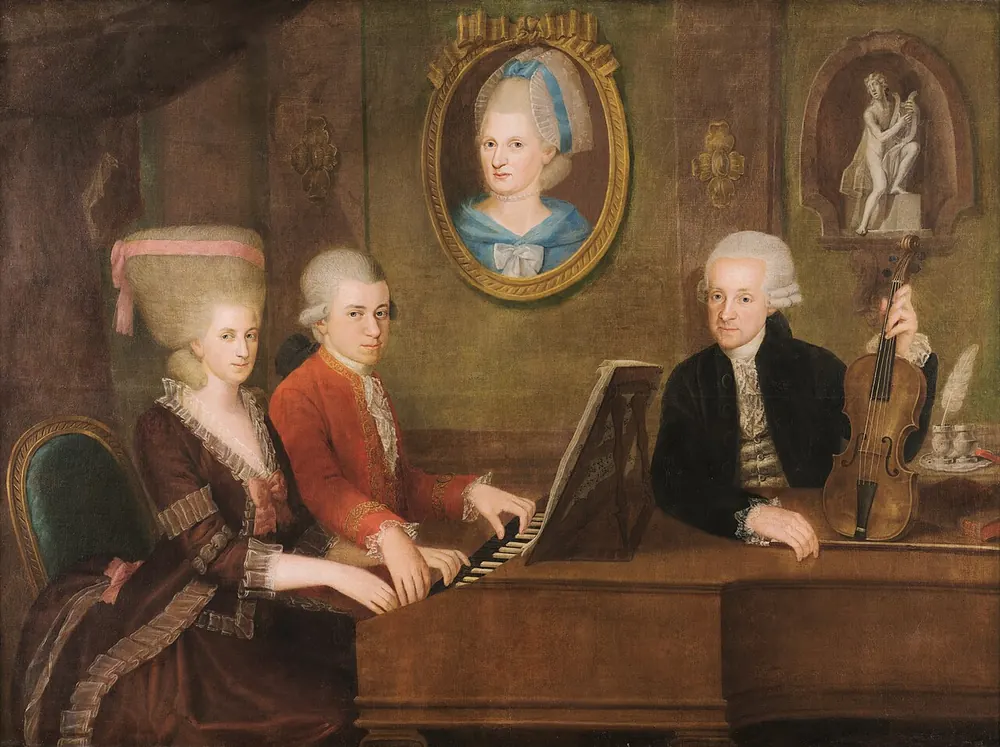
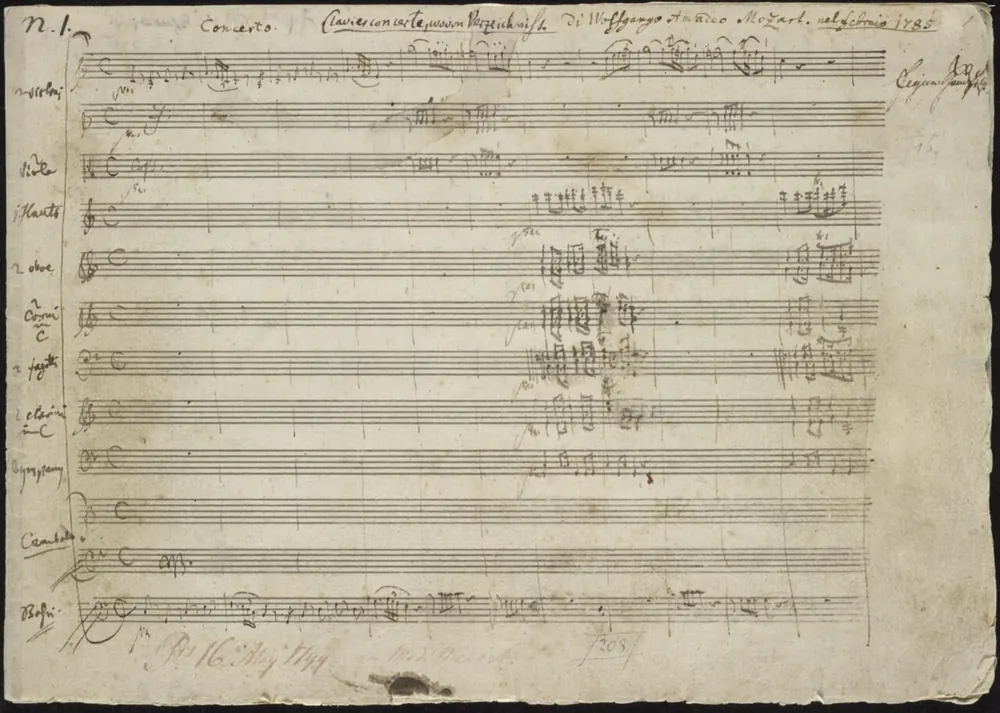
A family at the keyboard and a page of a piano concerto written at speed. Click any picture to enlarge it.
The Mozart family, c. 1780Wolfgang and Nannerl play a duet while Leopold holds his violin; their mother, who had died in 1778, appears as a portrait on the wall. Attributed to Johann Nepomuk della Croce. Possibly Johann Nepomuk della Croce, Public domain, via Wikimedia Commons.Piano Concerto No. 21, 1785The opening page in Mozart’s hand. Each staff is a different instrument; he wrote quickly and with very few corrections. Wolfgang Amadeus Mozart, Public domain, via Wikimedia Commons.
A Short, Crowded Life
1756 Born January 27 in Salzburg.
1761 Composes his first short keyboard pieces, written down by his father.
1762–66 Family tour across Europe, including Paris and London.
1764 Meets J. C. Bach in London; writes his first symphony.
1770 In Rome, writes out Allegri’s Miserere from memory (as reported in family letters).
1781 Leaves the archbishop’s service and settles in Vienna.
1783 Writes the Piano Sonata in A major with the “Rondo alla turca” finale (date approximate).
1786The Marriage of Figaro premieres in Vienna.
1787 Completes Eine kleine Nachtmusik on August 10.
1791The Magic Flute premieres; Mozart dies December 5, leaving his Requiem unfinished.
Question and Answer: Balanced Phrases
Classical-era music (roughly 1750–1820) prized clarity and balance. Composers built melodies from phrases that pair up like a question and an answer: the first phrase ends feeling open, the second ends feeling closed. Music theorists call these an antecedent and a consequent.
Eine kleine Nachtmusik shows this in just four bars. The opening rises through the home chord, G major. The answer outlines the dominant chord D7 — the chord that most strongly pulls back to G. When the music finally lands on G, the ear hears it as “home.”
The “Rondo alla turca” is a rondo: a main theme (A) that keeps returning between contrasting sections — A B A C A — a little like a song with a chorus.
I → V → I
I (tonic), G major: G – B – D · feels stable, like home
V7 (dominant seventh), D7: D – F♯ – A – C · feels tense and wants to move
Resolution: F♯ rises to G and C falls to B, landing back on the tonic
Home → away → home is the basic plot of Classical harmony, from a four-bar phrase to a whole symphony.
Did Mozart really invent a dice game for composing?
A “Musical Dice Game” was published under Mozart’s name in 1792, after his death: you roll dice to pick each of 16 bars from a table of choices. Whether Mozart actually wrote it is uncertain. With 11 possible rolls for each bar, it can produce about 1116 — tens of quadrillions — different minuets.
What does K. 525 mean?
K stands for Köchel, the scholar who catalogued Mozart’s works in rough order of composition in 1862. K. 525 is the 525th entry.
Was Mozart really a rival of Salieri?
They were both successful composers in Vienna and sometimes competed for commissions, but the story that Salieri poisoned Mozart is a legend with no evidence behind it.
Read & Play: Ten Selections
Explore strings, piano, and a two-part duet. Start with the short Minuet in F major, then try longer piano works or share the Menuetto with a partner.
Players include complete movements, the complete K. 265 theme, and the minuet section of the K. 487 duet. Use the song map or the Bar box to jump anywhere, click a note to hear it, and Shift-click a second bar to loop a passage. The measure-by-measure guide under each score follows the music as it plays; mute a hand or a part to hear one line alone. Every player links to the complete printed score for printing.
Eine kleine Nachtmusik · first movement, completeThe complete first movement of Eine kleine Nachtmusik (“A Little Night Music”) for two violins, viola and cello with bass. Bars 1–2 shoot up a G-major arpeggio; bars 3–4 answer with a D-major seventh chord.
Eine kleine, bars 1–2Only the notes G, B and D — the G-major chord, spread out as a rising rocket.
Eine kleine, bars 3–4C, A, F♯ and D: the D7 chord. It sounds unfinished, so the ear wants to go back to G.
Rondo alla turca, right handSmall circles of four sixteenth notes, each one starting a step higher than the last.
Turkish March · complete Rondo alla turcaThe complete “Rondo alla turca,” the last movement of Piano Sonata No. 11, K. 331. The left hand’s steady repeated chords imitate the drums of Ottoman military bands, popular in Vienna at the time. Every section repeats; the song map shows the sections A–E and the coda.
The order of playA A · B B · C C · D D · E E · C C · A A · B B · Coda part 1 (twice) · Coda part 2. Every section has a repeat sign, so each one is played twice.
Two keysA and B are in A minor (no sharps). C, D, E and the coda are in A major (three sharps: F♯, C♯, G♯). The same notes feel stormy, then sunny, then stormy again.
The pickupMost sections start with a short “pickup” before the first full bar, and end on a short bar that joins the next pickup. That is why the music flows from one section into the next without a gap.
Sonata facile · first movement, completeThe complete first movement of K. 545, with the left-hand Alberti bass. Follow the sonata form in the song map: exposition, development, and a recapitulation that surprisingly begins in F major.Ah, vous dirai-je, Maman · the complete themeThe 24-bar theme Mozart used for K. 265, both hands, read from the 1878 Breitkopf edition. Mute the right hand to hear the bass he keeps under every variation. Mozart wrote variations on an existing French tune; he did not compose the familiar tune itself.Minuet in F major, K. 2 · completeA short starting point: 24 bars in triple time, both hands. Learn four bars at a time, count the triplet in bar 7, and listen for the changed bass when the opening returns.Menuetto, K. 487 No. 2 · two-part duetThe complete 24-bar minuet section from the horn-duet edition, before its separate Trio. Learn one part at a time, then hear how the second part answers the first. The printed source includes the Trio.Sonata K. 545 · II. Andante · completeThe complete slow movement of Sonata K. 545. Practise a singing melody over a quiet Alberti bass, and compare the G-major opening with the G-minor episode.Sonata K. 545 · III. Rondo: Allegretto · completeThe complete finale of Sonata K. 545. Find the returning refrain, practise the short rests and running sixteenths, and trace the contrasting minor-key episode.Funeral March in C minor, K. 453a · completeA complete 16-bar piano march. Work on dotted rhythms, chord balance, and overlapping voices; use a comfortable hand division for wide stretches.Piano Sonata No. 11, K. 331 — I. Theme: Andante graziosoListen to the lilting 6/8 melody over the moving inner notes. Count two broad pulses per bar and learn the phrase before exploring the variations. Use the song map for the complete study guide.Piano Sonata No. 11, K. 331 — I. Variation 1Short neighboring notes decorate the theme while rests give the figures a light touch. Compare the melody with the theme at the same practice speed. Use the song map for the complete study guide.Piano Sonata No. 11, K. 331 — I. Variation 2The left-hand figuration becomes more active while the upper melody gains ornaments. Mute a staff to separate the two layers. Use the song map for the complete study guide.Piano Sonata No. 11, K. 331 — I. Variation 3The key signature changes to A minor. Compare the darker melody and flowing sixteenth notes with the major theme. Use the song map for the complete study guide.Piano Sonata No. 11, K. 331 — I. Variation 4Bright paired notes alternate between registers. The printed source uses hand crossing; the source staves show where notes are written, not always which hand plays them. Use the song map for the complete study guide.Piano Sonata No. 11, K. 331 — I. Variation 5: AdagioLong melody notes unfold above a flowing accompaniment. Listen to the written ornaments and compare both versions of the first ending. Use the song map for the complete study guide.Piano Sonata No. 11, K. 331 — I. Variation 6: AllegroThe meter changes to 4/4. Hear the theme transformed into a lively dance with quicker answering figures. Use the song map for the complete study guide.Piano Sonata No. 11, K. 331 — II. Menuetto and TrioCount three dance beats and follow the bold melody with its ornamental pickups. Listen for short answers separated by rests. Use the song map for the complete study guide.Piano Sonata No. 14 in C minor, K. 457 — I. Molto allegroRising C-minor notes and quieter answers create a dramatic contrast. Compare the registers and dynamics of successive phrases. Use the song map for the complete study guide.Piano Sonata No. 14 in C minor, K. 457 — II. AdagioThe upper melody unfolds over soft broken chords. Listen to its long notes before following the smaller decorative figures. Use the song map for the complete study guide.Piano Sonata No. 14 in C minor, K. 457 — III. Allegro assaiA held pickup and short gestures launch a restless three-beat movement. Listen for the changing phrase lengths and interruptions. Use the song map for the complete study guide.Fantasia in D minor, K. 397 — traditional performing versionLow broken chords spread upward through a spacious texture. A performer shapes these freely; the player gives their written proportions at one practice pulse. Use the song map for the complete study guide.Piano Sonata No. 7 in C major, K. 309 — I. Allegro con spiritoRising chord notes and clear answering phrases establish C major. Compare the strong opening with the softer melodic responses. Use the song map for the complete study guide.
Hear Mozart's Music
These recordings are available through Wikimedia Commons, including a historic 1953 recording of the Queen of the Night’s aria from The Magic Flute.
Now Playing Eine kleine Nachtmusik, K. 525 — 1. AllegroString ensemble · the opening in the score above
In Eine kleine Nachtmusik, count how many times the opening “rocket” idea comes back.
In the Rondo, raise your hand each time the A theme returns.
In Lacrimosa, listen for the sighing strings before the choir enters. Count four slow pulses, each divided into three; compare the choral sound with the piano arrangement.
The Queen of the Night’s aria climbs to a high F — one of the highest notes in standard opera.
Mozart's Key Contributions
✍️
Over 600 Works in 35 Years
The Köchel catalogue lists more than 600 works: symphonies, concertos, operas, chamber music, masses and songs.
🎭
Opera That Shows Character
The Marriage of Figaro, Don Giovanni and The Magic Flute use music to show what each person on stage is thinking and feeling.
🎹
The Piano Concerto
His 27 piano concertos turned the form into a conversation between soloist and orchestra. He often played the solo part himself.
🎼
The Last Three Symphonies
Symphonies 39, 40 and 41 ("Jupiter") were all written in about six weeks in the summer of 1788.
⚖️
Classical Balance
Clear question-and-answer phrases and well-proportioned forms made his music the model of the Classical style.
💼
Going Freelance
In 1781 he left the archbishop’s service in Salzburg to earn his living in Vienna by teaching, performing and publishing.
Mozart's Legacy Today
Mozart wrote masterpieces in every major form of his day, and his operas are still among the most performed in the world. Beethoven, fourteen years younger, went to Vienna hoping to study with him; Tchaikovsky called Mozart his musical idol and wrote a suite based on his music.
His fame as a child prodigy has made “Mozart” a shorthand for early genius, but his letters show how hard he worked: studying other composers, revising, and practising. The music that sounds effortless was built on years of disciplined training — and on the structure of question, answer and return that you can see in four bars of the score above.
Find the Complete Sheet Music
Mozart's music is in the public domain, so complete scores are free to download, print and play. The excerpts above were transcribed from these editions.