Players & strategies
Players make decisions. A strategy is a plan for choosing actions; in a repeated game it can depend on earlier rounds.
Human systems · Grades 7–12 · 55–65 minutes + optional second session
Your best move depends on someone else’s next move.
Why do teammates sometimes leave work to others? Why do drivers agree on one side of the road? How can rules help strangers cooperate? Game theory studies decisions whose outcomes depend on the choices of multiple decision makers.
Try the decision lab ↓ · Explore real applications · Whose scoreboard?
How can we change a situation so that doing well individually also helps the group?
Before you begin: You only need to compare numbers. Work alone or with a partner; no account or materials are required.
Two students share responsibility for tidying a makerspace. Each can help or leave the work to the other. Helping costs time; a clean space benefits both. Privately choose your move before discussing it.
Would your answer change if you would work together every week? If everyone could see your contribution? If you had agreed on roles first? These changes alter the game.
Think, pair, share: Describe a decision where another person’s choice changed what you wanted to do. Avoid identifying classmates.
Look closely · Information shapes decisions
Players make decisions. A strategy is a plan for choosing actions; in a repeated game it can depend on earlier rounds.
A payoff represents what a player values: time, money, safety, fairness, or something else. Ask what each player knows when deciding.
The action that gives you the highest payoff given the other player’s action or strategy.
A set of strategies where no player can improve their payoff by changing only their own strategy. It need not be fair or best for the group.
Zero-sum? In a zero-sum game, one player’s gain is exactly another’s loss. Many real interactions allow mutual gains or mutual losses. Cooperation is not automatically a sacrifice.
This is a Prisoner’s Dilemma model using invented points, not measured student behavior. Choices happen simultaneously: the computer commits without seeing your current move. Larger scores mean a better outcome for that player.
| Your action ↓ / Partner → | Help | Hold back |
|---|---|---|
| Help | 3, 3 | 0, 5 |
| Hold back | 5, 0 | 1, 1 |
Read the matrix · Try a best response
Hold your partner’s choice fixed. Which of your moves earns more?
Compare your points: help earns 3; hold back earns 5. Your best response is hold back.
Now switch the partner’s choice. Does your best response change?
Read it: If your partner helps, holding back earns 5 instead of 3. If your partner holds back, holding back earns 1 instead of 0. Holding back is a strictly dominant action: it pays more in either case. Both holding back is the unique one-round Nash equilibrium, even though both helping gives each more points.
Experiment 01 · Repeated decisions
Each experiment lasts 8 rounds. Changing the partner starts a fresh experiment. The strategies are public so you can reason about them.
Make your first move. Watch how today’s choice changes your partner’s next response.
Round 0 of 8. Your score: 0. Partner’s score: 0.
| Round | You | Partner | Points (you, partner) |
|---|
Investigate: Predict your total if you always help the reciprocator. Test it. Reset and hold back every round. Compare both players’ totals. Then test one hold-back move followed by helping.
Helping for all eight rounds against the reciprocator gives 24 points each. Holding back throughout gives you 12 and the partner 7: the first round is (5, 0), then seven rounds of (1, 1). A return to helping can restore mutual help after the response delay. These comparisons do not prove reciprocation is universally optimal.
Model limit: With a known final round, players may reason backward from the end. Against our fixed reciprocator, helping for seven rounds and holding back on the last earns you 26 and the partner 21. People may value fairness, misunderstand choices, or expect future contact. Eight rounds against a programmed opponent cannot establish how real communities behave.
Imagine two teammates choosing a file format. If both choose A, each earns 2; if both choose B, each earns 2; if they choose different formats, each earns 0. Both-A and both-B are Nash equilibria. There is no action that is best regardless of what the partner does.
Driving on an agreed side of the road has this coordination structure, though real safety rules are much more complex. Shared standards and clear communication help people select a compatible outcome.

Compare: Why can “let’s both choose A” solve the file-format problem more easily than “let’s both help” solves the one-round dilemma? Check whether either player benefits from breaking the agreement alone.
Players: teammates. Choices: contribute or leave work to others. Incentive: enjoy the result while saving effort.
Clear roles, visible contributions, and repeated collaboration can change incentives. Ask whether a proposed rule supports a student who needs help, rather than merely punishing low output.
Classroom analogy: The lab captures one tension; it leaves out ability, friendship, and unequal workloads.
Players: users of a fishery or shared water supply. Choices: take more now or conserve. Trade-off: private benefit today versus shared future supply.
Game theory helps compare monitoring, agreed limits, and incentives for cooperation. Real decisions also require ecological evidence and community knowledge.
Continue with Tragedy of the Commons.
Players: bidders. Choices: bids based on value, information, and expectations of rivals. Payoff: value of what is won minus what is paid.
Auction designers use game theory to choose rules. Work recognized by the 2020 economics prize helped develop formats used for allocating radio spectrum. A good design must consider competition, revenue, and the risk of overpaying.
Players: applicants and institutions, or patients and willing donors. Choices and constraints: preferences, priorities, capacities, and medical compatibility.
Matching theory helps design allocations without simply awarding everything to the highest bidder. The 2012 economics prize recognized stable allocation theory and market design, with applications to school admissions and kidney exchange.
“Stable” has a specific meaning in matching models; it does not guarantee equal access or settle ethical priorities.
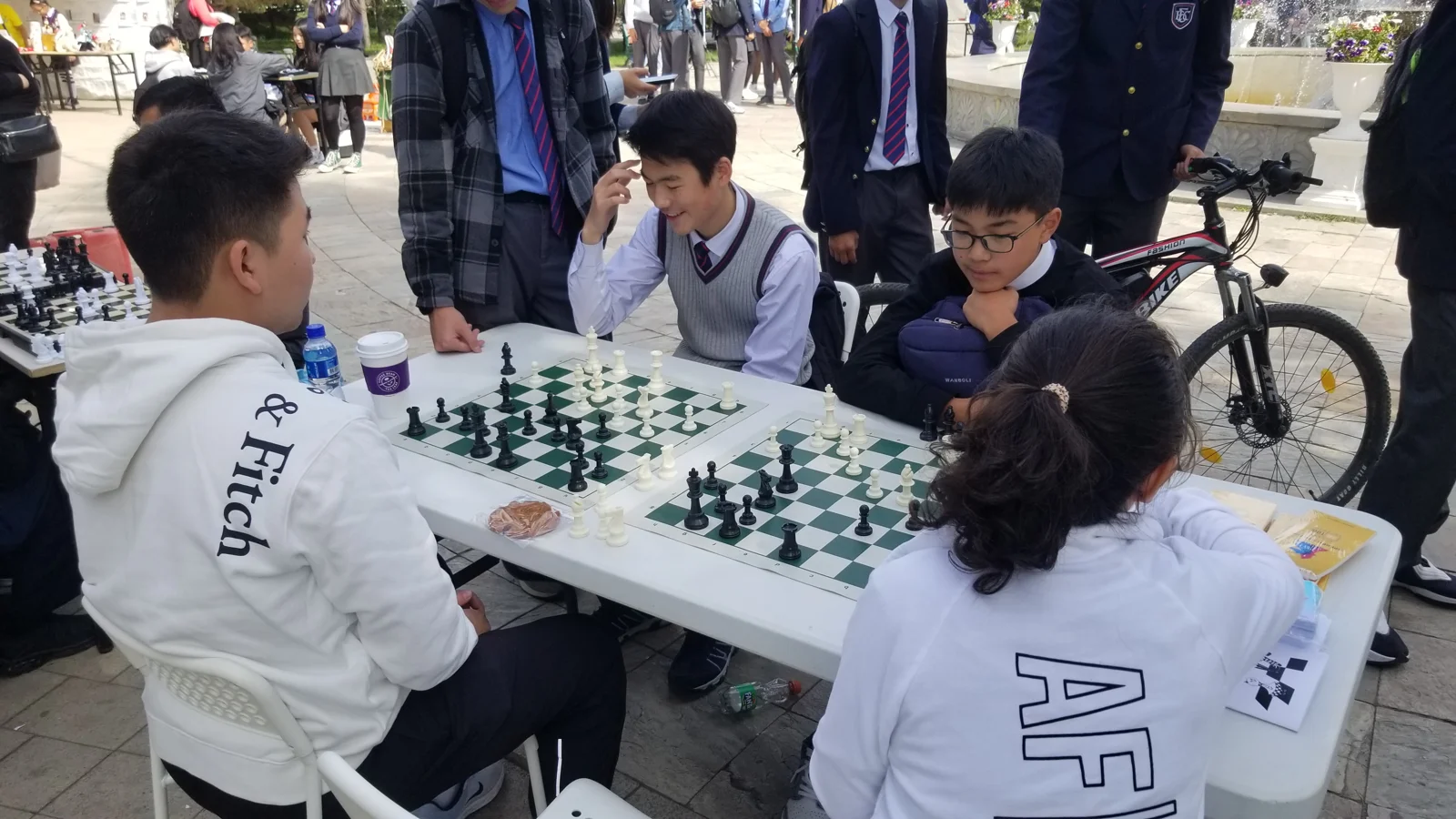
Look for the resource, the players, and the rules. Click either photograph to enlarge it for discussion.


Choose teamwork, a shared resource, or a coordination problem. Create a short proposal using this checklist:
Remember: A payoff table is a model, not a mind reader. Test its assumptions. Higher total points do not automatically mean a fair outcome. Game theory can help design cooperation; it does not tell us what people ought to value.
Our first game treated points as the players’ goals. Now question that assumption: who decided what deserves points? Philosopher C. Thi Nguyen’s The Score: How to Stop Playing Somebody Else’s Game asks how scoring systems shape our purposes. This is a philosophical extension of our game theory lesson: predicting a best response does not settle whether its goal is worth pursuing.
Likes, school rankings, workplace key performance indicators (KPIs), and activity trackers make different activities comparable. Numbers can help us notice progress and coordinate decisions. They also select what becomes visible. A count of finished assignments cannot, by itself, tell us whether someone understands an idea.
| Setting / metric | What it can help track | What it can miss | Possible response to incentives |
|---|---|---|---|
| Social media / likes | Visible audience reactions | Accuracy, care, quiet conversations | Post what provokes reactions rather than what helps someone understand. |
| School rankings / test averages | Performance on particular assessments | Student growth, belonging, different starting conditions | Concentrate on tested material at the expense of other learning. |
| Workplace KPI / tickets closed | Recorded throughput | Problem difficulty, lasting fixes, mentoring | Choose easy tickets or close a problem before it is resolved. |
| Fitness tracker / step streak | Recorded steps and consistency | Rest, accessibility, enjoyment, other forms of movement | Protect a streak even when taking a break would serve one’s purposes. |
These are possible mechanisms to investigate, not claims that every user or institution behaves this way. Ask who chose each metric, who benefits from it, and who has the power to revise it.
Nguyen uses value capture for cases in which an externally supplied, simplified measure comes to govern richer personal values. A learner might begin by wanting to understand a language, then come to care mainly about their position on an app’s leaderboard. Using a metric as one source of feedback does not by itself show value capture.
Three different cases: “The score is useful evidence.” “I chase the score because my job depends on it, although I think it misses good work.” “I now think good work simply means a high score.” The last most clearly shows internalized value capture. External pressure and changing one’s values can interact, but they are not identical.
Read Nguyen, Magnani, and Kennedy’s classroom case on gamified communication.
You run a fictional learning club. Its sponsor rewards completed activity cards. Choose an approach before revealing the sponsor’s points. Then choose again after the reveal. Do you feel pulled toward a different goal?
Choose an approach, then reveal the points.
Sponsor’s rule: 10 points per completed card. In this invented meeting, repeating cards completes 12 (120 points), the project completes 3 (30 points), and mentoring completes 1 (10 points). These numbers do not measure learning, care, or enjoyment.
Your notes stay on this page and are not saved after reloading.
Debrief: A changed choice does not diagnose value capture; it might be a reasonable response to funding pressure. Ask whether the score changed what you believe the club is for. Adding a “care score” could create another narrow target. Sometimes a conversation is a better safeguard than another number.
Nguyen argues that games can let us temporarily adopt clear goals for the pleasure of acting within them. Choosing a challenging puzzle can make the struggle itself worthwhile. Carrying a ranking into school, work, or identity has different stakes.
Discuss: Can participants genuinely opt out? Can they revise the rules? Does losing threaten income, opportunity, or belonging? Can they leave the score behind afterward? Voluntary games can also become consuming, and real-world metrics can be helpful; examine the conditions rather than declaring every game good or every metric bad.
A finished song, a working game, or a satisfying meal can be worth appreciating. This focuses on what was made.
Finding a musical phrase, debugging with a friend, or adjusting a stew by taste can be rewarding while it happens. This focuses on the experience of acting.
This classroom distinction draws on Nguyen’s work on the arts of action. Neither kind of enjoyment replaces the other. A polished result can come from a miserable process, and an imperfect result can emerge from deeply satisfying work.
Two-minute experiment: Sketch a creature or tap a rhythm. First focus on producing something impressive. Repeat while attending to the feel of the movements and the choices you discover. Describe each experience without rating it. Did the task change even if the finished result barely did?
Nguyen on process arts and appreciating our actions.
Return to our first game: What happens if “helping” earns fewer points but preserves a friendship you value? The table may have left out a payoff. Better modeling can acknowledge this without pretending every human value has a precise numerical price.
Use fictional scenarios; students need not disclose grades, follower counts, bodies, or workplace experiences. The exercise has no winning choice and no class leaderboard. Invite disagreement: a student may reasonably enjoy a score or need to meet an imposed target. Assess the explanation of trade-offs, not whether the student rejects metrics.
Sources: University of Utah: overview of Nguyen’s argument; publisher’s book description. The club, sample metrics, and reflection activities are original classroom illustrations, not quotations or empirical findings from the book.
Explain a real decision using “players,” “best response,” and “incentive.” Propose one rule change and one limitation of your explanation. Name one metric, one value it misses, and one way to preserve that value without creating another ranking.
The payoff values and classroom scenarios are teaching models created for this lesson. The application sources above document real uses of game theory and market design.
1994 economics prize: equilibrium analysis · Related lesson: Stock Exchange · All lessons

