Humanities · Game Theory
Tragedy of the Commons
A shared pasture. Five farmers. Each wants to add more livestock — but the grass is finite. If total grazing repeatedly exceeds regrowth, the common resource can collapse. Can you find the strategy that sustains the commons?
The Dilemma
- Individual payoff — each extra animal earns money for the farmer
- Shared cost — overgrazing degrades the pasture for everyone
- Incentives — rules can change which choices pay off
- Solutions: quotas, taxes, privatisation, or voluntary cooperation
Who gets to use a shared resource?
Learning goals: Explain how one person's benefit can create shared costs; use a model to compare rules; and propose a fair, enforceable agreement using evidence.
Classroom route · 40–50 minutes: read the dilemma (5), predict and test two rules (15), compare historical institutions (10), then design an agreement and complete the exit ticket (10–20). Younger learners can count animals together; older learners can calculate regrowth and challenge the model's assumptions.
Why the incentive matters
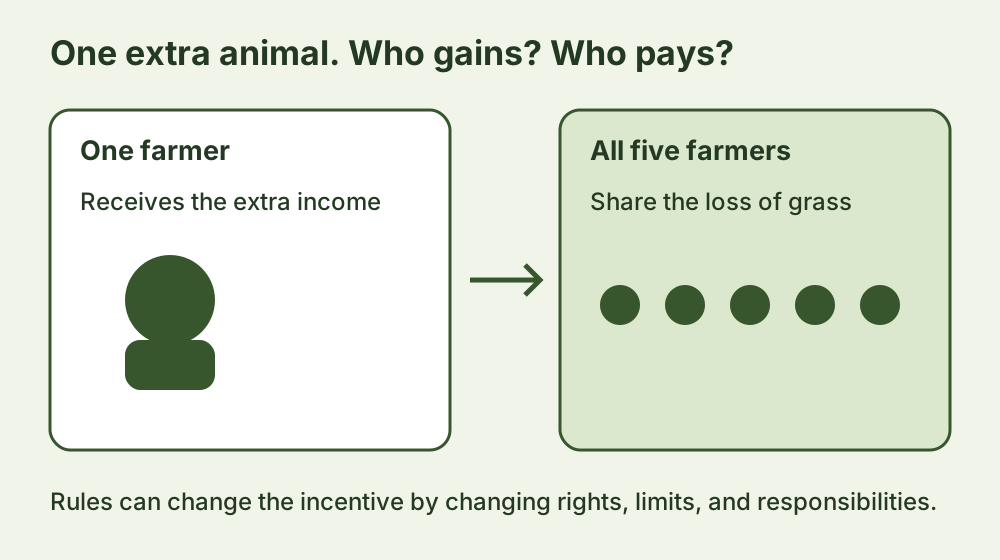
A farmer receives the income from an extra animal, while every farmer shares the loss of grass. Because the farmer receives a concentrated benefit but pays only part of the cost, adding livestock can look attractive even when it damages the group's future income. This is an externality: a consequence of a decision that falls on others.
A pasture is a common-pool resource when excluding users is difficult and one person's use leaves less for others. That describes the resource, not its ownership. A community can own it together and still set strict rules. Open access means access without effective restrictions; it is different from a commons governed by its users.
- Regeneration
- Replacement of a resource over time, such as grass regrowing.
- Quota
- A limit on how much a person or group may take.
- Institution
- A shared rule and the arrangements used to make it work.
- Monitoring
- Checking both resource condition and whether users follow agreements.
Prediction check: can one careful farmer save the pasture?
Predict what happens if you choose zero animals while the other farmers keep increasing their herds. One person's restraint helps, but total grazing can still exceed regrowth. Test your prediction below; distinguish an individual's choice from a rule that applies to everyone.
The shared pasture model
Each season the model pays income using the starting pasture health, adds regrowth, then subtracts one grass unit per animal. Health has a maximum of 100. Regrowth is 0.6 × health × (1 − health / 100): it peaks at 15 units when health is 50. These are teaching assumptions, not measured livestock recommendations.
Worked example: At health 50 with 20 animals, regrowth is 15, so next health is 50 + 15 − 20 = 45. At zero, the model cannot regrow; reset to begin again. Real ecosystems can recover differently.
One pasture, five herds
Each sheep wears its farmer's number. Everyone grazes the same land.
- 1 You
- 2 Greedy
- 3 Cooperative
- 4 Tit-for-tat
- 5 Random
Grass cover thins as health falls.
Advance a season to compare regrowth with grazing.
Your herd, your decision
Other farmers use the strategies shown below. Your slider changes only your own herd.
Predict, then run ten seasons in each mode. Record the pasture health and your income. Changing the rule starts a fresh run. Repeat unrestricted trials because one farmer chooses randomly. The quota mode automatically limits every farmer, including you.
1 You
2 Farmer 2
3 Farmer 3
4 Farmer 4
5 Farmer 5
What changes over time?
Two views of the same seasons: the shared resource above, each farmer's cumulative income below. Sheep numbers and line styles identify the farmers.
Health and income have separate vertical scales. Equal incomes produce overlapping lines. Read exact values in the table below; income is shown in model units.
| Season | Health | Your income | Group income |
|---|
Garrett Hardin (1968)
His 1968 essay used a pasture open to all to explain an overuse dilemma. Its assumptions do not describe every shared-resource institution.
Nash Equilibrium
A set of choices in which no player can improve their payoff by changing alone, given the others' choices. Whether such an equilibrium depletes a resource depends on payoffs and rules; this simulation does not calculate one.

Elinor Ostrom
Her field research documented ways resource users organize durable rules. Community management can interact with public authority; success depends on local conditions.
Modern Commons
Climate change, ocean fisheries, and internet bandwidth are today's "commons." Compare the incentives, but also ask which resources regenerate, which are depleted by use, and which need cooperation across borders.
Centuries of Evidence
Commons That Survived: Ostrom's Principles in History
Hardin's open-access pasture is one model. Historical commons have defined rights and institutions. Use the two examples below to ask who may use a resource and how disputes are resolved; survival alone does not prove a system is perfectly fair or ecologically unchanged.




Make cooperation possible
In her 2009 Nobel lecture, Elinor Ostrom described recurring features of durable resource institutions. These are guides to investigation, not a recipe that guarantees success everywhere.
- Boundaries: identify the resource and who has rights to use it.
- Local fit: match extraction and maintenance duties to local conditions and benefits.
- Participation: let affected users help change the rules.
- Monitoring: check users and resource condition, with monitors accountable to users.
- Graduated responses: increase consequences for repeated violations.
- Conflict resolution: offer an accessible way to settle disputes.
- Recognition: protect the community's right to organize.
- Connected levels: coordinate local institutions with wider systems when necessary.
For example, a limit on fishing means little if nobody can measure the catch. Monitoring makes violations visible; a fair dispute process lets people challenge errors. If users help revise a rule after a drought, it can respond to changed conditions. Explain how these mechanisms support one another.
Design challenge: Five households share a fictional well. In a normal week it refills by 100 buckets; during drought it refills by 60. Write an agreement stating who can draw water, how basic needs and unequal household sizes affect shares, who measures the water level, and how complaints are heard. Calculate a drought budget, then explain who bears each cost. A limit alone does not answer the fairness question.
Source: Elinor Ostrom, 2009 Nobel lecture, especially the discussion of design principles.
Where does the pasture analogy help today?
Climate: emitting greenhouse gases can benefit the emitter while spreading climate costs across borders and generations. Ask how emissions could be measured and how responsibilities could reflect different needs and histories. Unlike this pasture, the atmosphere has many interacting processes and no single annual reset.
Orbital debris: launching a satellite provides services, but objects left in orbit can create collision risks for other operators. A governance proposal needs ways to identify responsible operators and coordinate across countries. Avoid assuming one town's grazing rules can simply scale up to space.
Open-source software: copying code does not use it up as grazing uses grass. The scarce resource may be maintainers' time for reviewing changes, answering questions, and fixing problems. Distinguish a shared information resource from the labor needed to sustain it before proposing a rule.
Compare: Choose two examples. What is scarce? Who benefits? Who pays? Which boundary is difficult to define? Explain one way the analogy fits and one way it breaks down.
Check your understanding
Exit ticket
- Use one result from each simulation mode to explain how rules change outcomes.
- Explain why a shared resource does not imply unrestricted access.
- Propose one rule for a real shared resource. Explain its mechanism, one fairness concern, and the evidence you would collect to revise it.