Chemistry · Nuclear Chemistry · Level 3–4
Radioactive Decay
The periodic table says an element is defined by its protons. Radioactive decay is the exception that proves how deep that rule goes: when a nucleus changes its proton count, it becomes a different element. Alpha and beta decay can change the element; gamma emission changes the nucleus’s energy. Use the numbers of protons and nucleons to predict what each process produces.
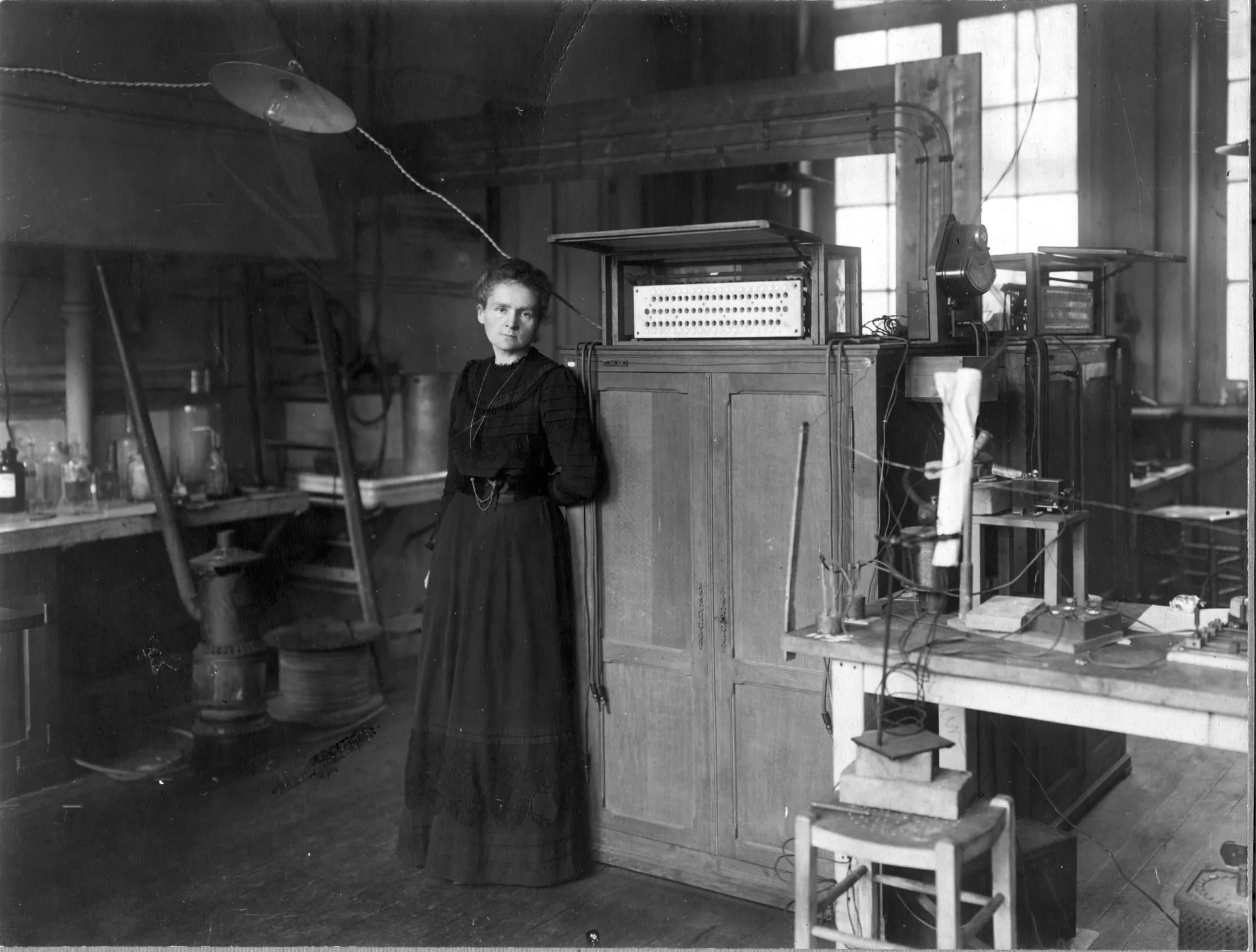
Prerequisite: Periodic Table of Elements (atomic number, isotopes) and Atoms: Structure, Motion & Matter. Historical story: Marie Curie.
1 · The problem
Why would a nucleus fall apart?
Inside a nucleus, protons repel each other with the electric force, while the strong nuclear force glues every proton and neutron to its close neighbors. Neutrons add glue without adding repulsion, so many light stable nuclides have similar numbers of neutrons and protons. Heavier nuclei need more neutrons than protons to stay together, because the repulsion reaches across the whole nucleus but the glue only reaches nearby.
Plot every nuclide with neutrons on one axis and protons on the other and the stable ones form a narrow band — the line of stability. A nuclide far from the stable region may be radioactive. Every nuclide with more than 82 protons is radioactive, though some lighter nuclides are radioactive too. A radioactive nuclide can change at an unpredictable moment; half-life describes the population pattern.
Same element, different isotope. Carbon-12 and carbon-14 both have 6 protons (so both are carbon on the periodic table) but C-14 has 8 neutrons, which puts it off the line of stability. That is why C-14 is radioactive and C-12 is not.
2 · The three radiations
Alpha, beta and gamma
Alpha (α)
The nucleus ejects a helium-4 nucleus: 2 protons and 2 neutrons. Common in heavy nuclei that are simply too big.
Z − 2, A − 4
Atomic number drops by 2.
Beta (β⁻ / β⁺)
β⁻: a neutron turns into a proton and emits an electron (plus an antineutrino). Too many neutrons. β⁺: a proton turns into a neutron and emits a positron (plus a neutrino). Too many protons. This is the weak force at work.
β⁻: Z + 1, A sameβ⁺: Z − 1, A same
Gamma (γ)
A high-energy photon, released when a nucleus drops from an excited state (marked with *) to a lower one. It usually follows an alpha or beta decay.
Z same, A same
The atom does not move on the table.
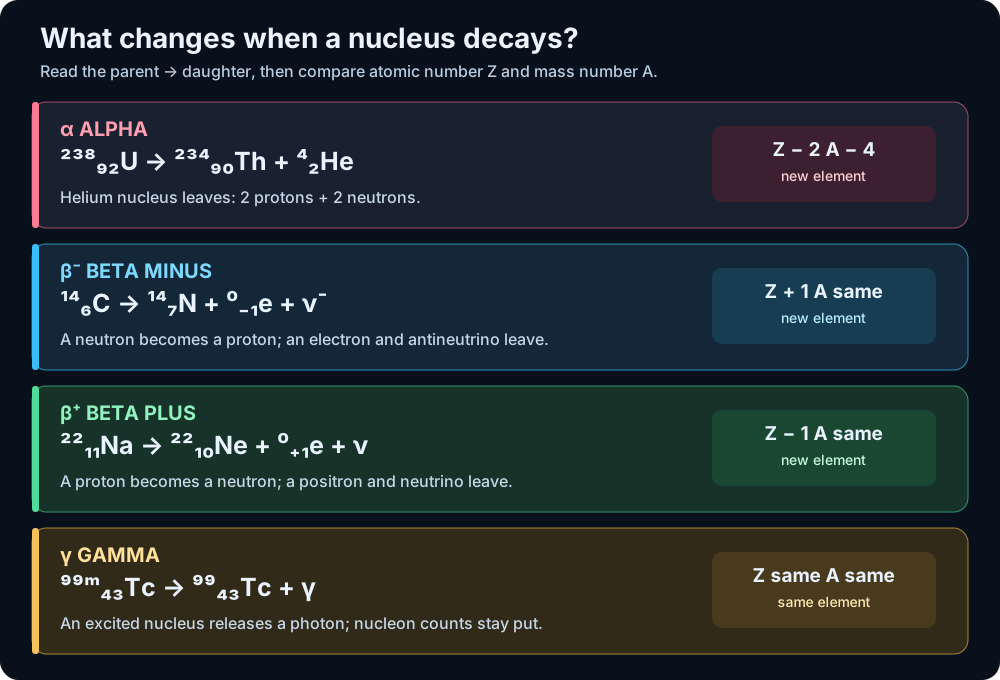
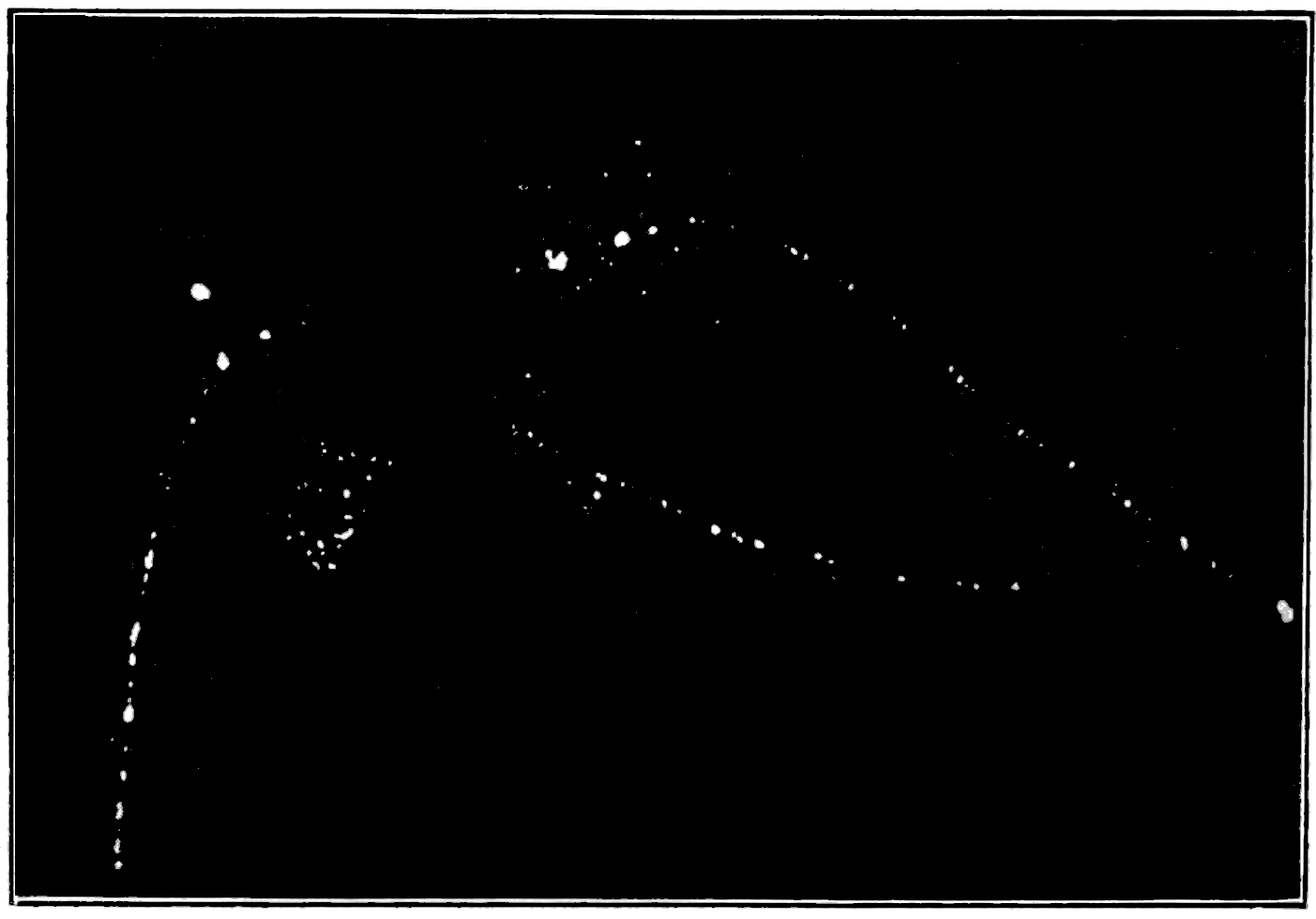
Two bookkeeping rules make every decay equation checkable: the mass numbers (A) on both sides add up, and the atomic numbers (Z) add up (an electron counts as −1, a positron as +1).
3 · Simulation 1
Decay Lab: predict, then test
4 · Simulation 2
Half-life: chance in each atom, law in the crowd
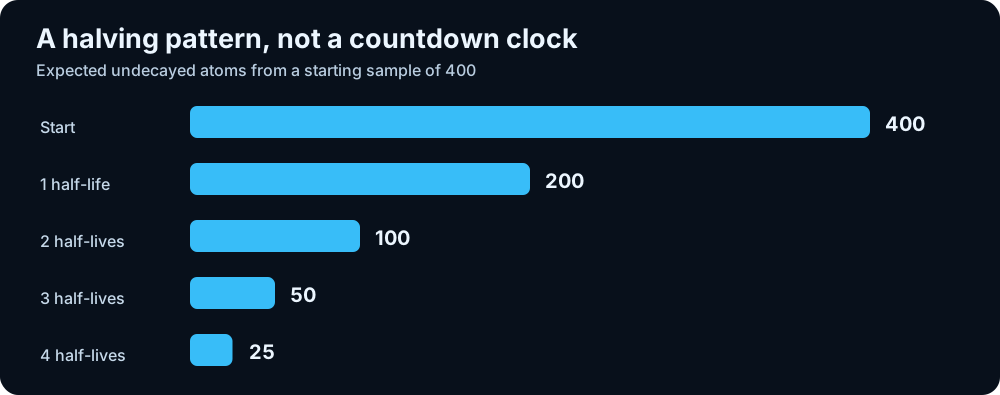
No one can say when one particular atom will decay — each has the same chance every moment. In a large sample, about half are expected to remain after one half-life, then about half of those after the next. A small sample varies from run to run. The decay is exponential: N = N₀ · (½)t / t½, the same curve built on Euler's number e.
Use it: radiocarbon dating
Living organisms exchange carbon with their environment. Radiocarbon dating estimates an initial C-14 level using calibration data; after death, that exchange largely stops and C-14 (half-life 5,730 years) decays by β⁻ into nitrogen-14. Compare the remaining fraction with the estimated starting level and count the half-lives. This slider is an idealized calculation; real ages need calibration and contamination checks.
After about 10 half-lives (~57,000 years) less than 0.1% is left, which is why radiocarbon dating doesn't work on dinosaur bones — other isotope clocks with far longer half-lives, like uranium-238 (4.47 billion years), are used for those. See it applied in The Pleistocene Epoch.
5 · Simulation 3
A decay chain: uranium-238 walks down to lead
The daughter of a decay is often radioactive too, so the atom keeps stepping until it lands on a stable nuclide. Uranium-238 takes 14 steps to become lead-206. On this chart, alpha moves down-left (two fewer protons and two fewer neutrons); beta-minus moves up-left (one more proton and one fewer neutron).
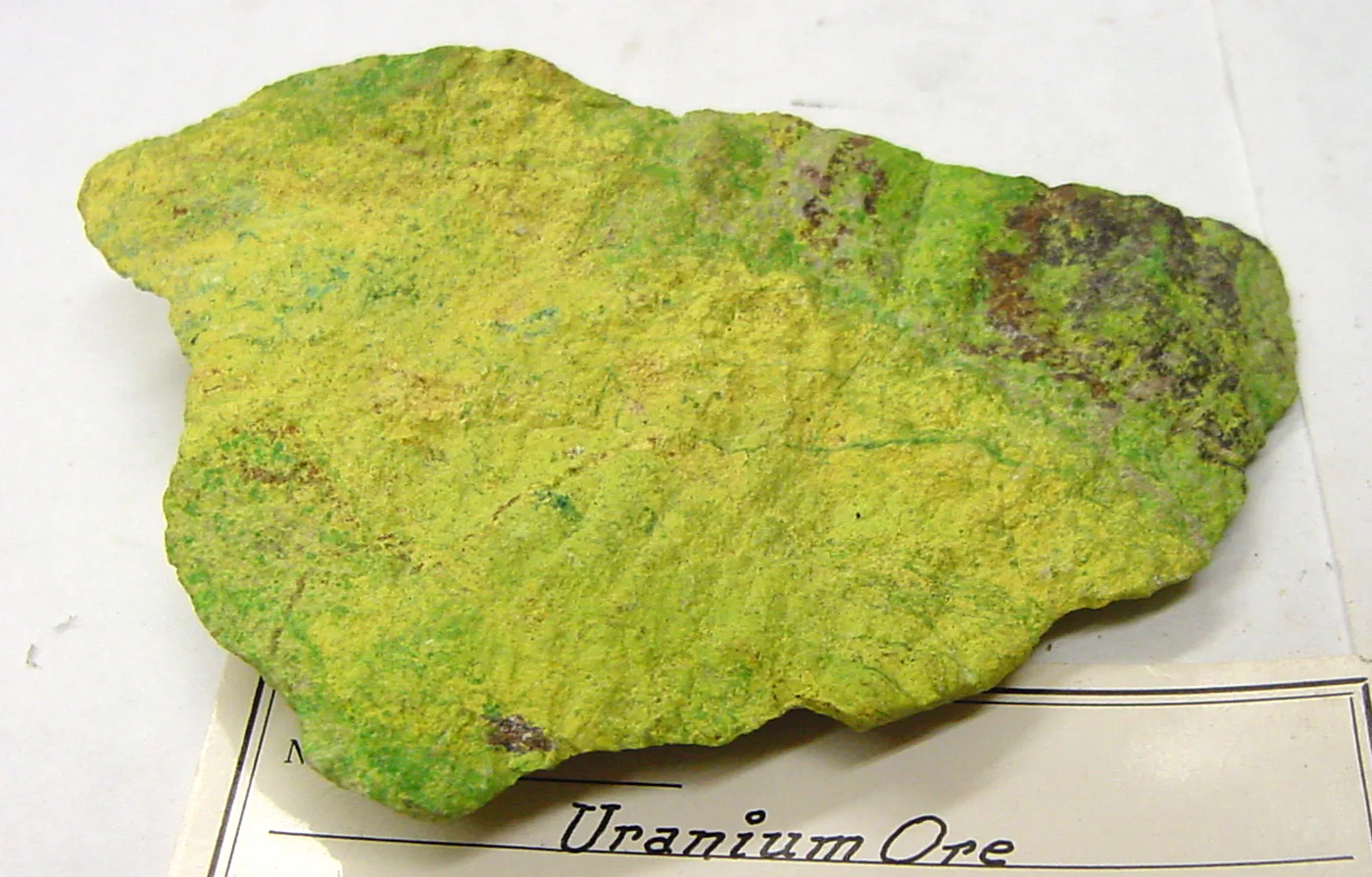
Radon-222 sits in the middle of that chain. It is the gas that seeps out of rock and basements — the reason radon testing exists. It is also why the periodic table lists radon as a noble gas with a health warning.
6 · Safety
Penetrating power and shielding
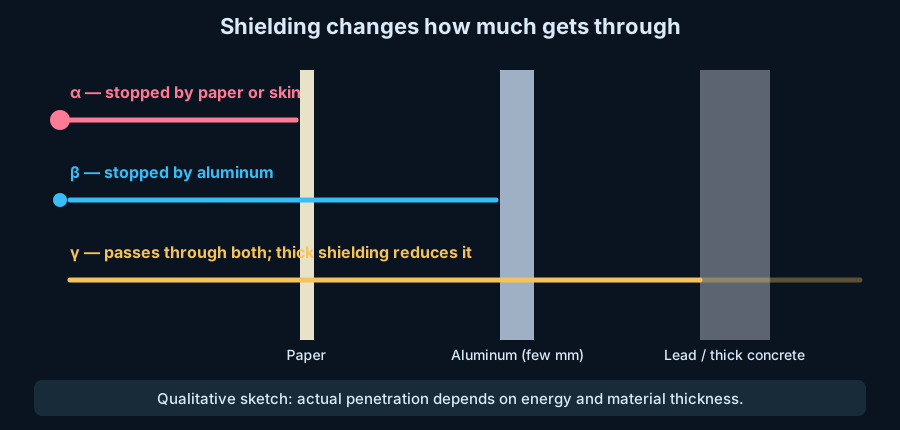
| Radiation | What it is | Stopped by | Main hazard |
|---|---|---|---|
| α | Helium-4 nucleus | Paper, skin | Inhaled or swallowed source (e.g. radon, polonium-210) |
| β | Electron / positron | A few mm of aluminum | Skin burns, internal exposure |
| γ | High-energy photon | Thick lead or concrete (reduces, never fully stops) | Whole-body exposure from outside |
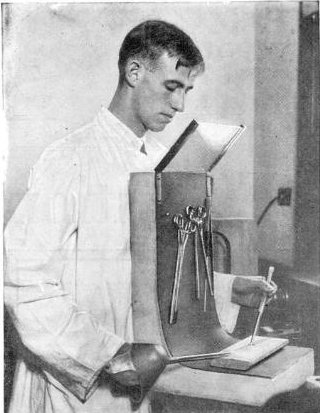
The three protections: time (less exposure), distance (for a small source in open space, intensity roughly follows an inverse-square pattern), and shielding. Radiation is also useful — PET scans use β⁺ emitters, and technetium-99m used in medical imaging emits diagnostic gamma rays with a roughly 6-hour half-life, which helps limit the duration of exposure.
7 · Check yourself
Quick checks
Radium-226 (Z = 88) emits an alpha particle. What are the daughter's Z and A?
Z = 86, A = 222 → radon-222. Alpha: Z − 2, A − 4.
Carbon-14 does β⁻ decay. What element results, and why does the mass number stay 14?
Nitrogen-14. A neutron turned into a proton (Z 6 → 7); the total number of nucleons is unchanged.
A sample has a half-life of 3 days. What fraction remains after 9 days?
9 days = 3 half-lives, so (½)³ = 1/8.
Does gamma decay change which element an atom is?
No. Z and A are unchanged, only the nucleus's energy drops.
The simulator shows 187 of 400 atoms after one half-life. Is its decay law broken?
No. 200 is the expected count, not a guarantee. Individual decays are random, so each 400-atom trial can vary.
Connections