Periods
Rows are called periods. As you move across a row, atomic number increases and properties shift in a regular way.
Chemistry · Lesson 01
Every substance in the universe is built from atoms of pure elements. Use the temperature slider, category filters, and property lenses to read the table like a living map, then click any element to inspect its shell model, matter state, crystal behavior, and real-world uses. For the structure of atoms themselves, use the companion Atoms lesson.
The periodic table is arranged by atomic number. That means every step to the right adds one proton, and the layout reveals repeating patterns in chemical behavior.
Rows are called periods. As you move across a row, atomic number increases and properties shift in a regular way.
Columns are groups. Elements in the same group often have similar outer electron patterns, so they react in related ways.
Labels like alkali metals, halogens, and noble gases help chemists predict reactivity, bonding, and other shared traits.
Metals mostly appear on the left, nonmetals cluster on the right, and the staircase region between them holds the metalloids.
A period runs left to right. Atomic number increases by one each step, so each next element has one more proton.
A group runs top to bottom. Elements in a group often have similar outer electrons, which makes their chemistry similar.
Families are named groups or regions, such as alkali metals, halogens, and noble gases. Family names are shortcuts for predicting properties.
The left side is mostly metallic, the right side is mostly nonmetallic, and the staircase region marks the metalloids.
Dmitri Mendeleev is usually called the founder of the periodic table because in 1869 he arranged known elements by repeating properties, left gaps for missing elements, and made predictions that were later confirmed. This lesson focuses on how elements are organized; the companion Atoms lesson focuses on protons, neutrons, electrons, and why atomic number gives each element its identity. When an atom's proton count changes through radioactive decay, it becomes a different element.

Early cultures knew metals, salts, pigments, stone, charcoal, sulfur, glass, medicines, and poisons long before they knew atoms. The first element systems were attempts to explain change: burning, melting, rusting, dissolving, healing, and decay.
The familiar four-element model is Greek, especially associated with Empedocles and later Aristotle. It treated visible behaviors as combinations of basic qualities such as hot, cold, wet, and dry, not as modern chemical elements.
Ancient Chinese thought often used Wu Xing, a five-part cycle of phases or agents. Wood, fire, earth, metal, and water described change in nature, medicine, seasons, music, politics, and cosmology. In this lesson, treat it as a different historical framework for explaining matter and change.
Alchemy became popular because it joined practical workshop knowledge with spiritual symbolism: dyeing, glassmaking, medicine, metallurgy, and the dream of transforming matter. The word reaches English through Arabic al-kimiya; older writers connected khemia with Egypt, sometimes called Khem, the black land of the Nile.
The philosopher's stone was imagined as a hidden substance that could turn base metals such as lead into gold and sometimes produce an elixir of life. The myth mattered because it kept generations experimenting with furnaces, acids, minerals, distillation, and purification.
By the 1600s and 1700s, chemists increasingly demanded measurement and repeatable tests. Boyle challenged old element lists; Lavoisier defined elements as substances not decomposed by chemical methods; Dalton connected elements to atoms; Mendeleev organized them into a predictive table.


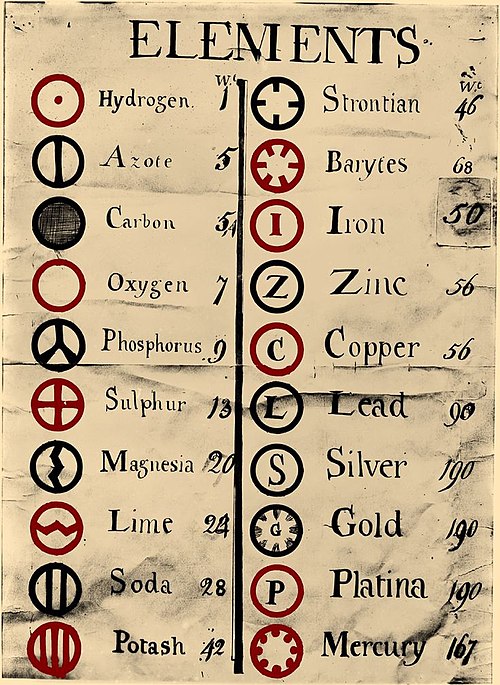

Carbon, sulfur, copper, silver, tin, gold, mercury, lead, and iron were known long before modern chemistry, but there was no reliable atomic explanation yet.
Antoine Lavoisier helped replace alchemy with chemistry by defining elements as substances that could not be decomposed by chemical methods.
Johann Dobereiner noticed groups of three elements with related properties, an early clue that element behavior followed a pattern.
John Newlands arranged elements by atomic mass and noticed that properties repeated roughly every eighth element.
Mendeleev organized elements by mass and chemical behavior, then boldly left empty spaces for elements not yet discovered.
Gallium, scandium, and germanium matched Mendeleev predictions, making the table a powerful scientific model instead of a memorization chart.
English physicist Henry Moseley fired electrons at metal targets and measured the X-rays each one gave off. The square root of the X-ray frequency rose in a straight line with each element's position number, so atomic number (protons in the nucleus), not atomic mass, is the true organizing principle. His line also showed the exact empty spots between hydrogen (Z=1) and gold (Z=79): elements 43, 61, 72, and 75, all found later.
Seaborg reorganized the actinides, and laboratories extended the table to superheavy elements such as nihonium, moscovium, tennessine, and oganesson.
Moseley, a young English physicist working with Ernest Rutherford in Manchester, used X-ray spectroscopy to test the table. He measured the X-ray "fingerprint" of about 40 elements and found a simple math rule: the square root of the X-ray frequency climbs in equal steps from one element to the next. Those steps count protons, which gave the periodic table a firm, measurable order. Places where a step was skipped were real gaps, so he could say which elements were still missing: 43, 61, 72, and 75. He also explained why pairs such as argon and potassium sit "out of order" by mass.
Moseley volunteered for the British Army in World War I and was killed at Gallipoli on August 10, 1915, aged 27. Many historians think he would have won a Nobel Prize; his loss led Britain to keep scientists out of front-line combat.

Select an element for its atomic model and origin story. Use the controls panel to filter families, change temperature, or compare chemical properties.
Swipe sideways to explore the full table.
Simplified shell model showing electron counts by energy level.
Arrangement decides properties. Carbon as diamond-cubic is the hardest natural material; as graphite sheets it is soft and conducts. Face-centred cubic metals such as Cu, Al and Au are ductile because atomic layers slip easily; hexagonal metals such as Zn and Mg deform less easily. Structure sets density, melting behaviour, how alloys mix and how X-rays identify a mineral, so engineers, chip makers and geologists all reason with these models.
Pick a lens, then pick an item. The matching elements light up on the table above and the rest fade. Each lens explains why the pattern matters and how to spot it on any periodic table.