Engineering · Robotics · Biomimicry · Emergent Behavior
Simple Rules,
Complex Walkers
In 1989, MIT roboticist Rodney Brooks built a six-legged robot called Genghis — and it walked without a brain. No central computer told it how to move. Instead, six legs each followed a handful of simple rules and complex walking emerged. That same trick is how every insect on Earth moves. You can build the same thing with a toothbrush.
Intelligence is in the eye of the observer. A simple nervous system can produce remarkably complex behavior — not because it contains a model of the world, but because the world itself is the model.
MIT AI Lab · 1989 · Now at the Smithsonian
Meet Genghis: The Robot That Walked Without a Brain
In 1989, roboticist Rodney Brooks and his team at the MIT Artificial Intelligence Laboratory built a small six-legged robot and named it Genghis. It was about the size of a large shoe box, covered in sensors, and had six independently controlled legs.
What made Genghis revolutionary was what it didn't have: a central brain. Traditional robots of the time used a single processor to plan every move — calculate where each leg should go, then send commands. Genghis used a completely different approach: each leg had its own small controller, and the robot's walking behavior emerged from those simple local rules interacting.
It could scramble over rough terrain, recover from stumbles, and explore uneven surfaces — behaviors that centrally-controlled robots of the era couldn't manage. Genghis now lives in the Smithsonian National Air and Space Museum.
Rodney Brooks went on to co-found iRobot in 1990 — the company that makes the Roomba vacuum cleaner. The same ideas inside Genghis are inside every Roomba navigating your floor today.
Built: 1989
Where: MIT AI Lab, Cambridge, MA
Builder: Rodney Brooks + team
Legs: 6 (hexapod)
Control: Subsumption architecture (8 behavior layers)
Weight: ~1.5 kg
Today: Smithsonian National Air and Space Museum
Brooks co-founded iRobot in 1990 with fellow MIT grad students Colin Angle and Helen Greiner. The company built robots for the military (PackBot), space exploration (worked on Mars rover concepts), and consumer products — including the Roomba (2002), which uses the same behavior-based navigation ideas pioneered by Genghis.

The Key Idea · Behavior-Based Robotics
Subsumption Architecture: Building a Brain from Layers
Traditional AI robots of the 1980s worked like this: sense → model → plan → act. First, build a complete model of the world. Then plan the best path. Then execute. The problem: the world changes while you're planning, and modeling everything is impossibly slow.
Brooks proposed the opposite: don't model anything. Instead, stack simple behaviors on top of each other. Lower layers handle basic survival. Higher layers handle more complex goals. Each layer can suppress the output of the layer below when it has something more important to do — that's where "subsumption" gets its name.
Think of it like this: you don't consciously command your legs to walk. Your spinal cord handles the basic rhythm. Your brainstem adds balance. Your cerebellum adds coordination. Your cortex only steps in when you need to avoid a puddle. That's exactly how Genghis worked — and how insects work too.
Layers 0–2 are always active. Higher layers activate only when needed. The dots animate in the simulator below.

How Insects Walk · Emergent Motion
The Tripod Gait: Nature's Stable Walker
Most six-legged insects use the tripod gait — the most stable walking pattern for a hexapod. Here's the rule:
- Divide the 6 legs into two groups of 3
- Group A: front-right, mid-left, back-right
- Group B: front-left, mid-right, back-left
- While Group A is lifted and moving forward, Group B forms a tripod on the ground
- Then they switch — Group B lifts and moves, Group A plants
A tripod is the most stable structure possible: three points define a plane, so the robot can never tip over while one group is down. This is why insects don't fall even on rough terrain, and why Genghis could scramble over rocks.
The brilliant part: no single controller decides this. Each leg just follows a simple local rule ("if my neighbor just lifted, I should plant") and the tripod gait emerges automatically. This is emergent behavior — complexity from simplicity.
Emergent behavior happens when a system's parts follow simple rules, but the whole system exhibits complex patterns that no single part "planned." Examples: ant colonies find the shortest path to food without any ant knowing the full route; flocking birds never collide using just three local rules; traffic jams form and dissolve without central coordination. The tripod gait is emergent.
Four legs (like a dog) require complex balance calculations — when a leg lifts, the center of gravity must shift. Six legs allow static stability: you always have three on the ground. This is why insects are so energy-efficient and can walk immediately after hatching, with no "learning" period. Evolution converged on the hexapod design independently dozens of times.
Top-down view of a hexapod in tripod gait. Filled circles = leg on the ground. Dashed lines = leg lifted and stepping. The two tripods alternate so three points always contact the surface — a triangle is the most stable base possible.
Hands-On Activity · Classroom Build
Build a Bristle Bot
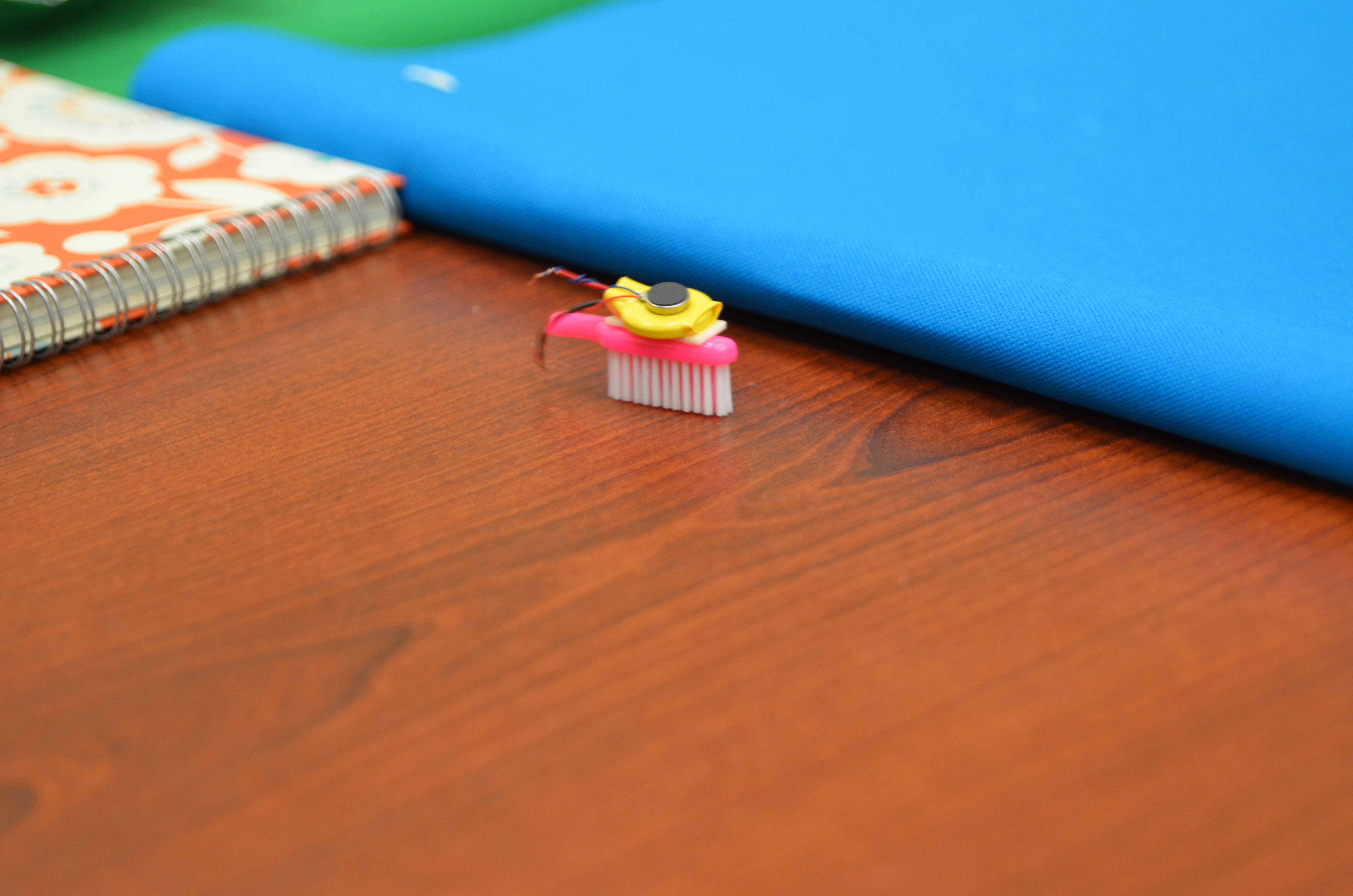
A bristle bot is the simplest robot you can build — it uses a vibrating motor to convert random shaking into directional motion. The secret is the bristles: when angled, they act like ratchets, letting the bot slide forward on the forward stroke but resisting backward movement. It's the same principle as a ratchet wrench, and the same reason a crawling baby moves forward instead of backward when rocking.
Materials
Build Steps
Cut or snap the head off an old toothbrush. Make sure the bristles are angled — don't use a flat-bristle brush. The angle is what makes the bot go forward instead of staying still.
Tape or glue the vibrating motor onto the back top of the bristle head. Position it slightly off-center — an off-center weight makes it vibrate rather than just spin.
Tape the CR2032 coin cell to the head near the motor. Keep it as light and centered as possible — too much weight on one side makes the bot spin in circles instead of going straight.
Touch one motor wire to the positive (+) side of the battery and the other to the negative (−) side. You should feel vibration immediately. Tape the wires down when it works.
Place it on a smooth hard surface and let go. Try tilting the motor forward or backward to change direction. Try adding more weight to one side to make it curve. Race against classmates!
Give it a name, add googly eyes, draw legs on paper and tape them to the sides. Real insect bodies are shaped to be aerodynamic — can you design a body shape that makes your bot faster?
The bristles act like a one-way ratchet. When the motor vibrates, it shakes the toothbrush up and down at high frequency. On the downstroke, the angled bristles flex backward and grip the surface. On the upstroke, the bristles spring forward, pushing the bot in that direction. Each tiny vibration cycle produces a tiny forward push. At hundreds of vibrations per second, those tiny pushes add up to real movement — the same way your leg muscles produce walking from millions of tiny contractions.
Side view — motor vibrates the body up and down. Angled bristles act as a one-way ratchet: they grip on the downstroke and spring forward on the upstroke, producing net forward motion.
Advanced Build · LEDs + Buzzer · Classroom Activity
Popsicle Stick Bug: Add Eyes and a Voice
Once you've mastered the bristle bot, upgrade to a popsicle stick bug — a light rigid body frame with two glowing LED eyes and a tiny phone buzzer that doubles as the drive motor. The buzzer makes the bug vibrate and buzz, so every student instantly knows when their bot is alive. The LED eyes draw almost no extra current from a CR2032, so they run at the same time as the motor with no extra battery needed.
Materials
Build Steps
Glue two popsicle sticks in a cross (+) or parallel pair for the body. This is your chassis — keep it as light as possible. A third stick raised slightly on top is the motor mount.
Cut 4–6 angled bristle clusters from the toothbrush and hot-glue them under the frame, all angled in the same rearward direction. Test on a smooth surface — the bug should roll forward when tapped.
Push two LEDs through the front of the frame facing outward. Connect both LED positive (long) legs together, and both negative (short) legs together. These are your two "eyes" wired in parallel — they share the same battery connection.
Tape the phone buzzer disc to the top-center of the frame. Its red wire is positive (+) and black is negative (−). The off-center weight inside the disc creates the vibration that drives the bug.
Tape the CR2032 flat between the top sticks. Connect: battery (+) → buzzer red + LED positives. Battery (−) → buzzer black + LED negatives. Touch the wires — the eyes should glow and the bug should buzz and walk.
Add pipe-cleaner antennae, draw a face on the sticks, color the body with marker. The LEDs already make it look alive — now give it a personality. Name it. Enter it in a race. Try adding a small piece of clay to one side to make it curve and patrol a circle.
Circuit Diagram: How It's Wired
All three components (motor + 2 LEDs) are wired in parallel between the + and − rails of the CR2032. Each gets the full 3V. The LEDs draw ~20mA each, the motor ~60mA — total well within the coin cell's capacity. Long LED leg = + (connects to red). Short LED leg = − (connects to black).
LEDs in parallel each need about 2–3V at 20mA. A CR2032 supplies 3V and ~220mAh. The buzzer motor draws ~50–80mA when vibrating. Total draw is under 120mA — well within the coin cell's range. The LEDs are your sensor readout: if they dim, the battery is almost dead. Replace it before the buzzer stalls.
Your popsicle stick bug walks by the same principle as Genghis: simple local rules (angled bristles = move forward, vibration = energy source) produce complex behavior (navigation, direction changes from weight shifts). The LEDs are your first sensor readout. See how Genghis added 8 layers of sensors above this ↑
Extensions · From Bristle Bot to Real Robot
Going Further: The Ladder from Bristle Bot to Genghis
One motor, no control, pure physics. Motion emerges from bristle geometry. No programmer decided "go forward" — the shape of the bristles decided it. This is physical intelligence.
Add a light sensor so the bot turns toward or away from light. Still no microcontroller — just analog circuits. The environment is the program. Add two sensors and it navigates a maze.
Six legs, each with its own microcontroller and force sensors. Layer 0–2 always running. Layers 3–7 fire when triggered by sensors. Complex walking, obstacle avoidance, and terrain navigation — from 8 simple rules.
Modern quadruped robots add machine learning on top of subsumption-style behavior layers. The base layers are still local and reactive. But higher layers now learn from experience. Genghis is a direct ancestor.
NASA's Perseverance uses behavior-based hazard avoidance at the lowest level — if a wheel senses too much force, it stops, even before the main computer has processed the image. Same idea as Genghis, same reason: the world moves faster than planners can plan.
Your spinal cord controls walking rhythm (Layer 1). Your cerebellum adds balance (Layer 2). Your motor cortex adjusts gait (Layers 3–5). Your prefrontal cortex plans the route (Layer 7). You are a subsumption architecture. Evolution built you bottom-up, just like Brooks built Genghis.
Boston Dynamics · 1992–Present · From MIT to Your Factory Floor
Walking Dogs & Backflipping Robots: Boston Dynamics
If Genghis is the grandfather of legged robots, Boston Dynamics is the company that grew the family tree into something that can dance, do parkour, and inspect an oil refinery. Founded by Marc Raibert in 1992 as a spin-off from the MIT Leg Lab — the same intellectual neighborhood as Rodney Brooks — Boston Dynamics has spent thirty years turning the dream of animal-like locomotion into real hardware.
Founded: 1992 · Cambridge, MA
Founder: Marc Raibert (MIT Leg Lab)
Key robots: BigDog, Spot, Atlas, Stretch
Owners over time: MIT spin-off → DARPA contracts → Google (2013) → SoftBank (2017) → Hyundai (2021–present)
Spot commercial launch: 2019
Famous for: Viral videos — robots that fall down, get back up, and dance
In 2020 Boston Dynamics released a video of Spot and Atlas dancing to "Do You Love Me" by The Contours. It hit 35 million views in days. Not because it was a gimmick — but because the robots moved like animals: hips swaying, weight shifting, recovering from stumbles mid-dance. People hadn't seen machines move that way before. That naturalness comes directly from the same ideas Genghis pioneered.
The Robot Family
The first famous one. Four legs, 75 kg, DARPA-funded as a robotic pack mule for soldiers. Could carry 340 lb across rough terrain, snow, and ice. The video of a Boston Dynamics engineer kicking it — and it not falling — shocked the robotics world. Hydraulically powered; too loud for military use, but it proved the concept.
BigDog's smaller, electric successor. 25 kg, 90-minute battery, top speed 1.6 m/s. Four legs, 12 actuated joints, full LIDAR + stereo cameras. Commercially available since 2019. Used in construction inspection, oil & gas, police, hospitals, and film sets. The "robot dog" students have seen on the news.
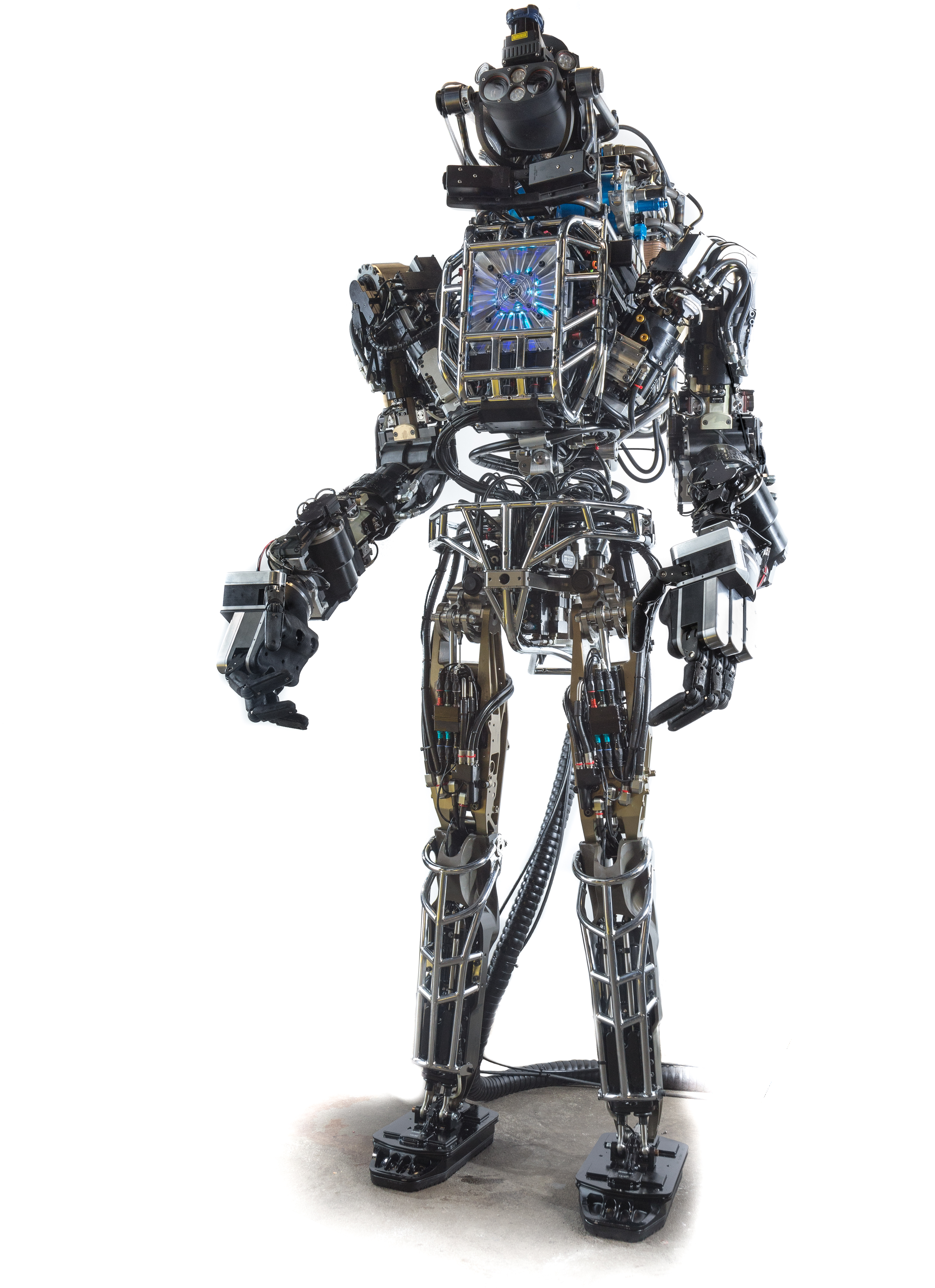
Boston Dynamics' humanoid. Originally hydraulic, now fully electric (as of 2024). 1.5 m tall, 89 kg. Can run, jump, do backflips, and full gymnastics routines. Designed to work in environments built for humans — push open doors, climb ladders, carry boxes. The most advanced bipedal robot ever built.


How Spot Actually Walks: Dynamic Balance
Genghis used static stability — it always had at least three feet on the ground, forming a stable tripod. Spot uses dynamic balance, the same way you walk: at any given moment, your center of gravity is actually outside your base of support, and you're constantly falling forward and catching yourself with your next step.
This is harder to engineer (you need to predict where your foot will land and pre-position for it) but it's far more efficient. A statically stable robot wastes energy keeping three legs planted. A dynamically balanced robot flows through gaits — walk, trot, bound — the way a real dog does, using momentum as an asset rather than fighting it.
Spot's lowest control layer handles individual joint torques at ~1000 Hz. Above that, a balance controller maintains the center of mass. Above that, a gait planner selects walk vs. trot vs. stair-climb. At the top, a mission planner navigates waypoints. Four layers — just like Genghis had eight. The architecture is the same; the hardware is 35 years better.
Spot's control stack — same subsumption idea, modern hardware. Compare to Genghis's 8 layers above.
Where You've Seen Them (and Where They Actually Work)
2015 — "BigDog Kick": engineer kicks BigDog on ice; it slips but recovers. First proof of dynamic balance to the public.
2018 — SpotMini opens a door: one robot holds a door, a second walks through. The internet panicked.
2019 — Spot at MIT commencement: pulled a truck across campus.
2020 — "Do You Love Me": Atlas + Spot dance to The Contours. 35M+ views.
2021 — Atlas parkour: backflip, 360 twist, full gymnastics floor routine.
2024 — New Atlas (electric): gets up from the floor in a single fluid motion no human could match.
Chernobyl: Spot used to map radiation zones too dangerous for humans.
Oil & gas: Shell and BP use Spot to walk pipeline infrastructure on offshore platforms.
Construction: Spot maps building sites with LIDAR as they're built, comparing to the design model daily.
Hospitals: Used during COVID to remotely assess patients without PPE exposure.
Police: NYPD trialed Spot for crime scene documentation (controversial; cancelled 2021).
Watch Them Move
Boston Dynamics — "Do You Love Me?" (2020) · 35M+ views
BigDog Overview — rough terrain, ice, kicks (2010)
Atlas Parkour — backflip, gymnastics, full routine (2021)
Your bristle bot has one behavior layer: vibrate → move. Genghis had eight. Spot has dozens, trained partly by machine learning on millions of simulated steps. But the core insight is identical across all three: don't try to plan everything — react locally and let global behavior emerge. Marc Raibert worked down the hall from Rodney Brooks at MIT. The ideas didn't just travel — they were neighbors.
What's Next · Continue the Robotics Path
Give Your Bug a Brain: Next Lessons
Your popsicle stick bug walks using pure physics. Genghis walked using eight stacked behavior layers. The next step is to give your walker real sensors so it can decide where to go — not just vibrate until it hits a wall.
How MIT's six-legged robot walked without a central brain. Learn how 8 simple behavior layers stack together to produce complex walking, obstacle avoidance, and terrain navigation — the same trick every insect uses.
bug-bots.html · This lesson · #genghis
Once your walker has sensors, it needs to plan a route. A* is the algorithm behind GPS navigation, game AI, and Mars rover path planning. This lesson shows how a robot with even two distance sensors can find the shortest path through any maze — exactly the upgrade from bristle bot to Genghis.
a-star-pathfinding.html · Algorithms & AI