Contact pose
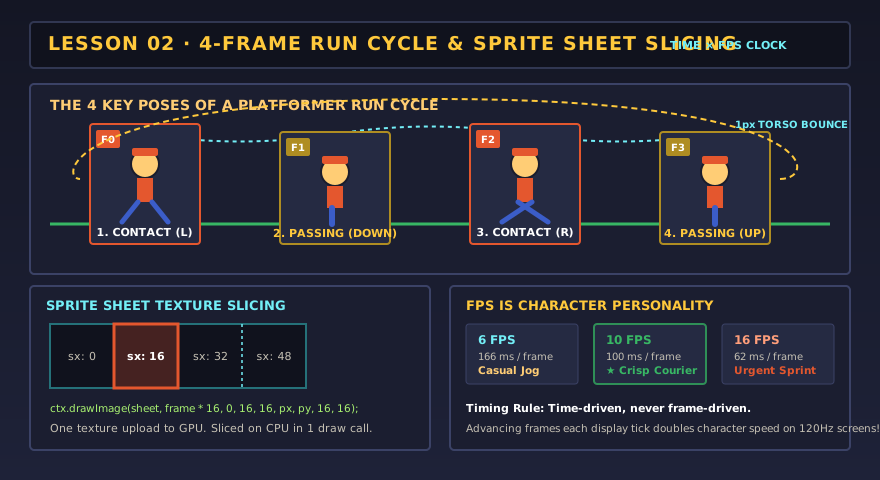
Legs spread, one foot touching down. The widest, most readable pose in a run.
Lesson 02 · 60 minutes · Art layer
An animation is several frames shown one after another. You will draw a run cycle with onion skinning, pack the frames into a sprite sheet, and find out how frame rate changes the feel.
Where this comes from
Consoles stored animation frames side by side in memory and the program pointed at a different frame each few screen refreshes. That “sheet of frames + pointer” idea is still exactly how a modern sprite sheet works.
Legs spread, one foot touching down. The widest, most readable pose in a run.
Legs together, body raised one pixel. Alternating the two gives a bounce.
Idle can be 2 frames at 2 fps. A blink every few seconds makes a character feel alive.
Four strong run frames beat eight muddy ones. Timing matters more than frame count.
x = frameIndex × 16.Animation lab
Courier animationsFrames + fps save automatically
Theory: sheets and source rectangles
A sprite sheet is one image holding every frame. To draw frame i, the game copies the source rectangle at x = i × 16 and pastes it at the player’s position. One image means one file to load and one texture for the graphics card.
let time = 0;                    // seconds since the animation started
function drawPlayer(dt) {
  time += dt;
  const frame = Math.floor(time * anim.fps) % anim.frames;  // 0, 1, 2, 3, 0, 1…
  ctx.drawImage(sheet,
    frame * 16, 0, 16, 16,         // source: which frame on the sheet
    player.x, player.y, 16, 16);   // destination: where on screen
}Same idea, other tools
Add a fifth run frame and set the cycle to 12 fps. Did it get smoother, or just slower? Explain using frames × milliseconds.
Definition of done
0/4 checked
Evidence: Record or show the run cycle at two frame rates and explain which matches your courier’s personality.
Your art and settings are already saved for the next lesson.