Space Science · Biography
Tycho Brahe — The Last Naked-Eye Astronomer
He lost the bridge of his nose in a duel at age 20, kept a tame elk as a castle pet, hosted kings and alchemists on his private island, and measured the positions of a thousand stars to a precision nobody had ever achieved — all without a telescope. His data launched the Scientific Revolution. His cosmology was wrong. His measurements were perfect. He is Tycho Brahe.
Who Was Tycho Brahe?
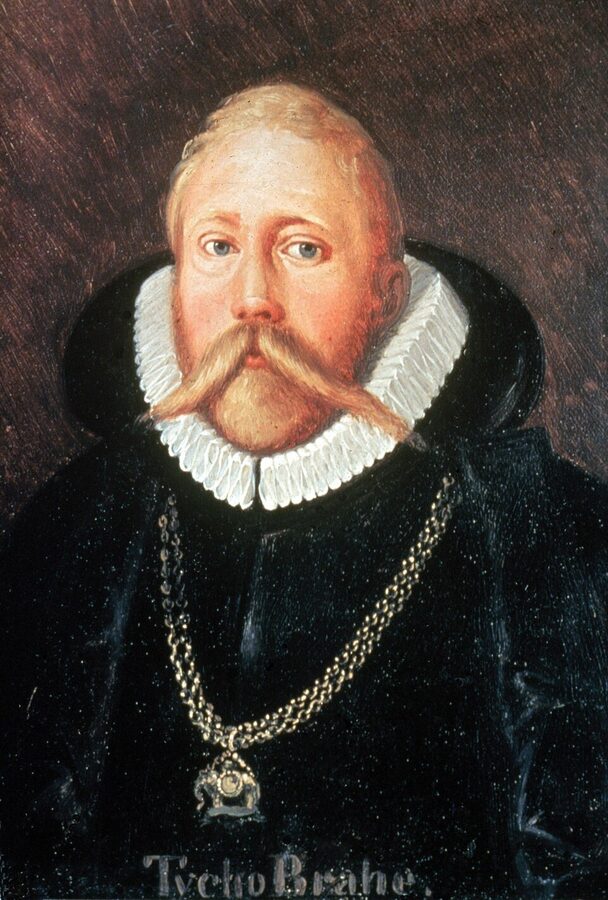
Tycho Brahe (1546–1601) was a Danish nobleman and astronomer, born Tyge Ottesen Brahe at Knutstorp Castle in Scania. He represents a unique turning point in the history of science: the last major astronomer to work without a telescope, and the man whose extraordinary naked-eye precision made all subsequent astronomy possible. He spent 21 years on a Danish island, surrounded by the finest scientific instruments in the world, compiling the data that Johannes Kepler would use to prove how the solar system actually works.
"He was wrong about the center of the universe. He was right about everything he measured."
Brahe's Tychonic system placed Earth at the center — incorrect. But his star catalog and planetary data were so precise that Kepler used them to derive the laws of planetary motion. The measurements were right even when the interpretation was not. This is science.
The Duel — And the Metal Nose
On December 29, 1566, Tycho Brahe attended a party in Rostock. He was 20 years old, a university student already obsessed with mathematics and astronomy. During the evening, an argument broke out between Brahe and his cousin Manderup Parsberg — reportedly over a mathematical formula. The dispute escalated into a duel.
Brahe lost the bridge of his nose in the fight. The wound was serious but survivable, and in an era before modern surgery, he responded with engineering: he commissioned a prosthetic nose, reportedly made of brass (analysis of his exhumed remains in 2012 suggested brass rather than gold or silver as legend had claimed). He wore it for the rest of his life, held in place by a paste or adhesive.
Uraniborg — His Castle of the Heavens
In 1576, King Frederick II of Denmark gave Brahe an entire island, a generous income, and a commission to build the finest observatory in the world. The result was Uraniborg — a Renaissance castle turned scientific instrument, built at a cost of roughly 1% of the Danish state budget.
Brahe spent 21 years on the island of Ven, surrounded by more than 30 assistants, running two observatories simultaneously and observing the sky on every clear night. It was the most ambitious scientific installation in history at the time. Learn the full story of the place where he did his work:
The 1572 Supernova — The Sky Can Change
On November 11, 1572, Brahe was walking home from his alchemical laboratory when he noticed something impossible: a brilliant new star in the constellation Cassiopeia. It was so bright it was visible in daylight. No such star had been there before.
Aristotle — whose philosophy governed Western science — had taught for nearly 2,000 years that the celestial sphere was eternal and unchanging. Stars were fixed, perfect, immutable. A new star appearing was, philosophically speaking, impossible. Brahe measured it obsessively.
By measuring the star's position against neighboring stars over months, Brahe showed it did not shift position at all — it had zero parallax. This proved it was not a nearby atmospheric phenomenon (like a comet or meteor) but a genuine star in the firmament, far beyond the Moon.
Brahe published his observations, coining the Latin term nova — "new star." It established his reputation across Europe immediately. A 26-year-old nobleman had just cracked the philosophical foundation of geocentrism: the heavens were not eternal and unchanging.
Brahe's "nova" is now known as SN 1572 — a Type Ia supernova, the explosion of a white dwarf star roughly 8,000 light-years away. Its remnant is still visible to radio telescopes today. Brahe saw the death of a star and proved it with mathematics.
If the celestial sphere could produce a new star, the sphere was not eternal. If the sphere was not eternal, Aristotle's cosmology was wrong. If Aristotle was wrong about the heavens, everything else he taught about the cosmos — including Earth's fixed position at the center — was open to question.
The 1577 Comet — Shattering the Crystalline Spheres
Five years after the 1572 supernova, Brahe got another gift from the sky: a brilliant comet appeared in November 1577. Ancient tradition said comets were atmospheric phenomena — weather events happening in the upper layers of air, not celestial objects.
Brahe measured the comet's position precisely from his observatory on Ven. He also collected measurements made simultaneously by astronomers in Prague and other European cities. By comparing how much the comet's apparent position shifted between different observation points — parallax — he could calculate its distance.
The comet showed virtually no parallax. It had to be at least six times farther away than the Moon — deep in the realm of the planets. It was not atmospheric. It was genuinely celestial.
The Tychonic System Simulator
Toggle between Brahe's geo-heliocentric model and Copernicus's heliocentric model. Both predict the same positions for every object — but they disagree on what is standing still.
Tychonic model: Earth is fixed. The Sun and Moon orbit Earth. Mercury, Venus, Mars, Jupiter, and Saturn orbit the Sun, which orbits Earth.
The Tychonic System — A Brilliant Dead End
By 1588, Brahe had enough data to know that Ptolemy was wrong — the supernova and comet had demolished the crystalline-sphere model. But he rejected the Copernican heliocentric model too. His primary objection was observational: he could not detect stellar parallax.
If Earth truly orbited the Sun, then stars should shift slightly in apparent position as Earth moved from one side of its orbit to the other over six months. Brahe's measurements were accurate to 1 arcminute. He found no parallax. His conclusion: Earth does not orbit the Sun — because if it did, the nearest stars would have to be incomprehensibly far away (they are — but he judged this implausible).
What the Tychonic Model Said
Brahe proposed a geo-heliocentric compromise:
- Earth remains stationary at the center of everything
- The Moon and Sun orbit Earth
- Mercury, Venus, Mars, Jupiter, and Saturn all orbit the Sun
- The Sun (carrying these five planets) orbits Earth
Brahe and Kepler — The Unlikely Collaboration
In 1597, Brahe was forced out of Denmark by political enemies and went into exile, eventually reaching Prague under the patronage of Emperor Rudolf II. In February 1600, a young German mathematician named Johannes Kepler arrived to join him.
It was one of history's most productive and most friction-filled scientific partnerships. Kepler was a committed Copernican — he believed Earth orbited the Sun and wanted access to Brahe's data to prove it mathematically. Brahe, protective of his life's work and suspicious of Kepler's Copernican sympathies, withheld full access to his observations and gave Kepler specific problems to work on instead.
The Deathbed Request
Brahe died on October 24, 1601, less than two years after Kepler arrived. According to Kepler's own account, Brahe's last words were a repeated plea: "Let me not seem to have lived in vain." He urged Kepler to complete the Rudolphine Tables — a new star catalog based on Brahe's observations — and to do so using the Tychonic system.
Kepler published the Rudolphine Tables in 1627 — but organized around a heliocentric system with elliptical orbits, not the Tychonic model. He used Brahe's data to contradict Brahe's cosmology. The data was so good that it survived the theory it was meant to support.
A Life in Numbers
- 1546
Born at Knutstorp Castle, Scania, Denmark
BirthBorn Tyge Ottesen Brahe on December 14, the eldest son of a Danish noble family. Raised from age two by his uncle Jørgen Brahe, who funded his education and early scientific interests.
- 1563
Observes Jupiter–Saturn Conjunction
First ObservationAt age 17, Brahe observes the conjunction of Jupiter and Saturn. He finds both the Ptolemaic and Copernican tables are significantly wrong — off by days. He resolves to spend his life making better measurements. A lifelong mission is born.
- 1566
The Duel — Brahe Loses His Nose
Famous IncidentAt age 20, a duel with his cousin Manderup Parsberg over a mathematical disagreement costs him the bridge of his nose. He wears a brass prosthetic for the rest of his life.
- 1572
Observes the Supernova in Cassiopeia
Major DiscoveryA brilliant new star appears in Cassiopeia — visible in daylight. Brahe's careful measurements prove it has no parallax and is therefore a genuine celestial object, not atmospheric. Publication of De nova stella establishes his European reputation.
- 1576
Uraniborg Founded on the Island of Ven
Observatory OpensKing Frederick II grants Brahe the island of Ven and funding to build the finest observatory in the world. Construction of Uraniborg begins. Brahe will observe from this island for the next 21 years.
- 1577
The Great Comet — No Crystalline Spheres
Critical DiscoveryParallax measurements of the 1577 comet prove it is far beyond the Moon and travels through regions where solid crystalline spheres were supposed to exist. The spheres do not exist. Ptolemaic cosmology loses its physical structure.
- 1588
Tychonic System Published
New ModelBrahe publishes his geo-heliocentric compromise: Earth fixed, Moon and Sun orbit Earth, other five planets orbit the Sun. Mathematically equivalent to Copernicus but keeps Earth central. Becomes widely adopted in Catholic Europe after 1616.
- 1597
Forced to Leave Denmark
ExilePolitical enemies at the Danish court strip Brahe of his income and patronage. He abandons Uraniborg — taking his instruments and data — and goes into exile. He will never see the island again. Uraniborg is demolished for building materials within the decade.
- 1599
Arrives in Prague as Imperial Court Astronomer
New PatronageEmperor Rudolf II welcomes Brahe to Prague, granting him a castle at Benátky nad Jizerou and unprecedented respect. He sets up a new observatory and resumes his systematic observations.
- 1600
Johannes Kepler Arrives
Historic MeetingKepler joins Brahe in Prague. Brahe assigns him the problem of Mars. The tension between Brahe's Tychonic model and Kepler's Copernican convictions produces one of the most productive scientific collaborations in history.
- 1601
Brahe Dies in Prague
DeathTycho Brahe dies October 24, 1601, after a sudden illness following a court banquet. He was 54. His last words, according to Kepler: "Let me not seem to have lived in vain." Kepler inherits his data — and uses it to change science forever.
- 1627
Rudolphine Tables Published — Brahe's Legacy Lives
Lasting ImpactKepler publishes the Rudolphine Tables using Brahe's data — organized around a heliocentric, elliptical-orbit model that contradicts Brahe's own Tychonic system. The measurements survived the theory. The data was right all along.
Continue Exploring
Brahe's story connects directly to the broader Scientific Revolution. Follow the thread:
Practice Problems
Apply what you've learned about Tycho Brahe and his discoveries.
Easy1. Tycho Brahe was born in 1546 and died in 1601. How old was he when he died?
Easy2. Brahe saw the 1572 supernova at age 26 and lost his nose in a duel at age 20. How many years before the supernova did the duel happen?
Medium3. In the Tychonic model, how many planets orbit the Sun (not Earth)? Count them: Mercury, Venus, Mars, Jupiter, Saturn are the five known planets. Enter the correct number.
Medium4. Brahe observed the 1572 supernova. Modern measurements show SN 1572 is about 8,000 light-years away. If light travels 9.46 × 10¹² km per light-year, how many km away is SN 1572? Give your answer in scientific notation as a × 10¹⁶ — enter just the value of a (one decimal place).
Challenge5. Brahe found no stellar parallax with 1-arcminute accuracy. The nearest star (Proxima Centauri) actually has a parallax of 0.77 arcseconds. Convert 0.77 arcseconds to arcminutes. (60 arcseconds = 1 arcminute.) Round to 2 decimal places. Was Brahe's equipment good enough to detect it?