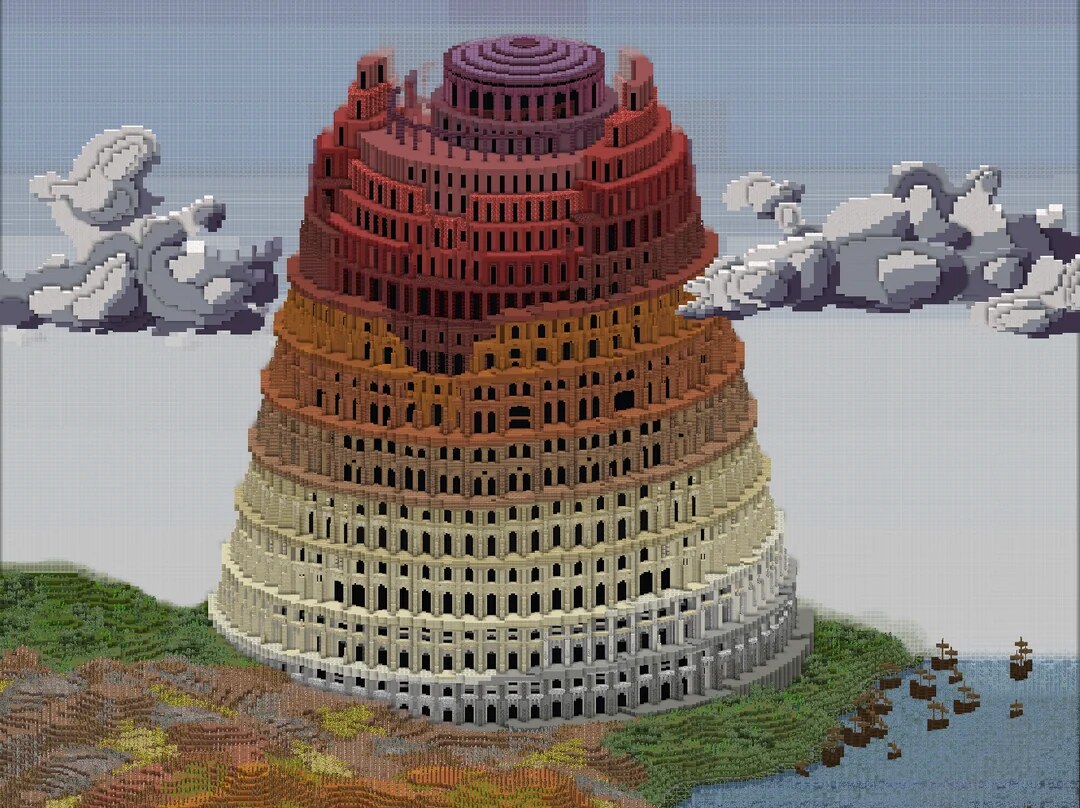
1. Babel as Symbol
What it represents: one human project, one shared direction, one giant system.
What it teaches: a knowledge system can unite people, but it can also become tangled with pride, centralization, and conflict.
Systems & Society · Lesson 04
Again and again, human beings have tried to gather all knowledge in one place and make it available to everyone. Sometimes that dream creates breakthroughs in learning. Sometimes it creates bottlenecks, power struggles, fragility, or information overload. This lesson follows that pattern from ancient story to ancient library to modern network.
Big Question
Each era builds a bigger container for knowledge: a tower, a library, a printing network, a search engine, a cloud archive. Each also discovers a weakness: language barriers, destruction, censorship, access gaps, bias, or too much information to sort.
Core Idea
Knowledge is never just about what is stored. It is also about who controls it, who can reach it, and what happens when the system breaks.
Timeline
These moments are not identical, but they share a common dream: collect, organize, and spread as much knowledge as possible.
Three Models
What it represents: one human project, one shared direction, one giant system.
What it teaches: a knowledge system can unite people, but it can also become tangled with pride, centralization, and conflict.
What it represents: collecting, copying, preserving, and organizing texts in one world-class center.
What it teaches: knowledge needs librarians, classification, translation, and long-term care, not just storage space.
What it represents: distributed, global, searchable knowledge shared across devices and platforms.
What it teaches: decentralization increases access, but it can also make truth harder to verify and quality harder to protect.
Ups and Downs
Compare
Strength: careful curation, scholarship, and focused preservation.
Weakness: knowledge is concentrated in one institution and depends on political stability.
Main problem: if the center fails, an enormous amount can be lost.
Strength: massive scale, instant copying, and global access.
Weakness: low barriers to publishing make quality uneven and manipulation easier.
Main problem: if everything is available, deciding what is trustworthy becomes the hard part.
Knowledge Systems Lab
Switch between centralized and distributed systems, then see what happens when a crisis hits. After that, test whether your problem is access or filtering.
Read the Lab
Event Log
Signal vs. Noise
Find the target fact. In Alexandria mode, there are only a handful of carefully selected sources. In Internet mode, there are many more voices, but most are low-quality or misleading.
Advanced Idea
Physicists have known since 1961 that information is not just an abstract idea. IBM physicist Rolf Landauer showed that erasing one bit of information always costs a small, unavoidable amount of energy: at room temperature, about 2.9 × 10⁻²¹ joules (the formula is kT ln 2, where k is Boltzmann's constant and T is temperature). This is called Landauer's principle, and it has been confirmed in real experiments (Bérut et al., 2012; Jun et al., 2014). It means that every time a file is deleted or a memory cell resets, physics quietly collects an energy toll. Handling information is never entirely free, even if the cost is far too small to notice.
A newer and far more speculative idea goes further. In 2019, physicist Melvin Vopson at the University of Portsmouth proposed the mass-energy-information equivalence principle, an extension of Einstein's E = mc² suggesting that a stored bit of information carries not just an energy cost when erased, but a tiny rest mass while it exists: about 3.19 × 10-38 kilograms per bit at room temperature, lighter than a neutrino. Vopson has proposed real experiments to test this, including comparing the mass of a data-storage device full of information to the same device wiped clean, and looking for extra low-energy photons when matter and antimatter annihilate. None of these tests have confirmed the idea so far, and it remains disputed: physicists including Sabine Hossenfelder argue the principle conflicts with the standard conservation of energy, and most of the physics community does not currently treat it as established science.
Whether or not information truly has mass, one thing is measured and certain: the Tower of Babel took one project to build, and the Library of Alexandria took centuries to fill. The counter at the bottom of this page adds more information than Alexandria ever held every few seconds.
Sources: Landauer, “Irreversibility and Heat Generation in the Computing Process,” IBM J. Res. Dev. (1961) · Bérut et al., “Experimental verification of Landauer's principle,” Nature (2012) · Vopson, “The mass-energy-information equivalence principle,” AIP Advances (2019) · Vopson, “The information catastrophe,” AIP Advances (2020) · Hossenfelder commentary and Vopson's response, AIP Advances (2025).
Think
A strong knowledge system must balance access, preservation, trust, and freedom. Use these prompts to test whether our modern systems are actually improving.