Physics · Waves & Sound · Foundational
Sound & Vibration
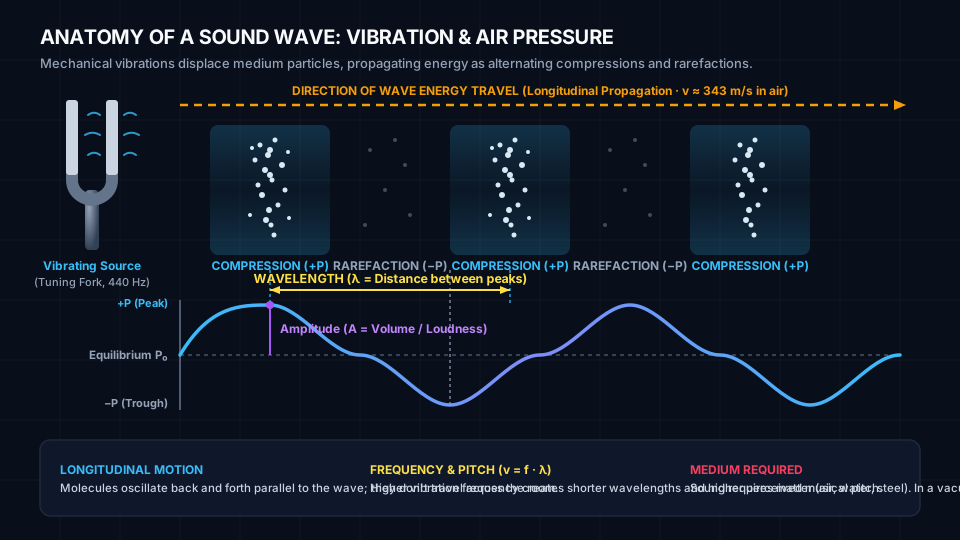
Sound is mechanical energy in motion. When an object vibrates, it transfers momentum to adjacent molecules, propagating high-pressure compressions and low-pressure rarefactions through the surrounding medium. The molecules themselves never travel across the room—they oscillate in place while the wave disturbance carries energy forward.
1. Anatomy of a Longitudinal Wave
Unlike transverse waves on a rope or ocean surface (where disturbance moves perpendicular to propagation), sound in air is strictly a longitudinal wave. Molecule displacement is parallel to the direction of wave travel:
- Compressions (\(+P\)): Zones where vibrating particles are pushed closely together, creating higher-than-ambient density and localized positive pressure.
- Rarefactions (\(-P\)): Zones where receding particles leave expanded gaps, creating lower-than-ambient density and localized negative gauge pressure.
2. Interactive Sound Wave & Molecule Simulator
Observe individual air molecules oscillating in place. Notice how the bright amber molecule bounces back and forth around its dotted home position while the pressure wave (below) sweeps smoothly to the right.
3. Tactile Vibration & Real-World Acoustics
Because sound is physical mechanical vibration, it can be sensed directly through touch, bone conduction, and solid materials, as well as by the eardrum. In this historic newsreel, teacher Anne Sullivan demonstrates how Helen Keller learned spoken language by feeling the physical vibrations of the throat, lips, and nose:
Worked Example: Sound Speed & Wavelength Across Media
The universal wave equation connects wave speed \(v\), frequency \(f\), and wavelength \(\lambda\):
Sample Problem: A concert tuning fork produces the standard pitch \(A_4 = 440\text{ Hz}\). Calculate the wavelength \(\lambda\) of this sound wave in air at \(20^\circ\text{C}\) (\(v_{\text{air}} = 343\text{ m/s}\)), in freshwater (\(v_{\text{water}} = 1,482\text{ m/s}\)), and along a structural steel girder (\(v_{\text{steel}} = 5,960\text{ m/s}\)).
Step 1: Calculate wavelength in air.
Substitute frequency \(f = 440\text{ Hz}\) and speed \(v_{\text{air}} = 343\text{ m/s}\):
\(\lambda_{\text{air}} = \frac{343\text{ m/s}}{440\text{ s}^{-1}} \approx 0.780\text{ m} = 78.0\text{ cm}\).
Step 2: Calculate wavelength in freshwater.
Substitute speed in water \(v_{\text{water}} = 1,482\text{ m/s}\):
\(\lambda_{\text{water}} = \frac{1,482\text{ m/s}}{440\text{ s}^{-1}} \approx 3.368\text{ m} \approx 3.37\text{ m}\).
Step 3: Calculate wavelength in solid steel.
Substitute speed in steel \(v_{\text{steel}} = 5,960\text{ m/s}\):
\(\lambda_{\text{steel}} = \frac{5,960\text{ m/s}}{440\text{ s}^{-1}} \approx 13.55\text{ m}\).
Step 4: Understand the physical mechanism.
Why does sound travel fastest in steel and water when steel is so dense? The speed of sound depends on the balance between elastic stiffness (bulk modulus \(B\)) and density (\(\rho\)): \(v = \sqrt{B/\rho}\). Even though steel is much denser than air, its metallic bonds are millions of times stiffer, snapping back with immense force and transmitting pressure disturbances over 17 times faster than air!
Check your understanding: When sound crosses from air into water, does its frequency change?
No! Frequency is determined entirely by the vibrating source (e.g. 440 cycles/sec). Because speed increases dramatically in water, the wavelength stretches proportionally (\(\lambda = v/f\)) from 0.78 m to 3.37 m, while the frequency remains exactly 440 Hz.
5. Practice Problems
Easy1. In a longitudinal sound wave, which direction do the air molecules oscillate relative to wave travel?
Easy2. What is a compression in a sound wave?
Medium3. A thunderclap sound wave has a wavelength of 1.715 m in air (\(v = 343\text{ m/s}\)). What is its frequency in Hz?
Challenge4. A naval sonar pulse with frequency 25,000 Hz travels through seawater at 1,500 m/s. What is its wavelength in centimeters?