Atoms & chargeStatic vs. currentConductors & gridInteractive labs · All ages
Every spark, every lightning bolt, every phone charge comes down to the same tiny thing: electrons moving around. Explore how charge works using interactive atom, fluid-pressure, conductivity, 3D static, and grid models — then trace the 2,500-year detective story of how humans figured it out.
Everything in the universe — this screen, the air, your hand — is made of atoms. Every atom has a dense center (the nucleus) of positively charged protons and neutral neutrons, surrounded by cloud-like shells of negative electrons. Normally an atom has equal numbers of protons and electrons, so those opposite charges cancel out cleanly.
Electricity is simply electric charge on the move. Because electrons sit on the outside of atoms and weigh almost 2,000 times less than protons, outer electrons can jump between surfaces or drift from atom to atom along a wire. Nothing mystical is happening — just tiny charged particles responding to electrical push and pull.
Voltage Push3 V DC (coin cell) Energy per unit charge
Power / Energy0.045 W (45 mW) 1 watt = 1 joule / sec
For younger learners Think of electrons like tiny invisible marbles carried by every building-block atom around you. Rub two things together and some marbles hop across; connect a battery in a loop and those marbles roll smoothly through the wires like cars on a track.
For older learners Charge is conserved and quantized (elementary charge e ≈ 1.602 × 10−¹⁹ C) — charge never appears from thin air, it only separates or flows. Voltage (joules per coulomb) provides the energy push, while electric current measures coulombs per second (amperes).
2. The Water Analogy: Voltage, Current, and Resistance
Once you know electricity is moving charge, you need words for how hard it is pushed, how fast it flows, and what slows it down. Physicists and electricians link these three quantities using the water-pipe analogy.
Voltage (volts, V) The electrical "push" behind charges — like the water pressure created by a tall water tower. Higher pressure forces charge harder around any loop.
Current (amps, A) The rate charge actually flows past a point — like liters per second passing through a pipe. Measured in amperes (1 A = 1 coulomb/s).
Resistance (ohms, Ω) How much the path fights the flow — like a valve or tight constriction inside the pipe. Raising resistance lowers current for the same voltage.
Drag the water level in the tower, drag (or tap either side of) the red valve wheel, and tap the red lever to switch the flow on and off.
1.5 V34.56912 V
50 Ω3002,000 Ω
Voltage (V)6 V Push from source
Resistance (R)100 Ω Path opposition
Current (I = V/R)60 mA Charge flow rate
Power (P = V·I)360 mW Energy per second delivered
Quick Prediction Check: Keeping the valve fixed at 300 Ω, if you double Voltage from 6 V to 12 V, what happens to Current?
Where the water analogy works, and where it breaks
Works: the pipe is always full. Wires are always full of electrons too, so when you flip a switch the push reaches the far end almost instantly even though each electron creeps along.
Works: the same flow passes every point of a single loop. Put an ammeter anywhere in a series circuit and it reads the same current.
Breaks: cut a water pipe and water spills out. Cut a wire and nothing leaks: the current just stops, because charge needs a complete loop.
Breaks: water has weight and falls on its own. Electrons are pushed by electric fields, not gravity, and they move the opposite way to the "current" arrows.
The exact relationship All three obey Ohm's Law: voltage = current × resistance (V = I · R). Push harder or open the valve wider and current rises; pinch the valve tighter and current drops for the same voltage. Continue to Ohm's Law once you finish here.
3. Why Some Materials Carry Electricity and Others Don't
Resistance depends directly on atomic bonding. In metals, outer electrons detach effortlessly into a shared "electron sea" that drifts the instant voltage appears. In insulators, electrons stay tightly bound to host molecules — unless breakdown voltage is high enough to tear them loose.
Material Conductivity Bench
Supply
Current (at 6 V)2.50 A Ammeter reading
Sample resistance2.0 mΩ A 5 cm piece
Lamp power15 W Rated 15 W at 6 V
Material classConductor (metal) How charge moves
Conductors
Copper, silver, gold, and aluminum have loose outer valence electrons that roam freely across atoms — giving very low resistance for wires and contacts.
Semiconductors
Silicon sits in between: nearly insulating when pure and cold, yet tunable on demand by heat, light, or trace impurities ("doping") — the secret behind every transistor.
Insulators
Rubber, glass, porcelain, and dry wood hold electrons in rigid covalent bonds — high resistance that keeps current safely inside cable insulation.
Why this matters for safety Pure distilled water is actually a poor conductor, yet tap water, sweat, and body tissues contain dissolved salt ions that conduct far more easily than dry skin or air. That is why wet hands around live outlets dramatically reduce your skin resistance and raise shock risk.
4. Two Kinds of Electricity: Static vs. Current
Almost every electrical effect falls into one of two behaviors: charge piling up on surfaces until it leaps across a gap (static), or charge circulating continuously around a closed loop (current).
Static Electricity: Charge That Jumps
When two different materials rub together, whichever material pulls harder on outer electrons strips some away from the other. Opposite charges attract — pulling hair upward toward a balloon — until excess electrons finally find a conductive path and leap across as an electrostatic discharge spark.
3D preview needs WebGL, which isn't available here — the rest of the demo still works below.
Interactive 3D Static Lab
Build up static charge step by step and drag the 3D scene to inspect the hair rising toward the balloon. When charged, touch a grounded metal knob to trigger a spark discharge.
A battery uses chemical reactions to maintain a voltage difference between its terminals. Closing a switch completes a closed loop so charge streams steadily around the circuit — powering bulbs and motors until an open circuit breaks the path.
Common misconception A light bulb never "uses up" electrons the way a car burns gasoline! Every electron entering a bulb exits the other side and returns to the battery. What gets converted is electrical potential energy carried by those moving charges — transformed into light and heat as current pushes through the filament.
5. The Long Search to Understand a Spark
People noticed electrical attraction thousands of years before knowing why it happened. Step through the 2,500-year chain of discoveries (you can also use the Left/Right arrow keys on the timeline tabs).
1 / 10
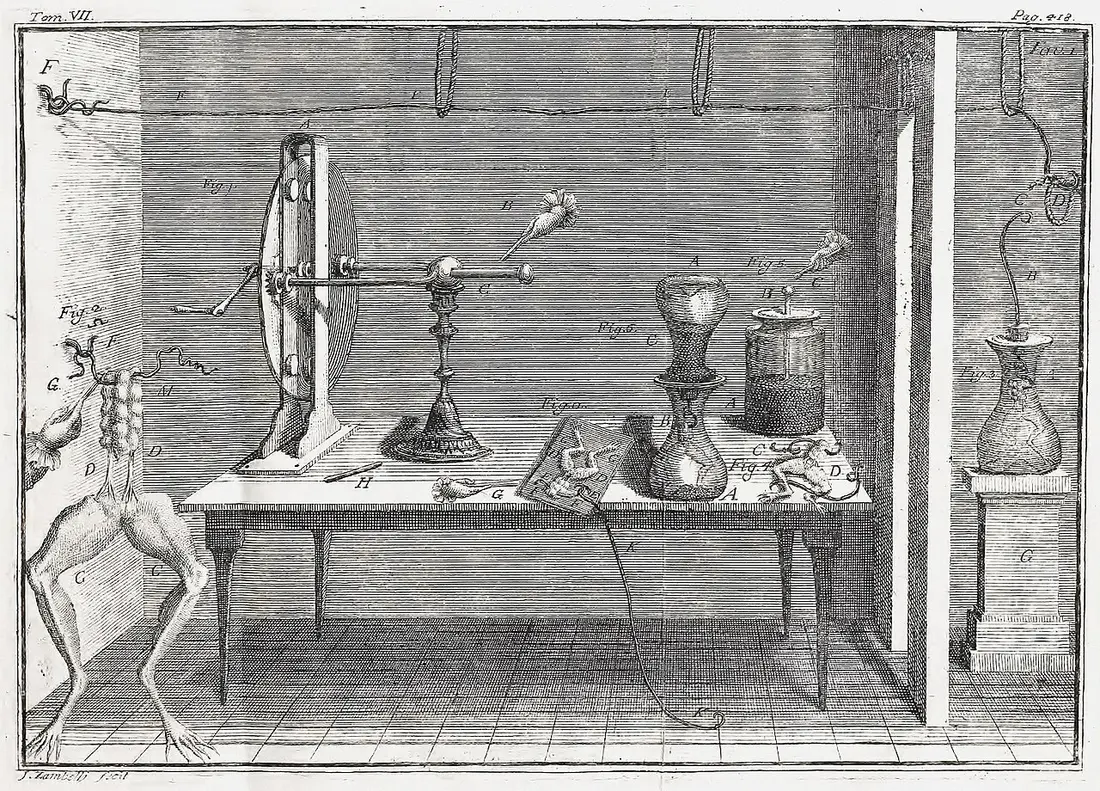
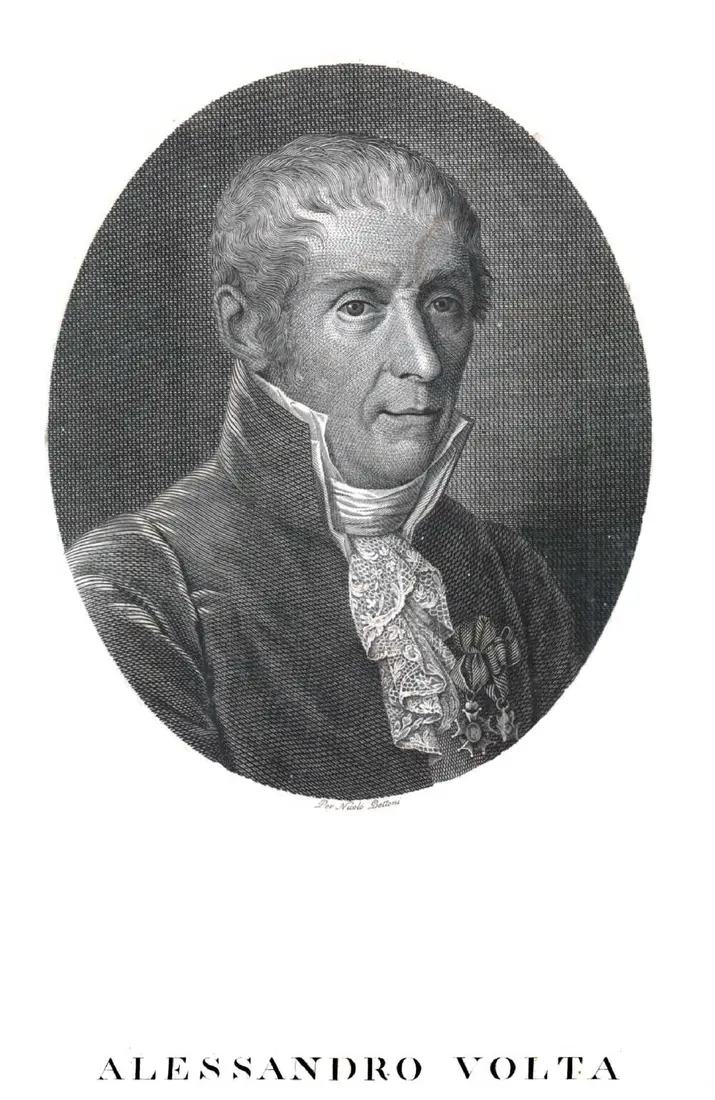
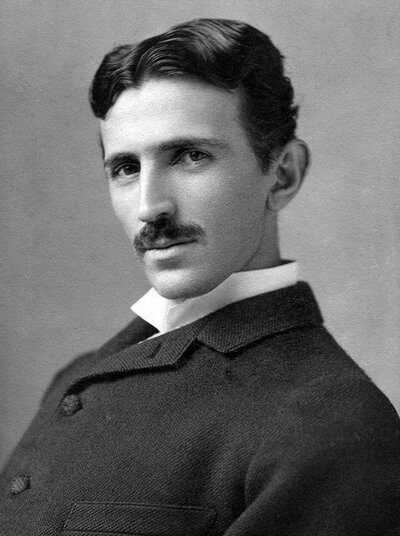
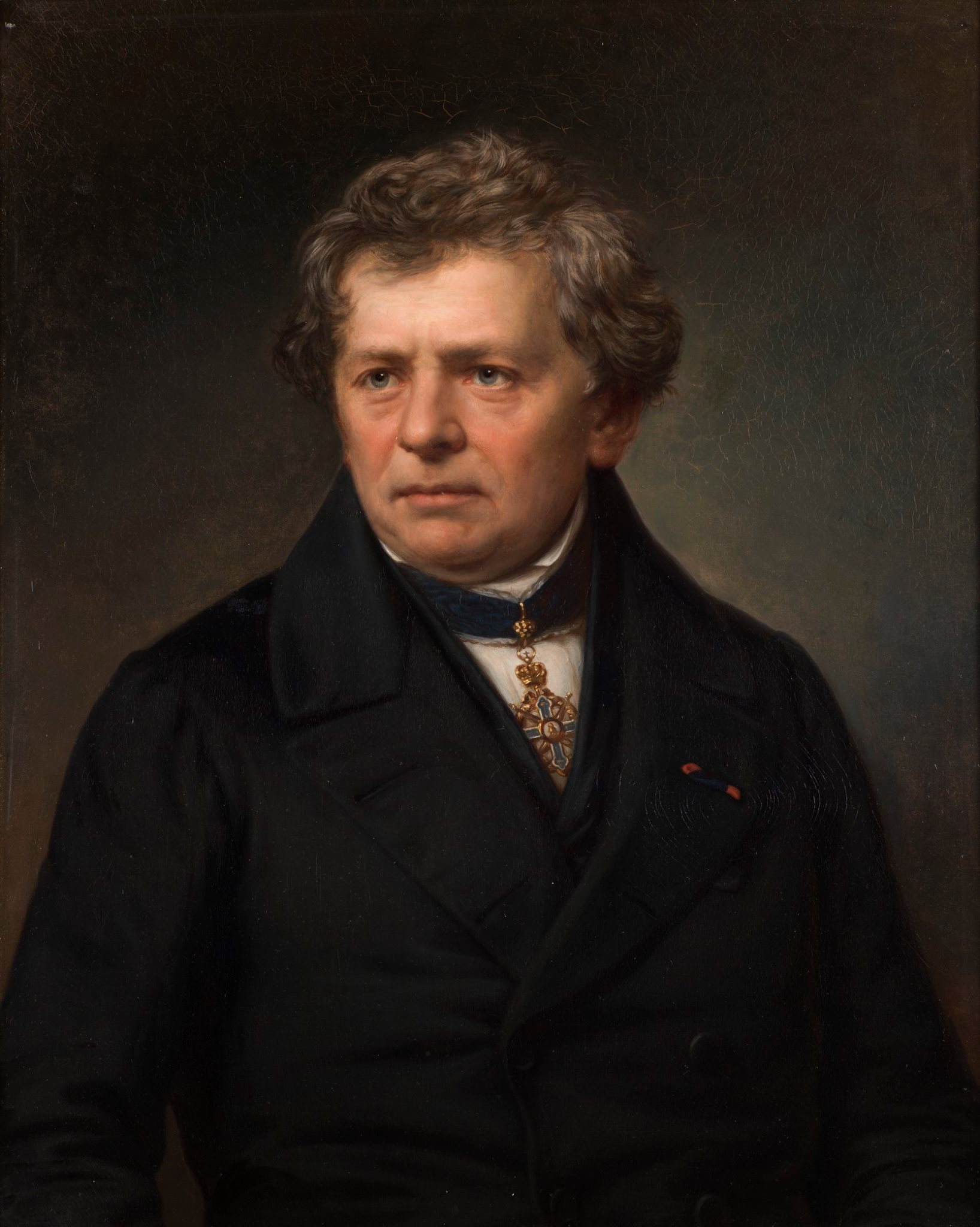
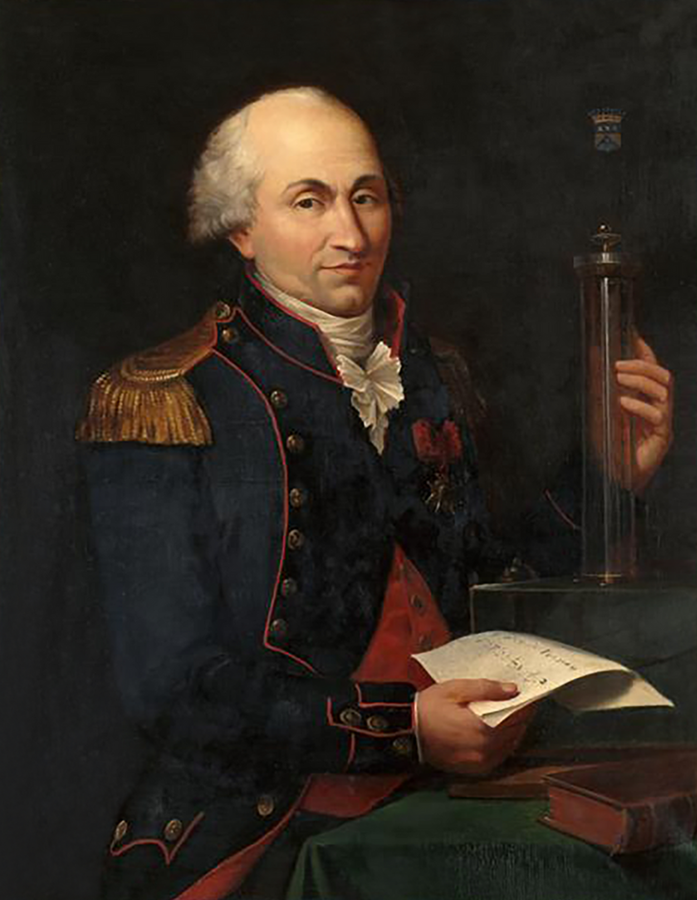
Luigi Galvani noticed two dissimilar metals touching damp muscle caused twitches (1780s), kicking off a debate over "animal electricity" vs. metal chemistry. Plate from De viribus electricitatis (1791) · Wikimedia Commons · Public domain Alessandro Volta proved the metals and salt solution drove the current — inventing the 1800 voltaic pile battery and giving his name to the volt (V). Engraving by Nicolò Bettoni · Wikimedia Commons · Public domain Michael Faraday discovered electromagnetic induction in 1831 — showing a changing magnetic field generates electric current in a generator. Historical portrait · Wikimedia Commons · Public domain Nikola Tesla championed polyphase alternating current (AC), allowing transformers to beam power long distances instead of Edison's short-range DC. See Nikola Tesla & AC vs. DC. Portrait by Napoleon Sarony · Wikimedia Commons · Public domain
6. From Power Plant to Your Wall
Fly along the grid from the generator to your wall. Press a stage (or drag the landscape sideways), or let the tour carry you. Watch the voltage climb to hundreds of thousands of volts for the long trip, then step back down before it reaches your outlets.
A power plant sends 100 MW (enough for about 80,000 homes) down a line with 10 Ω of resistance. Current is I = P ÷ V, and the line turns I²R into heat. Pick the line voltage:
13.8 kV69138345765 kV
Current in the line290 AI = P ÷ V
Heat lost0.8 MWI² × R
Share lost0.84%of the 100 MW sent
7. Try It Yourself
Electricity is easy to explore safely on a tabletop. Filter activities by age below — and always perform current-electricity projects only with low-voltage batteries (never wall outlets!).
Balloon on the wall
Any age
5 min
Easy
Rub a balloon on your hair or a wool sweater, then press it gently to a wall. It sticks with no glue at all.
You need: a balloon, dry hair or a wool sweater, a painted wall.
Steps
Blow up and tie the balloon.
Rub it briskly on dry hair or wool for 20 seconds.
Hold the rubbed side against a wall and let go gently.
Time how long it stays. Try again on a humid day and compare.
What's happening
Rubbing moves electrons from your hair onto the balloon, so it carries extra negative charge. Near the wall, that charge pushes the wall's electrons slightly away (electrostatic induction), leaving the wall's surface a little positive, and opposites attract. Humid air lets the charge leak away faster.
Bending water
Any age
5 min
Easy
Charge a plastic comb on dry hair and bring it near a thin, steady trickle of tap water. The stream swerves toward the comb in midair.
You need: a plastic comb (or balloon), a tap, dry hair.
Steps
Open the tap until the stream is pencil-thin and smooth, not dripping.
Comb dry hair 10 times quickly.
Bring the teeth close to the stream (don't touch it) and watch it bend.
Try with the comb uncharged. What changes?
What's happening
Water molecules are polar: the oxygen end is slightly negative and the hydrogen ends slightly positive. The charged comb twists them so their positive ends face it, and the whole stream is pulled sideways. Touch the stream and the charge drains away.
Jumping paper bits
Ages 4+
5 min
Easy
Tear tissue paper into confetti, charge a balloon, and hover it above the table. The confetti leaps up, clings, and some pieces jump away again.
You need: tissue paper, a balloon or plastic ruler, a wool sweater.
Steps
Tear tissue paper into pieces smaller than your fingernail.
Charge the balloon on wool for 20 seconds.
Hold it 2–3 cm above the pile and slowly lower it.
Watch closely: why do some pieces fly back off?
What's happening
The charged balloon induces opposite charge on the near side of each light paper scrap, so it is attracted. Once a scrap touches the balloon, it picks up some of the balloon's charge, now has the same sign, and is pushed off again.
Lemon (or potato) battery
Ages 8+
20 min
Medium
Push a galvanized (zinc-coated) nail and a copper coin into a lemon. A chemical reaction between the two metals and the juice pushes about 0.9 V. Chain lemons to add their voltages.
You need: 3–4 lemons or potatoes, galvanized nails, copper coins or strips, alligator-clip leads, a red LED.
Steps
Roll each lemon on the table to free up the juice inside.
In each lemon, push a nail and a coin in about 2 cm apart. They must not touch.
Wire the copper of one lemon to the nail of the next.
Connect the LED's long leg to the free copper and its short leg to the free nail. Dim the lights.
What's happening
Zinc gives up electrons more easily than copper does. The acid in the juice lets zinc dissolve as ions, leaving electrons behind on the nail; they flow through your wire to the copper. That makes the nail the negative terminal. The lemon is only the salt bridge: the energy comes from the zinc being used up.
Build a simple circuit
Ages 8+
20 min
Medium
Connect a battery, a switch, a resistor and an LED in one closed loop on a breadboard. Then break the loop anywhere and watch it go dark.
You need: a 9 V battery and snap, a breadboard, a 470 Ω resistor, an LED, a slide switch, jumper wires.
Steps
Battery + to the switch, switch to the resistor.
Resistor to the LED's long leg (anode).
LED's short leg back to battery −.
Flip the switch. Then swap in a 1 kΩ resistor: is it dimmer?
What's happening
Current only flows around a complete loop. The resistor limits it: (9 V − 2 V for the LED) ÷ 470 Ω ≈ 15 mA, a safe glow. Without it the LED would take far more current and burn out. Full wiring guide in Breadboard Basics.
Electromagnet from a nail
Ages 8+
15 min
Medium
Wrap insulated magnet wire 40+ times around an iron nail, touch the ends to a D-cell, and pick up a chain of paper clips. This is Ørsted's 1820 discovery in your hand.
You need: a large iron nail, 1 m of enamelled magnet wire, sandpaper, a D-cell, paper clips.
Steps
Sand 2 cm of enamel off each wire end.
Wind the wire tightly around the nail, all in one direction.
Hold the ends on the battery terminals for a few seconds at a time (it gets warm).
Count the clips it lifts. Add 20 more turns and count again.
What's happening
Every moving charge makes a magnetic field. Coiling the wire stacks the fields of all the turns together, and the iron nail lines up its own tiny magnetic domains with them, multiplying the field hundreds of times. Break the circuit and the magnet switches off.
Short-circuits a battery: only connect it for a few seconds, and never use a wall supply.
Fun Facts & Myths, Busted
Myth: individual electrons race at the speed of light Individual electrons inside copper actually drift slower than a snail (around millimeters per second!). What snaps forward at near light speed is the electric field wave pushing all electrons along the wire almost simultaneously.
Fact: lightning hits ~30,000 K (5× hotter than the Sun's surface) Superheating air to five times solar surface temperature (~5,800 K) causes explosive thermal expansion — creating the acoustic shockwave you hear as thunder.
Myth: Benjamin Franklin discovered electricity Static electricity was documented ~2,400 years before Franklin. His 1752 storm insight proved sky lightning and tabletop Leyden-jar sparks share the exact same physical nature.
Fact: your nervous system runs on electrical signals Every thought, blink, and heartbeat relies on sodium (Na⁺) and potassium (K⁺) ion currents racing down neurons — biology's own bioelectric circuits.
Safety first Never recreate Franklin's kite experiment — lightning carries millions of volts (fellow researcher Georg Wilhelm Richmann died repeating a lightning-rod test in 1753). Household static sparks are tiny and brief; wall outlets carry lethal sustained current. Experiment with batteries only.
Go Further
This lesson is your launchpad into the Electronics & Physics track. Pick any lesson or external simulation below to dive deeper.