Composer arrangement studio
Antonio Vivaldi
Read, play, or arrange three complete movements from The Four Seasons: the first movement of “Spring,” the lyrical Largo from “Winter,” and the stormy Presto from “Summer.” Compare the solo violin with the supporting strings, slow a passage, or isolate a source staff and voice. The bass line is included; playback does not add an improvised continuo realization.
Arranging with care
A source staff is not always the melody: in an orchestral score, find the staff carrying the theme. A two-part piano study pairs your selected voice with a source bass; it is not a concert reduction and wide leaps may need redistribution. Saxophone notation is transposed while playback stays at concert pitch. Violin parts stay at concert pitch and are moved by octaves to sit above the open G string. Guitar tab preserves pitch and rhythm but may need a different octave or fingering. Chords are prepared for the Ode to Joy theme only; classical harmony elsewhere requires score study rather than automatic chord guesses. Original ensembles are available only where the source contains those parts. Piano reductions and original classroom studies retain their source identities.
Recordings: Nicholaus P. Brosowsky’s Tonejs-Instruments sample collection, CC BY 3.0; VSCO 2 Community Edition, CC0. Sample credits and processing.
Music · Baroque Era · Program Music
About Antonio Vivaldi
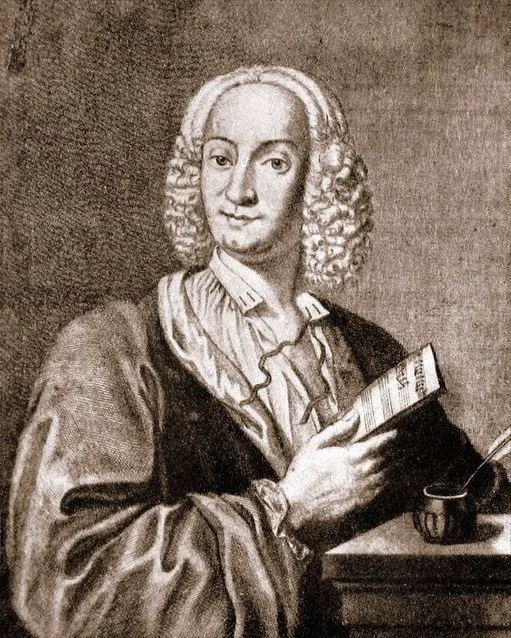
Antonio Vivaldi (1678–1741) was a red-haired priest from Venice who became one of the most famous violinists in Europe. He taught music at an orphanage whose all-girl orchestra drew visitors from across the continent, wrote hundreds of concertos for them, and published The Four Seasons — four violin concertos that tell stories about birds, storms, sleepy shepherds and icy roads using nothing but instruments.
Who Was Vivaldi?
Vivaldi was born in Venice on March 4, 1678. His father, Giovanni Battista, was a barber turned professional violinist at St. Mark’s Basilica, and almost certainly taught his son to play. Antonio trained for the priesthood and was ordained in 1703. Because of his red hair he became known as il Prete Rosso, “the Red Priest.” He suffered all his life from a tightness of the chest — probably a form of asthma — and soon stopped saying Mass, devoting himself to music instead.
In 1703 he became violin master at the Ospedale della Pietà, a Venetian home for abandoned and orphaned girls. The Pietà trained its most talented residents as musicians, and its concerts, played by young women, became a famous attraction for tourists. Vivaldi worked there on and off for about thirty years, writing concertos, sacred music and teaching pieces for its performers.
He was enormously productive. About 500 of his concertos survive — around 230 of them for violin — along with dozens of operas, which he also produced as a businessman. In 1725 a publisher in Amsterdam printed his Opus 8, Il cimento dell’armonia e dell’inventione (“The Contest between Harmony and Invention”). Its first four concertos were The Four Seasons, each printed with a sonnet describing the scene, and with labels in the score such as “the barking dog.”
Vivaldi’s popularity faded in Venice in the 1730s. In 1740 he moved to Vienna, perhaps hoping for support from Emperor Charles VI, who soon died. Vivaldi died in Vienna on July 28, 1741, and was buried in a simple grave. His music was then largely forgotten until the twentieth century, when a large collection of his manuscripts was rediscovered and scholars and performers brought him back.
Vivaldi in a Title Page and a Sketch
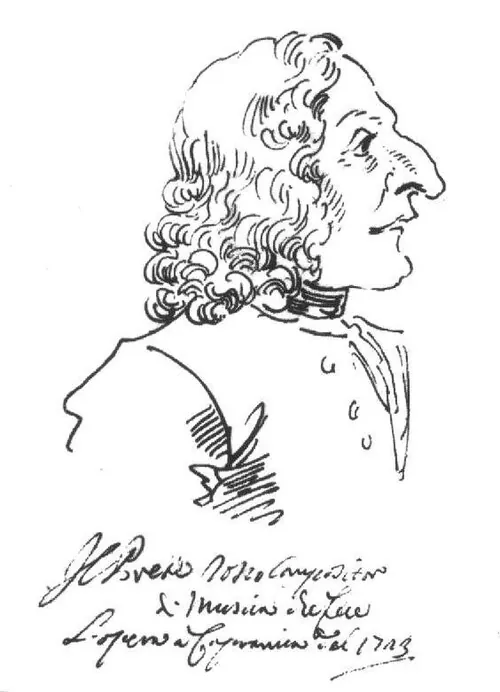
Even the engraving beside his biography is not a certain likeness; the only sure one is a quick ink caricature. His own publication shows how The Four Seasons first reached the world. Click any picture to enlarge it.

From Venice to Vienna
- 1678 Born March 4 in Venice.
- 1703 Ordained a priest; becomes violin master at the Ospedale della Pietà.
- 1711 His Opus 3 concertos, L’estro armonico, are printed and spread across Europe.
- 1713 His first opera is staged; he will produce dozens more.
- 1713–14 In Weimar, the young J. S. Bach arranges several Vivaldi concertos for keyboard.
- 1723 Agrees to supply the Pietà with two concertos a month, even while travelling.
- 1725 Opus 8, including The Four Seasons, is published in Amsterdam.
- 1740 Leaves Venice for Vienna.
- 1741 Dies in Vienna on July 28.
- 1920s A huge collection of his manuscripts is rediscovered, launching a Vivaldi revival.
Program Music: Telling a Story Without Words
Program music is instrumental music that describes something outside itself — a scene, a story, a feeling. The Four Seasons is one of the earliest famous examples. Each concerto came with a sonnet, and Vivaldi printed lines of the poem right in the score so players knew what they were painting.
Each fast movement is built on a ritornello (“little return”): a theme the whole orchestra plays at the start and keeps coming back to, with solo episodes in between. In “Spring” the solos are the pictures: three violins trilling like birds, a murmuring brook, a quick thunderstorm, then the birds again.
Notice the sudden switch from loud to soft in the score. Baroque composers often used terraced dynamics — whole phrases at one level, then another — instead of slow crescendos.
Like a chorus between verses: the returning theme holds the movement together while the solos tell the story.
How does a violin imitate a bird?
Who wrote the sonnets?
What is the barking dog?
Read & Play: “Spring”
This is the complete first movement in full score: the solo violin on top, then the orchestra’s first and second violins, viola and cello. Count four steady beats per bar; the single eighth-note pickup leads into bar 1. Predict how the p in bar 4 will change the music.
Each player holds a complete piece. Use the song map or the Bar box to jump anywhere, click a note to hear it, and Shift-click a second bar to loop a passage. The measure-by-measure guide under each score follows the music as it plays; mute a hand or a part to hear one line alone. Every player links to the complete printed score for printing.
Spring · first movement, complete
Predict → play → explain
- Read: say G♯–G♯–G♯, F♯–E, then B. Clap the rhythm before playing.
- Test: set Speed to 60%, click bar 1, then Shift-click bar 3 to loop the opening; then loop bars 4–6 to hear the echo. Does piano change pitch, speed or loudness?
- Explain: point to the soft entry and describe how the echo makes the return recognizable. Then jump to bar 14 and find the birds.
Use the zoom buttons to enlarge the notation and ⤢ for full screen. Pitch names are optional; the note list lets you choose a starting note with the keyboard. Playback is synthesized and represents only the written notes.
Hear Vivaldi's Music
Violinist John Harrison recorded all four concertos with a chamber orchestra and released them under a free licence. The Winter recording is by the US Air Force Concert Band — a wind band playing music written for strings.
- In “Spring,” listen for the ritornello theme returning between the birds, the brook and the storm.
- In the Largo, find the “barking dog” — two notes repeated in the violas underneath the calm solo.
- In “Winter,” the fast repeated notes paint shivering. How does a band make the same picture without violins?
Beyond “Spring”: Explore Vivaldi’s Repertoire
A repertoire is a collection of works to study or perform. Vivaldi wrote for many instruments and for voices, not just solo violin. RV numbers identify works in the catalogue of his music; they are not movement numbers or difficulty levels. Choose one work below to compare with “Spring.” The links open complete scores and, where available, recordings on IMSLP.
Play in the studio above: “Winter,” Op. 8 No. 4 (RV 297), second movement, Largo — follow the singing solo over the moving accompaniment. Then try “Summer,” Op. 8 No. 2 (RV 315), third movement, Presto — compare rapid repeated notes, scales, and solo episodes. Both selections include the complete movement and a passage-by-passage guide.
Two soloists: Concerto for Two Violins in A minor, RV 522
Concerto · Op. 3 No. 8, from L’estro armonico. Two solo violins share the spotlight with strings and continuo, the supporting bass-and-harmony part.
Investigate: follow the two solo lines in the first movement. Find a place where they answer each other and a place where they play together. How does sharing the lead change the solo-versus-ensemble relationship you heard in “Spring”?
A plucked solo instrument: Lute Concerto in D major, RV 93
Chamber concerto · lute, two violins and continuo. A lute’s strings are plucked rather than bowed; modern performances also use guitar.
Predict → test: will a plucked note sustain as long as a bowed violin note? Compare the slow movement, Largo, with the Largo of “Spring.” Describe the melody and the sound’s decay separately. Check which instrument your chosen recording uses.
Voices together: Gloria in D major, RV 589
Sacred vocal music · solo voices, chorus and orchestra · Latin text. This is a setting of the Gloria text used in Christian worship, rather than an instrumental concerto.
Compare: study the opening “Gloria in excelsis Deo” and the following “Et in terra pax.” How do tempo, texture and mood change? Unlike “Spring,” the singers communicate through words as well as musical gestures.
Music for the stage: Griselda, RV 718
Opera · three acts · Italian text · voices and orchestra. An opera tells a staged story through singing. An aria gives a character space to express a feeling, while recitative uses speech-like singing to move the action forward.
Investigate: find an aria and a recitative in the score. Compare their rhythms and accompaniment. How is a character singing words different from the violin suggesting a bird or storm?
Build a two-work concert programme
Pair “Spring” with one work above. Write the title and RV number, identify who carries the melody, and give two musical differences supported by a bar number or a recording timestamp. Finish with one sentence explaining why your pair shows more of Vivaldi’s range.
These are score-study and listening choices, not beginner performance assignments. The embedded player above contains Four Seasons recordings; the wider repertoire opens on the linked source pages. Check each edition’s and recording’s separate rights terms.
Vivaldi's Key Contributions
In his concertos, three movements (fast, slow, fast) and a returning orchestral "ritornello" became the standard plan. He wrote about 500 of them.
Published in 1725 with a sonnet for each season, these four concertos are some of the best-known program music ever written.
He wrote the solo parts for himself to play. His fast runs, high positions and special effects stretched what violinists were expected to do.
For decades he trained the orchestra of girls and young women at Venice’s Ospedale della Pietà, which became famous across Europe.
J.S. Bach copied and arranged several Vivaldi concertos for keyboard and organ to learn how he built them.
He wrote and staged dozens of operas, often managing the theater business himself.
Vivaldi's Legacy Today
Vivaldi helped fix the shape of the concerto — fast, slow, fast movements, with a soloist set against an orchestra — that composers used for the next three centuries. J. S. Bach learned from his concertos by copying and arranging them.
For almost two hundred years Vivaldi was little more than a name. Once his manuscripts resurfaced and recordings spread in the twentieth century, The Four Seasons became one of the most recorded pieces of classical music, and you can hear it today in films, adverts and phone hold music. His story is also a reminder of the many young women at the Pietà whose playing made his music famous, though most of their names were never recorded.
Find the Complete Sheet Music
Vivaldi’s composition is in the public domain; modern editions have their own terms. These study excerpts adapt the first orchestral violin part of Mutopia’s CC BY-SA 3.0 edition. Keep its attribution and share adaptations under the same licence. Choose the full score to study the orchestra, or the violin part to practise.
Practice Problems
Review: Biography · The musical idea · Read and play.
Use the score, the recordings and the biography above.
Easy1. What was Vivaldi’s nickname?
Easy2. How many sharps are in the key signature of “Spring”?
Medium3. The Four Seasons is four concertos, each with three movements. How many movements is that?
Medium4. In the score, what does the p on the last eighth note of bar 3 tell the players to do?
Medium5. What is a ritornello?
Medium6. The Four Seasons was published in 1725. Vivaldi died in 1741. How many years later was that?
Challenge7. A violin string vibrating at 330 Hz is shortened to half its length (same tension). What frequency does it make now?
Challenge8. Why is The Four Seasons called program music?