Composer arrangement studio
Erik Satie
Arranging with care
A source staff is not always the melody: in an orchestral score, find the staff carrying the theme. A two-part piano study pairs your selected voice with a source bass; it is not a concert reduction and wide leaps may need redistribution. Saxophone notation is transposed while playback stays at concert pitch. Violin parts stay at concert pitch and are moved by octaves to sit above the open G string. Guitar tab preserves pitch and rhythm but may need a different octave or fingering. Chords are prepared for the Ode to Joy theme only; classical harmony elsewhere requires score study rather than automatic chord guesses. Original ensembles are available only where the source contains those parts. Piano reductions and original classroom studies retain their source identities.
Recordings: Nicholaus P. Brosowsky’s Tonejs-Instruments sample collection, CC BY 3.0; VSCO 2 Community Edition, CC0. Sample credits and processing.
Music · Modern Era · The Avant-Garde Minimalist
Meet Erik Satie
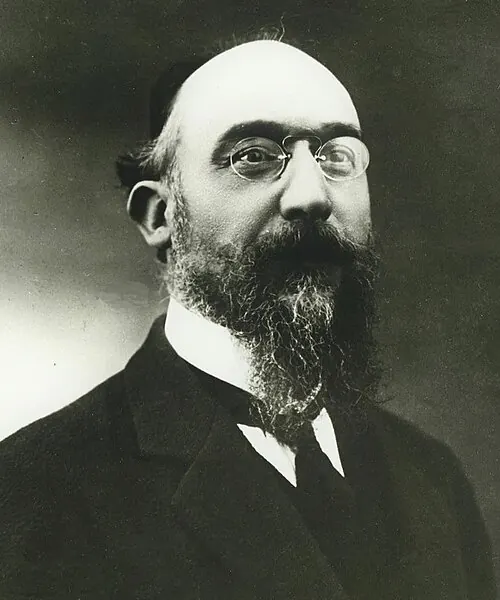
Erik Satie (1866–1925) turned Western music upside down. Writing from a tiny room in bohemian Paris, he rejected the grand bombast of late-Romantic symphonies in favor of serene modal chords, hypnotic stillness, and humorous Dadaist titles—laying the foundations for modern minimalism, Surrealism, and ambient music.
Who Was Erik Satie?
Éric Alfred Leslie Satie was born in Honfleur, Normandy, in 1866. When his family moved to Paris, he entered the Paris Conservatoire in 1879, aged thirteen. The strict academic professors were unimpressed: one teacher called him "the laziest student in the Conservatoire," while another labeled him gifted but hopelessly indolent. Satie dropped out, spent a brief stint in the military, and deliberately caught bronchitis by standing in the cold so he could be discharged and return to music.
In the late 1880s, Satie plunged into the bohemian artist community of Montmartre. He earned a meager living playing piano at the famous cabaret Le Chat Noir ("The Black Cat"). There he adopted an eccentric persona (a few years later, with a small inheritance, he bought seven identical grey velvet suits and wore nothing else, earning the nickname "The Velvet Gentleman") and composed short, distinctive piano works: the three Gymnopédies (1888) and the pieces now collected as six Gnossiennes (1889–1897). The first three Gnossiennes were published in 1893; Nos. 4–6 were published after his death. While his contemporaries wrote lush, overwrought romantic dramas, Satie created calm, unadorned music that floated without urgency.
In 1898, tired of Parisian salon gossip, Satie moved to Arcueil, a working-class suburb four miles south of Paris. Every day for the rest of his life, he walked across Paris in his suit with an umbrella in hand. Remarkably, in 1905 at age thirty-nine, feeling insecure about his technique, he enrolled in the Schola Cantorum, where he studied counterpoint with Albert Roussel and also studied with Vincent d'Indy. He earned a counterpoint diploma in 1908 and continued his studies afterward.
In his fifties, Satie became an icon to a new generation of avant-garde artists. Claude Debussy and Maurice Ravel championed his genius, Jean Cocteau recruited him to write the groundbreaking ballet Parade (1917) with sets by Pablo Picasso, and a group of young French composers known as Les Six idolized him. When Satie died in 1925, friends who entered his locked room for the first time in twenty-seven years found two grand pianos stacked on top of each other, dozens of unused walking sticks, and hundreds of unpublished manuscripts tucked into cigar boxes.
Sources: Palazzetto Bru Zane: Six Gnossiennes; Satie’s Schola Cantorum studies and 1908 diploma; Satie chronology.
Satie in a Painting and a Manuscript
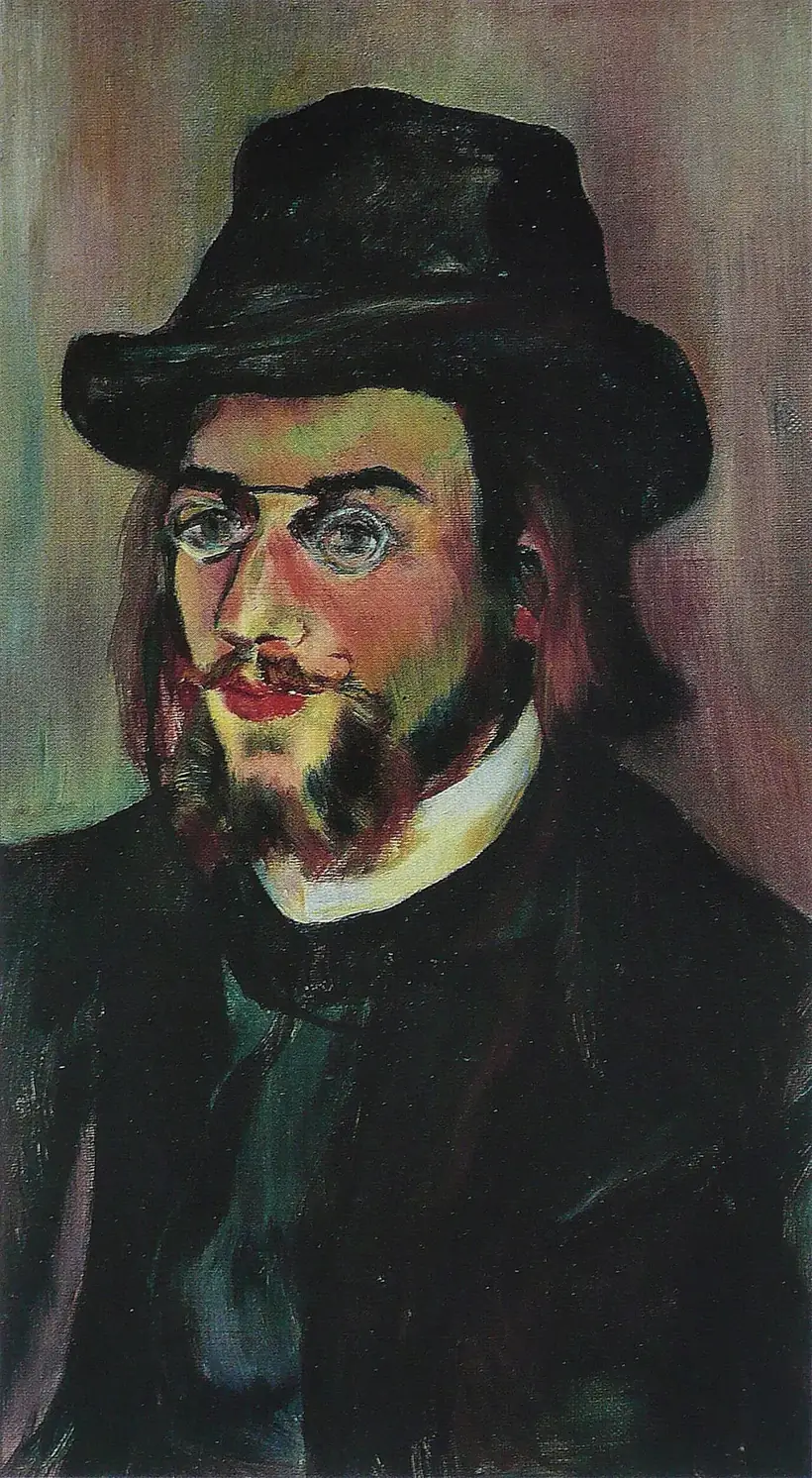
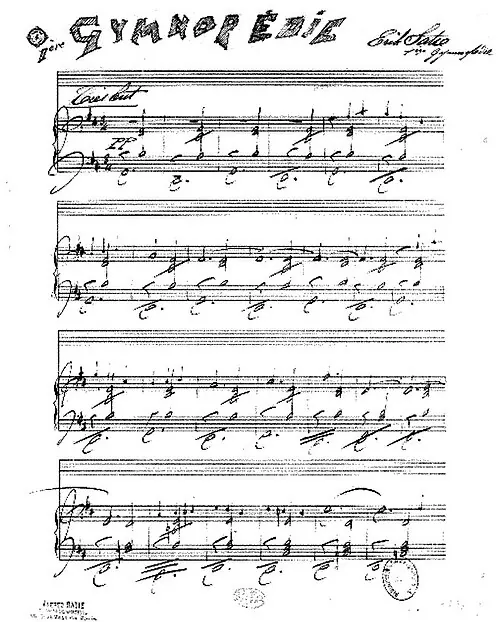
Satie’s visual world was just as idiosyncratic as his music. Suzanne Valadon, an artist who was his companion in 1893, captured his youthful intensity, while his own handwritten scores were famous for their exquisite calligraphic precision. Click any image to enlarge.
From Normandy to the Avant-Garde
- 1866 Born in Honfleur, Normandy (May 17).
- 1879 Enters the Paris Conservatoire; teachers brand him untalented and lazy.
- 1887 Moves to Montmartre; plays piano at Le Chat Noir cabaret.
- 1888 Composes the three Gymnopédies, pioneering serene modal harmony.
- 1889–1897 Composes the six pieces now collected as Gnossiennes; the first three use no barlines or time signatures.
- 1893 Writes Vexations, directing a brief motif to be repeated 840 times.
- 1898 Moves to the working-class suburb of Arcueil, walking into Paris daily.
- 1905–08 Enrolls at the Schola Cantorum at age 39; studies counterpoint with Albert Roussel and earns a diploma in 1908.
- 1917 Premieres the Cubist ballet Parade with Jean Cocteau and Pablo Picasso.
- 1917–1923 Writes Musique d’ameublement ("Furniture Music"), prefiguring ambient sound.
- 1925 Dies in Paris on July 1, aged 59.
Modal Harmony, Furniture Music & Surrealism
In the late nineteenth century, European concert halls were dominated by Richard Wagner and Johannes Brahms: massive orchestras, relentless tension, and heavy drama. Satie took the opposite path. He stripped away everything non-essential, crafting music of quiet dignity, bare textures, and hypnotic repetition.
Three radical ideas define Satie’s revolution:
“Furniture Music” (Musique d’ameublement): Satie instructed concertgoers to ignore his music, talk, and drink coffee while it played—anticipating ambient music by half a century.
What is a Gymnopédie?
What is a Gnossienne?
What was Satie’s piece Vexations?
Read & Play: Two Complete Satie Masterpieces
Explore Satie’s two defining keyboard works note by note. Follow the steady left-hand pulse and notice how the right-hand melody floats across the barlines without rushing.
Each player holds a complete piece. Use the song map or the Bar box to jump anywhere, click a note to hear it, and Shift-click a second bar to loop a passage. The measure-by-measure guide under each score follows the music as it plays; mute a hand or a part to hear one line alone. Every player links to the complete printed score for printing.
Gymnopédie No. 1 · complete, 78 bars
Gnossienne No. 1 · complete, 82 bars
Hear Satie's Music
Listen to public-domain recordings of Satie’s piano pieces, from his serene Gymnopédies to his sparkling cabaret waltz Je te veux.
- Compare the human performance of Gymnopédie No. 1 with the score player. Notice how the pianist allows the bass notes to bloom under the pedal.
- In Gnossienne No. 1, listen for the delicate grace notes and the exotic modal color created by the raised fourth scale degree.
- Je te veux shows Satie’s lighter, satirical café-concert style—a lilting waltz that became an instant Parisian favorite.
Satie's Key Contributions
Satie created Musique d’ameublement—background music meant to blend with ambient conversation and room sounds, directly anticipating Brian Eno and modern ambient music.
He broke free of traditional functional harmony, using parallel chords, ancient church modes, and floating major sevenths that influenced Debussy and Ravel.
In the first three Gnossiennes, Satie omitted barlines and time signatures, encouraging performers to feel music as breath and gesture rather than mechanical meter.
With Parade (1917), Satie, Picasso, and Cocteau brought typewriters, foghorns, and Cubist costumes to the stage, scandalizing Paris. The poet Apollinaire’s programme note for it coined the word “surrealism”.
His piece Vexations, requiring 840 repetitions of an enigmatic theme, predated 1960s minimalism, endurance performance art, and conceptual music by seventy years.
Satie was the godfather to Les Six (Poulenc, Milhaud, Honegger) and an essential inspiration to American iconoclasts like John Cage.
Satie's Legacy Today
During his lifetime, critics frequently dismissed Satie as an amateur or a musical trickster. Today, musicologists recognize him as one of the most prophetic figures in twentieth-century music. By questioning whether music must always develop, build climaxes, or tell dramatic stories, Satie opened the door to modern film scoring, ambient soundscapes, minimalism, and lo-fi beats.
His Gymnopédies and Gnossiennes are among the most frequently streamed and performed classical pieces in the world. Their timeless, meditative calm continues to inspire composers, film directors, and bedroom producers more than a century after they were written in a chilly Montmartre garret.
Find the Complete Sheet Music
These public-domain editions are free to download, print, and play. The players above include complete engraved scores; use these links for original historical editions and printable PDFs.
- Gymnopédie No. 1 — Mutopia Edition ↗Free engraved PDF and LilyPond source based on the Dover edition
- Gnossienne No. 1 — Mutopia Edition ↗Typeset by Knute Snortum after the 1913 Éditions Salabert score
- 3 Gymnopédies on IMSLP ↗Historical first editions and orchestral arrangements by Claude Debussy
- 6 Gnossiennes on IMSLP ↗The first three include unbarred notation and Satie’s poetic notes; Nos. 4–6 use barlines
- All of Erik Satie on IMSLP ↗Sarabandes, Je te veux, Sports et divertissements, and more
Practice Problems
Review: Biography · The musical idea · Read and play.
Use the scores, the recordings, and the biography above.
Easy1. In which Parisian bohemian district did Satie play cabaret piano at Le Chat Noir in the late 1880s?
Easy2. How many beats are in each measure of Gymnopédie No. 1 (in 3/4 meter)?
Medium3. What was Satie’s concept of “Furniture Music” (Musique d’ameublement)?
Medium4. Which two major-seventh chords oscillate continuously across the opening measures of Gymnopédie No. 1?
Medium5. In his extreme conceptual piece Vexations, how many times did Satie instruct the pianist to repeat the short motif?
Medium6. What standard notation element did Satie famously omit from the scores of his first three Gnossiennes?
Challenge7. How many bars long is Gymnopédie No. 1 in its complete unfolded form?
Challenge8. Erik Satie was born in 1866 and passed away in 1925. How old was he at his death?