Composer arrangement studio
Scott Joplin
Arranging with care
A source staff is not always the melody: in an orchestral score, find the staff carrying the theme. A two-part piano study pairs your selected voice with a source bass; it is not a concert reduction and wide leaps may need redistribution. Saxophone notation is transposed while playback stays at concert pitch. Violin parts stay at concert pitch and are moved by octaves to sit above the open G string. Guitar tab preserves pitch and rhythm but may need a different octave or fingering. Chords are prepared for the Ode to Joy theme only; classical harmony elsewhere requires score study rather than automatic chord guesses. Original ensembles are available only where the source contains those parts. Piano reductions and original classroom studies retain their source identities.
Recordings: Nicholaus P. Brosowsky’s Tonejs-Instruments sample collection, CC BY 3.0; VSCO 2 Community Edition, CC0. Sample credits and processing.
Music · American Ragtime · Syncopation & Piano Rolls
About Scott Joplin
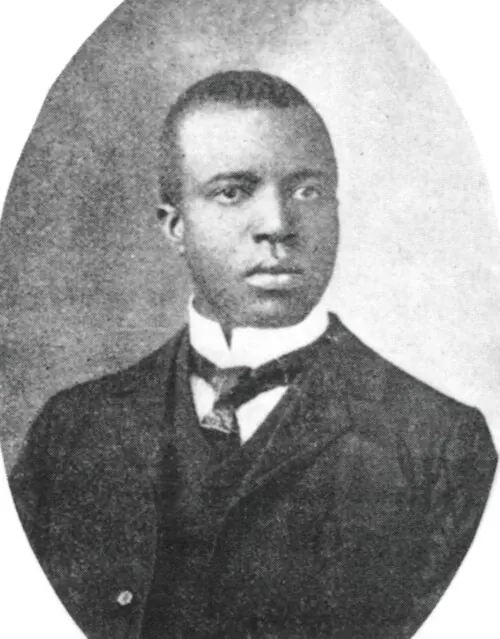
Scott Joplin (c. 1868–1917) was the son of a formerly enslaved father and a freeborn mother, and he became the “King of Ragtime.” His Maple Leaf Rag was one of the best-selling pieces of sheet music of its time, and his syncopated rhythms helped lay the ground for jazz. He saw ragtime as serious art — and wrote an opera to prove it.
Who Was Scott Joplin?
Joplin was born around 1868 in northeast Texas — the exact date is not known — and grew up in Texarkana. His father, Giles, had been enslaved; his mother, Florence, was freeborn and worked cleaning houses. According to accounts of his childhood, Scott taught himself on a piano in one of the homes where his mother worked. A German-born music teacher, Julius Weiss, noticed his talent and gave him free lessons in classical music and opera.
As a young man Joplin travelled as a pianist through the Mississippi Valley, playing in saloons, clubs and dance halls, and he was in Chicago in 1893 during the World’s Fair, where ragtime was reaching big crowds. Around 1894 he settled in Sedalia, Missouri, where he taught, played, and took music classes at the George R. Smith College for African Americans.
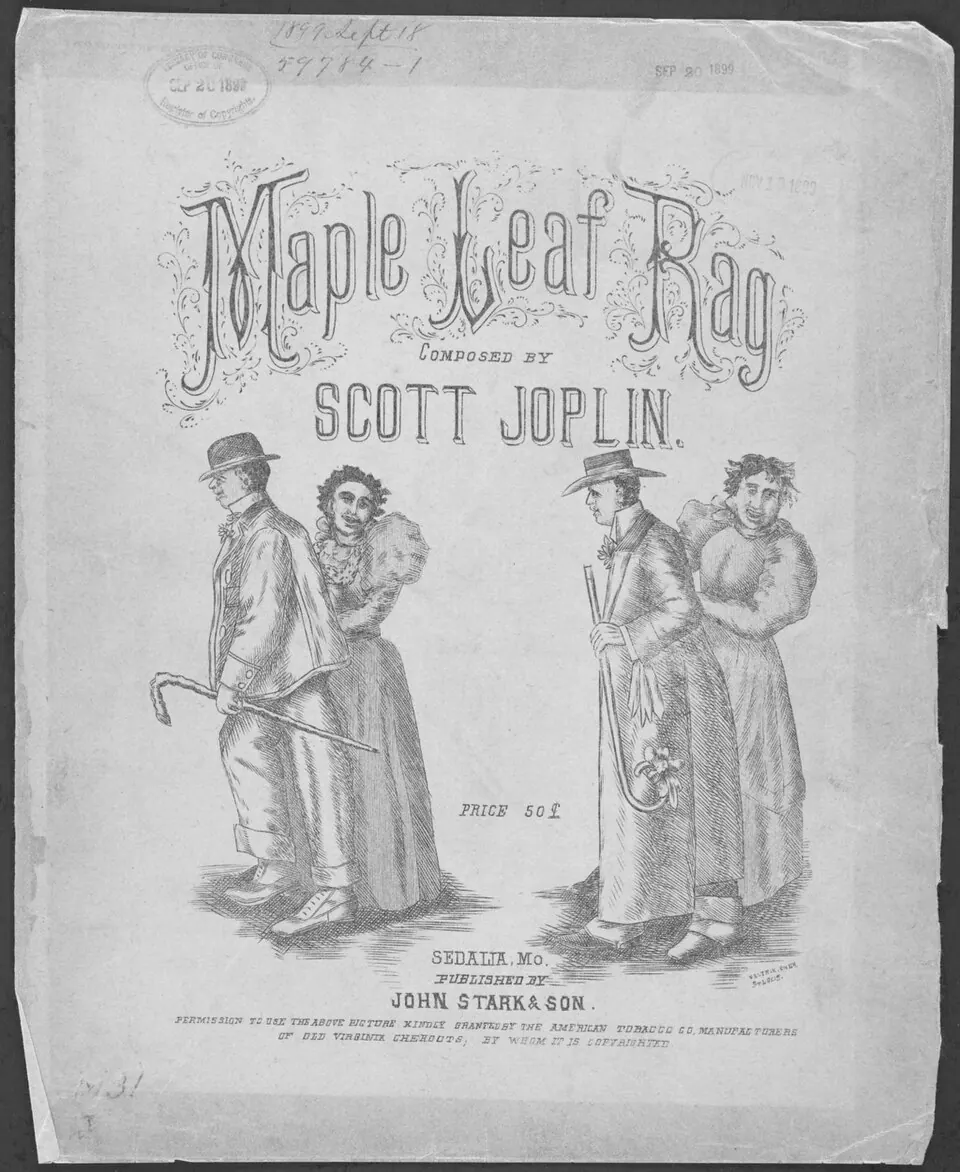
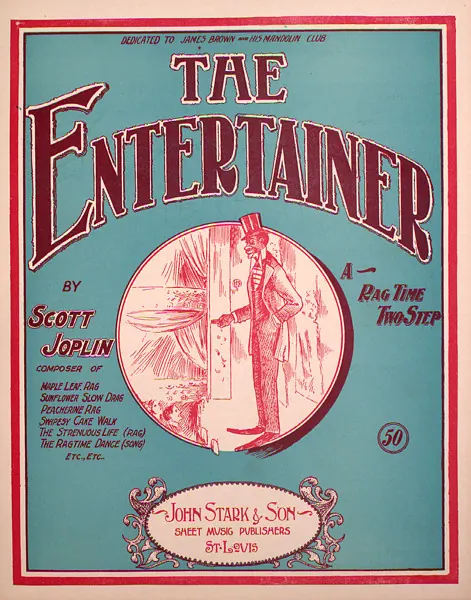
In 1899 the Sedalia publisher John Stark printed the Maple Leaf Rag, paying Joplin a royalty of one cent per copy — unusual for a Black composer at the time. It sold steadily for years and gave him a lasting income. More rags followed, including The Entertainer (1902). In 1908 he published School of Ragtime, a set of exercises that warned players that ragtime should never be played fast.
Joplin moved to New York and poured his energy into an opera, Treemonisha, about a young Black woman who leads her community through education. He could not find a producer and published it at his own expense in 1911; it was never fully staged in his lifetime. Seriously ill, he died in New York on April 1, 1917, and was buried in an unmarked grave. A ragtime revival in the 1970s — boosted by the film The Sting — brought him new fame, and in 1976 he received a special Pulitzer Prize.
Scott Joplin’s Sheet Music
Ragtime spread through printed sheet music sold for home pianos, so the covers were part of the advertising. Click any picture to enlarge it.
The King of Ragtime
- c. 1868 Born in northeast Texas; grows up in Texarkana.
- 1880s Studies with Julius Weiss; begins travelling as a pianist.
- 1893 Plays in Chicago during the World’s Columbian Exposition.
- c. 1894 Settles in Sedalia, Missouri.
- 1899 John Stark publishes the Maple Leaf Rag.
- 1902 The Entertainer is published.
- 1908 Publishes School of Ragtime, six exercises for players.
- 1911 Self-publishes his opera Treemonisha.
- 1916 Records his rags on piano rolls.
- 1917 Dies in New York on April 1.
- 1973–76 The Sting revives The Entertainer; Joplin is awarded a posthumous Pulitzer Prize (1976).
Syncopation: Accents Between the Beats
Most marches and dances put their strong notes on the beat. Ragtime keeps a steady beat in the left hand but lets the right-hand melody arrive early or late — “ragged” time. Putting emphasis between beats is syncopation.
To count it, split each beat into four sixteenths and say “1 e & a, 2 e & a.” In bar 5 of The Entertainer, the right hand plays E on “1,” then a C that starts on “e” and lasts until “a.” Your ear expects the C on the beat, so arriving early gives it a kick.
Joplin’s own recordings survive because of a 1910s technology: the piano roll. A long paper roll was punched with holes; in a player piano, air flowing through each hole pushed one key down. Each hole’s position across the roll chose the note and its length along the roll chose how long it lasted — music stored as data, just like a MIDI file today.
Clap the left hand’s eighths while a partner claps the right hand’s pattern. Where do your claps line up, and where do they disagree?
Is that really Joplin playing?
Why does the score say “Not fast”?
How is ragtime related to jazz?
Read & Play: The Entertainer
Here is the whole rag. Press Play at 100%, then mute the Right hand: the left hand marches evenly, bass note then chord. Now mute the left hand and hear how the melody lands between the beats.
Each player holds a complete piece. Use the song map or the Bar box to jump anywhere, click a note to hear it, and Shift-click a second bar to loop a passage. The measure-by-measure guide under each score follows the music as it plays; mute a hand or a part to hear one line alone. Every player links to the complete printed score for printing.
The Entertainer · complete, with every repeat
Hear Scott Joplin's Music
All of these recordings are in the public domain — including Scott Joplin himself, playing from a 1916 piano roll.
- Tap your foot with the left hand’s steady beat in the Maple Leaf Rag. Which right-hand notes land between your taps?
- The 1906 Marine Band recording was made by playing into a large horn — no microphones. What does that do to the sound?
- Compare Joplin’s own tempo to the band’s. Who follows his “not fast” advice?
Joplin's Key Contributions
Maple Leaf Rag (1899) became one of the best-selling pieces of sheet music of its era and set the pattern other ragtime composers followed.
Joplin notated his rags carefully and asked players to perform them as written, warning that ragtime should never be played fast.
His 1899 agreement with publisher John Stark paid him a royalty on every copy of Maple Leaf Rag sold, rather than a single flat fee.
He wrote and published a full opera about education and community. It wasn’t fully staged until 1972, and it won him a special Pulitzer Prize in 1976.
His School of Ragtime (1908) gave six exercises showing how to play syncopated rhythms correctly.
Ragtime’s syncopation and its march-like sections fed straight into early jazz, which grew up alongside it.
Scott Joplin's Legacy Today
Ragtime was the first distinctly African American musical style to sweep the whole United States, and Joplin was its finest composer. Its syncopations flowed into jazz, and from there into most American popular music.
For decades after his death Joplin was nearly forgotten. Then, in the 1970s, musicians recorded his rags again, Treemonisha finally received a full staging in 1972, and Marvin Hamlisch’s arrangement of The Entertainer for the film The Sting became a hit. The special Pulitzer Prize awarded in 1976 recognised what Joplin had believed all along: that ragtime was serious American art.
Find the Complete Sheet Music
Scott Joplin's music is in the public domain, so complete scores are free to download, print and play. The excerpts above were transcribed from these editions.
Practice Problems
Review: Biography · The musical idea · Read and play.
Use the score, the recordings and the biography above.
Easy1. What is Scott Joplin called?
Easy2. In what year was the Maple Leaf Rag published?
Medium3. How many sixteenth notes fit in one beat of The Entertainer (2/4 time)?
Medium4. Joplin earned 1 cent per copy of the Maple Leaf Rag. How many dollars would 75,000 copies earn?
Medium5. What is syncopation?
Medium6. What does a tie (the curved line between two notes of the same pitch) tell the player?
Challenge7. How did a player piano know which note to play?
Challenge8. Joplin died in 1917 and received a Pulitzer Prize in 1976. How many years after his death was that?