Composer arrangement studio
Claude Debussy
Arranging with care
A source staff is not always the melody: in an orchestral score, find the staff carrying the theme. A two-part piano study pairs your selected voice with a source bass; it is not a concert reduction and wide leaps may need redistribution. Saxophone notation is transposed while playback stays at concert pitch. Violin parts stay at concert pitch and are moved by octaves to sit above the open G string. Guitar tab preserves pitch and rhythm but may need a different octave or fingering. Chords are prepared for the Ode to Joy theme only; classical harmony elsewhere requires score study rather than automatic chord guesses. Original ensembles are available only where the source contains those parts. Piano reductions and original classroom studies retain their source identities.
Recordings: Nicholaus P. Brosowsky’s Tonejs-Instruments sample collection, CC BY 3.0; VSCO 2 Community Edition, CC0. Sample credits and processing.
Music · Modern Era · The Impressionist Pioneer
About Claude Debussy
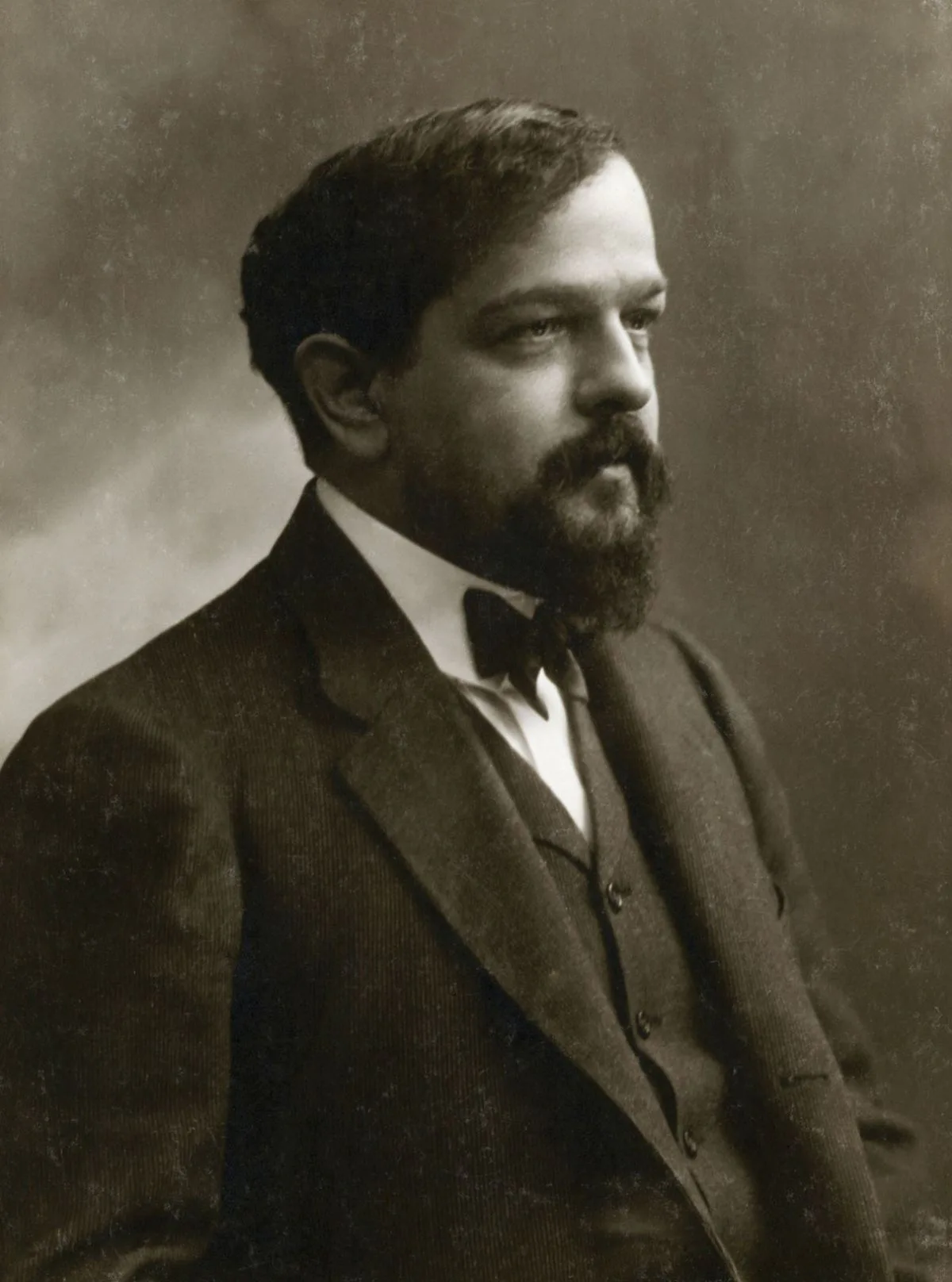
Claude Debussy (1862–1918) transformed Western music by treating sound as color and atmosphere. Breaking free from rigid German symphonic rules, he painted nature in sound—moonlight on water, shifting clouds, and evening mists—using floating whole-tone scales, shimmering pentatonic melodies, and fluid polyrhythms that sparked the twentieth-century modern revolution.
Who Was Claude Debussy?
Achille-Claude Debussy was born in Saint-Germain-en-Laye, a leafy town west of Paris, in 1862. His musical genius surfaced early: without formal childhood connections to the aristocracy, he was admitted to the prestigious Paris Conservatoire at age ten. Even as a student, Debussy rebelled against the rigid rules of harmony taught by academic masters. When a professor demanded to know which harmony rule governed a daring chord sequence he played, the young Debussy famously replied: “Mon plaisir” (“My pleasure”).
In 1884, at age twenty-two, Debussy won the coveted Prix de Rome for his cantata L'enfant prodigue, earning a funded residency at the Villa Medici in Rome. The conservative Italian atmosphere suffocated him, and he returned to Paris eager to find a personal musical language. A turning point arrived at the 1889 Paris Universal Exposition: listening to a Javanese gamelan orchestra, Debussy was spellbound by its shimmering gongs, interlocking rhythmic patterns, and non-Western pentatonic tunings. It proved to him that profound music did not need German major-minor keys or textbook resolutions.
Debussy gravitated toward Paris's avant-garde poets and painters. He attended Stéphane Mallarmé’s Tuesday evening Symbolist salons and found kinship with Claude Monet and the Impressionist painters, whose dappled brushstrokes caught fleeting sunlight on cathedral walls and lily ponds. In 1894, he unveiled the Prélude à l'après-midi d'un faune (“Prelude to the Afternoon of a Faun”), an orchestral work opening with a solitary, sensual flute solo that conductor Pierre Boulez called the beginning of modern music.
Over the next two decades, Debussy created an astonishing series of masterpieces: the opera Pelléas et Mélisande (1902), the orchestral sea-poem La Mer (1905), and two magnificent volumes of piano Préludes (1910–13). When he died of cancer in Paris in March 1918 during the German artillery bombardment of World War I, he had permanently opened the sonic gates of the modern world.
Debussy in a Portrait and a Manuscript
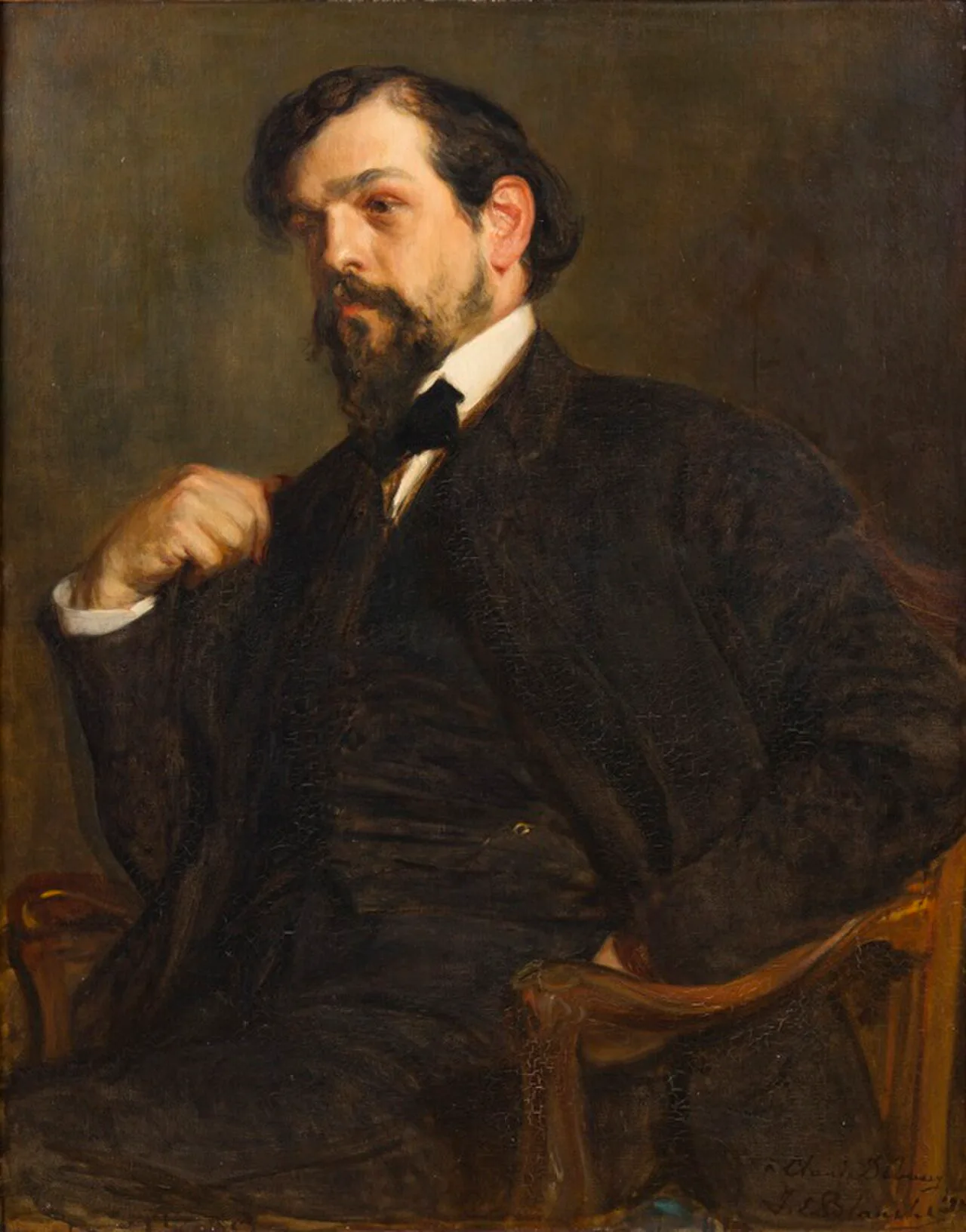
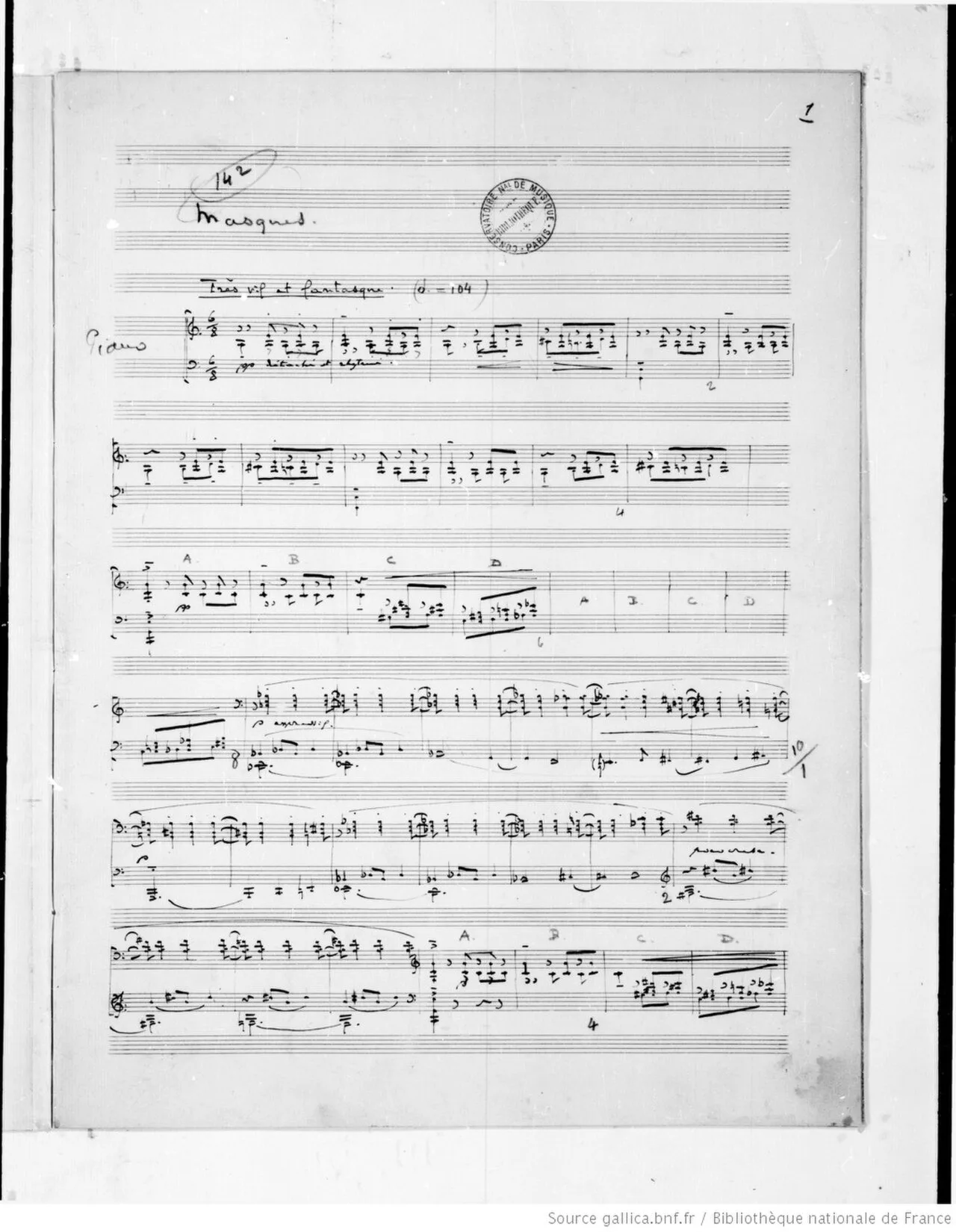
Debussy was celebrated for his artistic elegance and fastidious craftsmanship. Jacques-Émile Blanche painted him among the Parisian cultural elite, while his handwritten scores reveal a composer who weighed every dynamic marking and harmonic shadow like a painter mixing fine pigments. Click any image to enlarge.
From the Conservatoire to Modernism
- 1862 Born in Saint-Germain-en-Laye, France (August 22).
- 1872 Enters the Paris Conservatoire at age 10; studies piano and composition for eleven years.
- 1884 Wins the prestigious Grand Prix de Rome with his cantata L'enfant prodigue.
- 1888–91 Writes the Deux Arabesques for solo piano, introducing his flowing melodic style.
- 1889 Hears the Javanese gamelan at the Paris World's Fair, revolutionizing his sense of timbre and scale.
- 1890 Begins Suite bergamasque, containing the celebrated nocturne Clair de Lune.
- 1894 Premieres Prélude à l'après-midi d'un faune, hailed as the dawn of modern orchestral music.
- 1902 Premieres his groundbreaking opera Pelléas et Mélisande at the Opéra-Comique.
- 1905 Completes La Mer ("The Sea"), painting turbulent ocean waves in rich orchestral colors.
- 1910–13 Publishes the two iconic books of piano Préludes, including The Sunken Cathedral.
- 1918 Dies in Paris on March 25 during the German bombardment, aged 55.
Impressionism, Timbre & Whole-Tone Color
For two centuries, European classical music was built on architectural tension and release: themes were stated, developed through contrasting keys, and driven forward by dominant-to-tonic cadences (V → I). Debussy felt this system had become rigid and predictable. Instead of treating harmony as a grammatical engine, he treated chords as pure colors (timbre), allowing sounds to hang in the air for their sheer sensual beauty.
Three core breakthroughs distinguish Debussy’s revolution:
Polyrhythm & Fluid Meter: In pieces like Première Arabesque and Clair de Lune, Debussy blends 2-against-3 rhythms and compound 9/8 time so the bar lines seem to dissolve into liquid motion.
Why did Debussy dislike being called an "Impressionist"?
How did the Javanese Gamelan change Debussy’s thinking?
What is "Planing" in Debussy's scores?
Read & Play: Two Debussy Masterpieces
Explore two of Debussy’s most famous piano works measure by measure. Watch how his melodies float across the bar lines and listen to how pedal points sustain deep resonant overtones beneath shifting upper harmonies.
Each player holds the whole piece. Use the song map or the Bar box to jump anywhere, click a note to hear it, and Shift-click a second bar to loop a passage. The measure-by-measure guide under each score follows the music as it plays; mute a hand or a voice to hear one line alone. Every player links to the complete printed score for printing.
Clair de Lune · complete, 72 bars
Première Arabesque · complete, 107 bars
Hear Debussy's Music
Listen to public-domain recordings of Claude Debussy’s piano masterpieces, from the serene moonlit nocturne of Clair de Lune to the sparkling, flowing arabesques.
- In Clair de Lune, notice the subtle tempo rubato (expressive flexibility). The pianist stretches and breathes with each phrase rather than keeping a metronomic beat.
- In Première Arabesque, listen for how effortlessly the two hands interlock during the 2-against-3 polyrhythm: the triplets ripple like sunlight over flowing water.
- Compare the playful, dance-like staccato of Deuxième Arabesque with the dreamy, sustained cantabile melody of Rêverie.
Debussy's Key Contributions
Debussy made the sheer sensual beauty of instrumental timbre equal to melody and rhythm, proving that a changing orchestral tone color could shape a composition.
By popularizing six-note whole-tone scales and five-note pentatonic modes, he broke the three-hundred-year monopoly of major-minor functional harmony.
Inspired by Art Nouveau curves and nature's organic patterns, he wove intricate two-against-three rhythms and arching arabesques that float over the pulse.
He moved complex 7th and 9th chords in parallel streams across the keyboard, treating entire chords as individual color brushstrokes rather than cadential formulas.
Works like Prélude à l'après-midi d'un faune and La Mer discarded heavy Germanic brass bombast in favor of translucent solo woodwinds, antique cymbals, and divided strings.
His harmonic discoveries directly shaped 20th-century classical modernists (Stravinsky, Ravel, Messiaen), modal jazz pioneers (Bill Evans, Miles Davis), and cinematic scoring.
Debussy's Legacy Today
Debussy's influence extends far beyond the classical concert hall. When jazz pianists Bill Evans and Herbie Hancock voiced chords with floating 9ths, 11ths, and altered whole-tone scales, they were speaking Debussy's harmonic language. Miles Davis’s landmark 1959 album Kind of Blue drew directly on Debussy's modal innovations, freeing improvisers from rapid chord changes.
In film music, composers from John Williams to Joe Hisaishi routinely draw on Debussy’s shimmering woodwind colors, pentatonic warmth, and whole-tone suspense to depict wonder, outer space, ocean depths, and dream sequences. More than a century after his death, Claude Debussy remains the quintessential poet of musical light and atmosphere.
Find the Complete Sheet Music
These public-domain editions are free to download, print, and play. The players above include engraved scores with pedagogical guides; use these links for original historical editions and complete printable PDFs.
- Clair de Lune — Mutopia Edition ↗Free engraved PDF and LilyPond source typeset by Keith O'Hara after the 1905 Fromont edition
- Première Arabesque — Mutopia Edition ↗Typeset by Keith O'Hara after the 1904 Durand edition
- Suite bergamasque on IMSLP ↗Historical editions and complete four-movement suite including Prélude, Menuet, Clair de lune, and Passepied
- Deux Arabesques on IMSLP ↗Complete historical Durand editions for Arabesques No. 1 and No. 2
- All of Claude Debussy on IMSLP ↗Préludes, Images, Children's Corner, La Mer, String Quartet, and complete works
Practice Problems
Review: Biography · The musical idea · Read and play.
Use the scores, the recordings, and the biography above.
Easy1. At what remarkably young age was Claude Debussy admitted to the Paris Conservatoire?
Easy2. What is the meter (time signature) of Debussy’s Clair de Lune?
Medium3. Which non-Western musical ensemble did Debussy discover at the 1889 Paris World's Fair that profoundly altered his harmonic style?
Medium4. Which scale consists entirely of six equal whole steps without semitones, creating an ambiguous, floating atmosphere?
Medium5. What distinctive rhythmic device creates the flowing, wave-like texture in Debussy's Première Arabesque (bars 6–9)?
Medium6. Which Symbolist poem inspired Debussy's revolutionary 1894 orchestral work featuring an opening solo flute?
Challenge7. In 9/8 compound triple meter (as used in Clair de Lune), how many eighth notes are in each complete measure?
Challenge8. Claude Debussy was born in 1862 and died in 1918. How old was he when he passed away?