A source staff is not always the melody: in an orchestral score, find the staff carrying the theme. A two-part piano study pairs your selected voice with a source bass; it is not a concert reduction and wide leaps may need redistribution. Saxophone notation is transposed while playback stays at concert pitch. Violin parts stay at concert pitch and are moved by octaves to sit above the open G string. Guitar tab preserves pitch and rhythm but may need a different octave or fingering. Chords are prepared for the Ode to Joy theme only; classical harmony elsewhere requires score study rather than automatic chord guesses. Original ensembles are available only where the source contains those parts. Piano reductions and original classroom studies retain their source identities.
Recordings: Nicholaus P. Brosowsky’s Tonejs-Instruments sample collection, CC BY 3.0; VSCO 2 Community Edition, CC0. Sample credits and processing.
Music · Baroque Era · Counterpoint & Patterns
Meet Johann Sebastian Bach
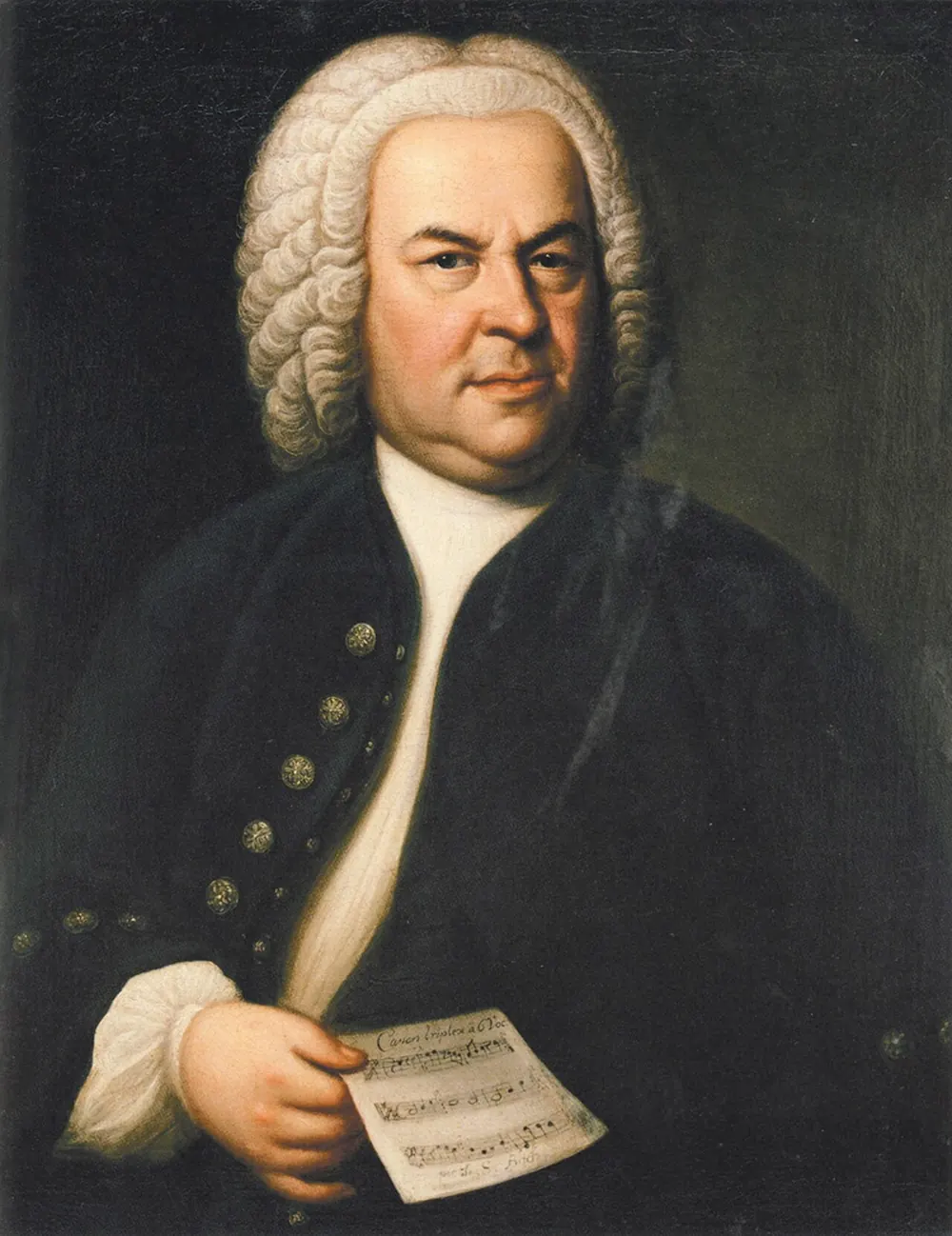
Bach, 1748Painted by Elias Gottlob Haussmann. The page in Bach’s hand is a six-voice puzzle canon: the reader has to work out how the voices fit together. Elias Gottlob Haussmann, Public domain, via Wikimedia Commons.
Johann Sebastian Bach (1685–1750) wrote music the way an engineer builds a clock: several independent melodies, each one singable by itself, fitted together so precisely that they make harmony at every moment. He worked as a church musician and court composer in Germany, wrote hundreds of pieces for worship, teaching and celebration, and was mostly forgotten by the public for decades after he died — before becoming one of the most studied composers in history.
Bach was born in Eisenach, in central Germany, on March 21, 1685, into a family that had produced professional musicians for generations. Both of his parents died before he turned ten, and he went to live with his older brother Johann Christoph, an organist, who gave him keyboard lessons. As a teenager he won a place at a choir school in Lüneburg and began the organ career that would make him famous.
In 1705, as a young organist in Arnstadt, Bach was given a few weeks off to travel — on foot, about 400 km (250 miles) — to Lübeck to hear the celebrated organist Dieterich Buxtehude. He stayed roughly four months, far longer than his leave, and came home full of new ideas. Over the next years he worked in Mühlhausen and then at the court of Weimar, where he wrote much of his greatest organ music. When he asked to leave Weimar for a better job in 1717, the duke had him jailed for about a month before letting him go.
At Köthen (1717–1723) Bach directed a court orchestra and wrote instrumental music, including the Brandenburg Concertos and the suites for solo cello. His first wife, Maria Barbara, died in 1720; the next year he married the singer Anna Magdalena Wilcke. Between his two marriages Bach had twenty children, about half of whom survived childhood, and several became important composers themselves. Much of his keyboard music, including the two-part Inventions, began as lessons for his own children and students.
From 1723 until his death Bach was Thomaskantor in Leipzig: in charge of music for the city’s main churches and of the boys at the St. Thomas School. For years he wrote a new cantata almost every week. Near the end of his life his eyesight failed, and two eye operations in 1750 left him nearly blind. He died in Leipzig on July 28, 1750. Fashion had moved on to simpler styles, and much of his music went unperformed until a young Felix Mendelssohn conducted the St. Matthew Passion in 1829 and sparked a Bach revival.
Bach’s Manuscript and His Church
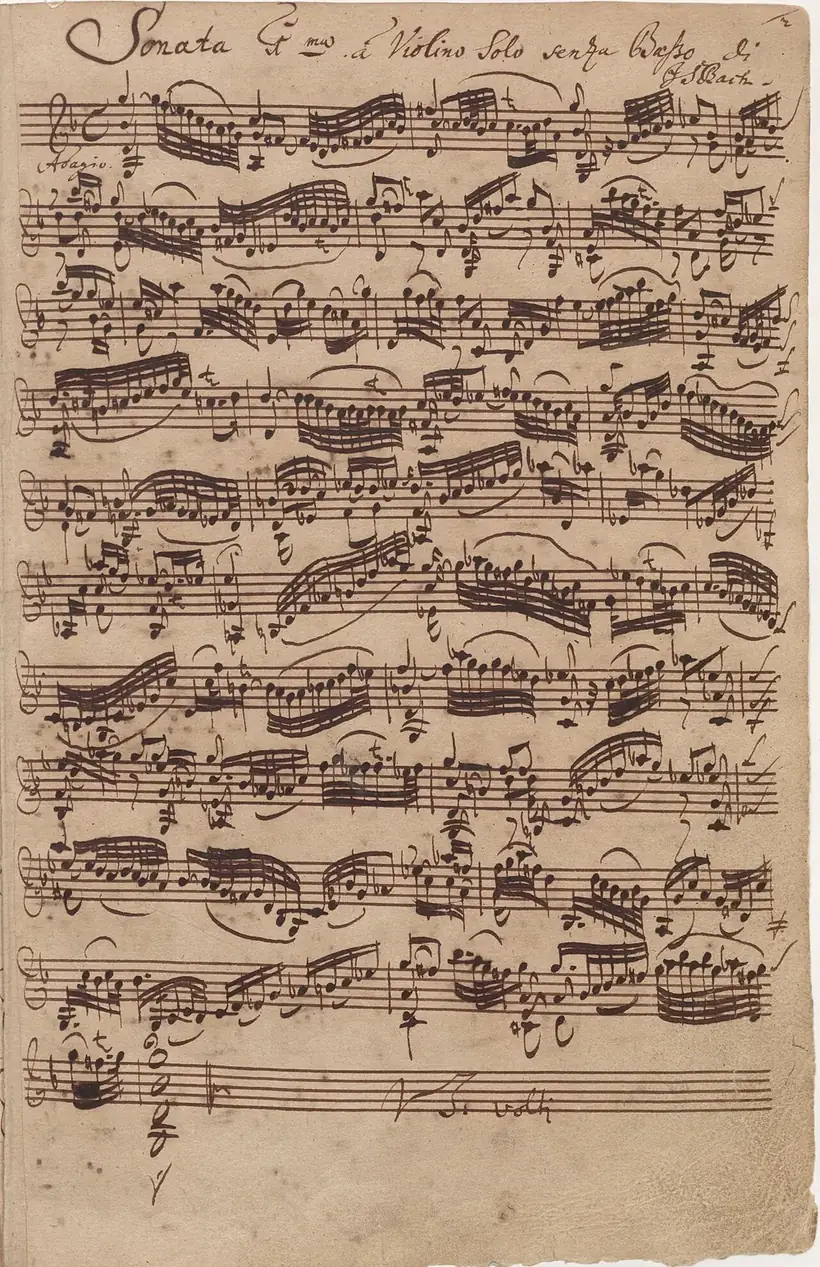
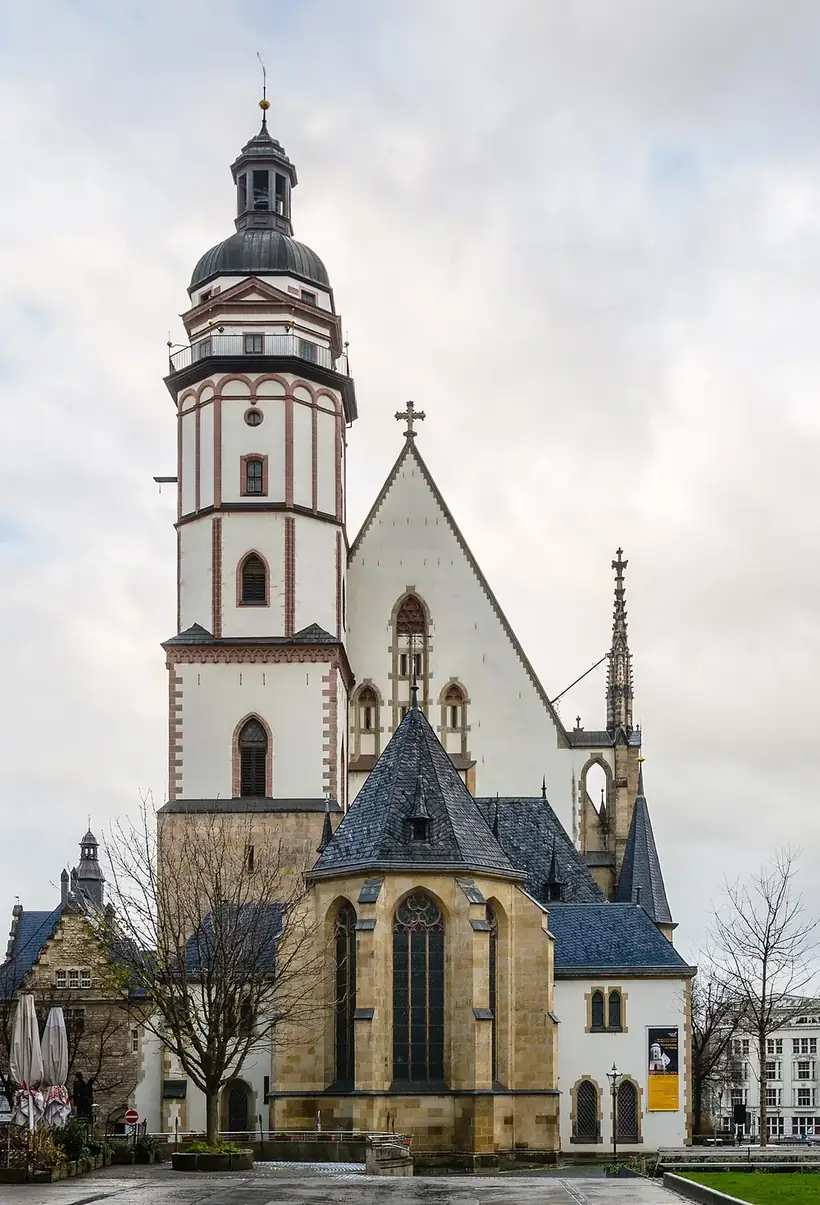
The portrait beside his biography is the only one widely accepted as a true likeness. Here is his own handwriting and the church where he worked for 27 years. Click any picture to enlarge it.
Bach’s own handwriting, 1720The Adagio from his Sonata No. 1 for solo violin (BWV 1001). Notice how the beams flow across the page — his manuscripts are admired as artworks. J.S. Bach, Public domain, via Wikimedia Commons.St. Thomas Church, LeipzigBach led the music here for 27 years, and he is buried inside today. Photo by Tuxyso, Tuxyso, CC BY-SA 3.0, via Wikimedia Commons.
A Life in Four Cities
1685 Born March 21 in Eisenach, Germany, into a family of musicians.
1695 Orphaned at nine or ten; moves in with his brother Johann Christoph in Ohrdruf.
1705 Walks about 400 km to Lübeck to hear the organist Buxtehude.
1708–17 Organist and concertmaster at the court of Weimar; writes much of his organ music.
1717–23 Music director at Köthen: Brandenburg Concertos, cello suites, violin solos.
1722–23 Finishes Book 1 of The Well-Tempered Clavier and a fair copy of the Inventions and Sinfonias.
1723 Becomes Thomaskantor in Leipzig, where he stays for the rest of his life.
1727 First performance of the St. Matthew Passion.
1750 Dies in Leipzig on July 28, after failed eye surgery.
1829 Mendelssohn revives the St. Matthew Passion, starting a Bach revival.
Counterpoint: Melodies That Fit Together
Counterpoint is the art of combining independent melodies so that each makes sense on its own and together they make good harmony. In Bach’s time it was the core of a composer’s training, and nobody did it better.
A particularly strict kind of counterpoint is a canon: one voice follows a rule to copy another. In a simple round, the copy starts later — the same idea as singing a round like “Row, Row, Row Your Boat.” In this kind of canon, the pattern moves in time (a delay) and sometimes in pitch (a transposition). In Invention No. 8 the delay is one bar and the transposition is one octave down.
A fugue grows the same way but more freely: a short theme enters in one voice after another, then gets developed, turned upside down, stretched or squeezed. Bach’s Well-Tempered Clavier contains 48 preludes and fugues, two in every major and minor key.
Canon
Leader: plays the melody, starting in bar 1
Follower: plays the same melody, starting in bar 2, one octave (8 letter names) lower
Rule: every moment where they overlap must still sound good together
Same notes, shifted in time and pitch. Bach had to choose each new note so it worked as a melody and against the copy.
Why is it called an “Invention”?
In Bach’s day an inventio meant a musical idea worth developing — the way a speaker “invents” an argument. Bach’s title page said the pieces would teach players to handle two (and then three) voices well and to play in a singing style.
What does “well-tempered” mean?
Keyboards have to be tuned with small compromises so that music sounds acceptable in every key. A “well-tempered” tuning makes all 24 major and minor keys usable. Bach proved it by writing a prelude and fugue in each one. Modern pianos use equal temperament, where each half step multiplies the frequency by the twelfth root of 2 (about 1.0595).
Is the canon in Bach’s portrait real?
Yes. The sheet he holds is a short puzzle canon for six voices (BWV 1076). It is written as just a few lines; performers have to work out where the other voices come in.
A canon can also transform its melody. In the Crab Canon, two voices read the same line in opposite directions. This backwards order is called retrograde.
Read & Play: 23 Complete Scores
Bach wrote the Inventions to teach keyboard players to play two independent lines cleanly. Start with Invention No. 8: press Play, then switch off the Left hand and listen to the right hand alone, and the other way round.
Each player holds a complete piece. Use the song map or the Bar box to jump anywhere, click a note to hear it, and Shift-click a second bar to loop a passage. The measure-by-measure guide under each score follows the music as it plays; mute a hand or a part to hear one line alone. Every player links to the complete printed score for printing.
Invention No. 8 in F major · complete, 34 barsInvention No. 8, complete. The left hand plays the right hand’s first bar one bar later and an octave lower, a canon; in bar 12 the hands swap roles.
Bar 1, right handA rising F-major arpeggio: F–A–F–C–F. This short idea is the “invention” the whole piece develops.
Bar 2, left handThe same notes, one octave lower and one bar later. Compare the two staves note by note.
Bar 2, right handWhile the left hand copies, the right hand runs down in sixteenth notes — a new line that fits against the copy.
Prelude in C major · complete, 35 barsThe C-major Prelude from The Well-Tempered Clavier, complete. Every bar is one chord played in the same broken pattern, and the guide names each chord. Before you play, predict which bars share a harmony.Cello Suite No. 1 · Prélude · complete, 42 barsThe complete Prélude for solo cello, with bowings omitted. Choose a string sound and a slower speed. Track the open G string in bars 1–4: how do the notes above it change the harmony?Invention No. 1 in C major · complete, 22 barsThe right hand introduces a short scale figure; the left hand answers within the first bar. Follow the same shape in the lower register. Use the staff controls to hear each hand separately, then compare this invention with No. 8.Invention No. 4 in D minor · complete, 52 barsThe right hand presents two bars of running sixteenths; the left hand enters in bar 3. Count three eighth-note beats in each bar. Use the staff controls to hear each hand separately, then compare this invention with No. 8.Invention No. 13 in A minor · complete, 25 barsBoth hands outline broken chords, with the left hand starting first. Hear the rising A-minor shape and the answering figures. Use the staff controls to hear each hand separately, then compare this invention with No. 8.Invention No. 2 in C minor, BWV 773 · complete, 27 barsA melody and its delayed copy. Follow one line long enough to hear how the other line fits around it.Invention No. 3 in D major, BWV 774 · complete, 60 bars including upbeatA lively three-eighth-note pulse with an upbeat. Keep the short opening gesture light when the hands answer.Invention No. 5 in E-flat major, BWV 776 · complete, 32 barsOrnaments decorate the two independent lines. Practise the underlying rhythm before adding the ornament signs.Invention No. 6 in E major, BWV 777 · complete, 62 barsListen for the difference between the beat and the accents made by the notes. Keep the dance pulse steady.Invention No. 7 in E minor, BWV 778 · complete, 23 barsRunning notes connect the two hands. Listen for where a small figure changes register and passes to the other hand.Invention No. 9 in F minor, BWV 780 · complete, 34 barsFollow the contour of each line separately, then hear how their moving notes combine.Invention No. 10 in G major, BWV 781 · complete, 32 barsThe 9/8 meter has three dotted-quarter pulses per bar. Group the running eighths in threes.Invention No. 11 in G minor, BWV 782 · complete, 23 barsRests are part of the conversation: listen for how a voice hands the musical space to the other.Invention No. 12 in A major, BWV 783 · complete, 21 barsFour dotted-quarter pulses fit in each 12/8 bar. Follow the compound pulse underneath the running figures.Invention No. 14 in B-flat major, BWV 785 · complete, 20 barsBroken-chord shapes move between registers. Hear each line as a phrase, rather than a succession of finger movements.Invention No. 15 in B minor, BWV 786 · complete, 22 barsKeep the two voices distinct as their running figures overlap. Compare the opening texture with the closing bars.Fugue in C major, BWV 846 · complete, 27 barsFour voices enter one after another. Compare this complete fugue with its companion C-major Prelude.Air from Orchestral Suite No. 3, BWV 1068 · complete, 19 barsFour string parts, including the continuo bass. Follow the upper melody, then isolate the bass to hear its steady movement.Goldberg Variations — Aria, BWV 988 · complete, 32 barsThe complete opening Aria, with both repeated halves. Listen to the bass and harmonic pattern that underpins the later variations.Toccata and Fugue in D minor, BWV 565 · complete, 143 barsThe complete organ work, with two manual staves and pedal. Contrast the free opening gestures with the imitative fugue.Crab Canon — Canon a 2 cancrizans, BWV 1079 · complete, 18 barsThe complete 18-bar canon, realised for two violins by Jürgen Knuth. One voice reads the musical line forwards while the other reads it backwards.Jesu, Joy of Man’s Desiring, BWV 147 — choir and keyboard · complete, 71 barsThe complete closing chorale in Jürgen Knuth’s arrangement for choir and keyboard. The flowing keyboard line surrounds the slower chorale melody; this is a reduction, not the original orchestral scoring.
Four More Ways to Hear Bach
A chorale, an orchestral movement, a musical puzzle and a keyboard aria: listen for how Bach gives each musical line a purpose. BWV means Bach-Werke-Verzeichnis, the catalogue of Bach’s works; the number identifies the work.
Open a performance below, then try its listening task. These videos come from the Netherlands Bach Society’s All of Bach project; the performers and recordings retain their own rights.
This familiar English title belongs to music from Bach’s church cantata Herz und Mund und Tat und Leben. The choir sings a steady hymn melody while the instruments weave a flowing line around it. The cantata’s two parts end with the same chorale music and different words.
Listen for two layersFollow the instruments first, then the choir. Tap the main pulse and notice how the flowing instrumental notes move in groups of three. Does the instrumental line stop when the singers pause?
BWV 1068 · Air from Orchestral Suite No. 3 in D major
Bach called this movement simply Air. Its long violin melody floats above a steadily moving bass, while the inner string parts fill out the harmony. The performance below uses the orchestral version.
The nickname comes from violinist August Wilhelmj’s later arrangement, which moves the melody lower so it can be played entirely on the violin’s lowest string, the G string. The Boston Symphony explains the title.
Follow the bassListen to the low instruments before following the high melody. How does their regular movement support a melody that often holds a note across the beat?
BWV 1079 · Canon a 2 cancrizans from The Musical Offering · 1747
One written melody produces two parts: one reads from beginning to end while the other reads from end to beginning. Reversing the order of the musical events is called retrograde. Bach makes the two directions fit together as counterpoint.
Hear the puzzle being solvedIn Shunske Sato’s film, listen to the line forwards, then backwards, then together. Try reading the sequence A–B–C–D backwards: D–C–B–A. That illustrates the rule; it is not an excerpt from Bach’s score.
This gentle keyboard aria opens the Goldberg Variations and returns after thirty variations. Here, aria describes an instrumental piece with a singing character. Jean Rondeau plays it on harpsichord, whose strings are plucked rather than struck as on a piano.
The variations build on the aria’s underlying bass and harmonic pattern. The decorated upper melody is only one part of the design.
Listen beneath the ornamentsStart with the opening Aria in the film, then compare Variation 1. Follow the low notes: what feels familiar even when the rhythm and upper melody change? Use the film’s chapters to return to the Aria.
Compare the four: Which piece places a choir inside flowing instrumental music? Which sets a long melody over a steady bass? Which reverses a line? Which supplies the harmonic foundation for a set of variations? Point to something you heard as evidence.
More Bach Recordings
These recordings are public domain. The first one is the Invention you just read; the others show Bach writing for cello, string orchestra and full symphony orchestra (Stokowski’s famous orchestral arrangement of an organ work).
Now Playing Invention No. 8 in F major, BWV 779Solo piano · the piece in the score above
In the Invention, try to follow just the left hand for a few bars, then just the right hand.
The Cello Suite is one instrument playing one note at a time — yet you hear harmony. Bach outlines chords by leaping between low and high notes.
The Toccata was written for organ. Stokowski’s version swaps organ pipes for orchestra sections: same notes, different timbre.
Bach's Key Contributions
🎼
Master of Counterpoint
His fugues and canons set the standard for combining independent melodies. The Art of Fugue works through one theme in more than a dozen ways.
🎹
The Well-Tempered Clavier
Two books of preludes and fugues, one in every major and minor key (Book 1 finished in 1722), showing that a well-tempered keyboard could play in all 24.
⛪
Music for Worship
As Thomaskantor he wrote church cantatas week after week. About 200 survive, alongside the St. Matthew Passion and the Mass in B minor.
🎻
Instrumental Showpieces
The six Brandenburg Concertos, the suites for solo cello, and the sonatas and partitas for solo violin are still core repertoire for those instruments.
📚
Music Written to Teach
The Inventions, the Orgelbüchlein and the notebooks for his family were lessons first. Students around the world still learn from them.
🎵
Four-Part Chorales
His hundreds of chorale harmonizations became the textbook example of how four voices move together, and harmony classes still use them.
Bach's Legacy Today
Bach never travelled far and published only a small part of what he wrote, yet later composers treated his music as a textbook. Mozart studied his fugues; Beethoven learned the Well-Tempered Clavier as a boy; Chopin practised it before his concerts. Musicians still learn harmony from Bach’s four-part chorales.
His music also reaches beyond the concert hall. Three Bach pieces are on the Golden Record carried by the two Voyager spacecraft launched in 1977, chosen to represent humanity to anyone who might find them. And the logic of his counterpoint — patterns copied, shifted and combined by rules — makes him a favourite example for mathematicians and computer scientists exploring how structure can create beauty.
Find the Complete Sheet Music
Bach’s compositions are in the public domain. These collections include historic scores; check each edition’s rights notice for your location. Use the featured works’ full scores to follow the choir, bass line, canon or keyboard parts.
Use the scores, biography and listening notes above.
Easy1. In what city did Bach spend the last 27 years of his life?
Hint: He was Thomaskantor there and is buried in St. Thomas Church.
Easy2. Look at the score. How many beats are in each bar of Invention No. 8?
Hint: Read the top number of the time signature (3/4).
Medium3. In the Invention, how many bars later does the left hand start copying the right hand?
Hint: The right hand starts in bar 1. Find the first bar where the left hand plays notes.
Medium4. The right hand begins on F4 and the left hand copies it starting on F3. How far apart are they?
Hint: Same letter name, octave number one lower.
Medium5. How does a simple round work?
Hint: Think of singing a round.
Medium6. The Well-Tempered Clavier has two books, each with a prelude and fugue in all 24 major and minor keys. How many prelude-and-fugue pairs is that altogether?
Hint: 2 books × 24 keys.
Challenge7. In equal temperament each half step multiplies the frequency by about 1.0595. A4 is 440 Hz. About what frequency is A♯4, one half step higher? (Round to the nearest whole hertz.)
Hint: 440 × 1.0595 ≈ 466.2.
Challenge8. Why was much of Bach’s music rarely performed in the decades after his death?
Hint: Think about the 1829 revival — what had happened to tastes in between?
Medium9. In the Crab Canon, how is the second part made from the written melody?
Hint: Retrograde changes the order of events, like reading a sequence from its end back to its beginning.
Medium10. What provides the shared foundation for the Goldberg Variations?
Hint: Listen underneath the decorated upper melody of the Aria.