Modern STEAM did not appear all at once. It grew from science clubs, workshops, national competition, school reform, design practice, and a later argument that the arts belong inside technical problem-solving—not at the edge of it.
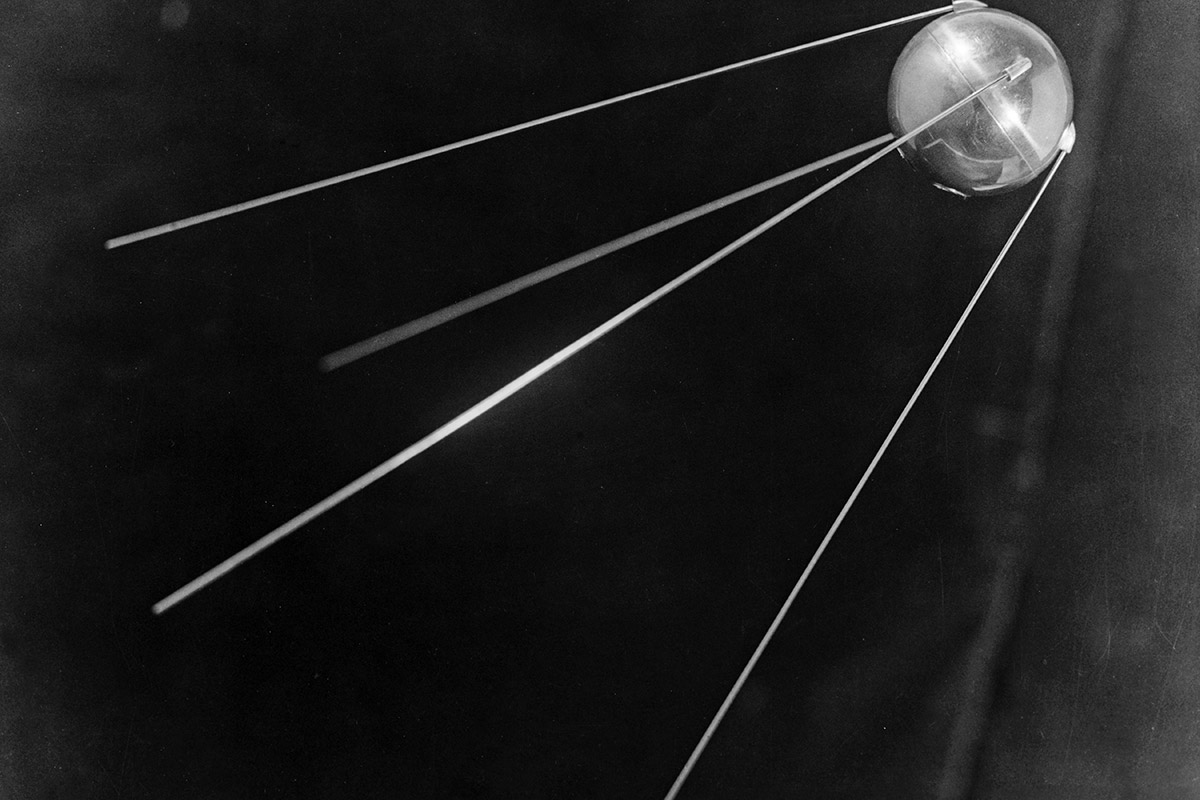
SIGNAL ACQUIRED · 4 OCT 1957 Sputnik made education part of the Space Race. But young people were already building, testing, measuring, publishing, and organizing around rockets.
Launch point · Youth rocketry
Before STEAM had a name, students were already doing it
In the 1950s, American teenagers fascinated by rockets often formed local clubs. Some experimented dangerously with homemade propellants. Physicist and writer G. Harry Stine, after receiving questions from young enthusiasts while working at White Sands, argued for a safer path: standardized model-rocket motors, a safety code, careful measurement, and organized clubs. He and Orville Carlisle helped establish modern model rocketry, and Stine founded the National Association of Rocketry (NAR) in 1957.
This is the strongest documented match for the “rocketry clubs of American youth” starting point. The exact phrase is not the name of one verified national organization; it describes a wider youth-club movement that included school science clubs and early NAR sections.
ASKWhat makes flight stable?
DRAWPlan the body and fins.
BUILDTurn a plan into an object.
LAUNCHTest under safety rules.
MEASUREUse time, angle, and altitude data.
Material history · Breakthrough artifacts
Pioneers of Integrated STEAM Engineering
Before curriculum designers coined the term STEAM, inventors and engineers repeatedly broke past single-subject boundaries to make new technologies work. Thermodynamics met mechanics; chemistry met aerodynamics; mathematics met real-time computing.
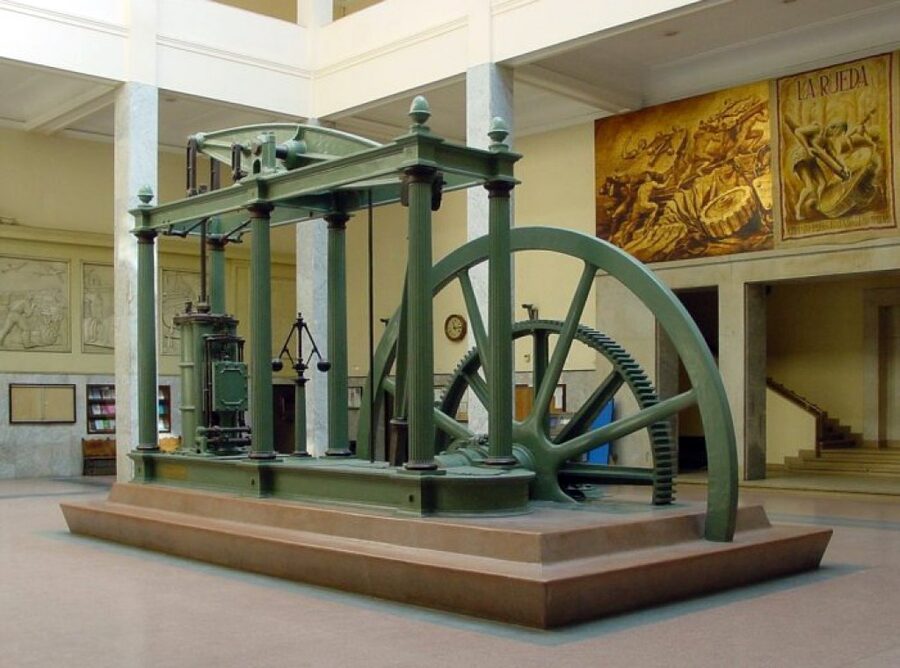
Thermodynamics & Cybernetics · 1788Watt’s Steam Engine & Centrifugal Governor. James Watt combined physics (the separate condenser) with automatic mechanical feedback (the centrifugal ball governor). As engine speed changed, whirling flyballs adjusted the steam throttle automatically—creating one of history's first self-regulating control loops and powering the Industrial Revolution. Credit: Science Museum, London / Wikimedia Commons · Public domain.Propulsion & Aerospace · 1926Robert Goddard: The Liquid-Propellant Rocket. On March 16, 1926, physics professor Robert H. Goddard launched the world’s first liquid-fueled rocket (gasoline and liquid oxygen) in Auburn, Massachusetts. Though the flight lasted only 2.5 seconds, it proved multi-fluid pressurized combustion and aerodynamic frames could propel vehicles through air and vacuum. Credit: NASA / Wikimedia Commons · Public domain.Software & Systems Engineering · 1969Margaret Hamilton: Apollo Guidance Software. Director of Software Engineering at the MIT Instrumentation Laboratory, Hamilton stands beside the Apollo 11 guidance code stacked as tall as herself. Her team's asynchronous priority scheduling prevented mission abort during lunar descent when the radar overloaded the computer. Credit: MIT Museum / NASA · Public domain.
Interactive flight log
How a club activity became a classroom philosophy
Choose an era. Notice that the story changes scale: from young builders, to national policy, to an acronym, and finally to a debate over what complete problem-solving requires.
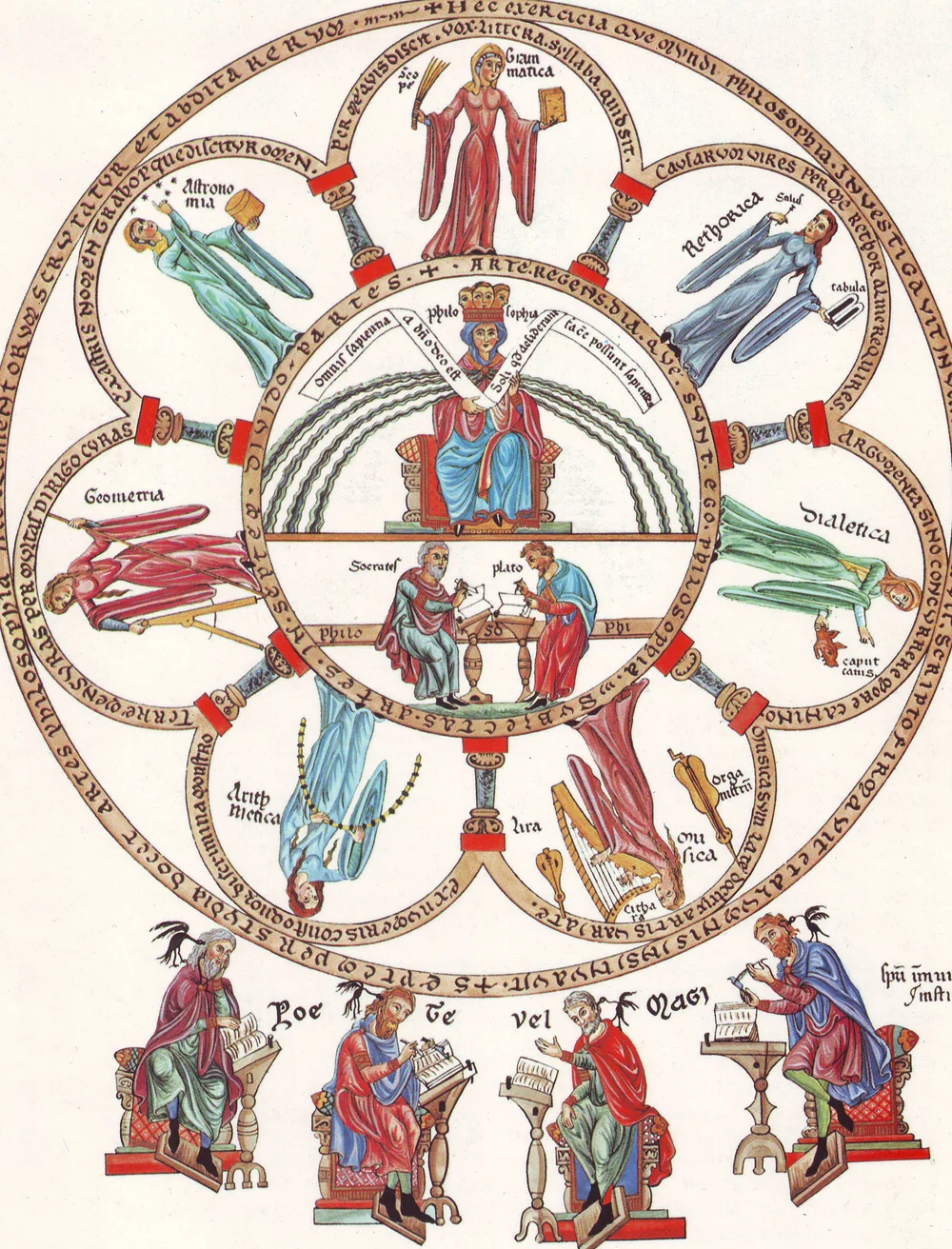
Medieval diagram of the seven liberal arts, showing math, music, and astronomy grouped as one subject
Long ago–1900s · ONE SUBJECT BECOMES MANY
Math, music, and stars used to be one class
For centuries, thinkers studied math, music, and the stars together, the same way as the Quadrivium (see the last lesson). But as science grew bigger, schools split it into separate subjects — physics class, math class, art class — each with its own experts who rarely talked to each other.
Classroom shift: one big connected idea breaks into many small, separate ones.
Mission simulator
Can a rocket mission fly with one discipline missing?
All five systems begin online. Switch disciplines off and read the mission report. This is the central claim of STEAM: real work crosses subject boundaries.
Mission ready · All systems connected
The team can explain the physics, use tools, engineer a safe solution, communicate its purpose, and measure the result.
The A changes the question
Why did educators push STEM toward STEAM?
The STEM case
Science, technology, engineering, and mathematics became a shared policy category because nations needed scientific literacy, technical workers, and integrated problem-solvers. The grouping helped focus money, curriculum, and public attention.
The STEAM case
Arts advocates and educators argued that invention also requires observation, visual thinking, iteration, storytelling, ethics, and designing for people. The “A” should mean authentic artistic and design practice—not merely coloring a science poster.
There is no single universally agreed birthday for STEAM. Integrative models appeared through several educators and organizations in the 2000s. By the early 2010s, Rhode Island School of Design's STEM to STEAM initiative helped move the idea into national policy discussion. The important shift was conceptual: technical knowledge answers Can we make it?; the arts help ask What should it feel like, communicate, and mean to the people who use it?
The same idea, echoing back
Long before STEAM, the Quadrivium already treated math, music, and the sky as one connected subject. This is an old idea that keeps coming back.