Complete one tiny task with a wonderfully ridiculous chain of energy transfers. Then think like an engineer: predict, test, find the first failure, and change one variable.
CAUSE → EFFECTENERGY TRANSFERSIMPLE MACHINESITERATION
Mission brief
Can every output become the next input?
Learning targetI can trace energy through a chain reaction, diagnose its first failure, and improve the design with evidence.
Success looks like this
I name the input, transfer, and output at each stage.
I distinguish a simple machine from an energy source or trigger.
I change one variable at a time and use the result as evidence.
I can explain why a funny, complicated path can still be carefully engineered.
01 · Read the mechanism
A machine is a story told by forces.
Rube Goldberg (1883–1970) trained as an engineer before becoming a cartoonist. His invention cartoons made fun of overcomplicated solutions: a tiny job took a long, labeled sequence of ordinary objects. Today, builders turn that visual joke into a real engineering challenge.
IN
Input
The push, pull, stored energy, or motion that begins one stage.
Δ
Transfer
Energy moves or changes form: gravitational to kinetic, elastic to kinetic, or motion from one object to another.
OUT
Output
The stage produces a motion or force strong and precise enough to trigger what comes next.
MA
Simple machine
A lever, wheel and axle, pulley, inclined plane, wedge, or screw changes a force’s size or direction.
Σ
System
The complete chain. A stage can work alone while the system still fails at a connection.
↻
Iteration
Test, observe, revise, and test again. A failed run is useful data when you identify where and why.
Ball loses gravitational potential energy
Ball gains kinetic energy
Collisions topple dominoes
Lever redirects the force
Weight turns the wheel
Bell converts motion to sound
Visual archive · Look closely
The joke is drawn like an engineering plan.
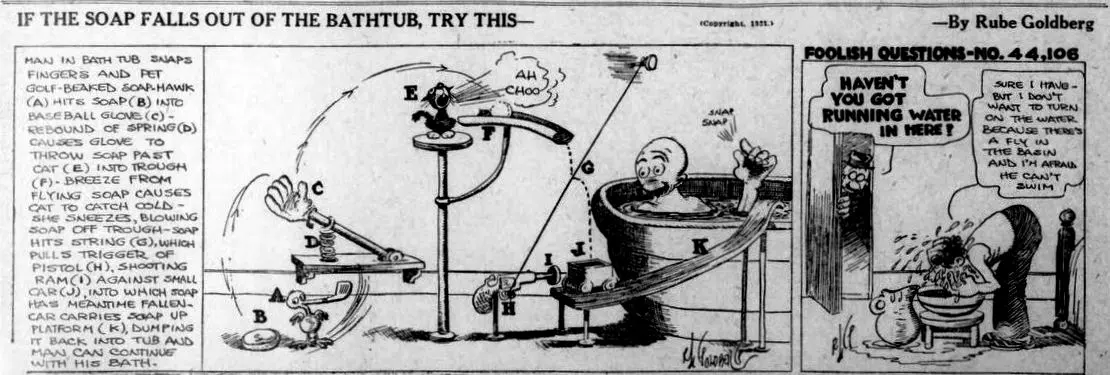
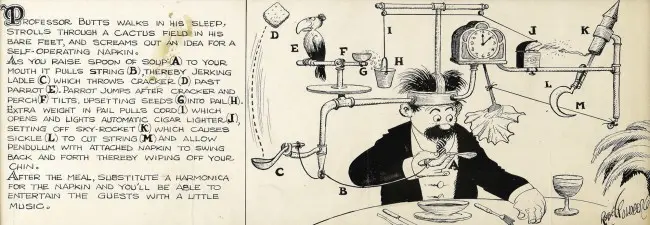
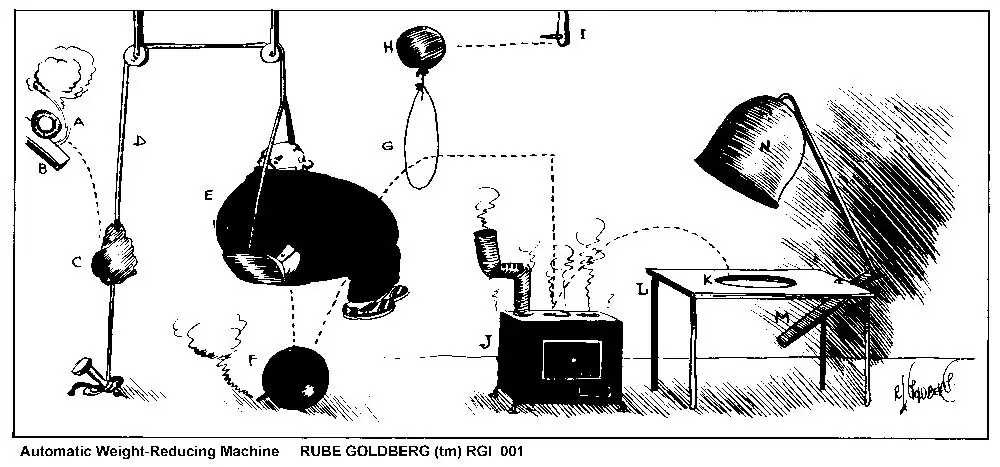
Read these as primary-source diagrams, not just funny pictures. Goldberg labels each step, sends the eye along a precise path, and makes the ordinary task comically small beside the machinery needed to finish it.
Public domainCreative CommonsCopyrighted study preview
Public domain · 1921If the Soap Falls Out of the Bathtub, Try This
The absurdly large solution begins with a tiny domestic problem. Trace the letters from the dropped soap to the final action. View source and rights.
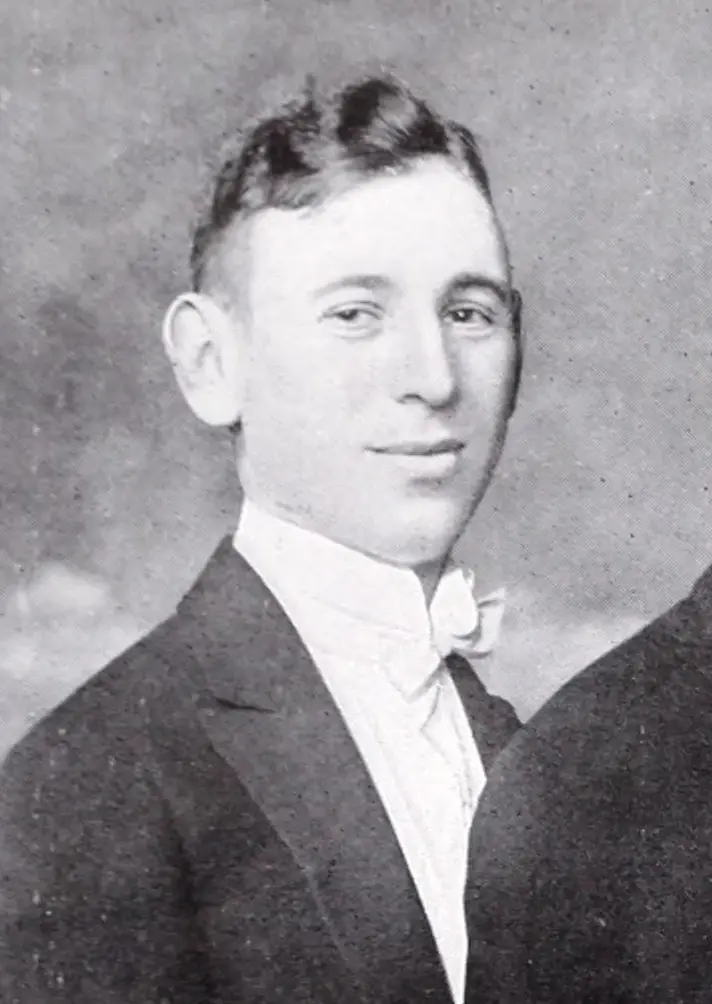
Public domain · 1915The engineer-cartoonist
Goldberg earned an engineering degree, then used diagram language to build visual satire. View source and rights.
Public domain · 1931Self-Operating Napkin
A spoon lift begins a ten-part sequence that wipes one diner’s chin. View source and rights.
Public domain · 1914Automatic Weight-Reducing Machine
An early invention drawing already contains the signature recipe: familiar objects, lettered links, and a wildly indirect result. View source and rights.
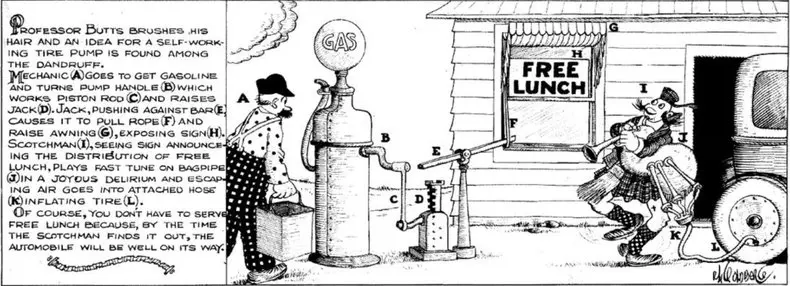
Public domain · 1929Self-Pumping Tire
Goldberg turns a roadside promise into the input for a machine. Notice how the written caption is part of the mechanism. View source and rights.
How the visual language travels through pop culture
These later works are not Goldberg cartoons. Compare how each borrows his chain-reaction vocabulary—a simple goal, readable cause and effect, comic delay, and a final payoff.
Mouse Trap made life-size
The board game translated a chain reaction into a toy; this Maker Faire build enlarged that toy into walk-around spectacle. Photo by Bill Ward, CC BY 2.0.
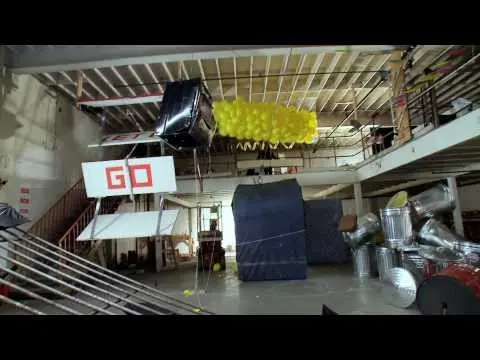
OK Go: synchronized spectacle
This Too Shall Pass makes the machine’s timing part of the music-video performance. Watch the official video.
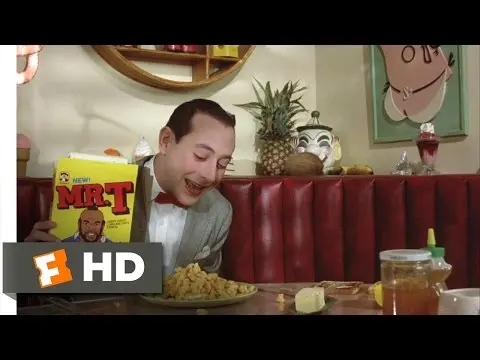
Aardman uses an automatic toast machine to create anticipation, mess, and a reaction shot. Watch Aardman’s official clip.
Compare: Choose one original cartoon and one modern example. Where is the input? What is the final task? Which link exists mainly to surprise or make the audience laugh?
The three video stills are low-resolution copyrighted previews shown for identification, comparison, and classroom analysis. They link to the rights holders’ or authorized official videos; no video or audio is copied into this lesson.
02 · Build, run, revise
Chain Reaction Workshop
Build a machine that carries the yellow energy ball to the bell. Choose a part, place it on the pegboard, drag it into position, and rotate it. Then press Run and let the physics decide.
Machine 01 · Warm-up run
Study the working chain. Move one part, predict what changes, and test again.
BUILD MODE
Drag move R rotate Delete remove
GOAL
Build mode.
Follow the dotted energy path or change the example. The bell rings when a moving object enters its target.
0 parts0 transfers0.0 seconds energy ball
Engineer’s test loop
Build: make each output meet the next input.
Predict: point to where the energy should go.
Run: watch the first place motion stops.
Revise: move or rotate one part, then test again.
Green motion trails
Show where moving objects carried kinetic energy during the last moments of a run.
Transfer counter
Counts new collisions between machine parts. More collisions are not always better—useful direction matters.
Slow or stuck?
Make a ramp steeper, shorten a gap, or use a spring to redirect the moving object.
Wild behavior?
Use platforms as guardrails. A reliable machine succeeds three times, not just once by luck.
03 · Classify the parts
Simple machine, energy source, or neither?
Select every item below that is one of the six classic simple machines. Then check your reasoning.
Select the parts you think belong to the classic six.
04 · Engineer it for real
Tabletop challenge: deliver a note.
Build a machine that moves a folded paper note into a cup. The chain must be safe, resettable, and understandable to someone who did not build it.
6+distinct energy transfers
3+types of simple machine
1variable changed per test
3successful runs in a row
Suggested materials
Cardboard, paper cups, craft sticks, tape, and string
Dominoes or blocks, toy wheels, marbles, and binder clips
Books or boxes for stable height
A folded note and a wide, unbreakable target cup
Design cycle
Sketch: draw arrows and label each input and output.
Build backward: make the final note drop reliable first.
Test in sections: connect two stages before connecting six.
Revise: record the first failure and one useful change.
Safety boundary: Use only low-energy classroom materials. No flames, sharp projectiles, glass, mains electricity, animals, or people as machine parts. Wear eye protection if an object could fly, and get adult help before using tools.
05 · Exit check
Can you read the chain?
1. A ball rolls down a ramp. Which energy change best describes the motion?
2. The first three stages work, but the light weight cannot turn the wheel. What should you change first?
The visual archive uses four public-domain Goldberg drawings and a public-domain portrait. The pre-1931 works are public domain in the United States because their U.S. copyrights have expired; the 1931 Self-Operating Napkin is marked public domain because its copyright was not renewed. Each caption links to its file record and rights statement.
The Mouse Trap photograph is by Bill Ward under CC BY 2.0. The three low-resolution video previews are copyrighted educational excerpts used for visual comparison and link to official or authorized videos. Full asset notes are in the gallery source record.
Simulator model renders: Spring and Crate by Quaternius (CC0); Baseball and Bell by Poly by Google (Creative Commons Attribution). Rendered and adapted for this lesson.
The schematic, ramps, platforms, dominoes, and fan are original instructional graphics. The success chime is synthesized in the browser.
Standards connection
This lesson supports 3-5-ETS1-1/2/3 and MS-ETS1-1/2/3/4 through criteria, constraints, comparison tests, failure analysis, and iterative modeling. It also connects to MS-PS3-5 by asking students to use evidence that energy transfers when objects interact.