Driving question: How can a living structure help solve a human design problem?
Try the idea first
Which cell needs the least wall?
Imagine building equal-area storage cells. Triangles, squares, and hexagons all tile a flat surface without gaps. Choose a shape and change the cell area. Which one needs the shortest boundary?
Ideal geometry: regular shapes, equal area, straight walls. Real wax cells have thickness and three-dimensional structure.
7.44boundary units for one cell
What does the model show?
At the same area, a regular hexagon has less perimeter than a square or equilateral triangle. Shared walls make this useful for a tiling. The model measures geometry; it does not prove why bees build every feature of a real comb.
Interactive investigation
Nature vs. Invention Matching Lab
Select an organism, read its engineering clues, then choose the real invention it inspired. Real biomimicry always starts from evidence — not a guess about what "seems similar."
0 of 6 matched
Burdock burr
Tip: match the physical clues to a function, not to the animal's name.
Why Look at Nature Before You Build?
Biomimicry starts with a problem: grip without glue, move with less drag, or cool a room with less energy. An engineer observes how an organism handles a similar challenge, identifies the working feature, then builds and tests a version for a different setting.
Living things are shaped by evolution and their environments. A feature that helps one organism may suggest an idea, but it is not proof that a human copy will work. Engineers still measure performance, tradeoffs, and cost.
Reflection: Psalm 19:1 invites readers to see creation with wonder. Whether you approach nature through faith, biology, or both, careful observation and fair testing matter in engineering.
Biomimicry (from the Greek bios, "life," and mimesis, "to imitate") is the practice of designing technology by studying how living things solve the same problem — moving efficiently, staying cool, sticking to a surface, packing material with almost no waste.
The Biomimicry Method
Biomimicry isn't "make it look like an animal." It's a three-step discipline engineers use to pull a working principle out of a living system, so it can be rebuilt in a completely different material at a completely different scale.
Observe
Watch closely. What problem is this organism actually solving — moving through fluid, shedding heat, gripping a surface, surviving impact?
Abstract
Strip away the biology. Describe the underlying shape, structure, or process in the language of physics, geometry, or chemistry — not "kingfisher," but "a tapered shape that changes pressure more gradually."
Emulate
Rebuild that principle in steel, plastic, fabric, or code. The invention rarely looks like the animal — it captures the function, not the costume.
Common trap: a robot with fake feathers glued on is decoration, not biomimicry. A train nose reshaped around a beak's pressure-wave geometry is biomimicry — even though it looks nothing like a bird.
Reading Nature's Blueprints: A Short History
People have studied living structures for centuries — long before "biomimicry" had a name. These are selected people, observations, and designs behind the story.
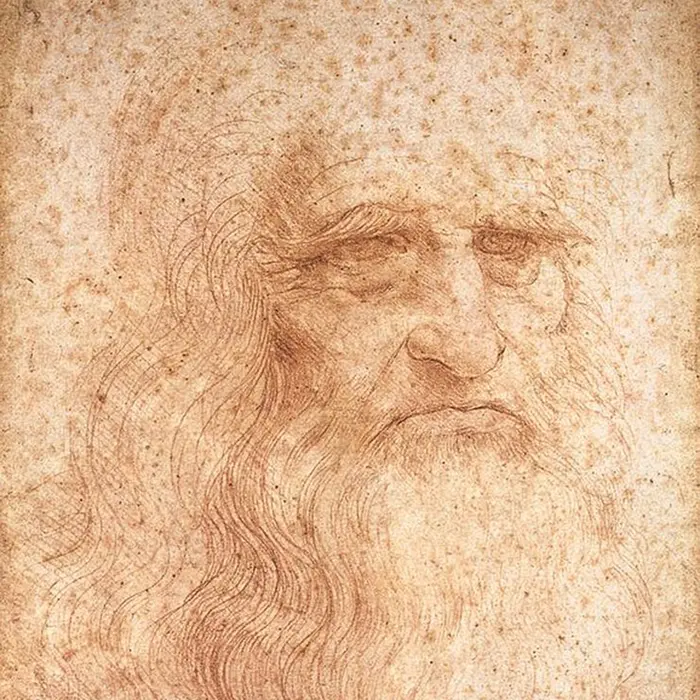
Red chalk presumed self-portrait of Leonardo da Vinci, c. 1512
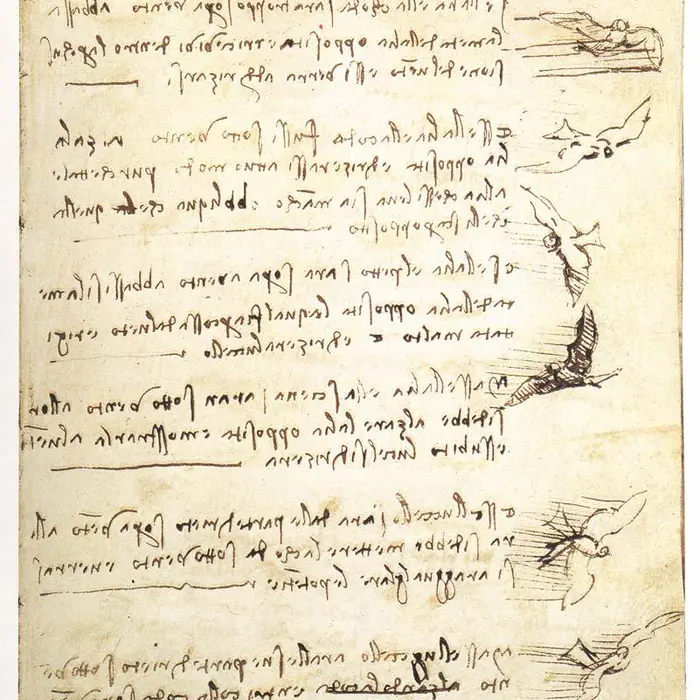
Page from Leonardo da Vinci's Codex on the Flight of Birds, showing anatomical studies of wings
1485 – 1505
Da Vinci sketches the sky
Leonardo da Vinci filled notebooks like his Codex on the Flight of Birds with anatomical studies of wings, convinced that if he understood exactly how a wing worked, he could build a flying machine. His ornithopter never flew — but his insistence on studying the animal's mechanics before designing became the biomimicry blueprint itself.
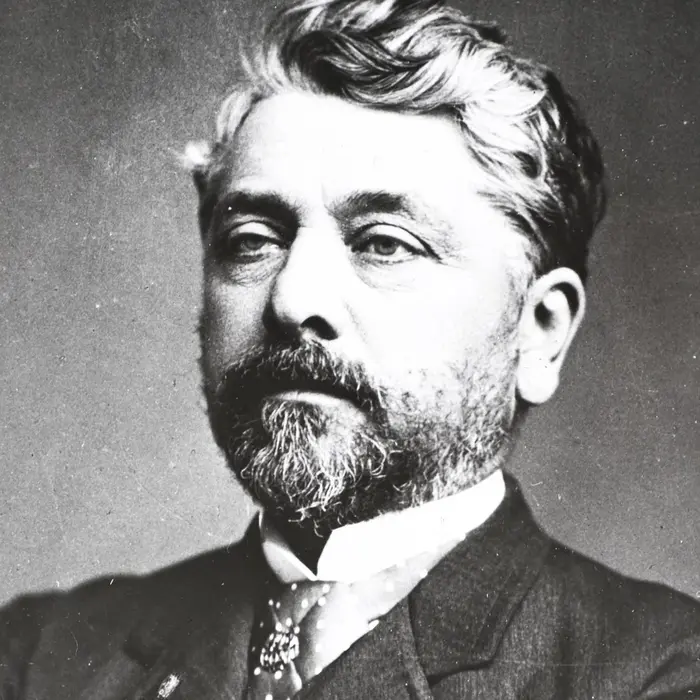
Photographic portrait of Gustave Eiffel
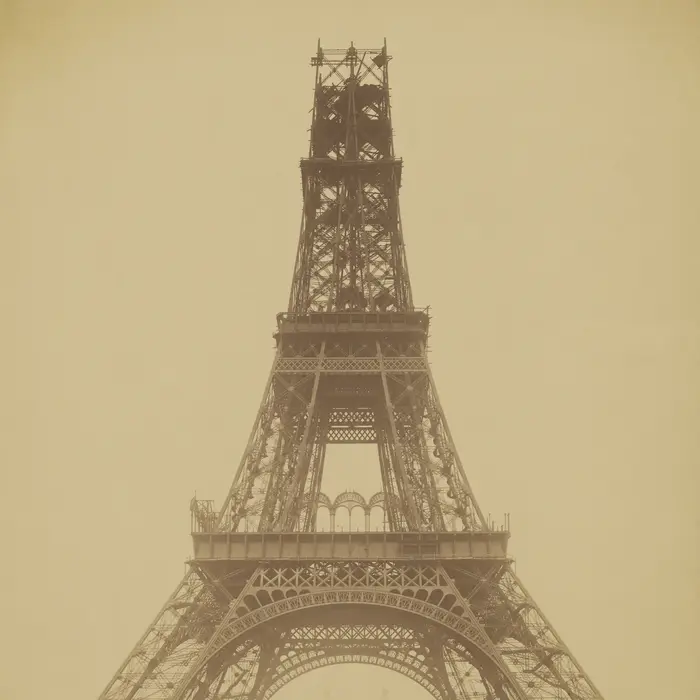
1888 photograph of the Eiffel Tower under construction, showing the curved lattice legs
1866 – 1889
A bone builds a tower
Swiss engineer Karl Culmann noticed that the internal lattice of a cow's femur — thin struts of bone arranged along the exact lines of mechanical stress — matched patterns he'd seen in crane design. The Eiffel Tower also uses a light, open lattice to manage loads. The popular claim that Eiffel directly copied a femur is not well established; compare the structural idea without assuming a direct line of inspiration.
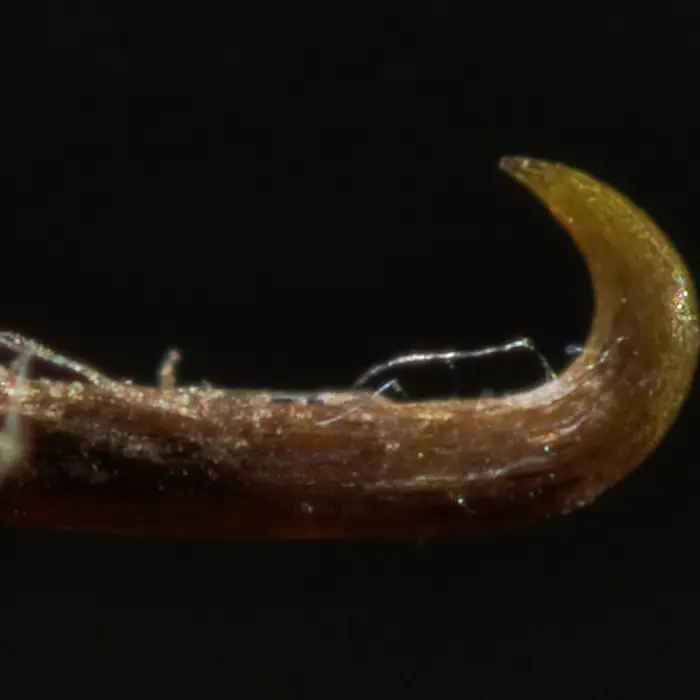
Macro photograph of a burdock (Arctium) bract spine, showing the curved hook tip
1941 – 1955
A burr invents Velcro
Swiss engineer George de Mestral came home from a walk covered in burdock burrs and examined them under a microscope. Each burr was covered in tiny hooks that snagged the loops in fabric and fur. Fourteen years of development later, he patented Velcro — a fastener built from exactly that hook-and-loop principle.
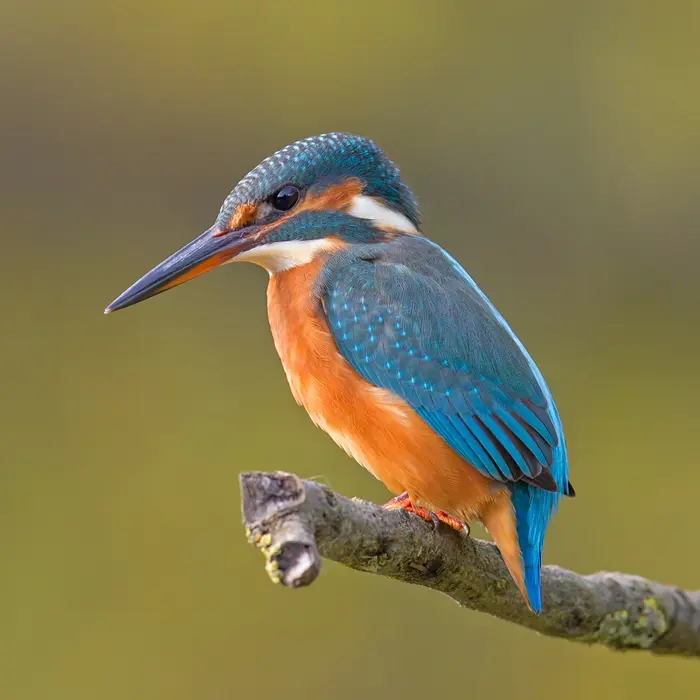
Photograph of a common kingfisher (Alcedo atthis) perched
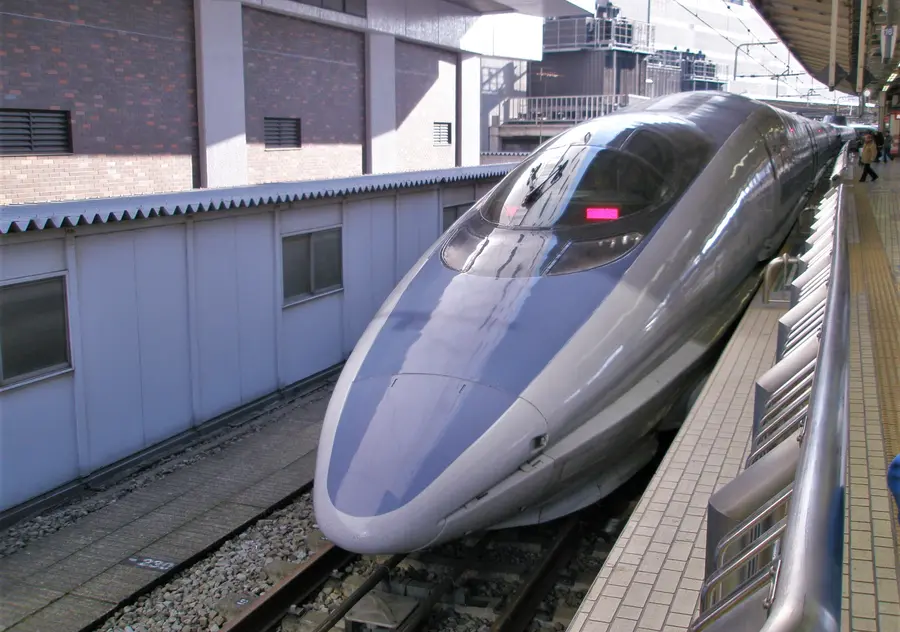
Photograph of a 500-series Shinkansen bullet train, showing its kingfisher-inspired nose
1994
A kingfisher solves the tunnel boom
Japan's original 300-series Shinkansen bullet train shot a deafening shockwave out of every tunnel it entered. Engineer and birdwatcher Eiji Nakatsu, tasked with fixing it, remembered how a kingfisher dives from air into water with barely a splash. He reshaped the 500-series train's nose around the kingfisher's beak geometry — the design helped reduce tunnel noise and aerodynamic drag.
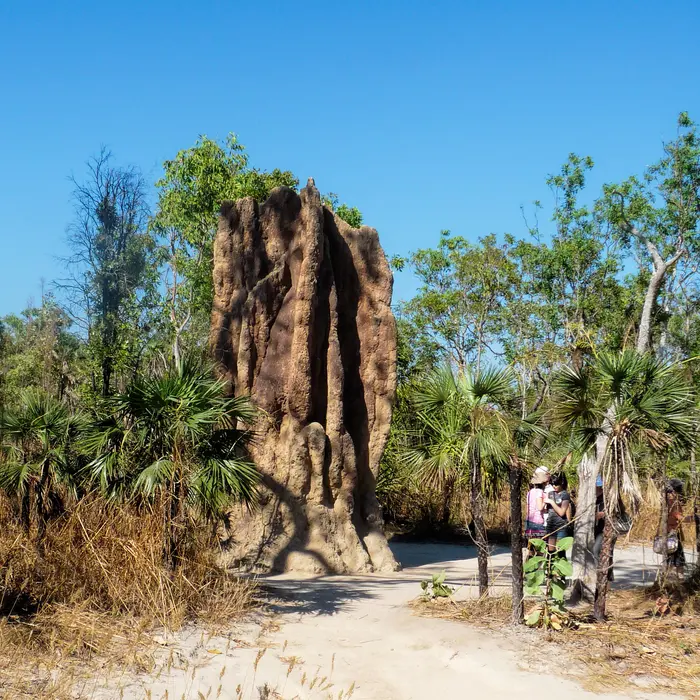
Photograph of a tall cathedral termite mound
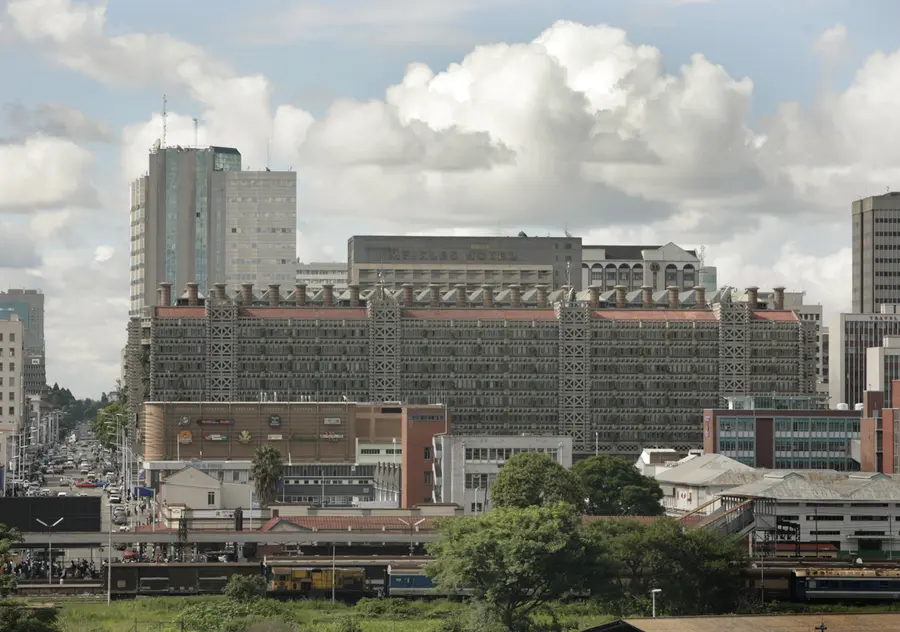
Photograph of the Eastgate Centre in Harare, Zimbabwe, showing its chimney-like roof vents
1996
Termites air-condition a building
Architect Mick Pearce studied African termite mounds, whose ventilation and thermal behavior inspired passive-airflow thinking. His Eastgate Centre in Harare, Zimbabwe uses passive ventilation and thermal mass to reduce its reliance on mechanical cooling. The exact savings depend on what is being compared.
1997
The field gets a name
Biologist Janine Benyus publishes Biomimicry: Innovation Inspired by Nature, arguing engineers should stop asking "what can I extract from nature?" and start asking "what can I learn from it?" The book turns a centuries-old habit into a named design discipline.
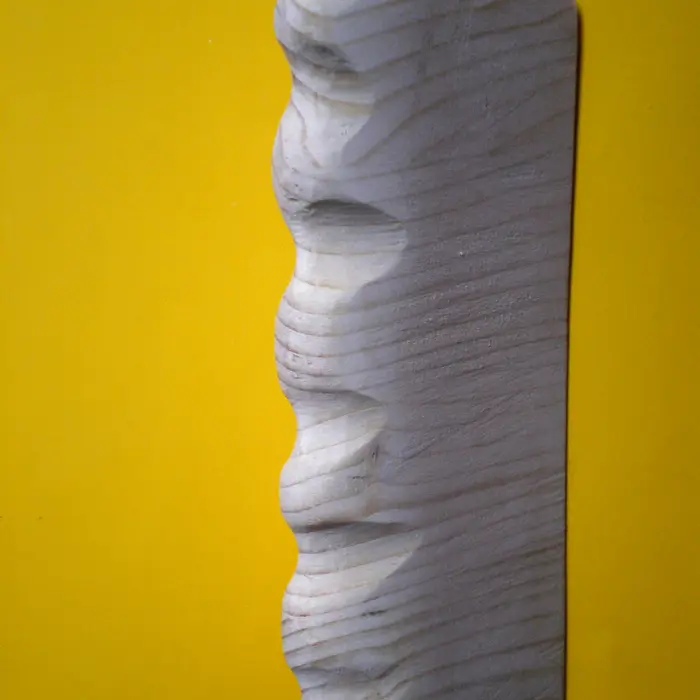
Museum model of a humpback whale flipper's leading edge, showing the bumpy tubercles
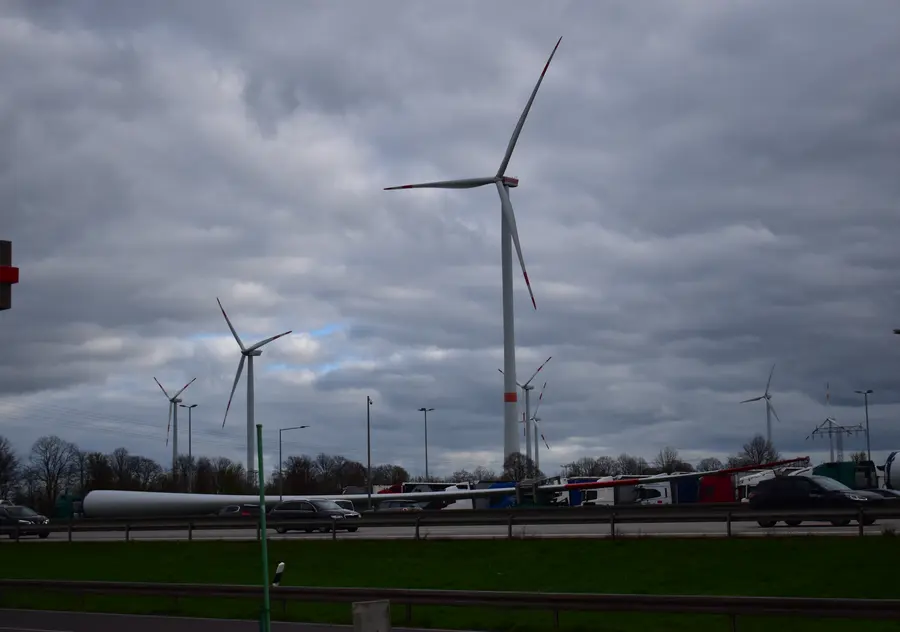
Photograph of wind turbines against a cloudy sky
2008
Bumpy whale fins reinvent wind turbines
Biologist Frank Fish noticed that humpback whales — enormous, slow-looking animals — turn sharply underwater thanks to bumps (tubercles) along their flippers' leading edge. Researchers have tested tubercled blade edges in fans and turbines; performance depends on blade shape and operating conditions.
Patterns Written Into Creation
Some of nature's best "engineering" is a mathematical pattern that shows up over and over, in different living systems.
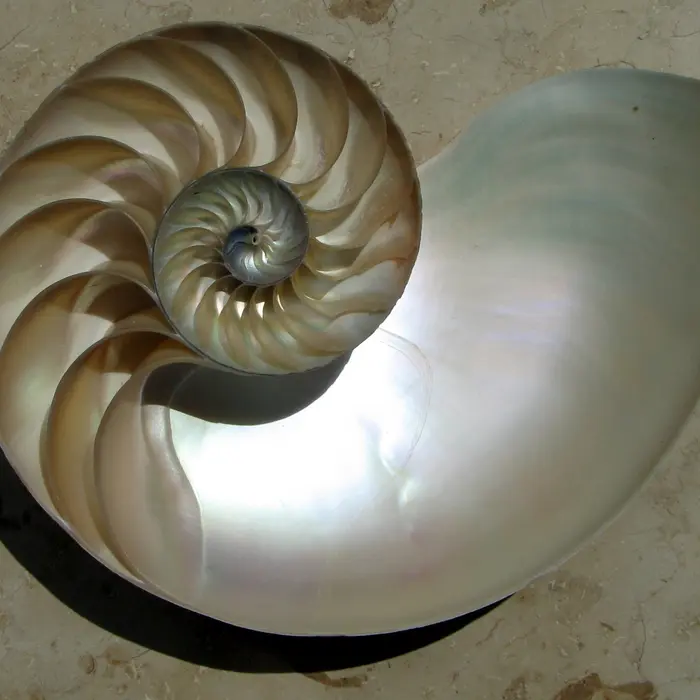
Cutaway photograph of a chambered nautilus shell showing its logarithmic spiral
Growing spiral
A nautilus shell grows in a roughly logarithmic spiral. It is not an exact golden spiral. Spiral patterns also appear in plants, but they arise from different growth processes.
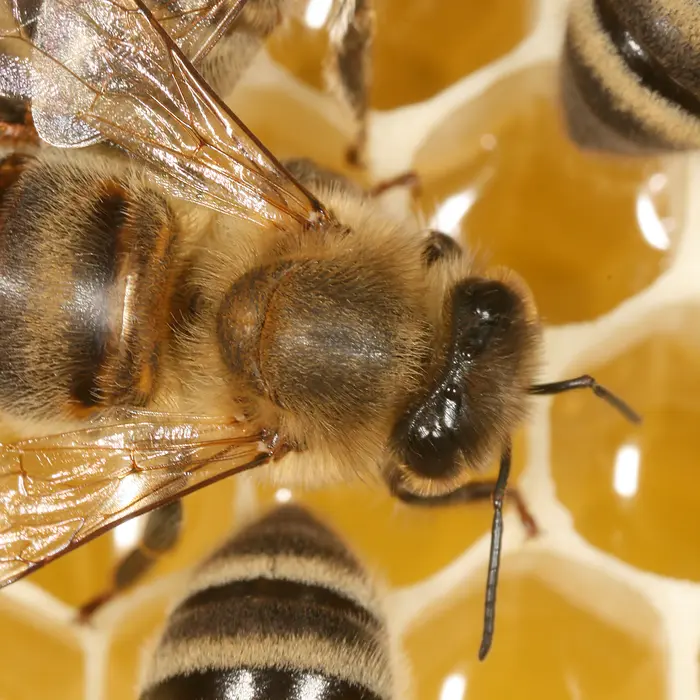
Photograph of bees on real hexagonal honeycomb cells
The Hexagon
Regular hexagons tile a flat surface without gaps. For equal-area cells, the hexagonal grid uses the least total boundary length in the ideal two-dimensional model; the honeycomb theorem was proved in 1999.
Fractal Branching
Trees, lungs, blood vessels, and river networks branch to distribute or collect material. Their patterns vary; they are useful analogies rather than identical fractals at every scale.
Try it: next time you're outside, look for one of these three patterns — a spiral, a hexagon, or a branch splitting in two. Note what the organism uses it for. That's the first step of biomimicry: observe.
Engineer's Challenge: Design Your Own Biomimetic Invention
Now run the three-step method yourself, on an organism nobody has assigned you.
Choose
Pick a plant or animal you can observe in person, in a video, or in a photo. Something ordinary is fine — a pinecone, a spiderweb, an ant.
Observe
Write down one thing its body does exceptionally well: grips, insulates, flies, filters, self-repairs, self-cleans.
Abstract
Describe that ability in physics or math terms, with no mention of the organism's name. What shape, material, or structure makes it work?
Sketch & Pitch
Sketch a product or technology that uses that same principle, then explain to a partner what problem it solves and how nature solved it first.
Stretch goal: look up your organism on AskNature.org after you sketch — see how close your abstraction gets to what real biomimicry engineers found.
One Design Discipline, Five Ways of Thinking
Science
Observe anatomy, materials, and survival strategies in living systems.
Technology
Turn a biological principle into a working prototype or material.
Engineering
Test, refine, and manufacture the emulated structure at scale.
Art
Sketch and communicate the design clearly enough for others to build it.
Math
Describe spirals, hexagons, and fractals with ratios, angles, and geometry.