Earth systems field guide

One drop.
Endless journeys.

Follow water through sky, land, oceans, and living things.

Earth’s water moves among connected reservoirs. Explore six important processes that change its location and state, shape weather, and make life possible.

6
core processes
3
states of matter
∞
times around
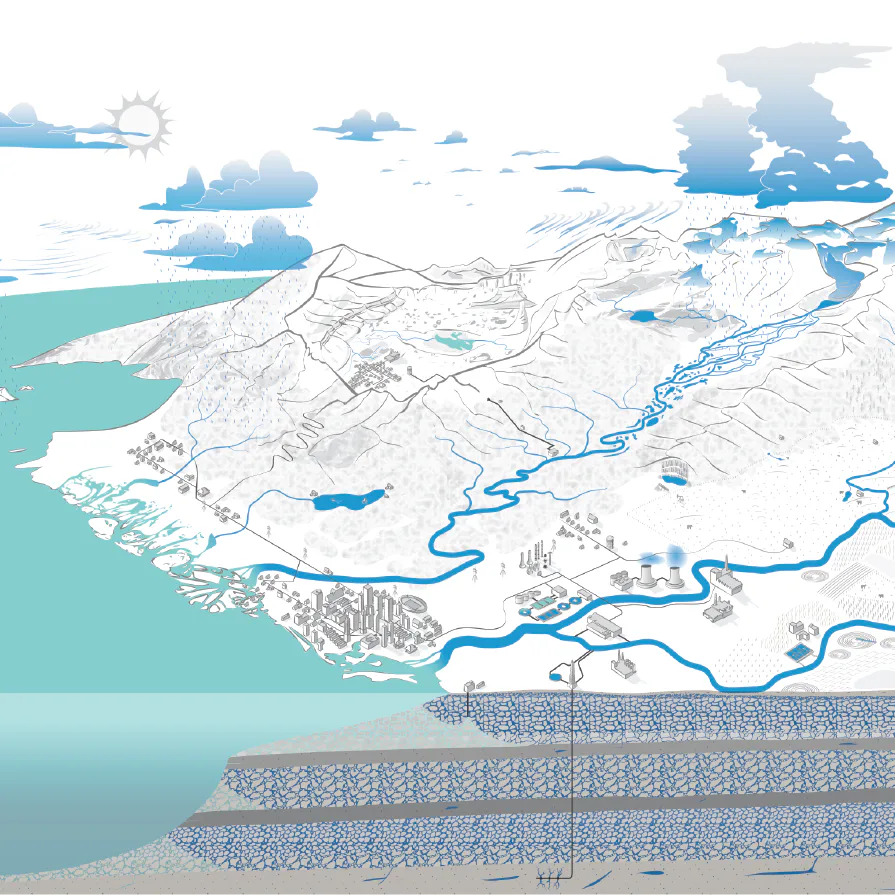
USGS field mapWater moving through a connected landscape
USGS water cycle landscape showing clouds, precipitation, rivers, groundwater, oceans, cities, farms, and industry.

Water-cycle weather lab

Predict, test, compare: does water evaporate faster into dry air or humid air? Keep sunlight and temperature the same, change humidity, and compare the results. Then test a different environment.

Evaporation tendency
Air's drying potential
Cloud clue

Save a result, change one variable, and compare.

A qualitative teaching model, not a weather forecast. Science reference: USGS Water Cycle. The tendency index has no physical units. Wind, water availability, cloud cooling, and soil properties are not modeled. Below freezing, ice can lose water by sublimation; this index does not model freezing or sublimation. Season changes the illustration’s sun color; the sliders determine the tendency. Moving dots trace an example route; real water can remain stored or take other routes.

What Is the Water Cycle?

The water cycle is the continuous movement of water from Earth's surface to the atmosphere and back again. Water travels through oceans, air, land, plants, and animals along many connected routes. Solar energy drives evaporation; gravity pulls precipitation, runoff, and groundwater downhill.

This cycle has no beginning or end. The same water molecules that fill today's oceans have cycled through clouds, rainfall, rivers, and living things for billions of years. Every raindrop, snowflake, and breath of humid air is part of this ancient, ever-moving system.

Key Idea: The water cycle is one of Earth's most important natural processes. It distributes fresh water across the planet, shapes weather and climate, and makes life possible.
How Does the Water Cycle Work?

Read a NASA Water-Cycle Map

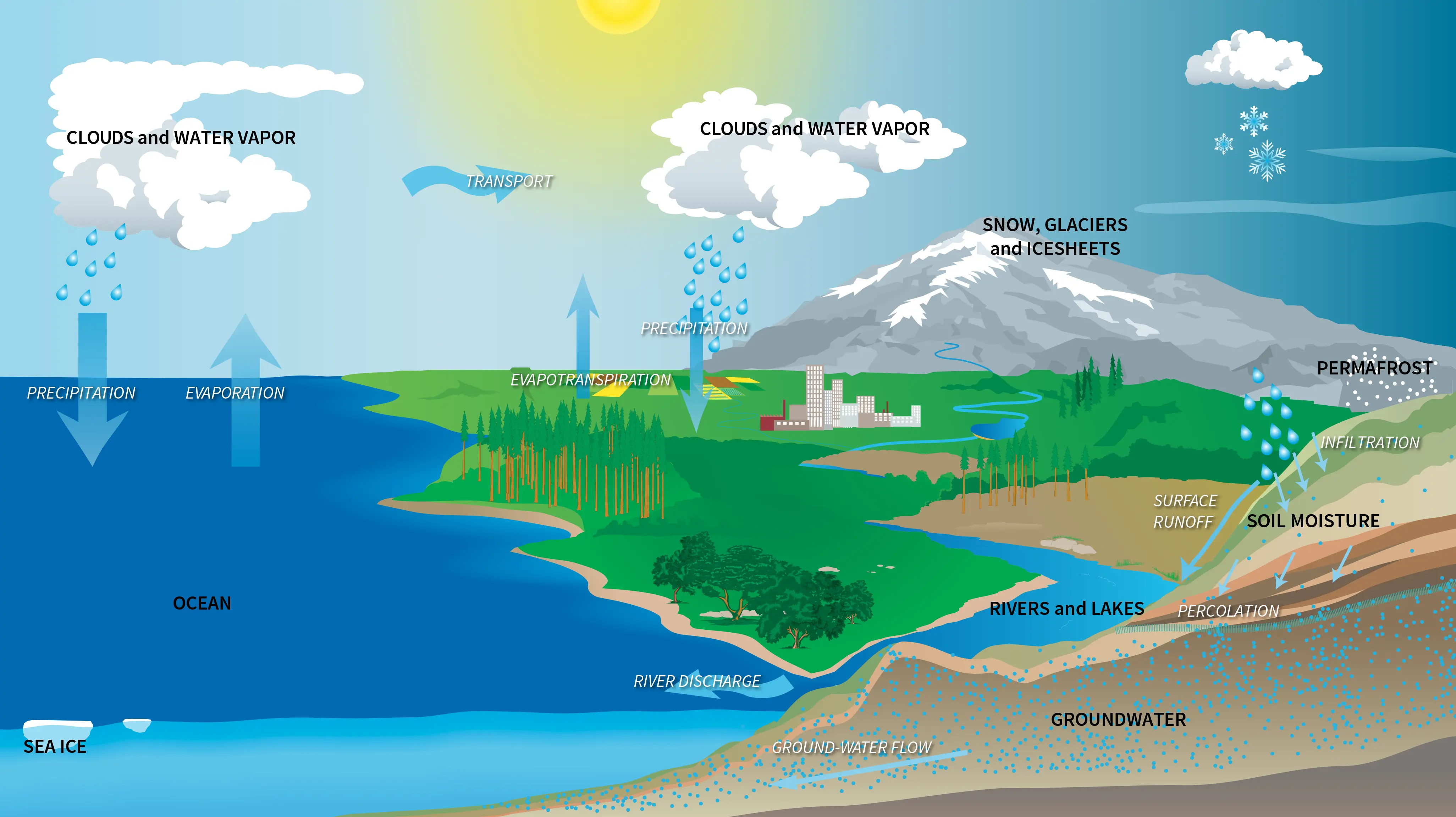
Use the controls to explore six processes on NASA’s Earth-system diagram. The tour order is a guide, not a route every water molecule must follow.

Current stage Evaporation
Water state Liquid to gas
Temperature Sun-warmed — happens at any temperature
NASA diagram of the water cycle showing precipitation, evaporation, evapotranspiration, transport, runoff, infiltration, percolation, and groundwater flow.
NASA Scientific Visualization Studio, 2015. Public-domain U.S. government work.

Choose a stage to update the readouts, then locate that process on NASA’s diagram above.

Stage 1: Evaporation

The Sun heats liquid water in oceans, lakes, and rivers. The water gains energy and transforms into invisible water vapor, rising into the atmosphere. Plants also release water through their leaves in a process called transpiration, which is sometimes counted as part of evaporation.

What happens: Heat + liquid water = invisible water vapor that floats upward

Ocean/Lake Water Vapor

Bonus processes: Water doesn't always melt or boil its way between states. Snow and ice can turn straight into vapor without ever becoming liquid — that's called sublimation. The reverse can happen too: water vapor can turn directly into ice, skipping the liquid phase, in a process called deposition (it's what forms frost on a cold morning). Source: NOAA Education, "The water cycle."

The Official USGS Water Cycle Diagram

This is the real diagram published by the U.S. Geological Survey — the same illustration used by scientists, teachers, and water managers across the country. Zoom in to see the pools that store water and the fluxes that move it between them, drawn straight from real hydrologic science.

Hold Ctrl (or Cmd) and scroll to zoom, or drag to pan once zoomed in. On a touchscreen, pinch to zoom and drag with one finger to pan.

Illustrated diagram of the water cycle showing the major pools and fluxes of water on Earth, published by the U.S. Geological Survey.
Download Printable PDF Poster

Source: Corson-Dosch, H.R., Nell, C.S., Volentine, R.E., Archer, A.A., Bechtel, E., Bruce, J.L., Felts, N., Gross, T.A., Lopez-Trujillo, D., Riggs, C.E., and Read, E.K., 2023, The water cycle: U.S. Geological Survey General Information Product 221, 1 sheet, doi.org/10.3133/gip221. See the interactive original at water.usgs.gov/vizlab/water-cycle.

States of Water

Water can exist in three states: solid, liquid, and gas. The state depends on temperature and pressure. Understanding these states helps explain what happens to water as it moves through the cycle.

Phase Change Explorer

Molecular Motion

Solid: Ice cube
Liquid: Cup of water
Gas: Steam

Solid (Ice)

Below 0°C (32°F)

ICE

Water freezes into solid ice. Molecules are tightly packed and move very slowly. Ice is less dense than liquid water, so it floats. Its molecules vibrate around fixed positions.

Liquid (Water)

0°C to 100°C (32°F to 212°F)

WATER

Most familiar state. Molecules move freely and flow. This is how water travels through oceans, rivers, and rain.

Gas (Water Vapor)

Boils at 100°C (212°F) — but evaporates at any temperature

VAPOR

Invisible gas state. Molecules are spread far apart and move very fast. Water vapor floats in the air all around us.

Phase Changes: Melting (ice → water), Evaporation (water → vapor), Condensation (vapor → water), Freezing (water → ice). The water cycle involves all these changes!

The Sun Powers the Cycle

Without the Sun, there would be no water cycle. The Sun's energy heats water, turning it from liquid into vapor. This heat drives wind and weather patterns. The Sun is the engine that keeps water moving around our planet.

NASA water-cycle diagram showing solar heating, evaporation, atmospheric transport, precipitation, runoff, and groundwater.
NASA’s system view shows sunlight driving evaporation and evapotranspiration. About 75% of heat transfer in the atmosphere happens through evaporation. NASA Scientific Visualization Studio source · Public domain.
Solar Energy Drives the Cycle Sun Heat Evaporation Wind Clouds Rain How it works: 1. Sun heats water → evaporation (liquid to vapor) 2. Heat causes air currents and winds → water vapor rises 3. Rising vapor cools → condensation → clouds → precipitation

Where Water Goes

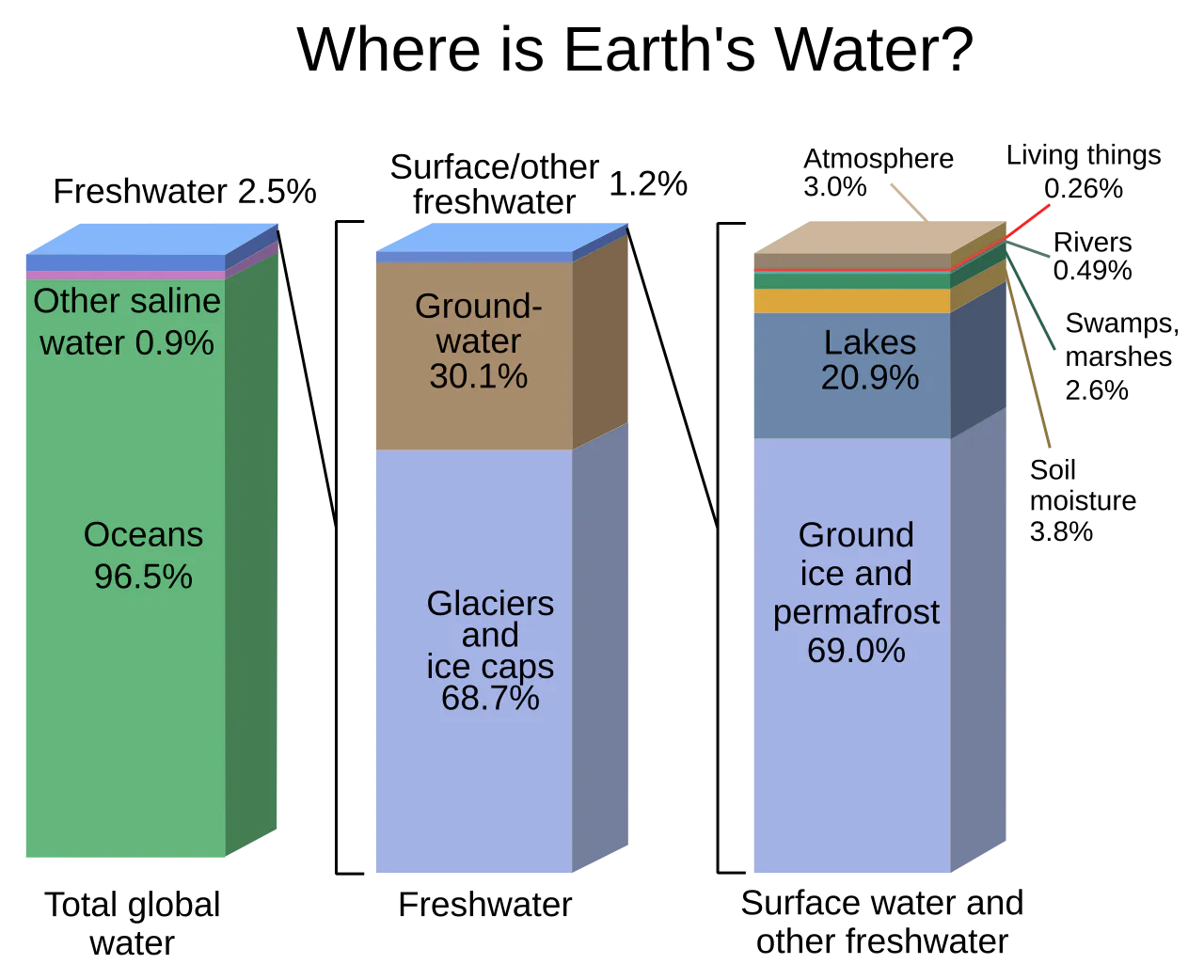
Water on Earth is found in many "pools" — places where it's stored. Almost all of it is salt water in the ocean. The rest — just 2.5% — is freshwater, and most of that is frozen. Plants and animals hold water too. Understanding where water is stored helps us use this precious resource wisely.

USGS chart comparing all water on Earth, freshwater stores, and surface-water stores. Oceans dominate all water; glaciers and ice caps dominate freshwater.
USGS comparison of Earth’s water stores. The first column includes oceans plus other saline water; the next two progressively magnify freshwater. View source · Public domain.

Hover or tap a slice to see details.

🌊

Oceans

97.5% of Earth's water

Saltwater covers most of the planet

❄️

Glaciers & Ice

~68% of Earth's freshwater

The single largest freshwater store, frozen in polar regions and mountains

🔵

Groundwater

~30% of Earth's freshwater

Liquid water in soil and rock — some of it takes centuries to replenish

💧

Lakes & Rivers

Well under 1% of Earth's freshwater

Tiny in volume, but our most important daily water source

🌱

In Plants

Absorbed from soil

Used for growth and released through transpiration

🦁

In Animals

Essential for all life

Makes up roughly 60% of the human body

Source: NOAA Education, "The water cycle", National Oceanic and Atmospheric Administration (accessed 2026).

Transpiration Explorer: inside the plant

Follow liquid water from soil to leaf, then watch it leave as invisible water vapor. Predict: will a plant lose more water in dry air or humid air?

Blue paths: liquid water · dotted paths: invisible vapor (shown for learning). Magnified views are not to scale. On a small screen, swipe across the diagram.

Change one condition

Save a baseline, change one condition, then explain the difference.

Simplified comparison index, not a measured rate. Temperature, wind, leaf area, and plant species are held constant. Real plants regulate their stomata; closing them also limits CO₂ entry for photosynthesis. A little water can still escape through the leaf surface.

Test & explain: Reset, then change only humidity. What happens to the flow? Reset again and reduce soil water. Explain why dry air alone cannot keep a water-starved plant transpiring rapidly.

Science reference: USGS: Evapotranspiration and the Water Cycle.

Vocabulary

Evaporation

The process by which liquid water turns into water vapor and rises into the atmosphere. Heat from the Sun powers this process.

Condensation

The process by which water vapor cools and changes back into liquid water droplets. This forms clouds and fog.

Precipitation

Water that falls from clouds to Earth in the form of rain, snow, sleet, or hail. The process returns water to the surface.

Collection

The gathering of water in oceans, lakes, rivers, and soil. Collected water is stored until it evaporates again or infiltrates into the ground.

Infiltration

The process by which water soaks into the soil and moves downward through soil layers. This water becomes groundwater.

Transpiration

The process by which plants release water vapor from their leaves. Combined with evaporation, it's called evapotranspiration.

Groundwater

Water stored beneath Earth's surface in soil and rock layers. It fills aquifers and feeds springs and underground streams.

Water Vapor

The invisible gas form of water. It floats in the atmosphere and becomes visible as clouds when it condenses.

Sublimation

The process by which snow or ice turns directly into water vapor, skipping the liquid phase entirely.

Deposition

The process by which water vapor turns directly into ice without becoming liquid first — it's how frost forms.

Quick Check

Test your understanding of the water cycle with these questions. Choose the best answer for each.

0/8 correct Question 1 of 8

Scavenger Hunt Challenge

Use the information from this page to answer these questions. Great for classroom activities!

0/6 correct Follow the hints to verify each answer

🔍 Challenge 1

Question: List the six main stages of the water cycle in order.

Hint: They start with E, C, P, C, I, and T.

🔍 Challenge 2

Question: What role does the Sun play in the water cycle?

Hint: Check the "Sun Powers the Cycle" section.

🔍 Challenge 3

Question: How much of Earth's water is in the oceans? What percentage is freshwater?

Hint: Look at the "Where Water Goes" section.

🔍 Challenge 4

Question: What is the difference between evaporation and transpiration?

Hint: One comes from water bodies, the other from living things.

🔍 Challenge 5

Question: Describe what happens to water during condensation. What causes it?

Hint: It's the opposite of evaporation. Think about temperature.

🔍 Challenge 6

Question: What is groundwater, and why is it important?

Hint: Check the vocabulary and "Where Water Goes" sections.

Wonder Zone: Beyond the Basics

The water cycle is even more fascinating when you explore its connections to weather, climate, and life. Here are some mind-bending ideas:

🧊 Glaciers: Frozen Storage

Glaciers are massive reservoirs of freshwater. As Earth's climate warms, glaciers melt, returning ancient water to the oceans. This affects sea levels and regional water availability.

💧 Aquifers: Underground Reservoirs

Groundwater fills hidden aquifers beneath our feet. Some aquifers took thousands of years to fill and provide crucial freshwater for drinking and farming. We must use them wisely.

⛈️ Severe Weather

The water cycle fuels hurricanes, tornadoes, and thunderstorms. Warmer oceans evaporate more water, which can intensify storms and change weather patterns globally.

🌍 Climate Change & Drought

Here's a surprising twist: warmer temperatures can cause both drought and heavier rainfall. Warm air can hold more water vapor before it's saturated, so rain becomes less frequent but more intense when it finally falls. Longer dry spells between storms can lead to drought — while the storms themselves can dump more water at once. (Source: NOAA Education)

🪐 Water on Other Planets

Scientists search for water on Mars, icy moons, and distant exoplanets. Water may indicate past or present life. Earth's water cycle is unique and precious in the cosmos.

🧬 Water in Living Things

You are about 60% water! Plants are up to 95% water. Every organism on Earth depends on the water cycle — and every organism is part of it too, since living things are themselves one of the many "pools" where water is stored for a while.