Seasons and the Heavens
Why is July hot in Texas and cold in Chile? Find out how Earth's tilt shapes the year. Measure sunlight and daylight at any spot on the globe, and watch the North Star change over thousands of years. Along the way, see how the order of the heavens points to the One who made them.
By the end you can…
- Explain the two ways tilt warms a hemisphere: steeper sunlight and longer days.
- Use evidence (perihelion in January) to show that distance does not cause the seasons.
- Describe where the Sun is overhead at each solstice and equinox.
- Explain how precession changes the pole star over 26,000 years.
- Connect the reliable seasons to God's faithfulness in Scripture.
"And God said, 'Let there be lights in the vault of the sky to separate the day from the night, and let them serve as signs to mark sacred times, and days and years.'"
— Genesis 1:14 (NIV)
Warm-Up: Make a Prediction
Before you learn anything new, commit to an answer. Scientists make a prediction first, so the evidence can surprise them.
Why is it hotter in summer than in winter?
What Causes the Seasons?
A tilted planet circling a star. That one picture explains summer and winter. Step through the five pieces of the puzzle.
Earth's Axis Is Tilted
Every planet spins around an imaginary line called its axis. The planets do not all spin at the same angle. Mercury stands almost upright. Venus is flipped nearly upside down. Mars leans much like Earth, and Uranus rolls around the Sun on its side.
Earth's axis leans about 23.4° (often rounded to 23.5°) from straight up and down compared with its orbit. This lean is called axial tilt. Most important of all, the axis keeps pointing the same direction in space all year, toward the North Star.
A tilt that stays pointed one way, carried all the way around the Sun, is the whole secret of the seasons.
Sunlight Hits at Different Angles
Shine a flashlight straight down at a table and you get a small, bright circle. Tilt the flashlight and the same light smears into a long, dim oval. The light is the same, but now it covers more table.
Sunlight works the same way. When your hemisphere leans toward the Sun, the noon Sun climbs high and its rays hit the ground steeply, packing energy into a small area. When your hemisphere leans away, the Sun stays low and the same energy spreads thin. Low sunlight also passes through more air on its way down.
Drag the slider. At 40°N the December noon Sun delivers less than half the energy per square meter of the June noon Sun.

The Sun Stays Up Longer in Summer
At every moment, half of Earth is in daylight. The line between day and night is a great circle around the planet. As Earth spins, your town rides around its own latitude line once a day.
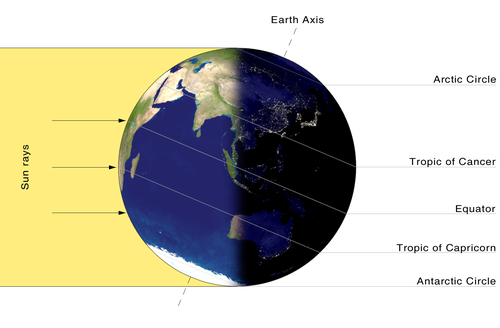
Because the axis is tilted, the day/night line is slanted compared with the latitude lines. When your hemisphere leans toward the Sun, more than half of your latitude line is on the sunny side, so you spend more of each turn in daylight. When it leans away, less than half is lit.
Long days plus steep sunlight make a hot summer. Short days plus low sunlight make a cold winter. Both effects come from the tilt.

The Hemispheres Trade Places
Look at the red axis in both pictures. It points the same direction in June and December. The axis does not flip. Earth moves to the other side of the Sun.
In June, the Northern Hemisphere leans toward the Sun and has summer, while the Southern Hemisphere leans away and has winter. In December it is the reverse. That's why Christmas in Australia is a beach holiday, and why July is ski season in Chile.
If distance caused the seasons, both hemispheres would have summer at the same time. They never do.
The Seasons Cycle Through the Year
As Earth travels once around the Sun, the axis stays parallel to itself, like a compass needle carried around a room. At the solstices, one hemisphere leans as far toward the Sun as it ever does. At the equinoxes, neither hemisphere leans toward the Sun, and day and night are nearly equal everywhere.
Read the labels under the solstices. Earth is closest to the Sun in early January, during northern winter. The orbit is so nearly circular that the change in distance barely matters.
One orbit makes one full cycle of seasons. The cycle is so regular that we can predict solstices to the minute centuries ahead.
Myth Buster: "Summer Is When We're Closer to the Sun"
Earth's orbit is an ellipse, so its distance from the Sun does change a little. Here are the real numbers:
- Earth is closest to the Sun in January, the middle of northern winter.
- The difference is only about 3% in distance and about 7% in sunlight. Compare the tilt: at 40°N, daily sunlight in June is about three times what it is in December.
- The two hemispheres have opposite seasons at the same distance. Distance can't explain that. Tilt can.
The Tilt: 23.4 Degrees of Difference
The planets have very different axial tilts. Mercury is barely tilted at about 0.03°. Venus is tilted about 177°, so it spins backward. Mars leans about 25.2°, Jupiter only about 3.1°, Saturn about 26.7°, Uranus about 97.8°, and Neptune about 28.3°.
Earth's 23.4° sits in a life-friendly middle ground. With an upright axis (0°), there would be no seasons at all. Every place would get 12 hours of daylight every day, and climate would depend only on latitude. With a much steeper tilt, most of the planet would swing between scorching summers and long polar nights.
The tilt also draws the lines you see on a globe:
Change the tilt and every one of those lines moves. Try the Tilt slider in the simulator below.
Solstices and Equinoxes: The Turning Points
Four moments divide the astronomical year. At each one, the subsolar point, the place where the Sun is straight overhead at noon, reaches a landmark latitude:
March Equinox
March 19, 20, or 21
Sun overhead at the Equator, moving north. About 12 hours of day and night everywhere. First day of spring in the north and autumn in the south.
June Solstice
June 20 or 21
Sun overhead at the Tropic of Cancer. Longest day in the north and shortest in the south. The noon Sun is at its highest point all year for northern skies.
September Equinox
September 22 or 23
Sun overhead at the Equator again, now moving south. Day and night are nearly equal everywhere. Autumn begins in the north and spring in the south.
December Solstice
December 21 or 22
Sun overhead at the Tropic of Capricorn. Shortest day in the north and longest in the south. North of the Arctic Circle, the Sun never rises.
See It in Action: Seasons Simulator
Pick a date and a place on Earth. On the left, Earth travels its real orbit, and you can drag that view to turn it. On the right, Earth is shown with the Sun to the left. The gold ring is your latitude line: its gold part is daylight and its blue part is night. Use the Controls panel to change the date, latitude, and even Earth's tilt.
Hours of daylight through the year
40°N 40°S Equator · Click or drag on the chart to jump to a date. Dotted lines mark solstices and equinoxes.
Model: Earth's real elliptical orbit and tilt. Daylight is measured from sunrise to sunset of the Sun's center, ignoring the bending of light by the air (which adds a few minutes). "Daily sunlight" (insolation) is the 24-hour average reaching the top of the atmosphere, before clouds and air absorb any.
Precession: The Great Wobble
Advanced topic. A spinning top that leans doesn't fall over. Instead, its axis slowly sweeps around in a circle. Earth does the same thing. The pull of the Sun and Moon on Earth's bulging equator makes the axis trace a circle in the sky about once every 26,000 years. This is called precession.
What changes?
- The North Star changes. Polaris is our pole star now. It will be closest to the pole around AD 2100, less than half a degree away. When the Great Pyramid was built, the pole star was Thuban in Draco. Around AD 14,000, bright Vega will be the pole star.
- The tilt angle stays the same. Precession changes which way the axis points, not how far it leans, so the seasons keep coming.
- The equinoxes drift against the stars. About 2,000 years ago the Sun stood in Aries at the March equinox. Today it stands in Pisces. Astronomers call this the precession of the equinoxes.

Cultures, Calendars, and the Heavens
For most of history, people's lives depended on the sky. They watched it to know when to plant, when to harvest, and when to prepare for winter. Solstices and equinoxes are built into monuments, festivals, and calendars around the world.


The Hebrew Calendar
Israel's calendar is lunisolar. Months follow the Moon, but a leap month is added about every third year so that Passover always falls in spring, at the barley harvest (Exodus 12:2; Deuteronomy 16:1).
The Christian Calendar
Easter falls on the first Sunday after the first full moon on or after the March equinox (fixed as March 21 in church reckoning). It blends solar and lunar cycles because the Resurrection happened at Passover.
The Maya
Maya astronomers tracked the Sun, Moon, and Venus with remarkable precision. They recorded cycles within cycles in their codices and built them into their architecture.
Islamic Lunar Calendar
Its 12 lunar months add up to about 354 days, with no leap month. Ramadan therefore moves about 11 days earlier each year and cycles through every season in about 33 years.
Chinese 24 Solar Terms
The year is divided into 24 solar terms, one for each 15° of the Sun's path. They have names like "Grain Rain" and "Frost's Descent" and guide planting and harvest.
The Gregorian Reform (1582)
The Julian calendar's year was 11 minutes too long, so by 1582 the equinox had drifted 10 days early. Pope Gregory XIII removed 10 days and adjusted the leap-year rule, putting the equinox back near March 21.
Creation, Christ, and Right Worship
The study of seasons and the heavens shows the order and power of God's creative work. But studying creation is not the same as worshiping it. Scripture draws a clear line between the two.
What Scripture Says
"And God said, 'Let there be lights in the vault of the sky to separate the day from the night, and let them serve as signs to mark sacred times, and days and years.'"
Reflection: The Sun, Moon, and stars were made on purpose, and with a job to do. They are a clock and a calendar, given so people could keep time and gather to worship. The ancient world often treated the sky as a set of gods. Genesis calls the Sun and Moon simply "lights," made by God.
"As long as the earth endures, seedtime and harvest, cold and heat, summer and winter, day and night will never cease."
Reflection: After the Flood, God made a promise to Noah: the seasons would keep coming. Every year that summer follows winter, that promise is kept again. The steady tilt you measured in the simulator is part of how God keeps His word.
"He made the moon to mark the seasons, and the sun knows when to go down."
Reflection: The psalmist sees sunsets and phases of the Moon as God's ordinary, daily care. The changing day length on your chart is the Sun "knowing when to go down," a little earlier or later each day, right on schedule.
"Can you bind the chains of the Pleiades? Can you loosen Orion's belt? Can you bring forth the constellations in their seasons or lead out the Bear with its cubs? Do you know the laws of the heavens?"
Reflection: God asks Job whether he can lead out "the Bear," probably the stars we call the Big Dipper, which circle the pole on the sky map above. Thousands of years later we know more of the "laws of the heavens," including precession. Still, no one can steer the stars. Knowledge should make us humble, not proud.
"The heavens declare the glory of God; the skies proclaim the work of his hands. Day after day they pour forth speech; night after night they reveal knowledge. They have no speech, they use no words; no sound is heard from them. Yet their voice goes out into all the earth, their words to the ends of the world."
Reflection: Creation itself testifies to God's glory. Its regular cycles, with seasons returning and orbits holding steady, preach a silent sermon in every language at once.
"For in him all things were created: things in heaven and on earth, visible and invisible, whether thrones or powers or rulers or authorities; all things have been created through him and for him. He is before all things, and in him all things hold together."
Reflection: Christ is not only the Redeemer but also the Creator and Sustainer. The orbits we map, the tilt we measure, and the seasons we live through are all "held together" in Him. Science studies His handiwork.
How We Study Creation Rightly
- Study with gratitude. Earth's habitable climate is a gift, not something owed to us. A stable tilt, a nearly circular orbit, and a steadying Moon are generous provisions.
- Study without fear. Understanding how the world works doesn't shrink God. It honors His wisdom, the way a craftsman is honored when people study the quality of his work.
- Reject astrology and divination. The heavens mark times and seasons, but they don't control human destiny (Deuteronomy 4:19; Isaiah 47:13–14). Precession even shows that astrology's star signs no longer line up with the dates they claim.
- Worship the Creator, not creation. We may admire the design, but worship belongs to God alone. The Sun is not divine. It is a lamp God made.
Vocabulary: Build Your Understanding
Master these key terms to think like an Earth scientist. Blue words in the lesson show their definitions when you hover over or tap them.
Axis
An imaginary line through Earth's center, from the North Pole to the South Pole, that Earth spins around once a day.
Axial Tilt
The angle between a planet's axis and a line straight up from its orbit. For Earth, it's about 23.4°.
Hemisphere
Half of Earth. The Equator divides the Northern and Southern Hemispheres, which always have opposite seasons.
Orbit
The path one object follows around another because of gravity. Earth's orbit is a slightly oval ellipse that takes one year.
Solstice
One of the two moments each year when a hemisphere leans most toward the Sun (longest day) or most away from it (shortest day).
Equinox
One of the two moments each year when the Sun is straight over the Equator. Day and night are nearly equal everywhere.
Perihelion / Aphelion
Earth's closest point to the Sun (about January 3) and its farthest point (about July 4).
Subsolar Point
The place on Earth where the Sun is straight overhead. It moves between the Tropics of Cancer and Capricorn over the year.
Insolation
The amount of sunlight energy reaching a surface, measured in watts per square meter (W/m²). Short for "incoming solar radiation."
Precession
The slow wobble of Earth's axis that traces a circle in the sky about every 26,000 years and changes which star is the pole star.
Pole Star
A star that sits close to the point in the sky where Earth's axis points. Today it's Polaris. Around AD 14,000 it will be Vega.
Calendar
A system for counting days using repeating cycles: lunar (Moon), solar (seasons), or lunisolar (both).
Quick Check: Test Your Knowledge
Answer the questions, then click Check Answers. Each answer comes with an explanation.
1. What is the main cause of Earth's seasons?
2. When is Earth closest to the Sun?
3. A beam of sunlight hits the ground at a low angle instead of straight down. What happens?
4. When is the June solstice?
5. What is true at an equinox?
6. How does day length at the Equator change through the year?
7. What is precession?
8. Because of precession, which bright star will be near the north celestial pole around AD 14,000?
9. At latitude 40°N, about how long is daylight on the June solstice?
10. During the Northern Hemisphere's December solstice, what is happening in the Southern Hemisphere?
11. According to Genesis 1:14, what did God make the lights in the sky for?
12. If Earth's tilt were 0°, what would happen to the seasons?
🔍 Investigate with the Simulator
Use the simulator and sky map to answer these questions. Write your answers and evidence (numbers!) on a separate sheet, then compare with a partner.
Set the tilt to 0°. Play the year. What happens to daylight hours at 40°N? At the North Pole? Explain using the gold ring.
Set the date to January 3 (perihelion). Record the Earth–Sun distance and the daily sunlight at 40°N. Then try 40°S. Which hemisphere gets more sunlight on the day Earth is closest? Why?
Switch the chart to "Sunlight energy" and choose the North Pole. On the June solstice, does the pole get more or less daily sunlight than the Equator? How can that be true when the pole is so cold? (Hint: think about ice reflecting sunlight, and the six dark months.)
Set the tilt to 45°. Where are the new "Tropics" and "Arctic Circle"? Would Earth be more or less comfortable for life? Use at least two readouts as evidence.
Find your own latitude. On which two dates does the simulator give your town closest to exactly 12 hours of daylight? What are those dates called? Real sunrise tables show exactly 12 hours a few days before the March equinox. Why? (Hint: read the fine print under the simulator.)
Use the sky map. Set the year to about 1450 BC, around the time of the Exodus. Did Moses' generation have a good North Star? Which star was closest? Then find the pole star for AD 7500.
Wonder and Reflection: The Gift of Time
Take a moment to think about what this all means.
Seasons mark time. Spring brings renewal, summer brings growth, autumn brings harvest, and winter brings rest. The pattern repeats year after year with astonishing reliability. Farmers know when to plant, birds know when to migrate, and you can know the date of next year's solstice to the minute.
That reliability is a gift. A steady tilt, a nearly circular orbit, and a Moon that holds the axis in place let life plan ahead. Seeds "trust" that spring will come. This dependable order is not something we built. It's the foundation we build on.
The order we observe points to a Maker. Many great scientists, including Kepler, Newton, and Faraday, saw in creation's order evidence of a wise Designer. Their science did not crowd out their faith; it deepened it. Kepler is often quoted as saying that the astronomer is "thinking God's thoughts after Him."
And this is reason for hope. In a world that often feels chaotic, the turning year is a reminder that God keeps His promises. "Seedtime and harvest, cold and heat, summer and winter" have not stopped once since Noah. The God who keeps that promise also keeps His promises to us.
"The day is yours, and yours also the night; you established the sun and moon. It was you who set all the boundaries of the earth; you made both summer and winter."
— Psalm 74:16–17 (NIV)
Summary: Key Concepts
- Seasons are caused by axial tilt, not distance from the Sun. Earth is actually closest to the Sun in early January.
- Tilt warms a hemisphere in two ways: steeper sunlight packs more energy into each square meter, and longer days give more hours of sunlight.
- The axis keeps pointing the same direction as Earth orbits, so the hemispheres take turns leaning toward the Sun and always have opposite seasons.
- Solstices mark the extremes and equinoxes mark the balance points. The Sun is overhead at 23.4°N in June, at the Equator in March and September, and at 23.4°S in December.
- Precession turns the axis in a circle about every 26,000 years, changing the pole star from Thuban to Polaris to, one day, Vega.
- Cultures around the world built calendars, monuments, and festivals around these cycles.
- The faithful turning of the seasons reflects the faithfulness of God (Genesis 8:22). Studying it rightly leads us to praise the Creator, not the creation.
Earth surface: NASA historical Blue Marble composite (public domain); offline land: Natural Earth v5.1.2, 50m (public domain). Globe orientation is illustrative; latitude, axis tilt, and sunlight geometry drive the experiment. Surface imagery is not live weather.