Earth Science · Atmospheric Optics
Rainbows
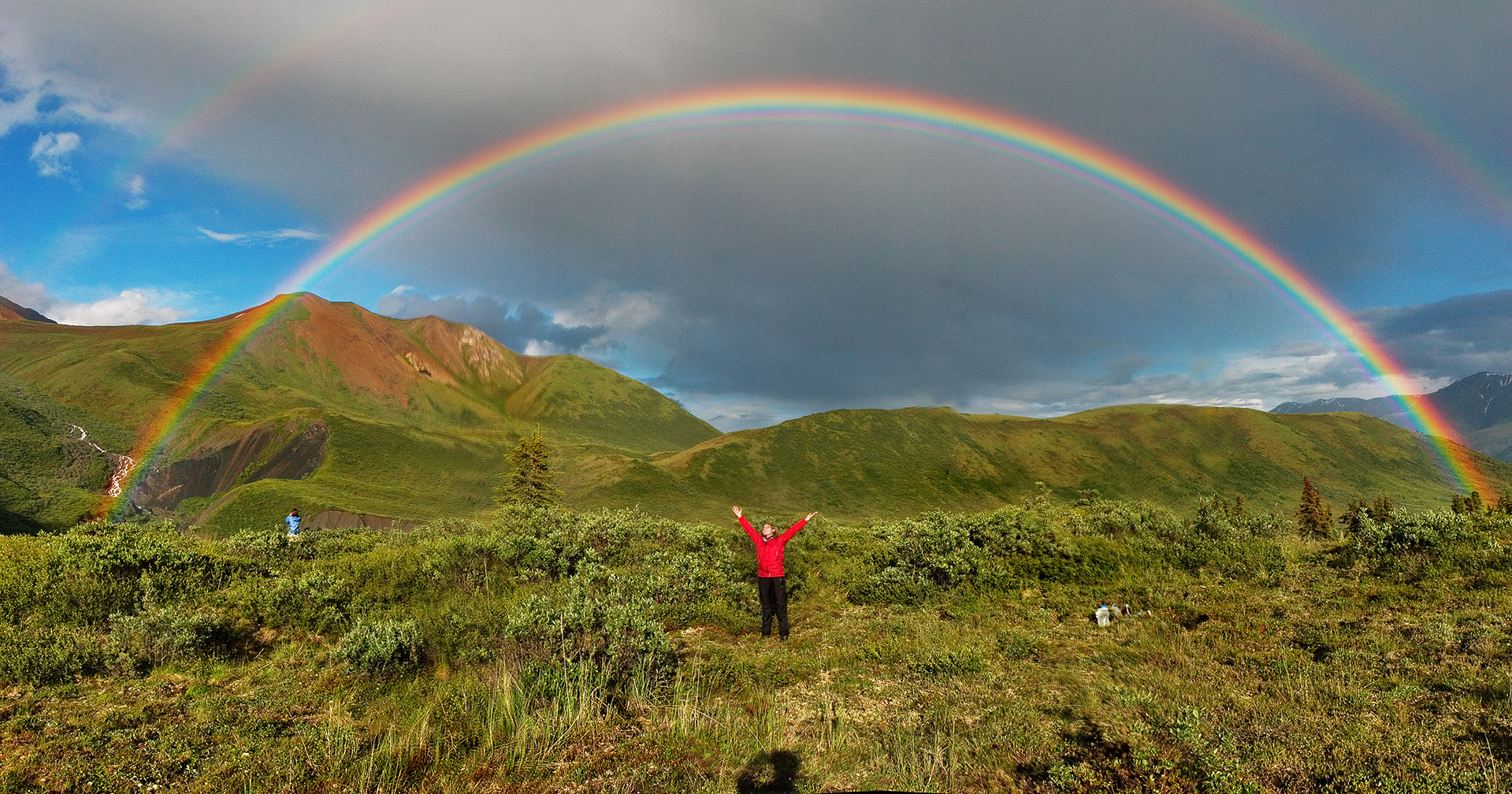
A rainbow isn't an object hanging in the sky. It's a direction. Millions of falling raindrops each send one color toward your eye, and every one of those drops sits about 42° from the shadow of your own head.
In this lesson you'll follow a single sunbeam through a single raindrop, find out why light piles up at one special angle, and then build a whole rainbow by moving the Sun.
- Sun behind yourain in front of you
- 42°radius of the main bow
- One drop, one colorfor each viewer
Part 1
Follow one sunbeam through one raindrop
A falling raindrop is almost a perfect sphere of water. Sunlight that hits it does three things, in order:
- Bends going in. Light slows down in water, so it changes direction at the surface. That's refraction.
- Bounces off the back. Some of the light reflects off the inside of the far wall. That's an internal reflection.
- Bends again coming out. It refracts a second time as it leaves the drop and heads back toward the sunny side of the sky, where you're standing.
Water bends violet light a little more than red light. Its index of refraction is about 1.331 for red and 1.344 for violet. That small difference splits white light into colors, which is called dispersion.
0 = dead center, 1 = grazing the edge
- Slide the beam from the center out to the edge. The exit angle climbs, stops near 42°, and then falls back. Where does it turn around?
- Turn on Show a whole beam. Most exit rays crowd together near one direction. That crowd is the rainbow.
- Switch to One color and drag from red to violet. Violet always comes out at a smaller angle than red.
Part 2
Why the light piles up at 42°
Sunlight lands evenly across the whole face of a drop, so rays strike at every distance from the center. Each one leaves at its own angle. The graph tracks that angle for every hit point. The bars on the right count how much light leaves at each angle.
The graph follows the Bounces inside setting from Part 1, and the dot marks your current hit point. Switch to 2 bounces to see the secondary bow's curve.
Part 3
Paint the rainbow across the sky
Now zoom out. Stand with the Sun at your back and look at your shadow. The shadow of your head points straight at the antisolar point, the spot in the sky directly opposite the Sun. Every drop that sits 42° from that point sends you red. Drops sitting about 40.5° away send you violet. All the drops at one angle make a circle around your shadow, which is why the bow is curved.
Test a drop: click or tap anywhere in the sky to see what that one raindrop sends to your eye.
Predict · test · explain
Where should you look?
Before choosing a location, predict which one will send a color to your eye. Then test it. These samples sit directly above the antisolar point, so their distance is easy to compare.
Choose a location to place a test drop. Tip: a colored bow needs a tight crowd of rays at one special angle.
Part 4
Double rainbows and the dark band
Some light bounces twice inside the drop before it leaves. Its curve in Part 2 bottoms out near 51°, so it makes a second, larger bow outside the first.
- Fainter. Each bounce lets some light escape out the back of the drop, so less is left for the second bow.
- Colors flipped. The extra reflection mirrors the order. Red is on the inside of the secondary bow and violet on the outside.
- Wider. The secondary spreads its colors over about 3.3°, compared with 2° for the primary.
Between the two bows is a strip of sky that looks darker. This is Alexander's dark band, named for Alexander of Aphrodisias, who described it around 200 CE. Look at the graph again. One-bounce light never leaves at more than 42°, and two-bounce light never leaves at less than 51°. Drops in between have no path to send sunlight to your eye, so that part of the sky stays dim. Inside the primary bow, all the rays that weren't at the peak still arrive, which is why that sky looks brighter.
Higher-order bows exist too. The third and fourth bows form around the Sun, not the antisolar point, and they are so faint against the bright sky near the Sun that they were first photographed only in 2011.
Part 5
Rainbow designer: change the drops, change the world
Ray tracing tells you where a bow sits. To see what it really looks like, you have to treat light as a wave. In 1838 George Airy worked out how light waves leaving a drop add up near the 42° ray. His answer depends on how big the drop is compared with a wavelength of light. That's why fogbows are white and why some bows have extra stripes. This sky is computed with Airy's theory, one color at a time.
Fog droplets are 20 µm. Raindrops are 0.2 to 4 mm.
- Drag the drop size from Downpour down to Fog. Watch the colors fade to white and the bow creep inward. You've just made a fogbow.
- Pick Drizzle. Count the pastel stripes inside the violet edge. These supernumerary bows come from interference, and ray tracing alone can never produce them.
- Slide the index of refraction up to 2. Where does the primary bow go, and why does it vanish?
Part 6
Make (and find) your own
🌿 Garden-hose bow
On a sunny day, stand with the Sun behind you and spray a fine mist ahead. Find your head's shadow, then look about two hand-spans (roughly 42°) away from it in any direction. Spray higher and lower to complete more of the circle.
🥛 Glass-of-water spectrum
Set a full, clear glass of water on a sunny windowsill and put white paper on the floor. Move the paper until a strip of colors appears. The curved glass of water is refracting and dispersing light the same way a raindrop does.
📓 Rainbow journal
Every time you spot a rainbow, write down the time, which way you were facing, the Sun's height, and whether a secondary bow or dark band was visible. Over a season, check your notes against the "Sun higher than 42°" rule.
Part 7
Wonder zone: bows beyond the ordinary
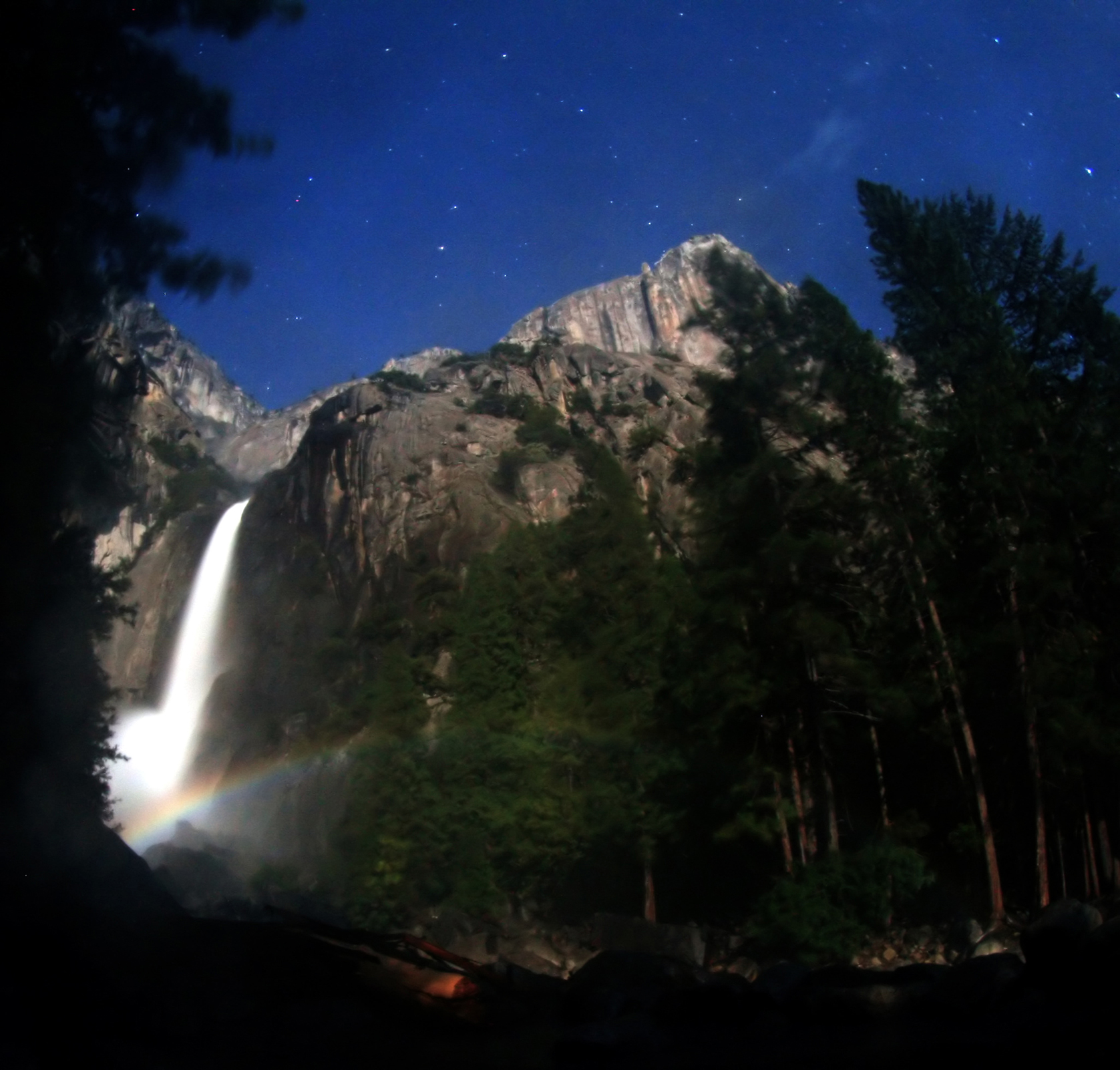
Same physics, different conditions. Click any photo to enlarge it, and use the arrow keys to step through the set.


🤔 Questions to argue about
No answer key. Use what you've learned to build the best case you can, then argue it with a partner.
- Is a rainbow real? You can photograph it, but you can't touch it, walk to it, or share the exact same one with a friend. What does “real” mean here?
- What if raindrops were cubes? Would there still be a 42° pile-up? Hint: the bow comes from a curved surface making exit angles turn around.
- What does the raindrop see? From inside one drop, where in the world is the Sun, and where is the one person it sends red light to?
- Why ROYGBIV? The spectrum changes smoothly with no gaps. Newton counted seven colors; many languages name fewer. Who decides how many colors a rainbow has?
Quick check
What do you know now?
Go further
- Ray Optics Simulation: Rainbows ↗ lets you drag the light source and drops in a full ray-optics sandbox.
- NOAA NESDIS Rainbow Simulator ↗ has rain-curtain, single-drop, and multi-drop views. Originally by Tom Whittaker, CIMSS, University of Wisconsin–Madison.
- Atmospheric Optics: Rainbows ↗ is Les Cowley's photo-rich guide to every kind of bow.
- Optics lesson covers lenses, mirrors, and more refraction.