DESIGN / REHEARSE / MAKE
Origami Paper Studio
Your folds. One sheet. Try the movement here, then repeat it with real paper.
STL exports the current pose, including the angle slider, as a solid sculpture. Overlapping layers are fused; paper colors and layer gaps are omitted. Default shell: 1.2 mm; allowed: 0.8–5 mm. Size changes preserve shell thickness. Open the STL in your slicer in millimeters and check orientation, supports, thin tips, and bed fit before printing. Wall thickness guidance.
Place a crease to begin.
The lesson & reference guide
Learn as you fold
Stuck on a fold? Explore the explanations, models, and mathematics below, then return to your paper.
Art & Design · Mathematics · Paper Engineering
Origami: one sheet, many possibilities
Turn a square of paper into a shape you can hold. Learn to read a fold, build a model, then use angles and crease patterns to explain what happened.
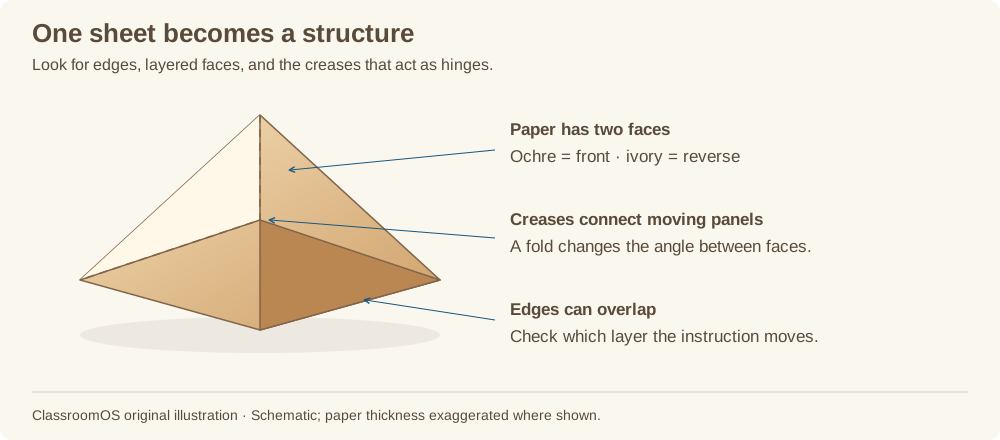
Two square sheets (15–20 cm), a pencil, and a flat surface. Thin paper is easiest. No glue or scissors needed for the folding models.
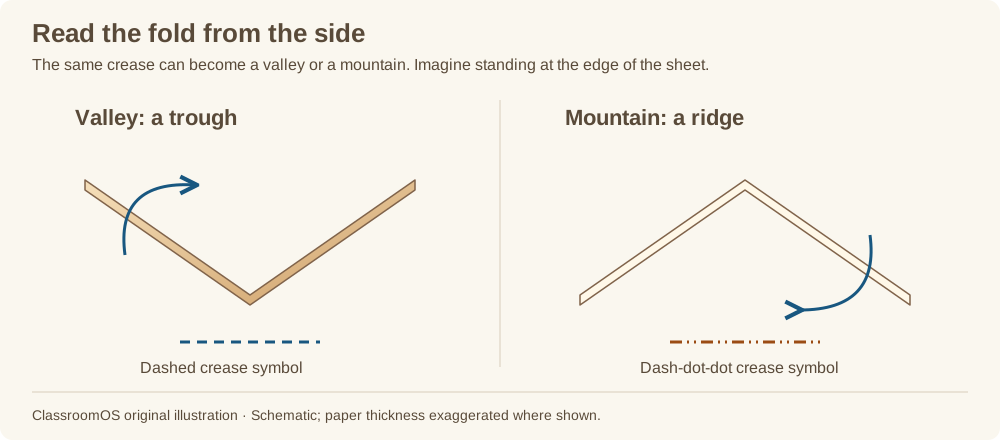
Fold one square corner to corner. Match the tips, crease from the middle outward, then unfold. What shapes and angles can you see?
First time? Try a virtual fold, then build the four-step bookmark. Ready for a challenge? Try the crane, then test a vertex in the math labs.
By the end: read mountain and valley symbols · follow a folding sequence · support a claim with measurements. Suggested time: 30–45 minutes; advanced mathematics is an extension.
Historical Evolution
From Ancient Paper Craft to Modern Science
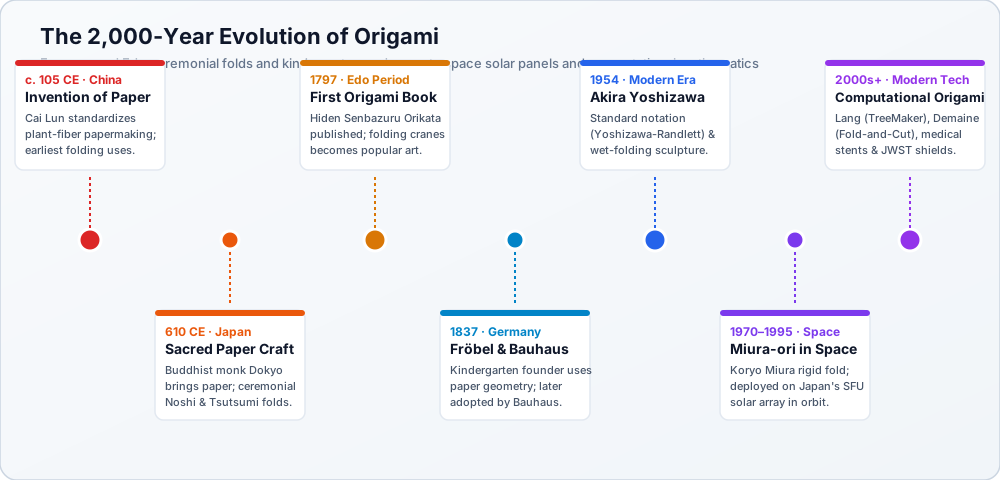
The story of origami is intertwined with the history of papermaking itself. In 105 CE, imperial court official Cai Lun of China’s Han Dynasty standardized papermaking using macerated mulberry bark, hemp, old rags, and fishing nets. Paper was originally a precious luxury reserved for religious talismans and official archives.
In 610 CE, the Buddhist monk Damjing (Donchō) introduced papermaking techniques to Japan. In the imperial court and among the samurai warrior class of the Heian (794–1185) and Muromachi (1336–1573) periods, folding was strictly ceremonial:
Noshi (熨斗)
Formal folded paper ornaments containing a strip of dried abalone, attached to gifts as a sacred token of good fortune, longevity, and high honor.
Tsutsumi (包み)
Ceremonial paper wrappers folded with geometric precision without scissors or glue to carry swords, poetry, certificates, and religious offerings.
During the peace and urban prosperity of the Edo Period (1603–1867), mass production made Japanese mulberry paper (washi) affordable to everyday citizens. Origami transitioned from an aristocratic ritual into a beloved recreational folk art. In 1797, Akisato Rito published Hiden Senbazuru Orikata ("The Secret to Folding One Thousand Cranes") — the world’s oldest surviving recreational origami book, showing connected cranes made from a sheet with carefully placed cuts. These historical designs differ from today’s no-cut folding convention.
The Western Convergence: Kindergarten & the Bauhaus
In 1837, German educator Friedrich Fröbel founded the Kindergarten system. He introduced a series of twenty "Gifts" and "Occupations," explicitly including paper folding (Faltarbeit) to teach young children 2D and 3D geometric transformations. Decades later, at the legendary Bauhaus school in Germany, master instructor Josef Albers gave students whole sheets of paper and instructed them to transform the material into rigid load-bearing structures purely through folding — exploring material stresses without scissors, fasteners, or adhesives.
Standardized Visual Language
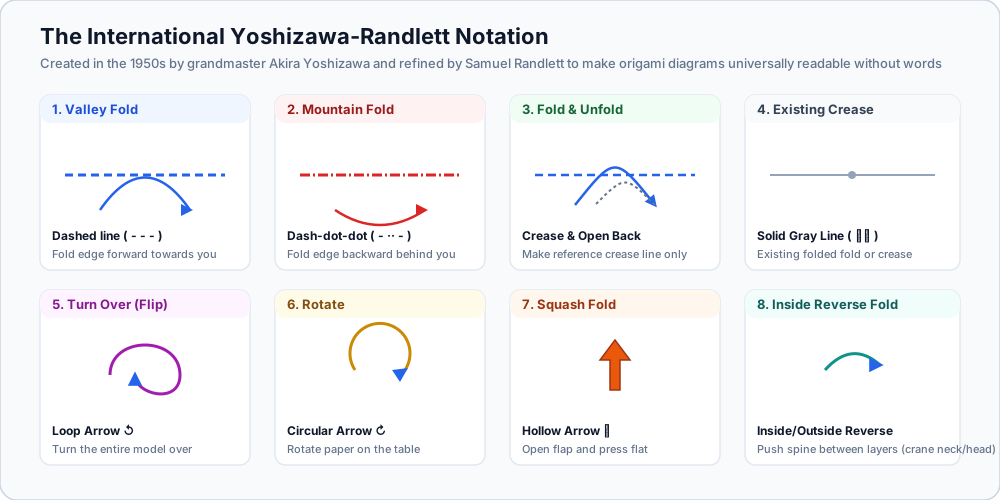
The Yoshizawa-Randlett Diagramming System
Before the mid-20th century, origami models were passed down primarily through oral demonstration or clumsy woodblock prints. The modern revolution began with grandmaster Akira Yoshizawa (1911–2005), who folded over 50,000 original models and pioneered wet-folding (dampening thick paper to form sculptural, organic curves).
In the 1950s, Yoshizawa developed diagram symbols that Samuel Randlett and Robert Harbin later helped spread and extend into the universal diagramming notation used worldwide today. Like musical notation or architectural blueprints, the Yoshizawa-Randlett code communicates complex 3D transformations completely across linguistic barriers.
Mathematical Rigor
The Mathematics of Paper Folding: More Powerful Than Euclid
For more than two millennia, Euclidean geometry reigned supreme: all classical geometric constructions were limited to a compass and an unmarked straightedge. In the 19th century, Évariste Galois and Pierre Wantzel mathematically proved that compass and straightedge can only construct numbers formed by square roots (field extensions of degree 2^k).
Consequently, the three classical problems of Greek antiquity were proven impossible with compass and straightedge:
- Trisecting an arbitrary angle (requires finding roots of cos(3θ) = 4cos^3(θ) - 3cos(θ), a degree-3 cubic polynomial).
- Doubling the cube (requires constructing ∛2, a degree-3 cubic equation).
- Squaring the circle (requires constructing transcendental π).
Origami breaks this 2,000-year barrier! Because a fold can simultaneously align multiple points and lines, paper folding can find the common tangent to two parabolas. This allows origami to construct roots of cubic equations (degree 3). Ideal mathematical folds can trisect angles and double the cube. Ordinary paper introduces measurement error; these operations still cannot square the circle.
The 7 Huzita-Justin-Hatori Axioms
Formulated independently by Jacques Justin (1986) and Humiaki Huzita (1991), and completed by Koshiro Hatori (2001), these 7 axioms define the complete mathematical universe of single-crease folding.
Axiom 6 is the crown jewel: "Given two points P₁, P₂ and two lines L₁, L₂, fold a line that places P₁ onto L₁ and P₂ onto L₂ simultaneously." This single operation solves general cubic equations, allowing paper to accomplish what Euclid’s tools could never achieve.

Flat Foldability: What Makes a Crease Pattern Possible?
When a finished origami model is flattened without cutting, stretching, or tearing the paper, its crease pattern must obey strict mathematical laws at every interior vertex:
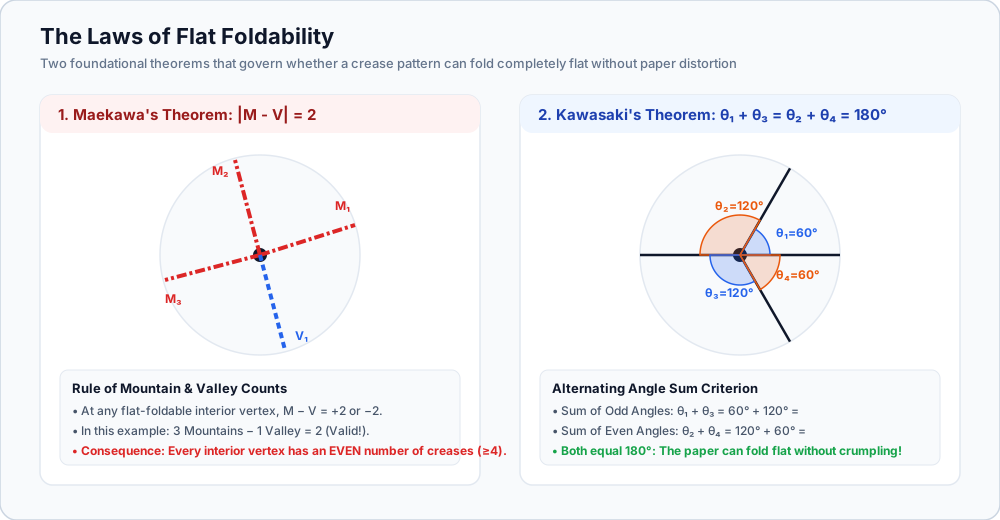
Maekawa's Theorem
At any flat-foldable interior vertex, the difference between the number of mountain creases (M) and valley creases (V) is always two:
|M - V| = 2
Consequently, every flat-foldable interior vertex must have an even degree (M + V = 4, 6, 8, …), never an odd number of creases.
Kawasaki's Theorem
A single interior vertex is flat-foldable if and only if the alternating sum of angles around the vertex is zero, meaning odd and even angles each sum to 180°:
θ&sub1; + θ&sub3; = θ&sub2; + θ&sub4; = 180°
This is a local test for an ideal single vertex with unassigned fold directions. It does not guarantee that a chosen mountain/valley assignment, or an entire multi-vertex model, folds flat.
The Two-Colorability Theorem
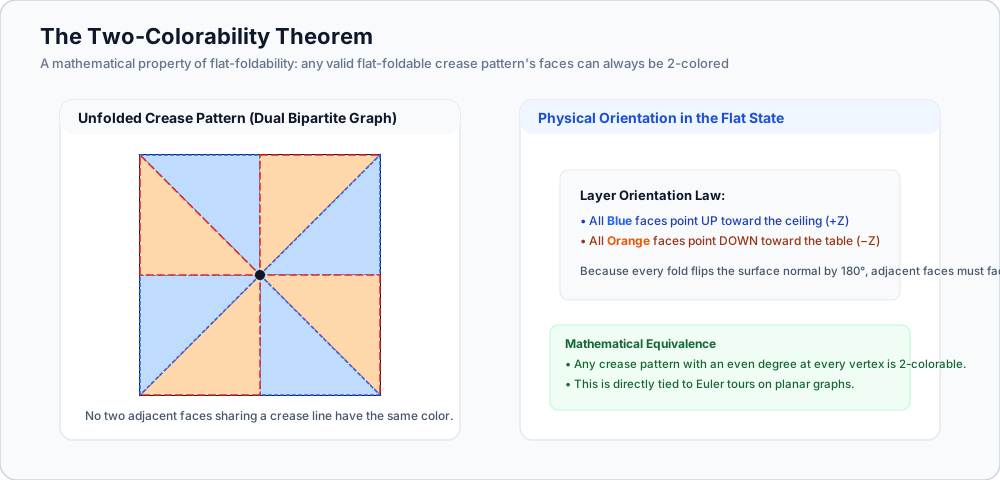
Every flat-foldable crease pattern can have its faces 2-colored like a checkerboard! When the pattern is folded flat, all faces of Color A point upward toward the ceiling (+Z), and all faces of Color B point downward toward the table (−Z). This proves that the dual graph of any flat-foldable crease pattern is bipartite.
The Fold-and-Cut Theorem
Proven in 1998 by Erik Demaine, Martin Demaine, and Anna Lubiw: Any shape with straight edges — from a simple star to the complete English alphabet — can be cut out of a single sheet of paper with exactly ONE straight scissor cut, if the paper is folded correctly along its straight skeleton crease pattern.
Interactive Exploration
Interactive Mathematical Laboratories
Lab 1: Huzita Axiom Inspector & Angle Trisection
Inspect the seven geometric folding axioms and see how Axiom 6 solves the cubic angle trisection problem.
Angle Trisection Target
Move the slider to select an angle θ. Compare the angle with three equal slices. This diagram divides the angle numerically; it does not demonstrate an Axiom 6 folding construction:
Trisected Slice (θ/3) = 20.00°
Lab 2: Maekawa & Kawasaki Vertex Inspector
Drag the angle sliders and toggle mountain/valley fold assignments. Predict the result before adjusting a slider. Test two necessary local conditions; passing both does not validate the chosen fold assignment or a whole model.
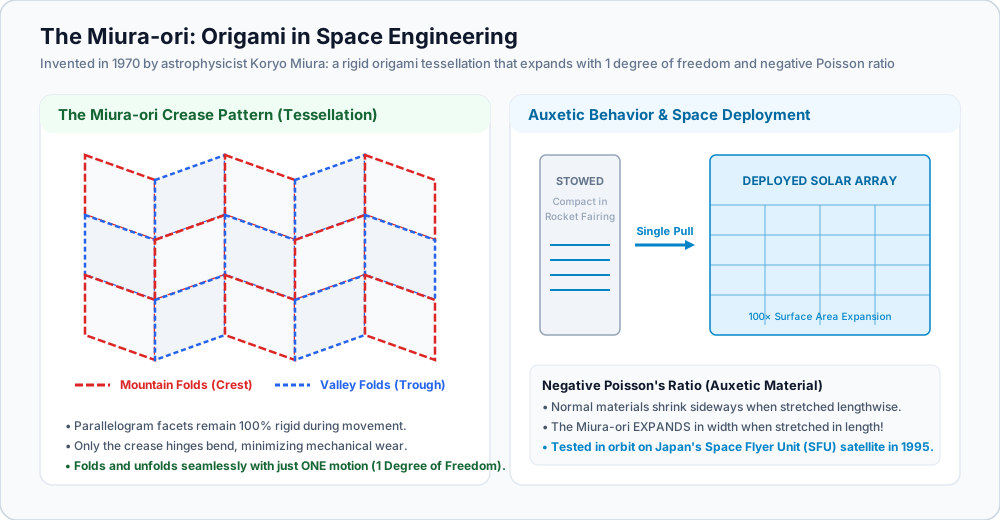
Lab 3: Miura-ori Space Solar Array Simulator
Predict: as the sheet gets wider, will it get taller or shorter? Move the slider, compare the footprint, then explain. This schematic illustrates expansion in two directions; it is not a rigid-panel physics simulation.
Interactive Studio
The Library of Creations: Step-by-Step Folding Workbench
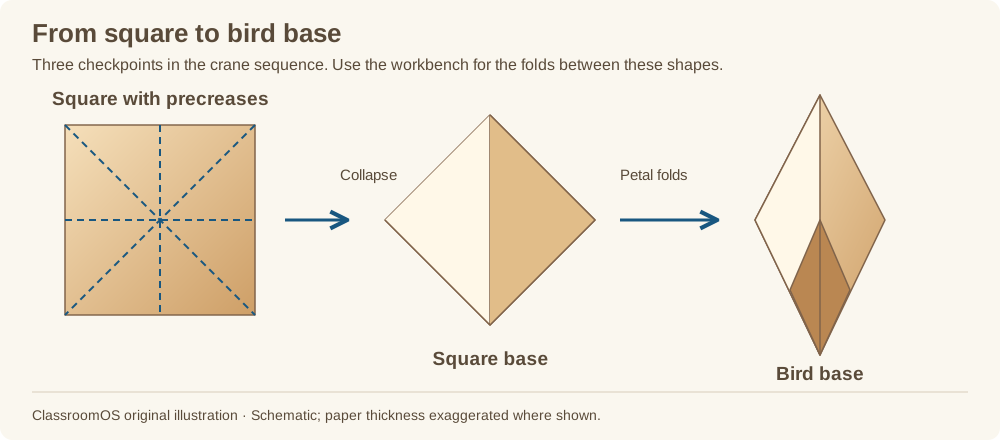
Start with the bookmark, then choose a beginner model before attempting the intermediate crane. Match corners before creasing; if a fold feels forced, return one step and check which layer moves. Follow each illustrated step with clear instructions, pro tips, and mathematical insights. You can also toggle Crease Pattern (CP) View to inspect a simplified crease sketch. These overview diagrams are teaching aids, not complete construction blueprints.
Ochre = colored paper · ivory = reverse
Shading reveals layers; arrows show the next fold.
Start with a Square Sheet
Place your square paper flat on the table, colored side facing down if using single-sided kami paper.
High-Tech Applications
Origami in Aerospace, Medicine & Metamaterials
Today, the world’s leading engineering institutes (NASA JPL, MIT, Oxford, Tokyo University) actively hire computational origami researchers. Why? Because rockets have limited payload fairing diameters (typically 4 to 5 meters), yet spacecraft need giant antennas, solar shields, and solar collectors measuring tens of meters across.
James Webb Space Telescope
The JWST’s tennis-court-sized 5-layer Kapton sunshield could not fit inside the Ariane 5 rocket nose cone. NASA used origami accordion folding to pack it into a 4.5-meter fairing, deploying it smoothly in space 1 million miles from Earth.
Biomedical Heart Stents
Researchers explore origami-inspired expandable tubes and medical devices. Packing and controlled expansion are useful design goals, but experimental folded devices should not be confused with all clinical stents.
Automotive Crash Boxes
Researchers investigate folded metal tubes that collapse progressively to absorb impact energy. Performance depends on the pattern, material, and loading; a paper model cannot establish vehicle crash safety.
Knowledge Verification
Check Your Understanding & Lab Notes
1. Which Huzita-Hatori axiom allows origami to solve cubic equations, trisect angles, and double the cube?
2. According to Maekawa's Theorem, what is always true at any flat-foldable interior vertex?
3. What is the fundamental condition required by Kawasaki's Theorem for flat foldability?
4. Why is the Miura-ori tessellation called an "auxetic" material?
Lab Reflection & Engineering Field Notes
Use evidence: Which model did you fold? Which step was hardest, and how did you fix it? Record one vertex’s angles and fold counts. What does passing the tests tell you, and what does it leave unproven?
Notes save on this device when browser storage is available.
Build → test → explain
Fold one sheet into an accordion. Place it across two equal-height supports and compare it with a flat sheet of the same paper. Add identical small objects one at a time. Keep the support gap and load position the same. Which holds more, and how do folds change the shape?
Explore the engineering evidence: NASA/JPL’s folding solar-array prototype, Webb’s folding structures, and origami engineering review (PDF).