Keyboard Controls ↑ Main thruster ←→ Rotate R Restart
Landing Criteria Safe Thresholds V-Speed < 4 m/s · H-Speed < 2.5 m/s · Tilt within 12°
Mission Question How do gravity, momentum, thrust, wind, and limited fuel interact during a controlled landing?
Mars Gravity 3.72 m/s² — about 38% of Earth's. Objects fall slower, but you still need thrust to slow your descent.
Martian Wind Mars has thin but persistent winds. A new wind direction and strength is set each game — watch the indicator.
Fuel Management Every thruster burn costs fuel. If you run out before landing, you'll fall uncontrolled. Burn smart.
Landing Criteria Hit the pad with vertical speed < 4 m/s, horizontal speed < 2.5 m/s, and tilt within 12°.
The Real Thing 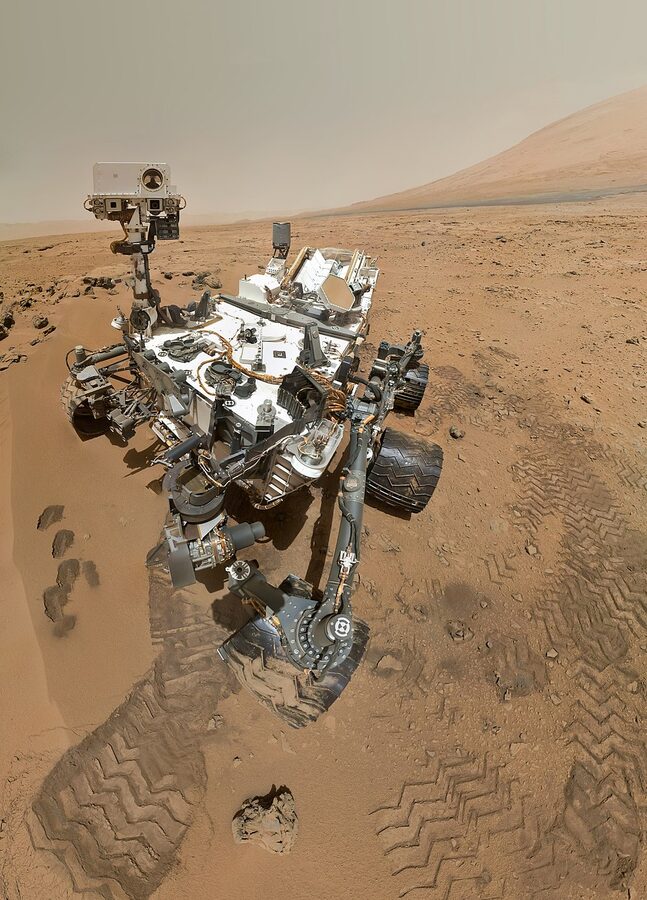 Curiosity rover self-portrait on Mars. Public domain, NASA/JPL-Caltech.
NASA's Curiosity rover safely landed on Mars in 2012 using a real "sky crane" descent stage — the same kind of fuel, gravity, and timing tradeoffs you just managed.
Flight-Test Challenge Complete three attempts. For each one, record starting wind, remaining fuel, vertical speed, horizontal speed, and tilt at touchdown. Change only one strategy between attempts so your evidence supports a fair comparison.
Explain Your Best Landing Identify when you used a long burn, short pulses, and rotation. Explain how each choice changed momentum and why waiting until the final second usually fails.
Exit Ticket Mars has weaker gravity than Earth. Why does a lander still need a powered descent? Use the words velocity, force, and fuel in your answer.