Zoom out far enough and galaxies stop looking scattered. They line up along glowing threads and sheets, the cosmic web. Between the threads are enormous, nearly empty bubbles called cosmic voids. Voids fill most of the universe's volume. Our Sun sits inside a gas cavity, while the Milky Way lies beside a cosmic void. These are different kinds of sparse space. How does gravity build the gaps between galaxies?
ExplainHow gravity empties voids and builds the web.
RankCompare sizes and weigh uncertain evidence.
LocateDistinguish a gas bubble from a cosmic void.
The cosmic web · about 1 billion light-years acrossEvery bright knot is a cluster of galaxies, and every dark hole is a void. Ask the class whether the light or the dark takes up more space. Visualization by Unmismoobjetivo, Wikimedia Commons, CC BY-SA 4.0
01 · Investigate
Gravity makes the empty places emptier
The early universe was almost perfectly smooth. Tiny ripples, a few parts in 100,000, made some places slightly thinner than others. Gravity then did the rest: thin regions lost matter to their denser neighbours, emptied out, and swelled into voids. Predict where matter will collect. Then press Play or move the slider to test your prediction in a simplified model.
Your notes stay on this page while it is open. Record two stages, then explain the change.
Model: smooth start
Below average density0%
Deep void (under 20%)0%
Emptiest spot100%
Densest knot100%
Click the map to measure density. With the map focused, press Enter to place a probe, then arrow keys to move it.
Your evidence
Measurements from this model (area, not 3-D volume)
Pattern / stage
Area below average
Deep void area
Probe density
Record a start and a later stage to compare.
Matter (galaxies + dark matter)Void (under 20% of average)Started in a thin spot (birthplace mode)
Try it. Turn on Color matter by where it started. Cyan dots began in slightly thin regions. Scrub forward and compare the cyan dots with their starting positions. Do all of them reach a wall? Voids don't fill in, because their matter drains outward. Then check Below average density: at the late stage most of the map is below average, even though most dots sit in the walls.
About the model. This is the Zel'dovich approximation, the pencil-and-paper model that first explained the web in 1970: each bit of matter keeps coasting in the direction gravity first pushed it. This is a 2-D teaching model with fixed particle count and periodic edges: particles leaving one side reappear on the other. The slider controls displacement growth, not a calibrated cosmic clock. After streams cross, this approximation cannot model bound clusters accurately. The shading and percentages depend on the chosen grid and density threshold; they are not measured fractions of the real universe.
02 · Read the evidence
The universe is built like foam
Picture the foam on a bubble bath. The soap film collects into thin walls and edges, and the bubbles inside are mostly air. Galaxies arrange themselves the same way:
Clusters are the knots where walls meet. They hold hundreds to thousands of galaxies.
Filaments are threads of galaxies hundreds of millions of light-years long that join the clusters.
Walls (sheets) are thin surfaces of galaxies stretched between filaments.
Voids are the bubbles. They are usually 30 to 300 million light-years across and hold very few galaxies.
Voids take up most of the space in the universe, but most galaxies live in the walls and filaments. A void is an underdensity, not a perfect vacuum. Their interiors can be much less dense than the cosmic average, but the value varies with the void, its boundary, and what is measured: galaxies or total matter.
How we found them. A photo of the sky is flat. To see the foam you need each galaxy's distance, and you get it from its redshift: the farther the galaxy, the more its light is stretched by cosmic expansion. A redshift survey measures thousands of redshifts and turns a flat sky into a 3-D map. In 1978 Stephen Gregory and Laird Thompson first noticed big empty gaps in such a map. In 1981 Robert Kirshner's team found one so large that it changed how people thought about the universe: the Boötes Void.
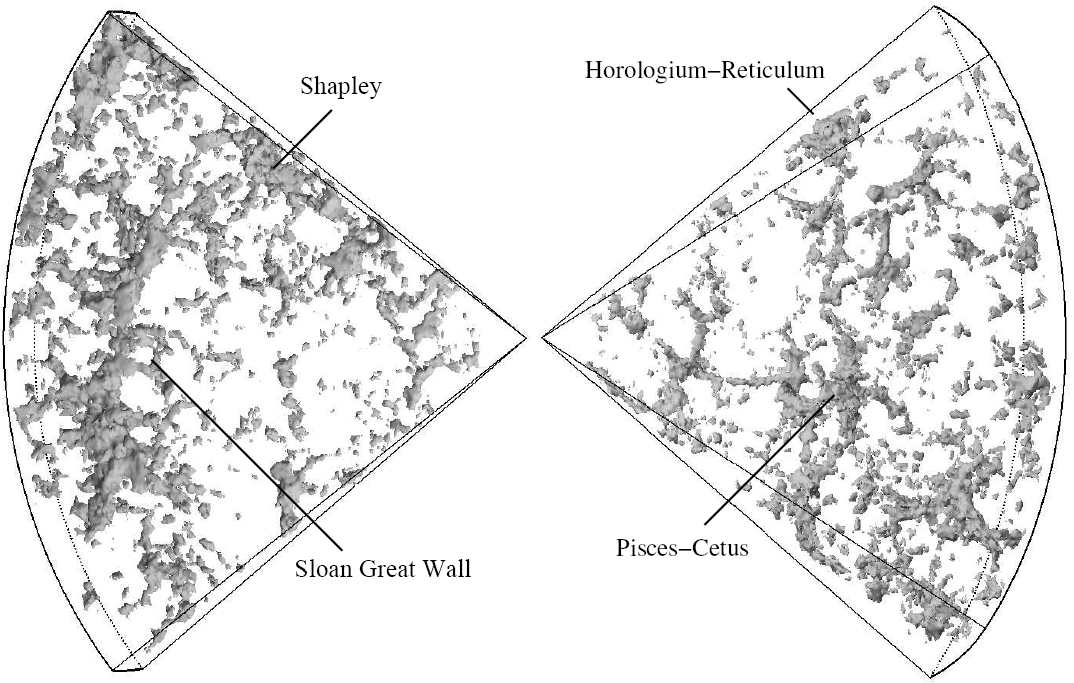
A real map: the 2dF Galaxy Redshift SurveyEarth sits at the point where the two fans meet. Each fan is a slice of sky with distance increasing outward. The bright threads are walls and filaments of galaxies, and the dark holes are voids. DTFE reconstruction by Willem Schaap, Wikimedia Commons, CC BY-SA 3.0
03 · Largest to smallest
The void ladder
This is a comparison of selected examples, not a definitive record-holder list. Ranges overlap, and the Local Bubble is included only as a gas-cavity size reference. Each step on this chart is ten times larger than the one before, a logarithmic scale. Without one, the Local Bubble would be thinner than a hair next to the biggest voids. Choose a bar to read about that void. A striped bar marks a void whose size or existence astronomers still debate.
KBC Void · about 2 billion light-years · debatedIf this void is real, the Milky Way sits a few hundred million light-years from its center, and almost everything we can see nearby is inside it. Pablo Carlos Budassi, Wikimedia Commons, CC BY-SA 4.0
#1 · Large proposed region Debated
The KBC Void, or "Local Hole"
Diameter
~2 billion ly
Distance
Our region, if supported
Found
2013
Ryan Keenan, Amy Barger, and Lennox Cowie counted galaxies in every direction and found fewer nearby than farther out, as if we live in a giant region about 20–30% below average density. Other teams say the data don't require it. It matters because living inside a void would make space around us seem to expand a little faster, which could help explain the Hubble tension.
The CMB Cold Spot, in the direction of EridanusThis patch of the universe's oldest light is about 70 millionths of a degree colder than average, an unusual feature whose statistical significance and origin are debated. A foreground supervoid could contribute to the cooling, but does not establish its cause. NASA / WMAP Science Team, public domain, via Wikimedia Commons
#2 · Supervoid Debated
The Eridanus Supervoid
Diameter
~0.5–1.8 billion ly
Distance
~3 billion ly
Found
2015
Astronomers went looking for this supervoid because of the Cold Spot. In 2015 István Szapudi's team found a giant underdense region in that direction and estimated it at up to 1.8 billion light-years across. Light crossing a void loses a tiny bit of energy, the integrated Sachs–Wolfe effect. Most researchers now think this void explains only part of the Cold Spot.
The Giant Void · 1 to 1.3 billion light-yearsThis is a historically catalogued large underdense region; its extent depends on the catalogue definition. A handful of lonely galaxy clusters drift inside it, too far apart to pull on one another much. Pablo Carlos Budassi, Wikimedia Commons, CC BY-SA 4.0
#3 · Historical catalogue Catalogued
The Giant Void (Canes Venatici Supervoid)
Diameter
1–1.3 billion ly
Distance
~1.5 billion ly
Found
1988
Also catalogued as AR-Lp 36, it lies in the northern constellation Canes Venatici, the Hunting Dogs, close on the sky to the Boötes Void. It contains only 17 galaxy clusters, all bunched in one small region of it. Light needs over a billion years to cross it.
The Boötes Void, "the Great Nothing"A region this size would normally hold about 2,000 galaxies. Astronomers have found about 60. Richard Powell, Atlas of the Universe, CC BY-SA 2.5, via Wikimedia Commons
#4 · The famous one Catalogued
The Boötes Void
Diameter
~330 million ly
Distance
~700 million ly
Found
1981
Robert Kirshner's team discovered it, and it is the void that made "void" a household word. Astronomer Greg Laughlin pointed out that if the Milky Way sat at its center, we wouldn't have known other galaxies existed until the 1960s. Its few galaxies line up in a thin tube through the middle, which hints that it formed when several smaller voids merged and their walls broke down.
Our neighbourhood within 500 million light-yearsThe Milky Way is at the center. The yellow circle marks the Local Void, starting right next door. The named blobs are superclusters, the walls and knots between voids. Richard Powell (modified), CC BY-SA 2.5, via Wikimedia Commons
#5 · Next door Our neighbour
The Local Void
Diameter
150+ million ly
Distance
Starts beside us
Found
1987
Brent Tully and Rick Fisher mapped it. The Milky Way lives in the Local Sheet, a thin wall of galaxies on the void's edge. The void is still expanding, and it pushes our whole Local Group away from it at about 259 km/s, nearly a million km/h. That movement on top of normal cosmic expansion is called a peculiar velocity. The void is hard to study because it lies behind the crowded, dusty center of our own galaxy.
Mapping voids from galaxy motionsThe CosmicFlows team mapped density from how galaxies move. Galaxies flow away from voids, so the motion reveals the void even where few galaxies shine. H. M. Courtois et al. 2023, Astronomy & Astrophysics, CC BY 4.0, via Wikimedia Commons
#6 · Everyday voids Thousands known
Typical voids
Diameter
30–300 million ly
Count
Thousands catalogued
Density
~10–20% of average
Large surveys such as the Sloan Digital Sky Survey have catalogued thousands of ordinary voids. Inside them live void galaxies, which tend to be small, blue, and gas-rich, and still forming stars. With few neighbours to collide with or steal their gas, they grow slowly, like trees in an open field.
#7 · Smallest cosmic voids Measured nearby
Minivoids
Diameter
~2–15 million ly
Where
Our Local Volume
Found
2006
Voids come in every size, and big ones contain smaller voids separated by faint walls, like bubbles in foam. Close to home, where even dim dwarf galaxies are visible, Alexander Tikhonov and Igor Karachentsev mapped about 30 minivoids only a few million light-years wide. The smallest are about as wide as the gap between the Milky Way and Andromeda.
Below the cosmic scale: other kinds of emptiness
Smaller than a minivoid, "void" stops meaning a gap between galaxies. Space stays mostly empty at every scale, though:
The Local Bubble · ~1,000 lyA cavity in the Milky Way's gas, blown out by roughly 14–20 supernovae over the last 10–20 million years. The Sun is inside the Local Bubble (details in section 04).
Interstellar space · ~4 ly gapsThe nearest star is 4.2 light-years away. Shrink the Sun to a 1 mm grain of sand and the next grain is about 30 km away.
The Solar System · ~99.9…% emptyLine up all the other planets side by side and they would just about fit in the average gap between Earth and the Moon.
Atoms · a different meaning of spaceA nucleus is roughly 100,000 times smaller across than its atom. Electrons occupy quantum states around it; this is not a miniature cosmic void.
04 · Earth's voids
Your address, written in voids
Start at Earth and compare successively larger scales. These drawings are schematic: the Local Void is beside our neighbourhood, not a container around it. Distinguish a gas cavity, a wall of galaxies, and a cosmic underdensity.
Step 1 of 11
Earth
Laniakea, our home supercluster · about 520 million light-yearsLaniakea is Hawaiian for "immeasurable heaven". It is defined by where galaxies are flowing, like a watershed for rivers. The Local Void is part of the same flow map, an empty basin that galaxies move away from. Andrew Z. Colvin, Wikimedia Commons, CC BY-SA 4.0
Pushed by nothing
Voids don't actually push. Gravity only pulls. Because the void has less mass than its surroundings, the walls around it pull harder from every other direction, and anything sitting on the edge drifts away from the void. That is our situation.
In 2017 Yehuda Hoffman, Daniel Pomarède, Brent Tully, and Hélène Courtois mapped the motion of thousands of galaxies and found two things acting on us together:
a pull toward the dense Shapley Supercluster, and
an apparent push from the opposite direction, an empty region they named the Dipole Repeller.
Together they set the Milky Way moving at about 630 km/s relative to the cosmic microwave background. Empty space steers the motion of galaxies as much as full space does.
05 · Why voids matter
Laboratories made of nothing
🌑
A clean test of dark energy
Voids have so little matter that dark energy dominates inside them sooner than anywhere else. Their shapes, how fast they grow, and how they bend light test models of dark energy and of gravity itself.
❄️
Cold spots in old light
Light from the Big Bang that crosses a supervoid comes out a bit colder, because the gravitational potential of an underdensity changes as the universe expands. This late-time effect is called the integrated Sachs–Wolfe effect. Stacking many voids shows the effect.
⚖️
The Hubble tension
Nearby galaxies give an expansion rate near 73 km/s per megaparsec, while the early universe predicts about 67–68. If we live inside the KBC Void, galaxies flowing outward could explain part of that gap. The question is still open.
🌱
Galaxies in isolation
Void galaxies grow up without crowds, mergers, or hot cluster gas. Comparing them with crowded galaxies shows which features come from nature and which from the neighbourhood.
👻
Ghost particles
Neutrinos move fast enough to resist clustering on small scales, changing how matter is distributed around voids. Measuring how empty voids really are helps pin down the neutrino's tiny mass.
🔭
What's next
DESI and Euclid survey galaxies across large volumes. The planned Nancy Grace Roman survey will extend this work. Comparing void catalogues can test expansion and gravity, while also revealing how results depend on survey coverage and void definitions.
06 · Check yourself
Rank the voids, then answer five questions
Put these in order, largest at the top
Use the arrow buttons to move each one.
07 · For teachers
Teaching notes & sources
Discussion prompts
Voids fill most of space, yet most galaxies are not in voids. How can both be true? (Hint: think about foam.)
Gravity only pulls. Why do galaxies move away from voids?
Why are sizes for the KBC Void and the Eridanus Supervoid given as ranges or marked "debated"? What evidence would settle them?
If you lived in a galaxy at the center of the Boötes Void, how would your astronomy be different?
Hands-on extension
Blow a cup of soapy water into foam with a straw. Sketch a slice of the foam. Label nodes (clusters), edges (filaments), films (walls), and bubbles (voids), then compare the sketch with the 2dF map above.
Common misconceptions
"A void is a perfect vacuum." It isn't. It holds thin gas, dark matter, and a few galaxies, at densities that vary with the region and measurement.
"Voids are black holes." They are the opposite: regions with less mass and weaker gravity than average.
"Something in the void pushes." No. The surrounding walls pull harder than the thin interior.