A slain Lamb on the throne. Seven cities under pressure. A world made new.
The last book of the Bible is not a sealed code for the far future. It is a letter, written by a prisoner on an island, to seven real churches living inside the Roman Empire. It pulls back the curtain (apokalypsis means “unveiling”) to show them who really rules history, and it ends the Bible’s story in a garden-city where God lives with his people.
Grades 7–12 · Two to three class periods · Revelation 1–22
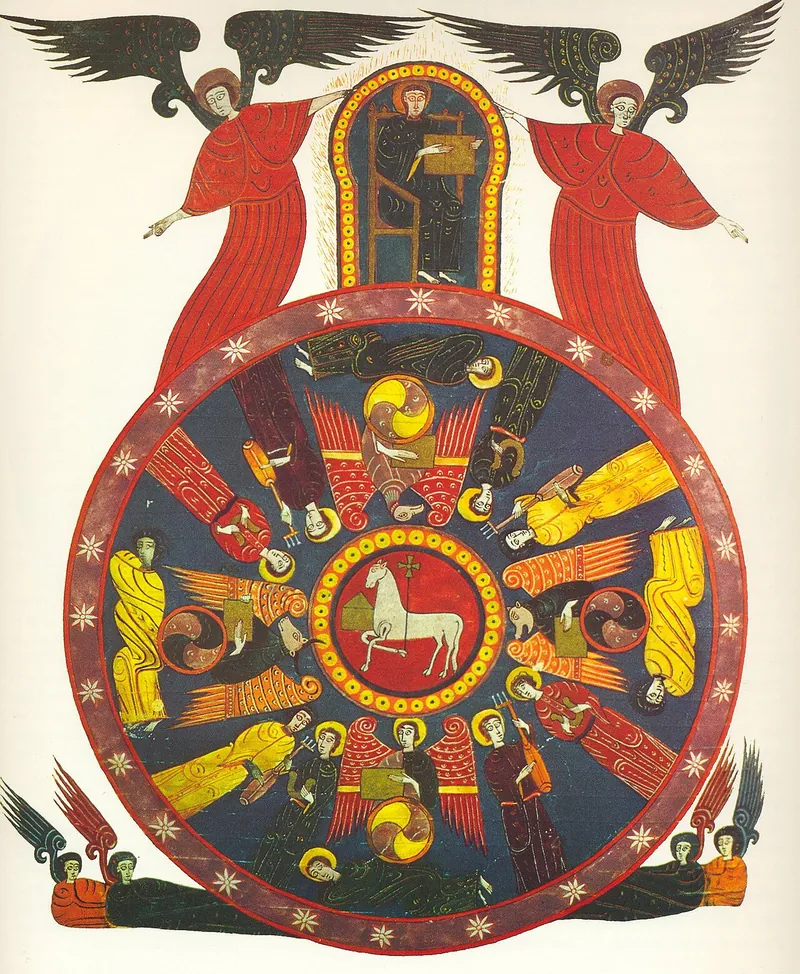
Illuminated manuscript · Revelation 4–5The Adoration of the Lamb. In 1047 the painter Facundus copied Beatus of Liébana’s commentary on Revelation for King Ferdinand I and Queen Sancha of León. He draws heaven’s throne room as a wheel of worship with the Lamb at its hub: the whole universe turns around the one who was slain.Facundus, Beatus of Ferdinand I and Sancha, fol. 117v, 1047. Biblioteca Nacional de España, Vitr. 14-2. Wikimedia Commons · Public domain.
The big question
When an empire seems to own the world, who really sits on the throne?
Revelation was written to Christians who had very little: no army, no vote, sometimes no place in the trade guilds that fed their families. Rome had the legions, the temples, the coins and the roads. John’s answer is a vision: a door opens in heaven, and the throne at the centre of everything is not Caesar’s. On it, and beside it, is a Lamb that was slain and is alive again.
By the end of this lesson you can…
Retell Revelation’s story in order, from Patmos to the New Jerusalem.
Name the three kinds of writing Revelation combines (letter, prophecy, apocalypse) and say how each changes the way you read it.
Place the book in its history: Roman Asia, the cult of the emperors, and the pressure on small churches.
Trace Old Testament images (Eden, the Exodus, Daniel, Ezekiel) that Revelation reuses on almost every page.
Compare the main ways Christians have read the book, and tell what the text says from what an interpreter argues.
1
Where Revelation fits
The Bible ends where it began
Read Genesis 1–3 and Revelation 21–22 side by side and the Bible turns out to be shaped like a circle. Almost everything lost in the first three chapters is given back in the last two, and given back bigger: a garden becomes a garden-city, two people become the nations.
Genesis 1–3 · the beginningRevelation 21–22 · the end
God creates the heavens and the earth (1:1).⟷“I saw a new heaven and a new earth” (21:1).
Darkness over the deep; God separates day from night (1:2–5).⟷“There will be no night there”; the Lamb is its lamp (21:23–25).
The waters of the deep, the old picture of chaos (1:2).⟷“And the sea was no more” (21:1).
A river flows out of Eden to water the garden (2:10).⟷The river of the water of life flows from the throne (22:1).
The way to the tree of life is guarded by cherubim (3:24).⟷The tree of life stands open; its leaves heal the nations (22:2).
The ground is cursed (3:17).⟷“No longer will there be anything accursed” (22:3).
Death enters: “to dust you shall return” (3:19).⟷“Death shall be no more” (21:4).
The serpent deceives (3:1–13).⟷“That ancient serpent” is thrown down for good (12:9; 20:10).
Adam and Eve hide from God’s presence and are sent out (3:8, 23).⟷“They will see his face” (22:4); God dwells with them (21:3).
Notice the difference, too. Revelation does not simply rewind to Eden. The end is a city, full of the “glory and honor of the nations” (21:26): human history, culture and work, healed and brought in, not erased.
2
History before symbols
The world of the first readers
Revelation names its audience in its first chapter: “John to the seven churches that are in Asia” (1:4). Asia here means the Roman province on the west coast of what is now Türkiye. Before we can hear what the visions said, we need to stand in those cities.
The writer: John, on Patmos
“I, John, your brother and partner in the tribulation and the kingdom and the patient endurance that are in Jesus, was on the island called Patmos on account of the word of God and the testimony of Jesus” (1:9). Patmos is a small rocky island in the Aegean, about 60 km off the coast. John is there because of his preaching, most likely banished by a Roman governor.
He calls himself a brother, a servant and a prophet, never an apostle. From Justin Martyr (c. 155) and Irenaeus (c. 180) onward, most early Christians identified him with John the son of Zebedee, one of the Twelve. Around 250, Bishop Dionysius of Alexandria noticed that the book’s rough, Hebrew-flavoured Greek is very different from the Gospel of John and suggested another John wrote it. Both views are still held.
The date: Domitian, or Nero?
Irenaeus wrote that the vision was seen “toward the end of Domitian’s reign”, which would be around AD 95. Most scholars follow him. Domitian liked to be greeted as dominus et deus noster, “our Lord and God” (Suetonius, Domitian 13), which makes the elders’ song in Revelation 4:11 sound pointed: “Worthy are you, our Lord and God.”
A minority argues for an earlier date, around AD 68–69, just after Nero’s persecution in Rome and before the Temple in Jerusalem fell in AD 70 (they point to 11:1–2, where John measures a temple, and to the list of kings in 17:10). The book’s message does not hang on settling this, but it helps to know the evidence on both sides.
Living inside Rome’s story
🏛
Temples to the emperors
Cities in Asia competed to honour Rome. Pergamum built the province’s first temple to Roma and Augustus in 29 BC; Smyrna won the right to a temple for Tiberius in AD 26 (Tacitus, Annals 4.55–56); Ephesus dedicated a temple of the emperors around AD 89–90. Honouring Caesar was civic loyalty, like saluting a flag, but it was also worship.
⚖
Work and the guilds
Craftsmen and traders belonged to guilds (dyers, bronze-smiths, wool workers) that held feasts in honour of patron gods. Refusing to eat “food sacrificed to idols” (2:14, 20) could cost a Christian their trade. That is why Revelation 13 speaks of people who cannot “buy or sell” without the beast’s mark.
⛓
Local, sudden danger
There was not yet an empire-wide hunt for Christians. Danger came locally: a governor, an angry crowd, an accusation. In Pergamum, “Antipas my faithful witness” had already been killed (2:13). About twenty years later Pliny, governor of nearby Bithynia, tested accused Christians by asking them to offer incense and wine to the emperor’s image and to curse Christ (Letters 10.96).
⚓
Rome’s wealth
Ships carried the world’s goods to the capital. When Babylon falls in chapter 18, the merchants weep over a cargo list of 28 items that runs from gold and silk to cinnamon and wheat, and ends with “slaves, that is, human souls” (18:13). Revelation sees what the wealth was built on.
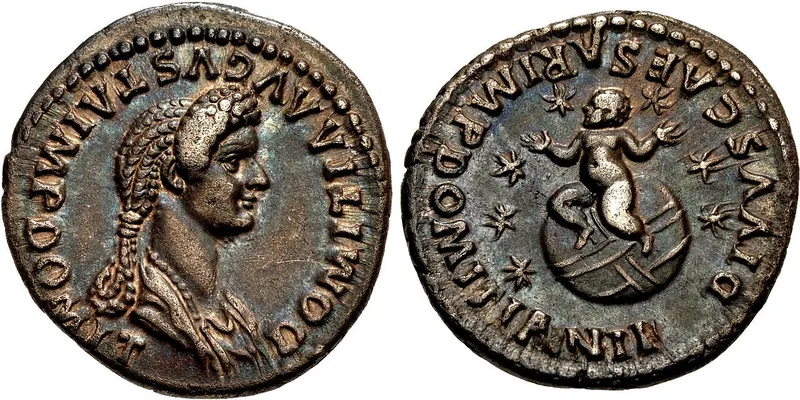
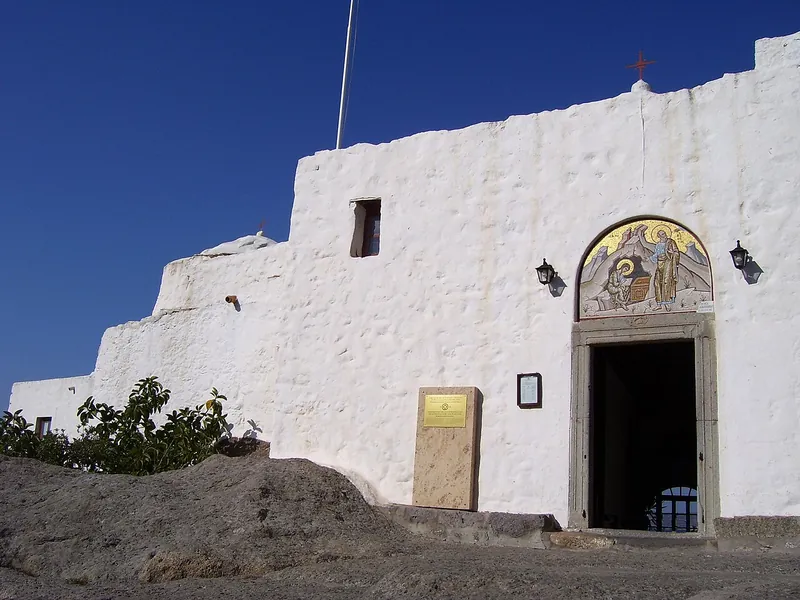
Roman coin · AD 82–83A child, a globe and seven stars. Domitian struck this denarius for his wife Domitia after their infant son died. The boy, now called divus Caesar (“the divine Caesar”), sits on the globe of the world, ringed by seven stars. Revelation’s first readers would have handled coins like it. Then John sees the risen Jesus “holding seven stars in his right hand” (1:16). Who really holds the stars?Domitia, denarius, Rome mint, AD 82–83 (RIC II 153). Photo: Classical Numismatic Group. Wikimedia Commons · CC BY-SA 2.5.Photograph · Patmos, GreeceThe Cave of the Apocalypse. Since the Middle Ages, pilgrims have been shown this grotto as the place where John received his visions. That part is tradition. What the text itself says is enough: a real man, on a real island, exiled “on account of the word of God” (1:9).Photo: Vladimir Boskovic. Wikimedia Commons · Public domain.
3
Reading tools
Three kinds of book in one
The first five verses tell you how to read the rest. Revelation calls itself three different things, and each one is a reading instruction.
1:1
An apocalypse
“The revelation (apokalypsis) of Jesus Christ…” An apocalypse is a well-known Jewish kind of writing (think of Daniel 7–12) in which a heavenly guide shows a human the hidden side of history in vivid symbols.
So read it like: a political cartoon drawn by a prophet. The images are not photographs, but they tell the truth about real powers.
1:3
A prophecy
“Blessed is the one who reads aloud the words of this prophecy, and blessed are those who hear, and who keep what is written in it.” Biblical prophecy is first a word to God’s people now: comfort, warning, a call to change, and only then a word about what is coming.
So read it like: something meant to be kept, not just decoded. It was read aloud in a single service.
1:4
A letter
“John to the seven churches that are in Asia: Grace to you and peace…” It opens and closes like one of Paul’s letters. It has a sender, an address and real readers who had to understand it.
So read it like: mail. Whatever it meant, it must have meant something to a dyer in Thyatira in AD 95.
John hears one thing, then turns and sees another
One of the book’s most important habits: John is told something, then turns and sees something that seems completely different. The two belong together, and the seeing reinterprets the hearing. Press each card to turn it.
Numbers are pictures, not statistics
7
completeness, God’s full work (seven churches, seals, trumpets, bowls)
4
the whole created world: four corners, four winds, four living creatures
12
the people of God: twelve tribes, twelve apostles, twelve gates
3½
a limited time of trouble, borrowed from Daniel 7:25 and 12:7: “time, times and half a time”, also written 42 months or 1,260 days
1,000
a vast, complete span (10 × 10 × 10)
666
falling short of 7, three times over
Let the book explain itself first
Revelation interprets several of its own symbols. Before guessing, check:
1:20 the seven stars are the angels of the seven churches; the lampstands are the churches.
5:6 the seven eyes are the seven spirits of God sent out into all the earth.
5:8 the bowls of incense are the prayers of the saints.
12:9 the dragon is “that ancient serpent, called the devil and Satan”.
17:9, 18 the seven heads are seven hills, and the woman is “the great city that has dominion over the kings of the earth”. Rome was famous as the city on seven hills.
19:8 the bride’s fine linen is the righteous deeds of the saints.
4
The story, retold
Revelation in nine acts
Revelation is a drama meant to be heard in one sitting. Here it is, told as a story in order. Each act names the chapters, so read the passage itself alongside it: the retelling is a guide, not a substitute.
Act I · Revelation 1
The voice on Patmos
It is the Lord’s Day, and John is alone on a prison island. He is “in the Spirit” when a voice behind him rings out like a trumpet: Write what you see in a book and send it to the seven churches. He turns to see the voice, and sees seven golden lampstands, and walking among them “one like a son of man”.
Every detail of the figure is borrowed from the Old Testament, and the borrowings are startling. The long robe and golden sash are a priest’s. The hair “white like wool, like snow” belongs, in Daniel 7:9, to the Ancient of Days, God himself. The voice “like the roar of many waters” is the sound of God’s glory in Ezekiel 43:2. His eyes are flames, his feet burnished bronze, a sharp two-edged sword comes from his mouth, and his face shines like the sun in full strength. In his right hand he holds seven stars.
John falls at his feet like a dead man. Then a hand touches him: Fear not. I am the first and the last, and the living one. I died, and behold I am alive forevermore, and I have the keys of Death and Hades. Before any beast or dragon appears, the reader knows who holds the keys.
Act II · Revelation 2–3
Seven letters to seven cities
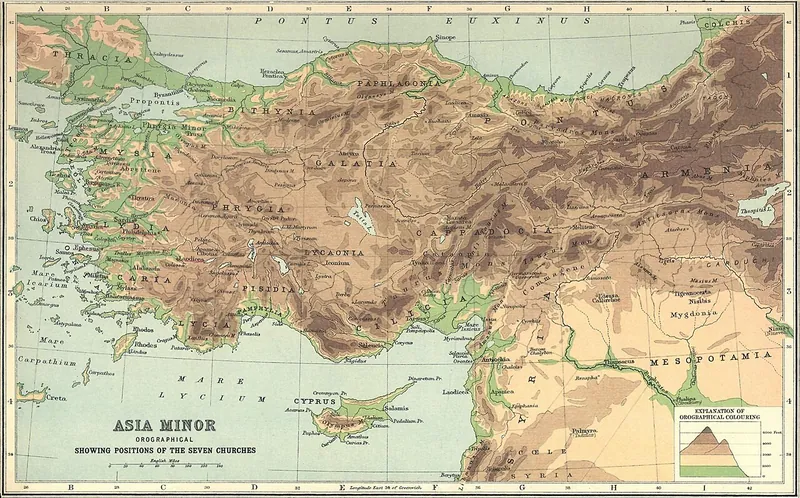
Now the risen Christ dictates seven short letters. A courier landing at Ephesus and travelling the Roman roads north and then south-east would reach the cities in exactly this order: a circuit. Each letter follows the same pattern: a title of Christ drawn from chapter 1, “I know your works”, praise or rebuke, a command, and a promise “to the one who conquers”.
The churches are not alike. Two (Smyrna and Philadelphia) are poor and pressured, and receive no rebuke at all. Two (Sardis and Laodicea) are comfortable, and receive almost no praise. The others are mixed. The danger Revelation worries about most is not only persecution from outside; it is compromise from inside: going along with the empire’s worship and wealth because everyone else does. Many details seem to speak to each city’s own history, and readers have long noticed them, though some of these links are suggestions, not certainties.
Map · Revelation 1:11A courier’s circuit. Find Patmos off the coast, then Ephesus, and follow the letters: north to Smyrna and Pergamum, then south-east through Thyatira, Sardis, Philadelphia and Laodicea.George Adam Smith, Atlas of the Historical Geography of the Holy Land, 1915. Wikimedia Commons · Public domain.
1Ephesus 2:1–7
“who walks among the seven golden lampstands”
Praised: hard work, endurance, testing false teachers. Rebuked: “You have abandoned the love you had at first.”
Promise: to eat from the tree of life in the paradise of God.
Ephesus was a great harbour city, home of the Temple of Artemis, one of the Seven Wonders, and of a new temple to the emperors.
2Smyrna 2:8–11
“the first and the last, who died and came to life”
Praised: poor, slandered, about to be imprisoned, “but you are rich”. No rebuke. Command: “Be faithful unto death, and I will give you the crown of life.”
Smyrna had been destroyed around 600 BC and refounded three centuries later: a city that “died and came to life”. Its hilltop skyline was called “the crown of Smyrna”. Its bishop, Polycarp, was burned there around 155: “Eighty-six years I have served him.”
3Pergamum 2:12–17
“who has the sharp two-edged sword”
Praised: they held fast “where Satan’s throne is”, even when Antipas was killed. Rebuked: some follow “the teaching of Balaam”: idol feasts and immorality.
Promise: hidden manna and a white stone with a new name.
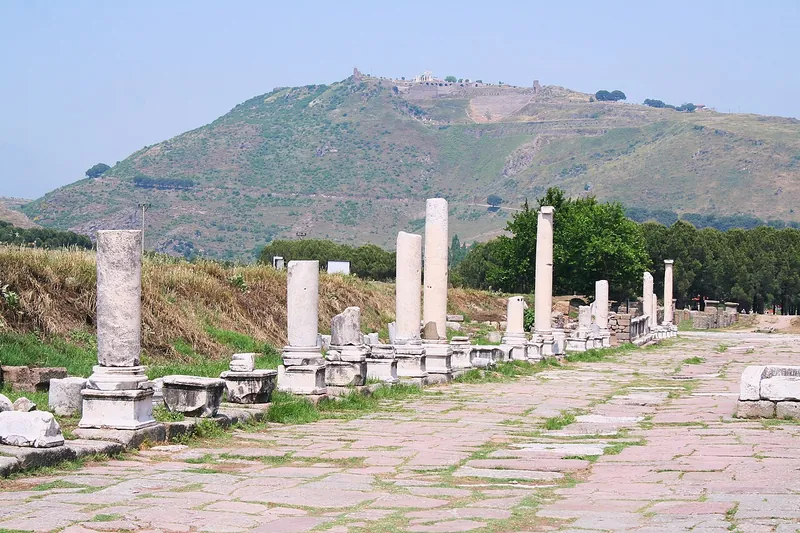
Pergamum’s acropolis held the Great Altar of Zeus and the province’s first temple to Rome and Augustus. Rome’s governor held “the right of the sword”; Christ’s sword is sharper.
4Thyatira 2:18–29
“whose feet are like burnished bronze”
Praised: love, faith, service, endurance, growing. Rebuked: they tolerate “Jezebel”, a self-styled prophetess who teaches compromise.
Promise: authority over the nations, and the morning star.
A trade town of guilds: bronze-smiths, wool workers and dyers. Lydia, “a seller of purple goods from Thyatira” (Acts 16:14), came from here.
5Sardis 3:1–6
“who has the seven spirits of God and the seven stars”
Rebuked: “You have the reputation of being alive, but you are dead. Wake up… I will come like a thief.” A few have not soiled their garments.
Promise: white garments and a name never blotted from the book of life.
Sardis sat on a cliff-top acropolis that looked impossible to capture, yet it fell twice to surprise night attacks (to Cyrus, 546 BC, and Antiochus III, 214 BC) because no one was watching.
6Philadelphia 3:7–13
“who has the key of David”
Praised: “You have but little power, and yet you have kept my word.” No rebuke. An open door no one can shut.
Promise: “I will make him a pillar in the temple of my God; never shall he go out of it,” with a new name.
After the great earthquake of AD 17, tremors went on so long that many residents lived outside the city walls (Strabo). The city took a new name, Neocaesarea, in thanks for imperial aid.
7Laodicea 3:14–22
“the Amen, the faithful and true witness”
Rebuked: “You are neither cold nor hot… because you are lukewarm, I will spit you out.” “You say, I am rich… not realizing that you are poor, blind and naked.”
Promise: “Behold, I stand at the door and knock”, and a seat on Christ’s throne.
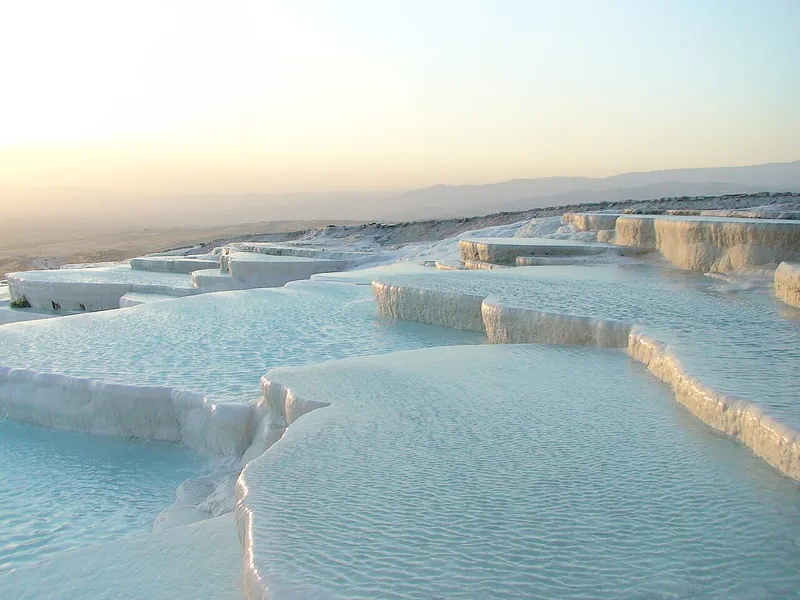
A banking city so rich that after an earthquake in AD 60 it rebuilt “from its own resources” (Tacitus). It was known for black wool and an eye-salve. Its water came by aqueduct and arrived tepid, unlike the hot springs of Hierapolis and the cold water of Colossae nearby: useful hot, useful cold, useless lukewarm.
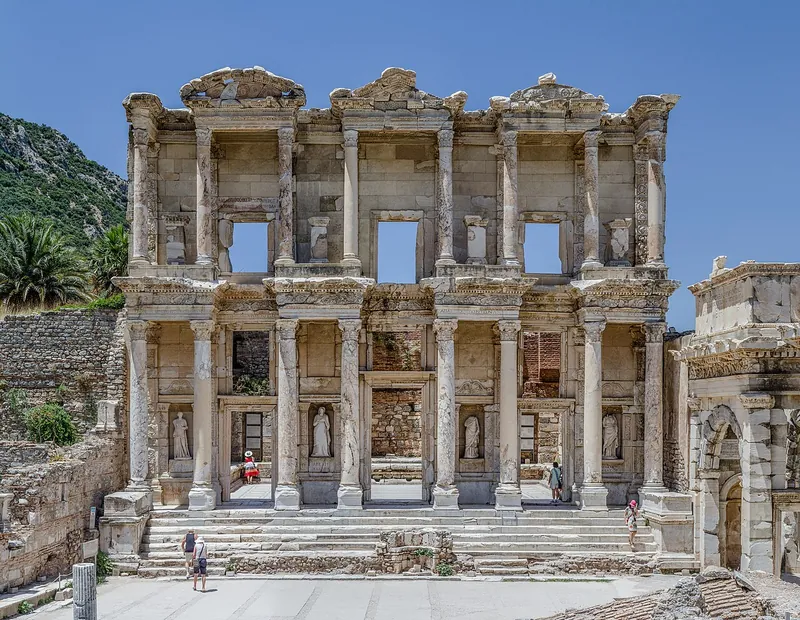
Photograph · EphesusEphesus, church 1. The Library of Celsus was finished around AD 117, a generation after Revelation. Its marble shows the confident, wealthy civic culture the churches lived in.Photo: Benh LIEU SONG. Wikimedia Commons · CC BY-SA 3.0.Photograph · PergamumPergamum, church 3. The acropolis rises 300 m above the plain, crowned with temples. “I know where you dwell, where Satan’s throne is” (2:13) is most likely a statement about allegiance and imperial worship, not a single building.Photo: Ingo Mehling. Wikimedia Commons · CC BY-SA 3.0.Photograph · Hierapolis, near LaodiceaHot water, 10 km away. The hot springs of Hierapolis left these white mineral terraces, visible from Laodicea across the valley. Laodicea’s own water was piped in and arrived lukewarm and full of minerals. Hot water heals; cold water refreshes; lukewarm water makes you spit.Photo: Pvasiliadis. Wikimedia Commons · CC BY-SA 3.0.
Act III · Revelation 4–5
The throne and the Lamb
After the letters, John looks up: “behold, a door standing open in heaven!” He is called up, and the scene shifts from seven small churches to the control room of the universe. There is a throne, and someone seated on it who shines like jasper and carnelian, with a rainbow like emerald around it. Lightning and thunder roll from the throne. Around it sit twenty-four elders in white with golden crowns, and four living creatures, like a lion, an ox, a human and an eagle, covered in eyes. Day and night they never stop: Holy, holy, holy, is the Lord God Almighty, who was and is and is to come! The elders throw their crowns before the throne. Every emperor in Asia was greeted with crowns and hymns. Here, the crowns are given back.
Then a crisis. In the right hand of the one on the throne is a scroll, written on both sides and sealed with seven seals: the plan of God for history. A mighty angel calls out, Who is worthy to open the scroll? No one in heaven or on earth or under the earth can. And John begins to weep loudly.
One of the elders says, Weep no more; behold, the Lion of the tribe of Judah, the Root of David, has conquered. John turns to see the Lion, and sees instead a Lamb, standing, as though it had been slain. This is the hinge of the whole book. The power that rules history is not the lion’s claw but the lamb’s self-giving. The Lamb takes the scroll, and heaven explodes into a new song: Worthy are you… for you were slain, and by your blood you ransomed people for God from every tribe and language and people and nation. The music spreads outward ring by ring, angels by the myriad, then every creature in heaven, on earth, under the earth and in the sea, until the whole universe is singing to “him who sits on the throne and to the Lamb”.
Act IV · Revelation 6:1–8:5
Seven seals
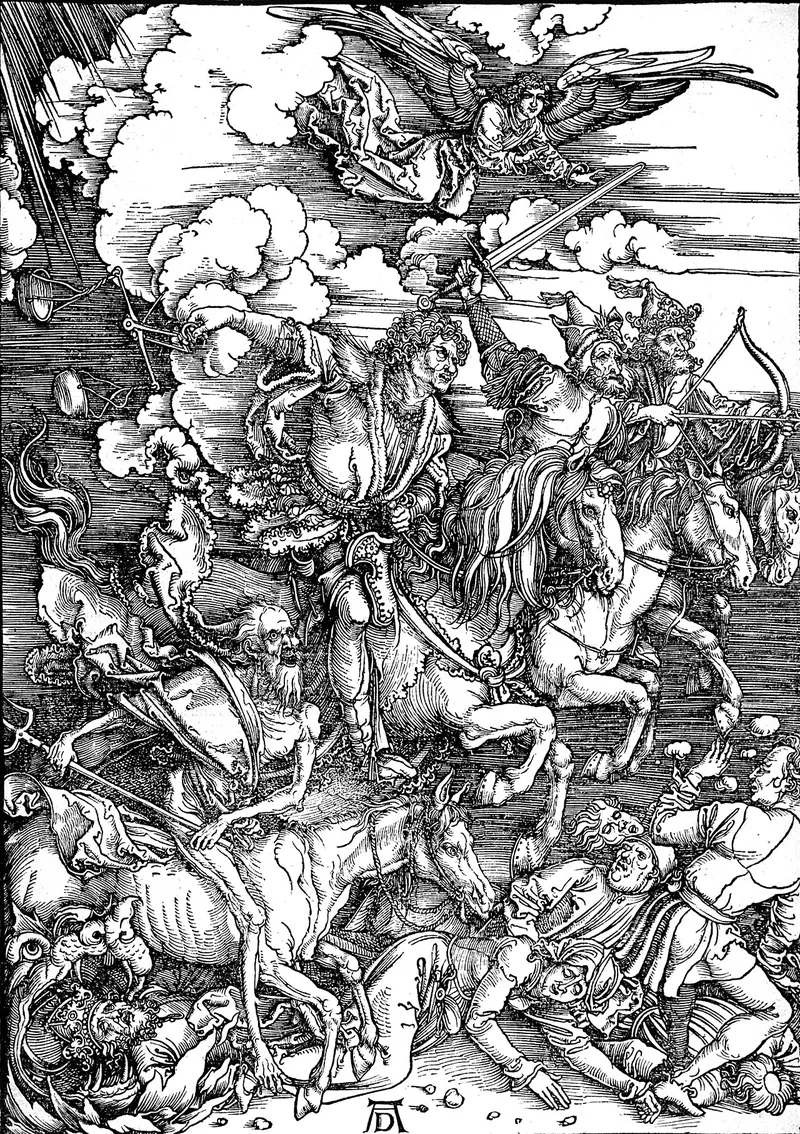
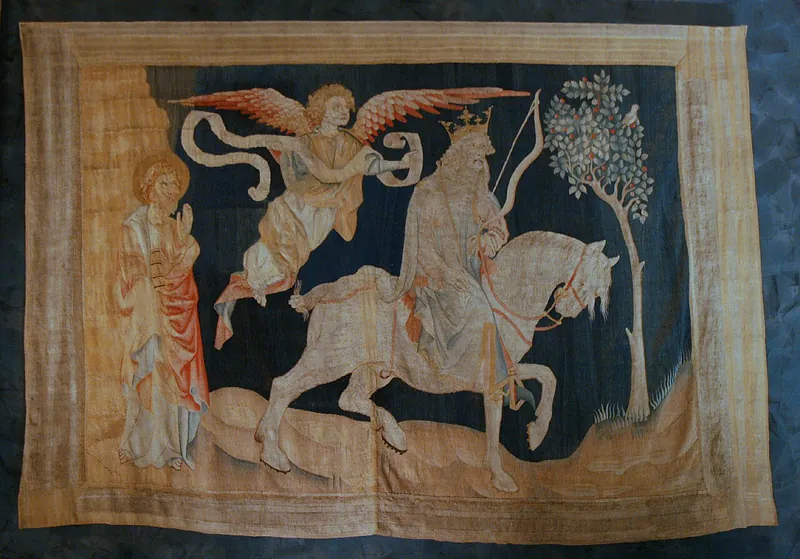
The Lamb breaks the seals one by one, and with each a living creature thunders, Come! Four horses ride out. A white horse whose rider has a bow and a crown goes out conquering. A red horse takes peace from the earth. A black horse’s rider carries scales, and a voice calls out famine prices: a quart of wheat for a denarius, a whole day’s wage for one person’s bread, and do not harm the oil and the wine: luxuries for the rich go on untouched. A pale, corpse-green horse is ridden by Death, with Hades following. These are not new evils invented for the end: they are conquest, war, famine and plague, the ordinary disasters of history under empire, released within limits (“a fourth of the earth”).
The fifth seal shows the souls of martyrs under heaven’s altar crying, How long, O Lord, holy and true? They are given white robes and told to rest a little longer. The sixth seal shakes the cosmos: a great earthquake, the sun black as sackcloth, stars falling like figs, the sky rolled up like a scroll. Kings, generals, the rich and the slave all hide in caves and cry to the mountains, Fall on us… for the great day of their wrath has come, and who can stand?
The story stops. Before the seventh seal, chapter 7 answers that question: who can stand? John hears the number of God’s sealed servants, 144,000 from the twelve tribes, then looks and sees “a great multitude that no one could number, from every nation”, standing before the throne with palm branches. These are the ones coming out of the great tribulation. God will shelter them, “and the Lamb will be their shepherd… and God will wipe away every tear from their eyes.” Then the seventh seal is opened, and there is silence in heaven for about half an hour. An angel offers incense with the prayers of the saints, and fire is thrown to the earth. The prayers of the persecuted turn out to move heaven.
Woodcut · Albrecht Dürer, 1498 · Revelation 6:1–8The Four Horsemen. Dürer sends all four riders out at once in a single stampede; the text releases them one at a time, each only when the Lamb opens a seal. What does the artist gain, and what does he lose?Albrecht Dürer, The Four Horsemen, from Apocalypse, 1498. Wikimedia Commons · Public domain.
Act V · Revelation 8:6–11:19
Seven trumpets and two witnesses
Seven angels blow seven trumpets, and the plagues of Egypt break out again across the whole world. Hail and fire fall, and a third of the earth burns. A burning mountain is hurled into the sea, and a third of the sea becomes blood. A star called Wormwood falls and makes the rivers bitter. A third of the sun, moon and stars go dark. Then an eagle flies through mid-heaven crying, Woe, woe, woe! The fifth trumpet opens the bottomless pit, and out swarm locusts like war horses, with human faces and lion’s teeth, led by a king named Abaddon in Hebrew and Apollyon in Greek: “Destroyer”. The sixth releases an army of two hundred million cavalry from the Euphrates, the river that marked Rome’s frightening eastern frontier.
Then comes one of the saddest sentences in the Bible: The rest of mankind, who were not killed by these plagues, did not repent of the works of their hands (9:20). Like Pharaoh, the world hardens. Judgment alone does not change hearts.
So the story pauses again. A mighty angel plants one foot on the sea and one on the land and hands John a little scroll; he eats it, “sweet as honey” in his mouth and bitter in his stomach, as Ezekiel once did. He must prophesy again “about many peoples and nations”. Then two witnesses appear, clothed in sackcloth: they shut the sky like Elijah and turn water to blood like Moses. When their testimony is finished, the beast kills them, and their bodies lie in the street of “the great city… where their Lord was crucified” while the world celebrates and swaps presents. After three and a half days the breath of life from God enters them, they stand up, and they rise to heaven in a cloud as their enemies watch. And now, for the first time in the book, the survivors respond differently: they were terrified and gave glory to the God of heaven (11:13). What the plagues could not do, faithful witness to the point of death does.
The seventh trumpet sounds, and loud voices in heaven announce the end of the story before we have seen it: The kingdom of the world has become the kingdom of our Lord and of his Christ, and he shall reign forever and ever (11:15).
Act VI · Revelation 12–14
The woman, the dragon and the beasts
Here the curtain opens on the war behind all the other wars. A great sign appears in heaven: a woman clothed with the sun, the moon under her feet, a crown of twelve stars on her head, crying out in labour. Facing her is a great red dragon with seven heads and ten horns, whose tail sweeps a third of the stars from the sky. It waits to devour her child. She gives birth to a son “who is to rule all the nations with a rod of iron”, and the child is snatched up to God and his throne. The woman flees into the wilderness, where God feeds her for 1,260 days.
War breaks out in heaven. Michael and his angels fight the dragon, “that ancient serpent, who is called the devil and Satan, the deceiver of the whole world”, and he is thrown down to earth. A voice explains how he was defeated: They have conquered him by the blood of the Lamb and by the word of their testimony, for they loved not their lives even unto death (12:11). The dragon is furious, “because he knows that his time is short”, and goes off to make war on the woman’s other children, “those who keep the commandments of God and hold to the testimony of Jesus”. He stands on the shore of the sea.
Out of the sea climbs a beast. It is leopard, bear and lion in one body, all four of Daniel’s empire-beasts rolled together. It has a mortal wound that has healed, and the whole earth follows it in amazement, saying, Who is like the beast, and who can fight against it?, a twisted echo of Israel’s song at the sea: “Who is like you, O LORD?” (Exodus 15:11). A second beast rises from the land, with horns like a lamb but the voice of a dragon. It works signs, sets up a speaking image of the first beast, and makes everyone take a mark on the right hand or forehead in order to buy or sell. Empire, and the propaganda that makes it look divine, demand the whole person: hand and head, work and mind.
Then John looks, and the Lamb is standing on Mount Zion with the 144,000, who have his name and his Father’s on their foreheads. Angels fly through the sky with “an eternal gospel” for every nation, and with news: Fallen, fallen is Babylon the great. A voice says, Blessed are the dead who die in the Lord from now on… that they may rest from their labours. The act ends with two harvests: one like a son of man reaps the earth with a sickle, and an angel gathers the grapes of wrath into the great winepress.
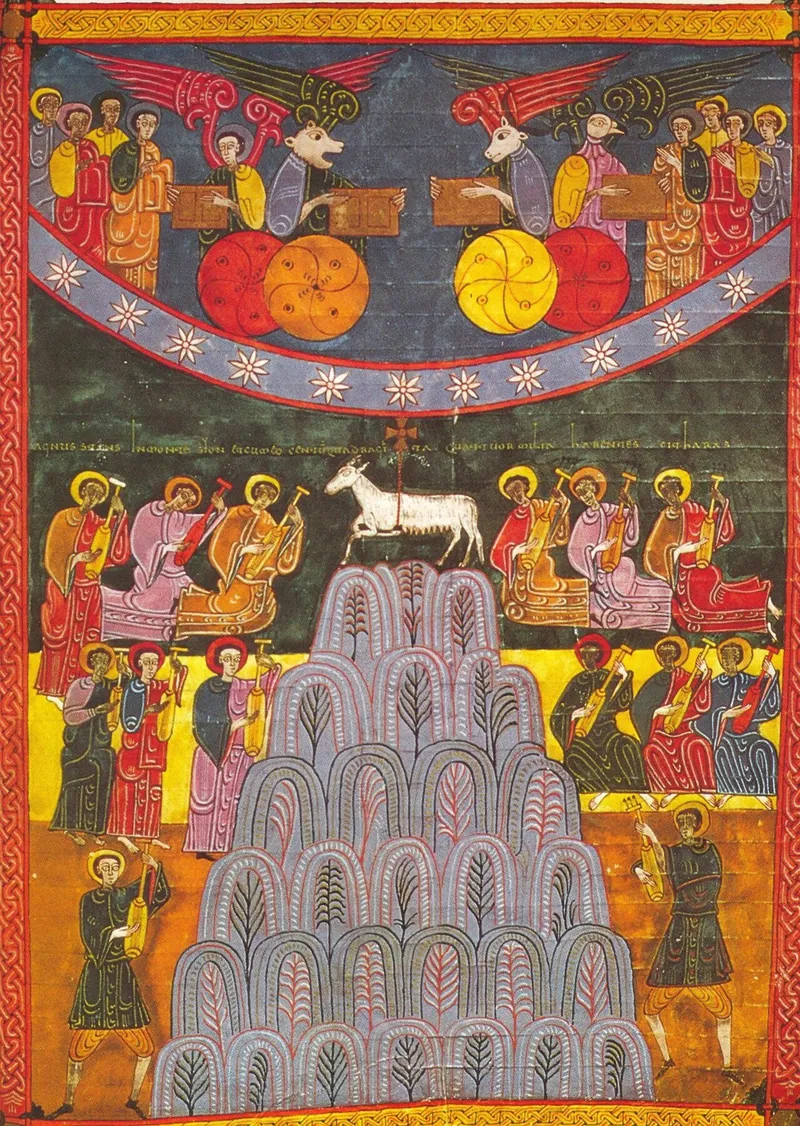
Illuminated manuscript · Revelation 14:1–5The Lamb on Mount Zion. Facundus paints the Lamb on a mountain of blue scales, surrounded by the redeemed with their harps. Compare it with chapter 13: two crowds, two marks on the forehead, two songs.Facundus, Beatus of Ferdinand I and Sancha, fol. 205, 1047. Biblioteca Nacional de España. Wikimedia Commons · Public domain.
Act VII · Revelation 15–18
Seven bowls and the fall of Babylon
Beside a sea of glass mixed with fire stand those who conquered the beast, holding harps. Like Israel on the far shore of the Red Sea, they sing “the song of Moses, the servant of God, and the song of the Lamb”: Who will not fear, O Lord, and glorify your name?… All nations will come and worship you. Then seven angels pour out seven bowls, and the plagues return in full force, no longer a quarter or a third. Sores break out on those who bear the beast’s mark. The sea, then the rivers, turn to blood, and an angel says, They have shed the blood of saints and prophets, and you have given them blood to drink. The sun scorches; the beast’s own throne is plunged into darkness. Three times we are told the people cursed God… and did not repent.
The sixth bowl dries up the Euphrates, and froglike spirits from the mouths of the dragon, the beast and the false prophet gather the kings of the world “to the place that in Hebrew is called Armageddon”: Har-Megiddo, the mountain of Megiddo, a famous old battlefield of Israel. But no battle is described yet. Instead, a voice breaks into the scene: Behold, I am coming like a thief! Blessed is the one who stays awake (16:15). The seventh bowl is poured into the air, and a loud voice from the throne says, It is done!
Now the great city is shown for what it is. John is carried into a wilderness and sees a woman dressed in purple and scarlet, glittering with gold and pearls, riding a scarlet beast, holding a golden cup full of abominations, drunk with the blood of the saints. On her forehead: Babylon the great. The angel explains that her seven heads are seven hills, and that she is “the great city that has dominion over the kings of the earth”. Babylon is Rome, and every empire like it, that seduces the world with luxury and is built on violence.
Her fall is told not as a battle but as a funeral. A voice calls, Come out of her, my people. Kings, merchants and sea captains stand far off and wail, Alas, alas, the great city, mourning not her but their lost profits, reciting her cargo down to “slaves, that is, human souls”. An angel heaves a stone like a great millstone into the sea: So will Babylon be thrown down with violence, and will be found no more. No more harp music, no more craftsmen, no more lamplight, no voice of bridegroom and bride.
Act VIII · Revelation 19–20
The rider, the thousand years and the last judgment
Heaven roars back with the only “Hallelujahs” in the New Testament, four of them: Hallelujah! For the Lord our God the Almighty reigns. The marriage supper of the Lamb is announced, and the bride is dressed in fine linen, “the righteous deeds of the saints”. Overwhelmed, John falls down to worship the angel speaking to him and is stopped at once: You must not do that! I am a fellow servant with you… Worship God.
Heaven opens. A rider on a white horse is called Faithful and True; his eyes are flames, he wears many crowns, and his robe is already dipped in blood before any battle begins. His name is The Word of God. The armies of heaven follow him dressed not in armour but in white linen. From his mouth comes a sharp sword, and on his robe is written: King of kings and Lord of lords. The beast and the kings of the earth gather to make war, and then, in a single sentence, the beast and the false prophet are captured and thrown into the lake of fire. The rest are struck down “by the sword that came from the mouth of him who was sitting on the horse”. The great battle of the ages is won by a word.
Then an angel comes down with a key and a great chain, seizes the dragon and locks him in the abyss for a thousand years, “so that he might not deceive the nations any longer”. John sees thrones, and the souls of those who had been beheaded for their testimony come to life and reign with Christ for the thousand years. Afterward Satan is released for a little while, gathers the nations (“Gog and Magog”) against the beloved city, and fire from heaven ends the rebellion. The devil is thrown into the lake of fire for good.
Finally a great white throne appears, so holy that earth and sky flee from it. The dead, “great and small”, stand before it. Books are opened, and the book of life. The sea, and Death and Hades, give up their dead, and each is judged by what they have done. Then Death and Hades themselves are thrown into the lake of fire. Death, the last enemy, dies.
Act IX · Revelation 21–22
All things new
John looks again: Then I saw a new heaven and a new earth, for the first heaven and the first earth had passed away, and the sea was no more. The holy city, the new Jerusalem, comes down out of heaven, dressed like a bride. Human beings are not taken away to God; God comes to live with them. A loud voice from the throne says: Behold, the dwelling place of God is with man. He will dwell with them, and they will be his people, and God himself will be with them as their God. He will wipe away every tear from their eyes, and death shall be no more, neither shall there be mourning, nor crying, nor pain anymore. The one on the throne speaks for the first time in the book: Behold, I am making all things new.
The city is measured, and it is impossible. Twelve thousand stadia long, wide and high, roughly 2,200 km each way: a perfect cube, the shape of the Most Holy Place in Solomon’s Temple (1 Kings 6:20). The whole city has become the inner sanctuary. Its twelve gates bear the names of Israel’s tribes, its twelve foundations the names of the apostles, set with twelve jewels like the high priest’s breastpiece. Each gate is a single pearl. And John notices what is missing: I saw no temple in the city, for its temple is the Lord God the Almighty and the Lamb. There is no sun, for God’s glory is its light. Its gates are never shut, and “the kings of the earth will bring their glory into it”.
Through the middle of the street flows the river of the water of life, bright as crystal, from the throne of God and of the Lamb. On either side grows the tree of life, bearing fruit every month, “and the leaves of the tree were for the healing of the nations”. No curse. No night. They will see his face, and his name will be on their foreheads.
The book closes like a letter, with a promise repeated three times: Behold, I am coming soon. Daniel had been told to seal up his book (Daniel 12:4); John is told, Do not seal up the words of the prophecy of this book, for the time is near. Then a last invitation goes out, to anyone at all: The Spirit and the Bride say, “Come.” And let the one who is thirsty come; let the one who desires take the water of life without price. And the church’s answer is the Bible’s last prayer: Amen. Come, Lord Jesus!
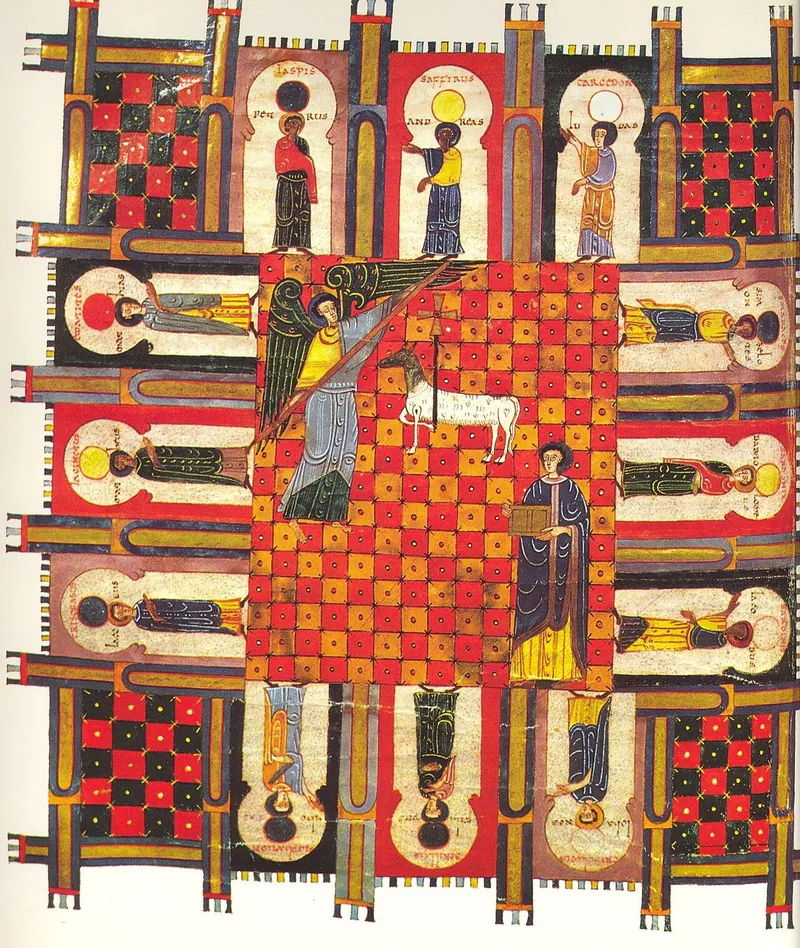
Illuminated manuscript · Revelation 21:9–27The New Jerusalem. Facundus draws the city as a square map seen from above: twelve gates, twelve figures, the angel with his golden measuring rod, John, and the Lamb at the centre where the Temple should be.Facundus, Beatus of Ferdinand I and Sancha, fol. 253v, 1047. Biblioteca Nacional de España. Wikimedia Commons · Public domain.
5
The architecture
Sevens within sevens
Revelation is built like a cathedral. Three series of seven judgments sit at its centre, and each series seems to come out of the last one. But do they happen one after another, or do they show the same history three times, each time more intensely? Readers have argued both since the third century.
Read the diagram. Each seventh item opens the next series, each series is longer and wider in reach, and each one ends with the same storm “formula” at the throne, louder every time (8:5; 11:19; 16:18–21). Original ClassroomOS teaching diagram.
A sequence: one thing after another
The seventh seal contains the trumpets, and the seventh trumpet leads to the bowls, like telescoping tubes. On this reading the judgments unfold in order, growing from partial to total. It takes seriously the way each series grows out of the one before.
Question it must answer: why does the world seem to end already at 6:12–17, with the sky rolled up and every mountain moved, and then carry on?
A spiral: the same story, retold louder
Since Victorinus of Pettau (died c. 304), many readers have seen recapitulation: each series covers the whole time between Christ’s first and second coming and ends at the final judgment, but from a sharper angle each time, like three movements of one symphony. The growing storm at the end of each series is the clue.
Question it must answer: why does the book link the series so tightly, with the seventh of one opening the next?
The Exodus plagues, replayed twice
Exodus 7–12
Trumpets (⅓ of the world)
Bowls (all of it)
Hail and fire (plague 7)
1 · hail and fire on the earth
1 · sores on the beast’s followers (like plague 6)
Nile turned to blood (plague 1)
2 · a third of the sea becomes blood
2 · the sea becomes blood
Undrinkable water (plague 1)
3 · Wormwood makes rivers bitter
3 · rivers and springs become blood
Darkness (plague 9)
4 · a third of sun, moon, stars darkened
4 · the sun scorches; 5 · darkness on the beast’s throne
Locusts (plague 8)
5 · locusts from the abyss
6 · frogs (plague 2) and the Euphrates dried up
Pharaoh hardens his heart
“They did not repent” (9:20–21)
“They did not repent” (16:9, 11)
Why the Exodus? Because it is Israel’s great story of a slave people freed from an empire. Revelation tells the church that it is living through a new Exodus, with a new Passover Lamb and a new song at the sea (15:3).
6
Scripture interprets Scripture
The echo finder
Of Revelation’s 404 verses, roughly 275 allude to the Old Testament, yet the book never once says “as it is written”. John expects his hearers to recognise the melodies. Choose an image, guess where it was first heard, then check.
Choose an image above to begin.
7
Interpretation
Four ways Christians have read it
Faithful Christians have read Revelation in very different ways. Most careful readers today borrow from more than one. To compare them fairly, watch what each one does with the same passage: the beast from the sea in chapter 13.
Preterist “already past”
Core idea: most of the visions describe events in John’s own century: Rome, Nero and the persecutions, and for some, the fall of Jerusalem in AD 70.
The beast in chapter 13: the Roman Empire, perhaps embodied in Nero (666).
Strength: takes seriously that the book was written to real readers about things “that must soon take place” (1:1).
Question to ask: if it is all past, what does it say to readers today, and how does it handle the final judgment and new creation, which have not happened?
Historicist “the whole of church history”
Core idea: the visions are a map of church history from the first century to the end, in order. Popular with Protestant Reformers and many readers until the 1800s.
The beast in chapter 13: often identified with later powers, from the papacy to Napoleon, depending on the interpreter’s own time.
Strength: it expects the book to speak to every generation.
Question to ask: why does almost every historicist find the story reaching its climax in their own lifetime, and why does it keep needing to be re-mapped?
Futurist “still to come”
Core idea: after the letters (chapters 2–3), most of the book describes events just before Christ’s return, still in our future.
The beast in chapter 13: a final world ruler, often called the Antichrist (a word Revelation itself never uses; it comes from 1 and 2 John).
Strength: the book clearly does look forward to a real end: Christ’s return, judgment and new creation.
Question to ask: how would chapters 4–22 have helped the seven churches in AD 95, if almost all of it was about events two thousand years later?
Idealist “every age”
Core idea: the visions picture the timeless struggle between God and evil, the Lamb and the beast, repeating in every generation.
The beast in chapter 13: any political power that demands worship and crushes dissent, whether Rome, a modern dictatorship or a system that makes buying and selling depend on loyalty.
Strength: it lets the book speak directly to every reader, as it was clearly meant to.
Question to ask: does the book have a real ending in history, or only patterns?
The thousand years (20:1–6): three readings
Premillennial
Christ returns before the thousand years and reigns on earth. Held by many early Christians (Papias, Justin Martyr, Irenaeus) and many evangelicals today.
Amillennial
The thousand years is symbolic of the present age: Christ already reigns, and Satan is “bound” by the gospel going to the nations. Taught by Augustine (City of God, book 20); the historic view of Catholic, Orthodox and many Protestant churches.
Postmillennial
The gospel will gradually transform the world into a long age of peace, and Christ returns after it. Widespread among 18th- and 19th-century Protestants, including many who campaigned against slavery.
Common ground. All three agree on what Revelation spends most of its ink on: Christ is risen and reigns, evil is real and doomed, the martyrs are vindicated, there will be a final judgment, and God will make all things new.
Practice: text or interpretation?
For each statement, decide: is it what the text says, or an interpretation someone argues?
8
Reception history
Revelation through the centuries
No book of the Bible has been painted, sung, feared, argued over and misused as much as this one. Its story did not stop in AD 95.
After the great fire of Rome, Nero blames the Christians of the city, and many are killed (Tacitus, Annals 15.44). Peter and Paul are traditionally said to have died in these years.
Roman legions under Titus destroy Jerusalem and its Temple, ending the Jewish revolt.
The emperor Domitian rules. Temples to the imperial family spread across the province of Asia.
The traditional date of Revelation, according to Irenaeus: John, exiled on Patmos, writes to the seven churches.
Pliny the Younger, governor of Bithynia, asks Emperor Trajan how to deal with Christians who refuse to offer incense to the emperor’s image (Letters 10.96–97).
Polycarp, bishop of Smyrna, is burned alive for refusing to call Caesar “Lord”. Around the same time Justin Martyr names John the apostle as Revelation’s author.
Irenaeus of Lyon dates the vision to the end of Domitian’s reign and discusses copies that read 616 instead of 666.
Dionysius of Alexandria argues from its style that Revelation was written by a different John from the Gospel’s author.
A scribe in Egypt copies Revelation on papyrus. The fragment, Papyrus 115, reads the beast’s number as 616.
Athanasius of Alexandria’s Easter letter lists the 27 books of the New Testament, including Revelation. Some Eastern churches stayed cautious about the book for centuries.
Augustine completes The City of God, reading the thousand years as the present age of the church. His approach shapes Western reading for a millennium.
The Spanish monk Beatus of Liébana writes a commentary on Revelation. Copies are illustrated for centuries.
Facundus paints the Beatus for King Ferdinand I and Queen Sancha of León, with the images in this lesson.
Weavers in Paris make the Apocalypse tapestry for Louis I of Anjou: originally more than 100 m long, the largest medieval tapestry to survive.
Albrecht Dürer publishes fifteen woodcuts of the Apocalypse. Printing makes Revelation’s images available to ordinary people across Europe.
Martin Luther’s preface says he can “in no way detect that the Holy Spirit produced it”. By 1530 he has written a much warmer preface reading it as church history.
Handel composes Messiah. Its Hallelujah chorus sets Revelation 19:6, 11:15 and 19:16.
Followers of William Miller, who had calculated from Daniel 8:14 that Christ would return on 22 October 1844, wait in vain. Date-setting has failed every time it has been tried.
Julia Ward Howe’s “Battle Hymn of the Republic” borrows Revelation’s harvest of “the grapes of wrath” (14:19) for the American Civil War.
In a German prisoner-of-war camp, Olivier Messiaen premieres his Quartet for the End of Time, inspired by the angel of Revelation 10 who swears “there will be no more delay”.
Papyrus 115 is published from the Oxyrhynchus collection at Oxford, confirming early copies with 616.
Tapestry · Angers, 1377–82 · Revelation 6:2The first horseman. The great Angers tapestry was woven while France was deep in the Hundred Years’ War and recovering from the Black Death. People who had lived through war, famine and plague saw their own world in the four riders.Photo: Remi Jouan. Wikimedia Commons · CC BY-SA 3.0. div>
9
Check and respond
What have you understood?
Write and discuss
Creative task: a letter to your city
Write an eighth letter in the pattern of Revelation 2–3, to a church in your own town or to your class. Be honest about your setting: what pressures, comforts and compromises does it offer? Use the five-part shape:
Title. Choose a description of Christ from chapter 1.
“I know…” What is good and true here?
“But I have this against you…” Where is the quiet compromise?
Command. Remember, repent, hold fast, wake up, open the door…
“To the one who conquers…” A promise drawn from chapters 21–22.