Antithetic
Line B states the opposite. The reader learns by contrast.
“For the Lord knoweth the way of the righteous: but the way of the ungodly shall perish.” (1:6)
Wisdom & Christian Life · Grades 6–12 · 40–60 minutes
The Psalms are prayers a whole people learned to sing: praise, grief, protest, thanks, and trust, all spoken straight to God. Learn to hear how each is built, why it moves you, and what its ancient setting adds.
1 · What kind of writing is this?
The Hebrew title of the book is Tehillim, “praises.” The English name comes from the Greek psalmoi, songs sung to a stringed instrument. Yet many of the 150 psalms are not praise in the narrow sense. The book also holds some of the most raw complaints in Scripture, thanksgiving for rescue, royal songs, travel songs for pilgrims, and poems about wisdom and Torah.
Psalm 1 is the doorway. “Blessed” (ashrei) is a cry of happiness, closer to “oh, the joy of…” than a calm label. It names two paths, and the rest of the book becomes a long walk along them, with all its detours, doubts, and returns.
Reading rule: a psalm is speech to God from a particular voice, so it records what a faithful person says, including what they feel, not always what God says. “Make me weep” and “where are you?” are in the Bible because they are honest prayers. Ask first: Who is speaking, to whom, and in what trouble or joy?
2 · The whole book
All 150 psalms and 2,461 verses are here. Pick a psalm, or search and filter the whole book. Press Study on any verse to see it in three translations, the patterns and themes in its wording, notes on its craft and context where we have them, and a place for your own note. Use Highlight by kind to light up the psalms in the grid that are laments, praise, trust, and so on. Your notes, stars and progress stay in this browser.
Highlight by kind
Filter verses
Kinds follow a long scholarly tradition (Hermann Gunkel, early 1900s) but are a teaching aid: many psalms mix kinds, and scholars classify some differently. Patterns and themes are spotted automatically from the wording (for example, “but” in the middle of a verse often marks a turn) and are starting points for your own reading, not verdicts. Verse text: Berean Standard Bible, King James Version and American Standard Version, all public domain. Many psalms open with a heading (“For the choirmaster,” “A Psalm of David”). In the Hebrew text those headings are part of the psalm, so they appear as part of verse 1.
3 · The craft
Hebrew verse does not rhyme. Its music is in parallelism, a second line that answers the first. Robert Lowth named the pattern in 1753; later scholars such as Robert Alter and James Kugel noted that line B seldom just repeats A: it sharpens, narrows, or turns it. The Psalms add tools that songs need: refrain, a repeated opening and closing line, an alphabet for a skeleton, and a sudden “But.”
Line B states the opposite. The reader learns by contrast.
“For the Lord knoweth the way of the righteous: but the way of the ungodly shall perish.” (1:6)
Line B restates A in fresh words, and the second wording deepens the first.
“The heavens declare the glory of God; and the firmament sheweth his handywork.” (19:1)
Line B completes or extends A, pushing the thought forward. Prayer often climbs this way.
“Wash me throughly from mine iniquity, and cleanse me from my sin.” (51:2)
An abstraction becomes something you can see, touch, or feel. Psalms rarely explain God; they picture God as shepherd, rock, shield, fortress, light.
“As the hart panteth after the water brooks, so panteth my soul after thee, O God.” (42:1)
A line repeats so a congregation can sing it. In Psalm 42–43 the same question returns three times (42:5, 42:11, 43:5). Psalm 8 begins and ends with one line (8:1, 8:9), a frame. Psalm 136 repeats “for his mercy endureth for ever” in all 26 verses.
Many laments pivot on one small word: “But I have trusted in thy mercy” (13:5). Psalm 119 is an alphabetic acrostic: 22 stanzas, one per Hebrew letter, eight verses each. Others are Psalms 9–10, 25, 34, 37, 111, 112, and 145.
Songs are made to be remembered and sung together. Compression, repetition, and picture are not decoration. They help a people carry prayer into the worst day of their life.
4 · Where the psalms came from
The Psalter is a collection, edited over centuries. Its own headings credit roughly 73 psalms to David, others to the sons of Korah, to Asaph, to Solomon, and one to Moses. Many headings use musical or technical words (maskil, selah) whose meaning is uncertain today. Knowing which room a psalm came from changes how we hear it.
Four of the five books end with a doxology (41:13, 72:18–19, 89:52, 106:48), and Psalm 150 serves as the doxology for the whole book. The five-book shape echoes the five books of Torah.
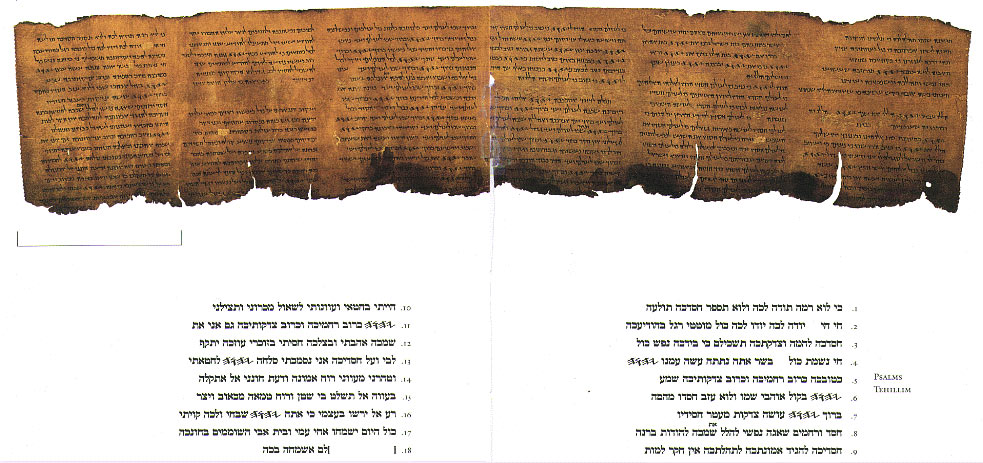
Levite singers and instrumentalists served in the temple (1 Chronicles 15–16, 25). Pilgrims sang the Songs of Ascents on the road to the feasts (see The Feasts of Israel). Psalms were also used at bedside, in the field, and in exile.
Egypt, Mesopotamia and Ugarit had hymns and laments too. Psalm 104 is often compared with Egypt’s Great Hymn to the Aten, and Psalm 29 uses storm imagery familiar from Canaanite poetry. Israel shares the forms but reorients them: it is the LORD, not Baal or the sun, who thunders and gives light.
The Psalms are the Old Testament book most often quoted in the New. Jesus prays Psalm 22:1 on the cross (Matthew 27:46) and Psalm 31:5 (Luke 23:46). Psalm 1 shares its two ways with Proverbs, and Job and Lamentations speak the same honest grief.

5 · Try it
Psalm 13 is six verses long and has a classic shape. Pick a tool, then tap a verse to mark it. A verse can carry more than one mark; tap again to remove it. When you finish, compare with the expert marks.
6 · Honesty in tension
Psalm 88 is one of the few laments that never turns. Its last word in Hebrew is “darkness.” Psalm 150 has no complaint at all: it is praise from first line to last. Both are in the book, and the Psalter never smooths them into one mood. Yet Psalm 88 still begins “O LORD God of my salvation” (88:1), so even this speaker is praying, and still addressing God. Most psalms hold the two together in one prayer; the book as a whole travels from lament toward praise without erasing either.
| Verse | What it does | Where it needs care |
|---|---|---|
| 88:18 · the last word is darkness | Faith can keep speaking to God when nothing improves. | It is a pattern for honest lament, not a rule that grief must stay unresolved. Psalm 30:5 holds the other side: “joy cometh in the morning.” |
| 137:9 · a cry for revenge | The raw rage of exiles, spoken to God after Jerusalem’s fall. | It is a prayer of the powerless handed to God, not a command to harm anyone. Compare Romans 12:19, “leave room for the wrath of God.” |
| 46:10 · “Be still” | An invitation to stop striving and recognize God. | It is spoken in the middle of war language, and the verb means to let go or relax your grip. It is not a slogan for quiet moods. |
| 23:4 · the valley | The comfort is presence: “thou art with me.” | The psalm says “through” the valley. It does not promise there will be no dark valley. |
| 91:11–12 · “he shall give his angels charge” | A psalm of confidence in God’s protection. | Satan quotes it in Matthew 4:6 to tempt Jesus, who answers with Deuteronomy 6:16. A verse can be quoted out of context. |
7 · Check and reflect
Choose one psalm. In five sentences: name its kind, point out one image, refrain, or turn, explain the feeling or claim beneath it, give one piece of context that changes how you hear it, and say what it would be like to pray it.