Space Science · Lesson 09

The Asteroid Belt

Between Mars and Jupiter is a broad ring of rocky leftovers from the early Solar System. It is not a crowded movie-style danger zone. It is mostly empty space, shaped by gravity, collisions, and Jupiter's enormous influence.

Mars to Jupiter Ceres Kirkwood Gaps Meteorites
Orbital Belt Lab Click named objects or change the view in the side panel.
The main asteroid belt sits roughly between 2.1 and 3.3 astronomical units from the Sun.

What Is the Asteroid Belt?

The asteroid belt is a region of millions of rocky and metallic bodies orbiting the Sun between Mars and Jupiter. Most are small, irregular fragments, but a few are large enough to be worlds in their own right.

The belt is not the remains of an exploded planet. It is mostly material that never successfully became a planet because Jupiter's gravity stirred up the region, making collisions too fast and disruptive for easy growth.

2.1-3.3 AU The densest part of the main belt lies beyond Mars and inside Jupiter.
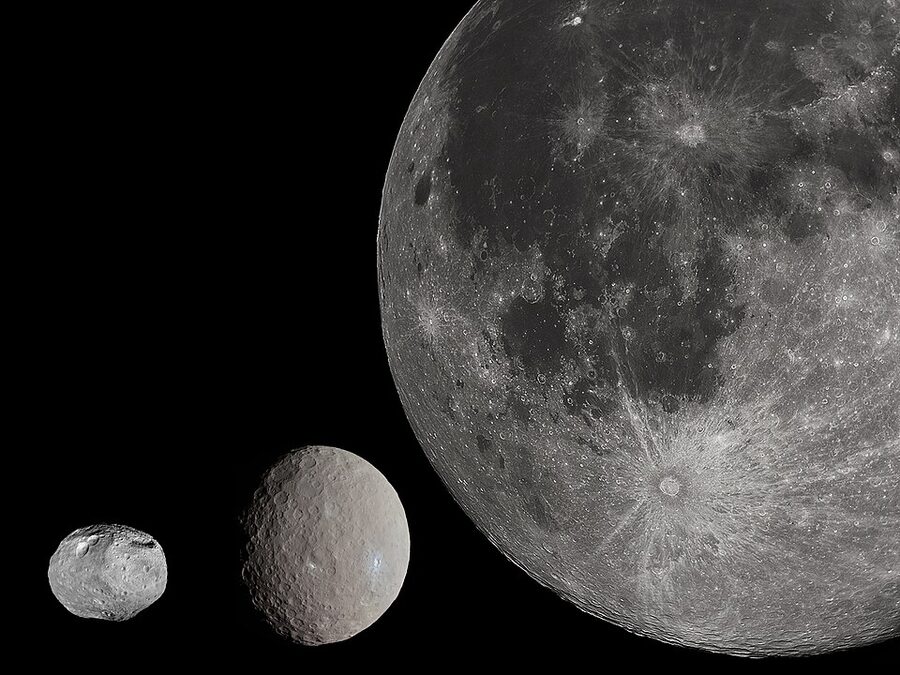
Ceres The largest object in the belt and classified as a dwarf planet.
Mostly Empty Spacecraft cross the belt safely because objects are widely separated.
Old Material Asteroids preserve clues from the Solar System's formation.
Why Did Jupiter Matter?

Jupiter's gravity creates resonances, places where an asteroid's orbit lines up repeatedly with Jupiter's orbit. These repeated tugs can stretch or destabilize an asteroid's path.

The result is a set of sparse zones called Kirkwood gaps, visible when astronomers plot asteroid distances from the Sun.

Ceres, Vesta, Pallas, Hygiea

Ceres alone contains about a quarter of the belt's mass. Vesta has a giant impact basin and has sent meteorites to Earth. Pallas and Hygiea are also among the largest bodies in the belt.

These objects are not just rubble. They are small worlds with histories written in craters, minerals, ice, and impact scars.

Asteroids, Meteoroids, Meteors, Meteorites

  • Asteroid: a rocky object orbiting the Sun.
  • Meteoroid: a smaller piece traveling through space.
  • Meteor: the bright streak as it burns in an atmosphere.
  • Meteorite: a piece that reaches the ground.

Practice Check

Real-World Connection

NASA's Dawn mission orbited Vesta and Ceres, turning tiny points of light into mapped worlds. Missions like OSIRIS-REx and Hayabusa2 show why asteroid samples matter: they let scientists study ancient Solar System material in laboratories on Earth.

Big idea: Asteroids are small, but they preserve an enormous history.