Visual Art · Geometry · History of Art
Pablo Picasso
Pablo Picasso (1881–1973) was a Spanish painter and sculptor whose restless experiments reshaped 20th-century art. With Georges Braque, he co-founded Cubism — a way of painting that shows an object's front, side, and top all at once on a flat canvas, breaking centuries of single-viewpoint perspective and turning painting into a kind of geometry problem.
Who Was Pablo Picasso?
Born October 25, 1881 in Málaga, Spain, Picasso was the son of José Ruiz y Blasco, an art teacher and painter. By family accounts he was a child prodigy who could draw before he could speak clearly, and he grew up sketching alongside his father's lessons. He trained formally at art academies in Barcelona and Madrid, mastering traditional technique years ahead of his peers before he ever thought to break from it.
Around 1904 Picasso moved to Paris, settling into the Bateau-Lavoir, a ramshackle building in Montmartre that housed a community of poor, bohemian artists and writers. His early Paris years passed through a somber "Blue Period" (roughly 1901–1904), painted in cold blues and grays after the suicide of his close friend Carlos Casagemas, followed by a warmer "Rose Period" (roughly 1904–1906) full of circus performers and softer oranges and pinks.
In 1907 Picasso painted Les Demoiselles d'Avignon, a jarring, angular depiction of five nude figures widely seen as the breakthrough toward Cubism — partly inspired by African and Iberian sculpture he had encountered in Paris. From around 1908 to 1914, Picasso and fellow painter Georges Braque worked side by side developing Cubism, fracturing objects into geometric planes and showing them from several angles simultaneously.
Picasso remained enormously prolific for decades across painting, sculpture, ceramics, printmaking, and stage design. In 1937 he painted Guernica, a monumental anti-war mural responding to the bombing of the Basque town of Guernica by Nazi and fascist forces during the Spanish Civil War. He died April 8, 1973, in Mougins, France, at age 91, leaving behind an extraordinarily large body of work across nearly eight decades of continuous output.
A Life in Reinvention
- 1881 Born October 25 in Málaga, Spain, son of art teacher José Ruiz y Blasco.
- 1890s Shows prodigious talent as a child, reportedly drawing before he could speak; trains at academies in Barcelona and Madrid.
- 1901–1904 Blue Period: somber, blue-toned works following the suicide of his friend Carlos Casagemas.
- 1904 Moves to Paris, settling in the Bateau-Lavoir artist community in Montmartre.
- 1904–1906 Rose Period: warmer tones, circus performers and harlequins.
- 1907 Paints Les Demoiselles d'Avignon, a breakthrough toward Cubism.
- 1908–1914 Develops Cubism alongside Georges Braque, fracturing form into geometric planes.
- 1912 Pioneers collage and papier collé, pasting real materials directly onto canvas.
- 1937 Paints Guernica, a monumental anti-war response to the bombing of the town of Guernica.
- 1940s–1960s Continues prolific work across sculpture, ceramics, printmaking, and stage design.
- 1973 Dies April 8 in Mougins, France, at age 91.
The Geometry Behind Cubism
Since the Renaissance, most Western painting followed single-point perspective: the artist picks one fixed viewpoint, and everything in the painting is drawn as it would appear to an eye frozen in that one spot. A cup on a table shows its side, not its rim and its base at the same time — because from any one viewpoint, you can only ever see some of an object's faces.
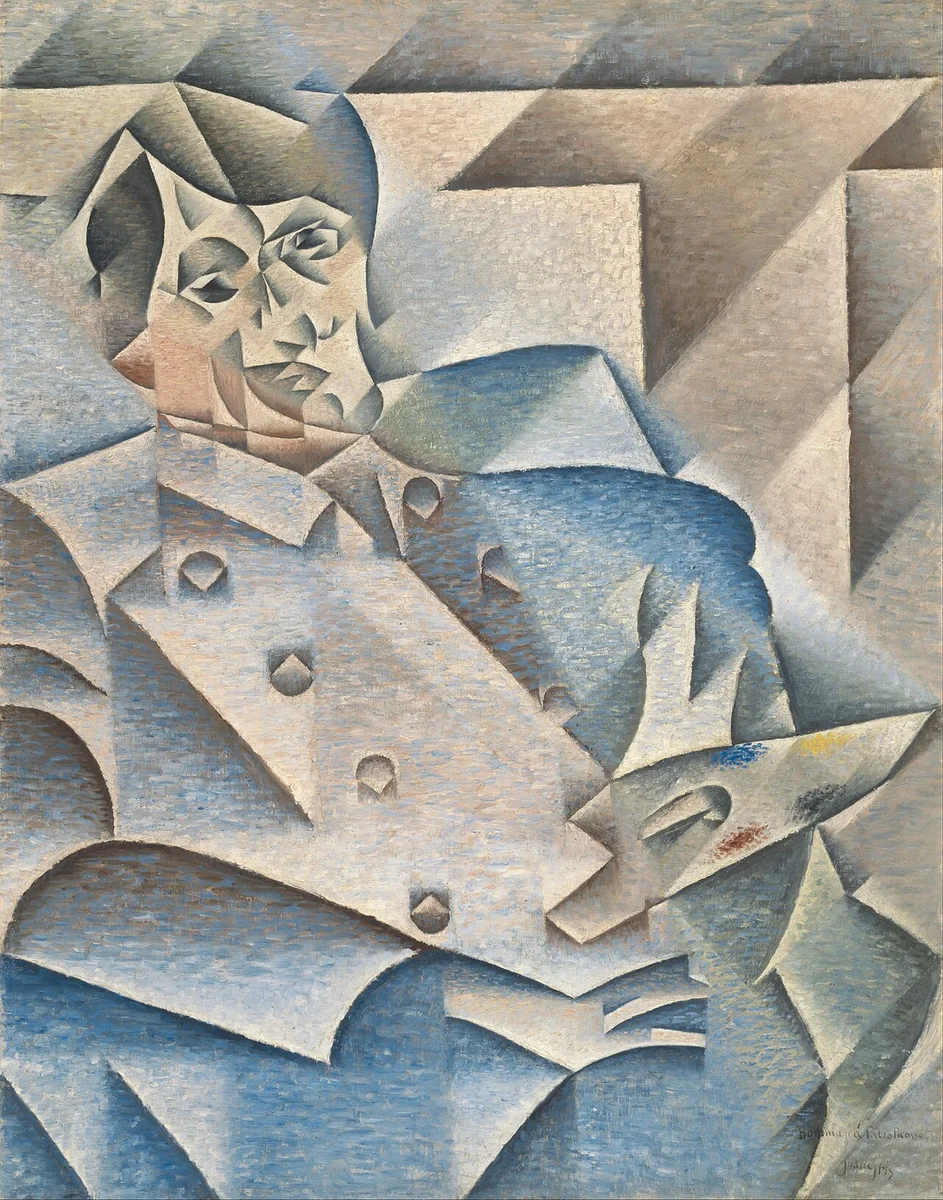
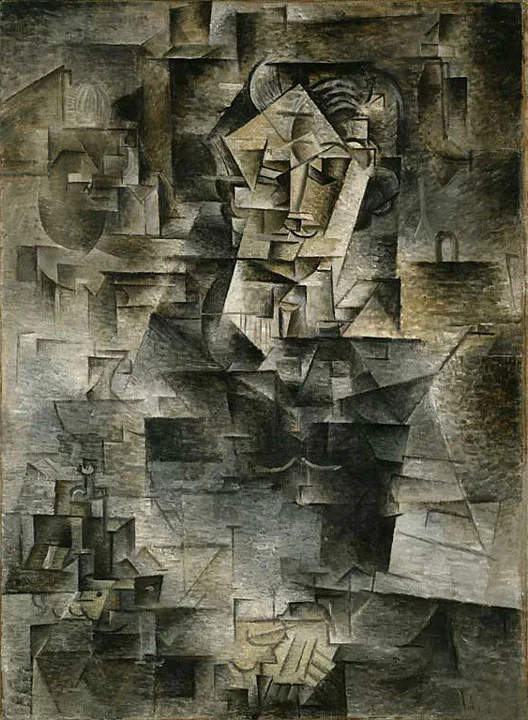
Picasso and Braque broke that rule on purpose. Cubism paints an object's front, side, and top simultaneously on a single flat canvas, as if the painter had walked all the way around the subject and flattened every view into one image at once. It's conceptually similar to an unfolded net of a 3D solid — the kind of diagram that lays every face of a cube flat so you can see all six sides in one picture, instead of the two or three faces a fixed eye would ever actually see.
Just as an unfolded net shows every face of a 3D solid flattened into 2D, Cubist paintings "unfold" an object's front, side, and top onto one canvas at the same time.
Analytic and Synthetic Cubism
The style unfolded in two phases. Analytic Cubism (roughly 1908–1912) broke objects apart into overlapping, near-monochrome geometric facets — almost a visual diagram of an object's structure. Synthetic Cubism (from about 1912) built images back up from simplified shapes and pasted materials — newspaper, wallpaper, fabric — in a technique called collage or papier collé, adding real texture instead of only painted illusion.
Is Cubism just "abstract art"?
Did Picasso invent Cubism alone?
Interactive Studio · Multi-Viewpoint Unfolding · Analytic vs. Synthetic Cubism
Cubist Multi-Viewpoint & Collage Studio
How do you show a subject's front (0°), side profile (90°), and top plan (+60°) on a single flat canvas at the same time? Use the Multi-Viewpoint Unfolding slider below to unfold five camera angles onto the canvas, switch between Analytic Cubism (monochrome interlocking facets) and Synthetic Cubism (papier collé collage with Le Journal newsprint, woodgrain, and sheet music), and drag any plane on the canvas to recompose the viewpoints yourself.
Visual Studies: Cubism & Multiple Viewpoints
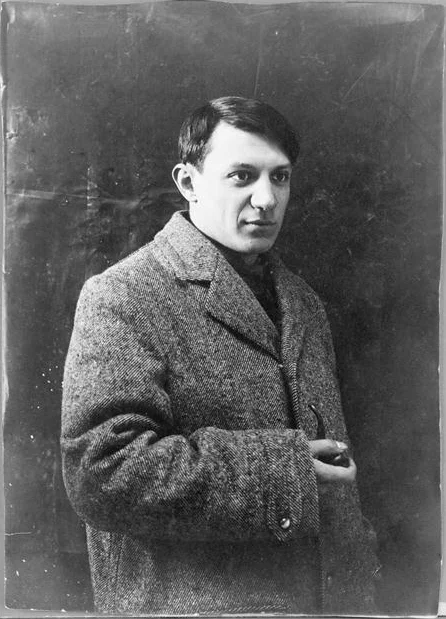
Examine how Picasso and his contemporaries replaced single-point Renaissance perspective with faceted geometry and multiple simultaneous viewpoints. Select any image to enlarge it in the classroom lightbox.
Picasso's Key Contributions
With Georges Braque, developed a way of painting that shows multiple viewpoints of an object at once, replacing single-point perspective.
Pioneered pasting real materials — newspaper, wallpaper, fabric — directly into paintings, blurring the line between painting and object.
Painted the 1937 anti-war mural Guernica in response to the bombing of a Basque town, turning painting into public protest.
Extended Cubist ideas into three dimensions, assembling sculpture from everyday objects and reinventing decorative ceramics late in life.
Moved through Blue, Rose, Cubist, Neoclassical, and Surrealist-influenced phases across a career spanning nearly eight decades.
Shaped nearly every movement that followed Cubism, from Futurism to abstract art, by proving painting didn't have to depict a single fixed view.
Picasso's Legacy Today
Cubism's central idea — that a flat image can show more of an object than a single eye ever could — influenced nearly every movement in modern art that followed, from Futurism and Constructivism to abstract art later in the 20th century. Picasso's willingness to keep reinventing his own style, rather than settle into one signature look, became a model for what it means to be a restlessly working artist.
Guernica remains one of the most recognized anti-war images ever painted; a tapestry reproduction has long hung outside the United Nations Security Council chamber as a reminder of the human cost of war. Across painting, sculpture, ceramics, and printmaking, Picasso left behind an extraordinarily large body of work — a testament to nearly eight decades spent treating every material and every viewpoint as something worth trying.
Practice Problems
Think about geometry, perspective, and Picasso's life.
Easy1. In what year was Pablo Picasso born?
Easy2. Which painting style did Picasso co-found with Georges Braque?
Medium3. A painter using single-point perspective can typically show at most 3 faces of a cube at once (say, the top, front, and one side). An unfolded net lays out all of a cube's faces flat. How many faces does a cube have in total?
Medium4. Which 1907 painting is widely seen as Picasso's breakthrough toward Cubism?
Challenge5. What event did Picasso's 1937 painting Guernica respond to?
Medium6. Picasso's Blue Period ran from about 1901 to 1904, and his Rose Period ran from about 1904 to 1906. About how many years did the Blue Period last?
Easy7. What technique did Picasso help pioneer around 1912 that involved pasting real materials like newspaper directly onto a canvas?
Challenge8. What idea from single-point perspective did Cubism deliberately break with?