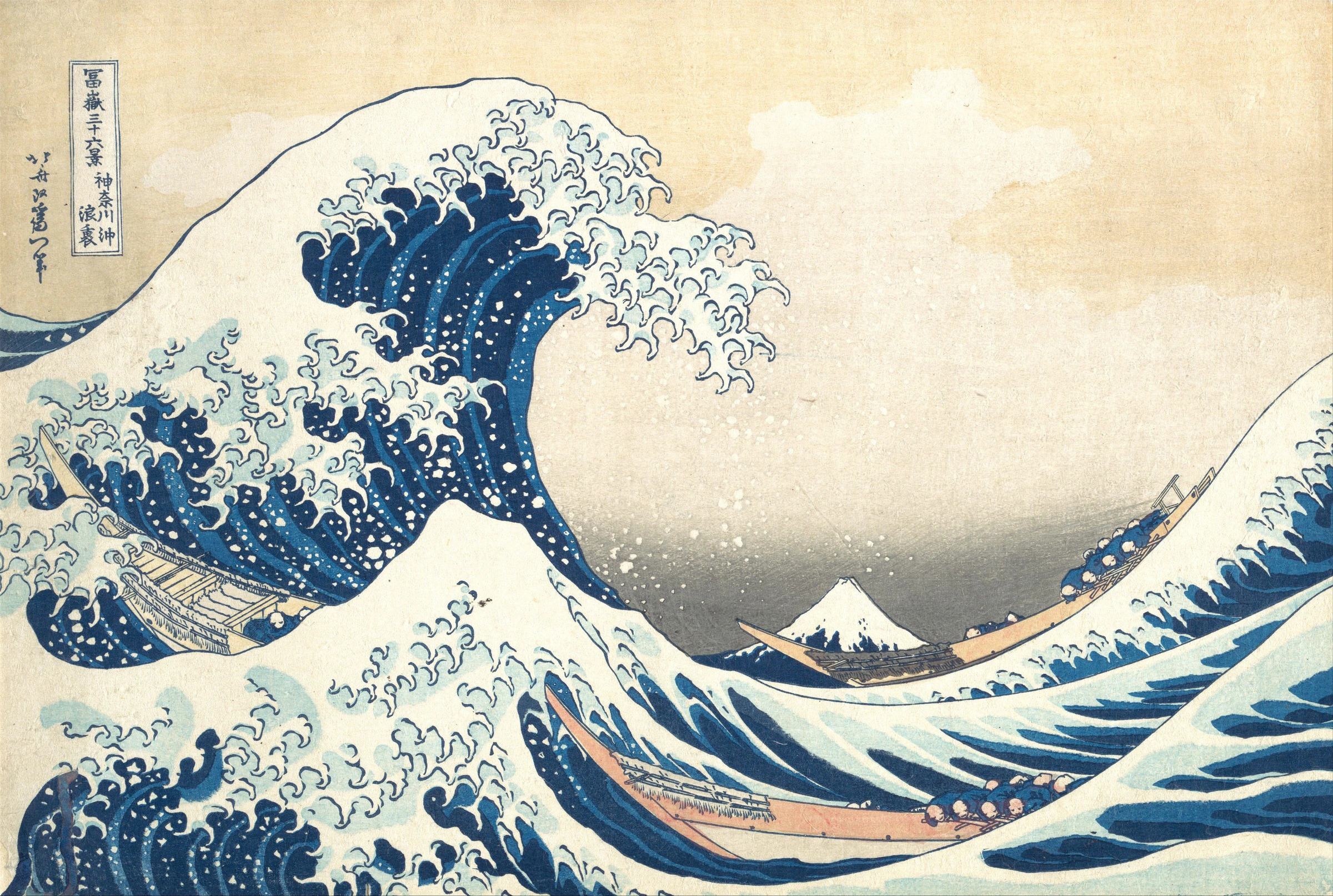
Edo, Japan · c. 1830–32 · Woodblock print
Katsushika Hokusai
Thirty-six Views of Mount Fuji 富嶽三十六景
Observe the print. Test the process. Make your own view.
A curling wave, three fragile boats, a distant mountain. Explore how Hokusai turned observation into a memorable design—and how carvers and printers turned that design into many colorful impressions.
Start here · 25–35 minutes · Art + engineering
How can one image feel so powerful?
Open the wave above. Look silently for 30 seconds, then find three boats, the tiny Mount Fuji, and the curling foam. Where does your eye go first? What makes the people seem vulnerable?
Today’s investigation
- Look for contrast, scale, and repeated shapes.
- Predict what happens when printed colors shift.
- Test registration in the studio below.
- Make a small design and explain one choice.
Meet the artist
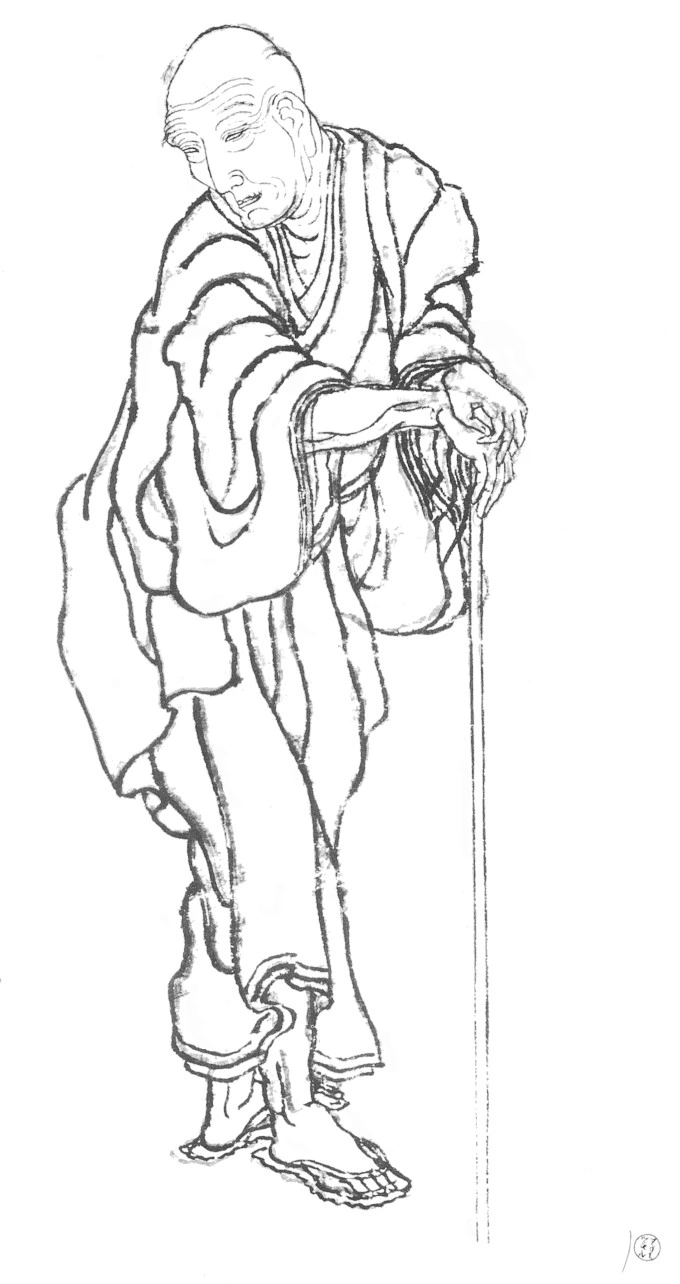

Hokusai (1760–1849) worked in Edo, now Tokyo. He designed prints, painted, and made illustrated books. His landscapes made everyday work and changing views of nature compelling subjects.
The Great Wave, made about 1831 when he was around 70, belongs to Thirty-Six Views of Mount Fuji. The mountain connects the series even when it appears small in the distance.
A lifetime of learning
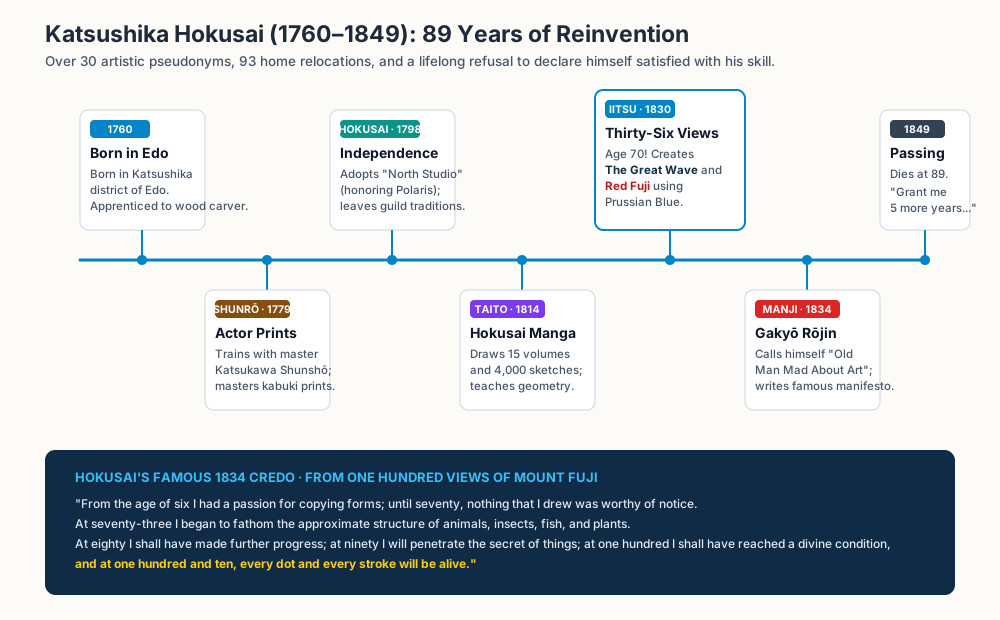
Hokusai trained in Katsukawa Shunshō’s studio, published the first volume of Hokusai Manga in 1814, and continued making art into his eighties. These drawing books collect observations and sketches; they are not modern narrative comics.
Explore the artist’s timeline
How a drawing becomes a print
Japanese ukiyo-e was never the work of a lone romantic painter in a studio. It was a collaborative process involving design, carving, printing, and publishing:
Hokusai drew the master linework (hanshita-e) in black sumi ink on gossamer-thin mulberry paper. Once approved by government censors, this drawing was pasted face-down onto the woodblock and destroyed during carving!
Using razor-sharp bull-nosed gouges and chisels (hangi-tō), the carver peeled away every speck of negative space from dense, fine-grained mountain cherry wood (yamazakura), leaving fine raised lines to carry pigment.
The printer applied water-based pigment mixed with rice-flour paste (nori) using stiff horsehair brushes (marubake), laid damp washi paper into registration notches, and burnished with a coiled bamboo-skin disc (baren).
Publishers like Nishimuraya Yohachi (Eijudō) financed the cherry wood, paid the artisans, and sold finished prints to Edo citizens as affordable commercial artworks.
Keep each color in the same place
To print a full-color artwork like The Great Wave, the printer pressed damp washi paper onto separate carved surfaces for the outlines and colors. Wet mulberry paper stretches when humid and shrinks as it dries. If a sheet shifted by even half a millimeter, the dark wave outlines would separate from the blue water, creating unsightly gaps and color bleed.
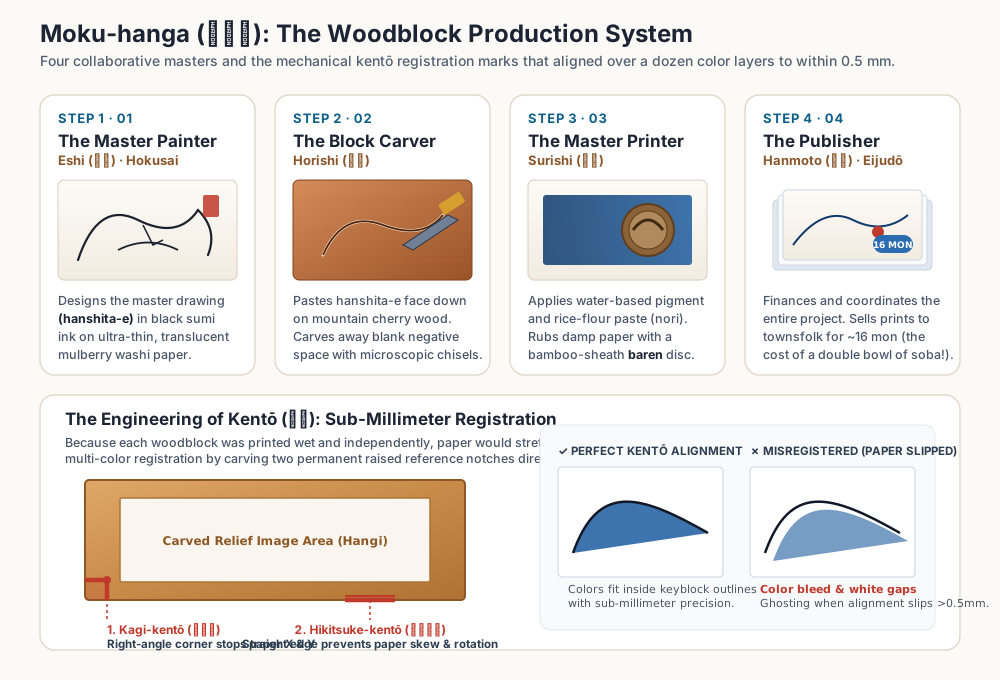
Think of a paper corner against two guides: the guides help you return it to the same position for each color.
Test the print: shift, compare, restore
Step into the workshop of a 19th-century master printer. Predict: if the color shifts right while dark marks and pale paper stay still, where will a gap appear? Press Shift the colors, inspect the mountain and wave edges, then restore alignment. Turn off a digital region to inspect its detail. Press Show original print to restore every region, the reference tone, and zero offset.
About this model. The reference is the Met’s actual impression, JP1847. Movable regions are digital teaching separations, not Hokusai’s historical woodblocks. Pale foam remains part of the paper image. Sky tone, ink strength, and the animated paper reveal are digital demonstrations, not reconstructions of historical blocks or measured pigment recipes; Show original print restores the unedited web reproduction.
The printer’s bench · Moku-hanga
Loading the museum reference…
Digital regions · select one to hide or show it:
Composition: curves, triangles, and echoes
Compare the large wave with the small triangle of Fuji. Curving water suggests motion; the mountain’s stable outline offers a contrast. The small foreground wave also echoes the mountain’s shape.
Look closer: a geometric interpretation
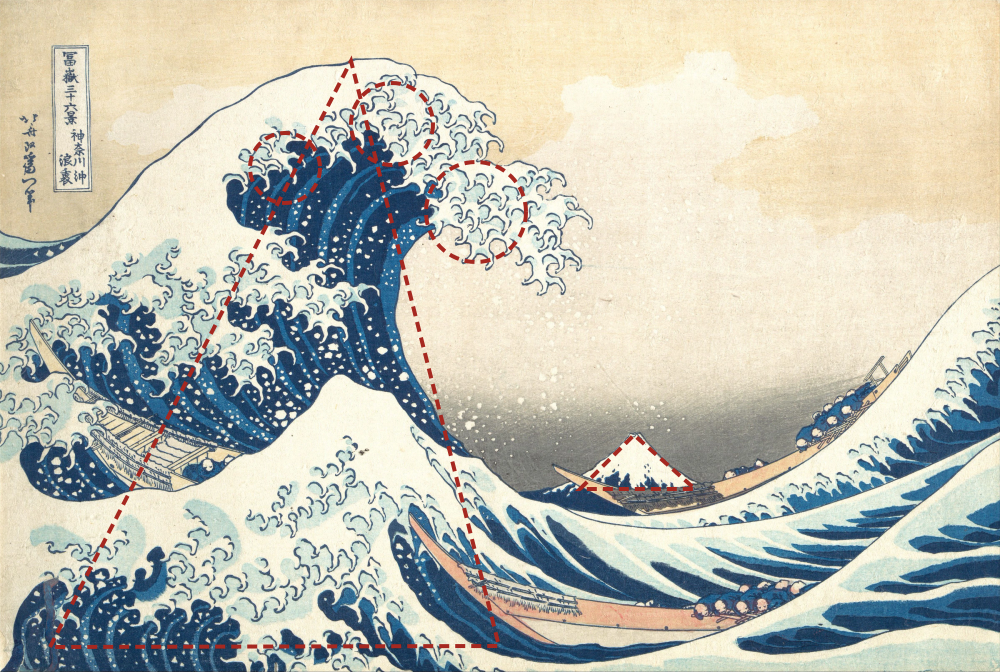
Test a geometric interpretation
This is the same museum reproduction with adjustable classroom overlays. A spiral can help us discuss a curl, but it does not prove that Hokusai used an equation. Repeated foam shapes suggest visual echoes, not an exact mathematical fractal.
Loading the museum reference…
A logarithmic spiral follows r = a × ebθ. Increase b: what changes? Does the curve match every part of the wave, or only suggest its motion?
Try drawing with simple shapes
Hokusai’s drawing manuals encouraged learners to build forms from simple shapes. These details are taken directly from the 1812 drawing manual, not redrawn imitations. Pick a subject, move to 0% to see its printed construction guide, then move to 100% to see the finished illustration. Which simple shape helps describe the bird or fish? The crossfade compares two separate drawings on the source page.
Open the original drawing-manual pages
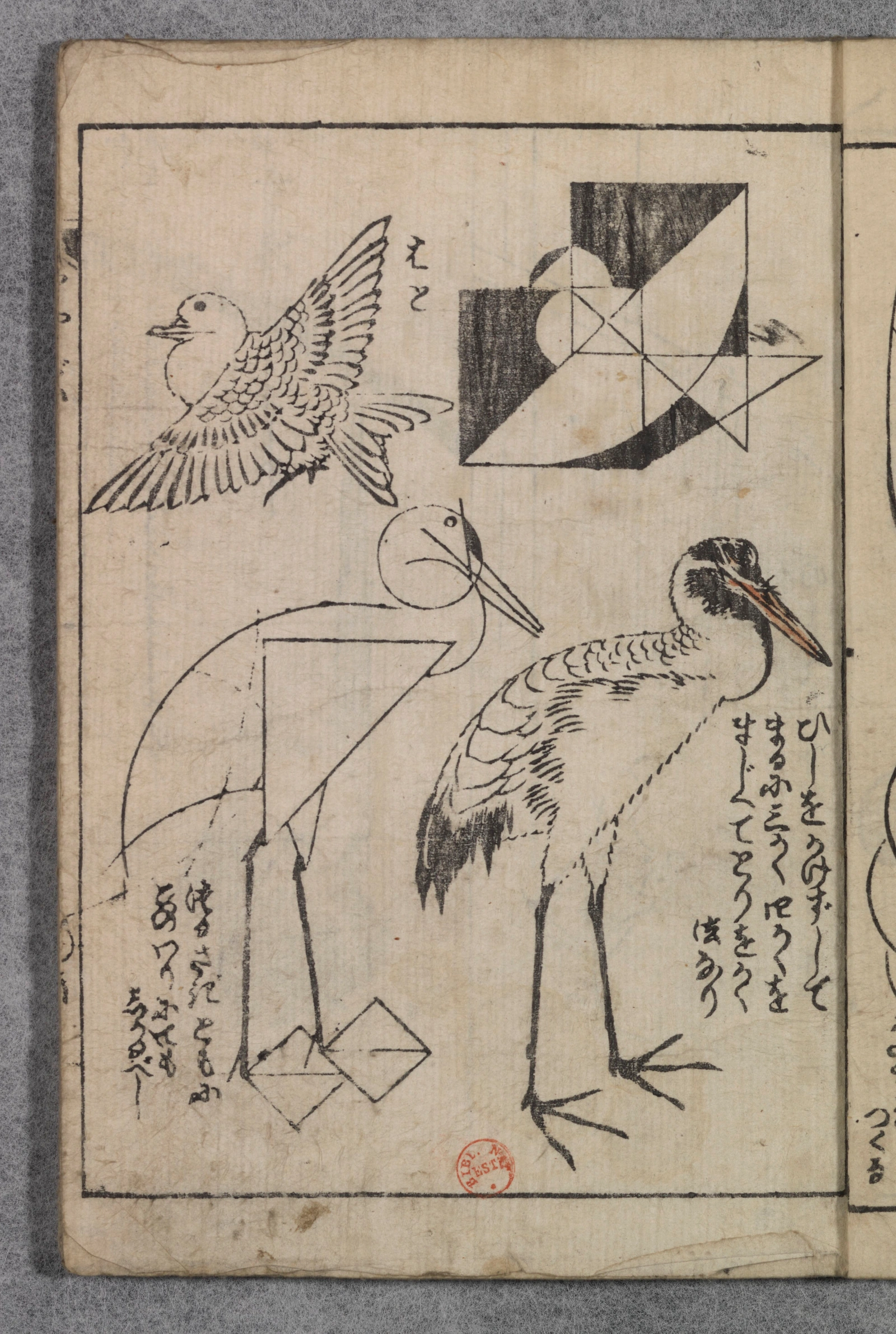

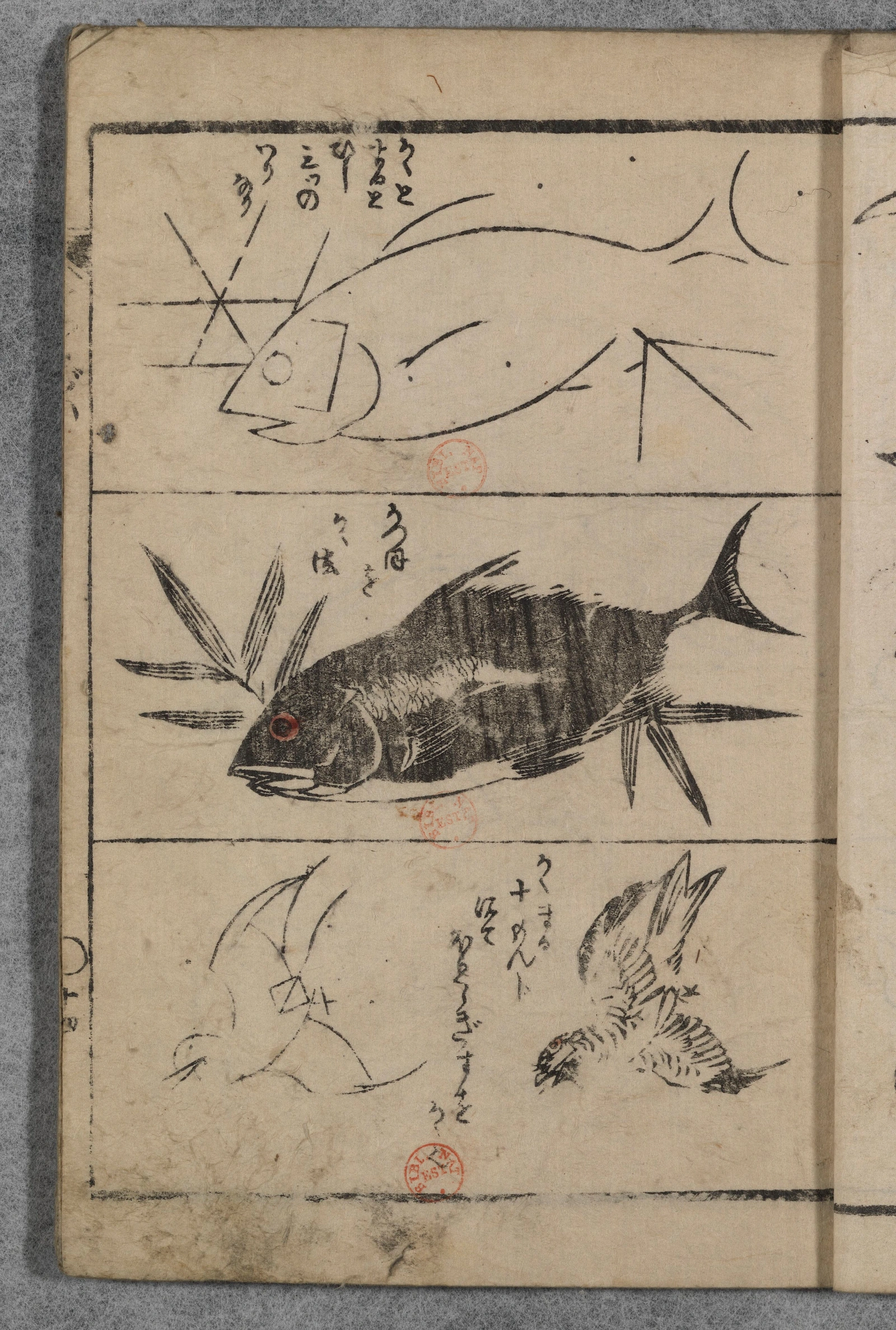

Compare Hokusai’s actual drawings
Loading the original drawing details…
Why the blue matters
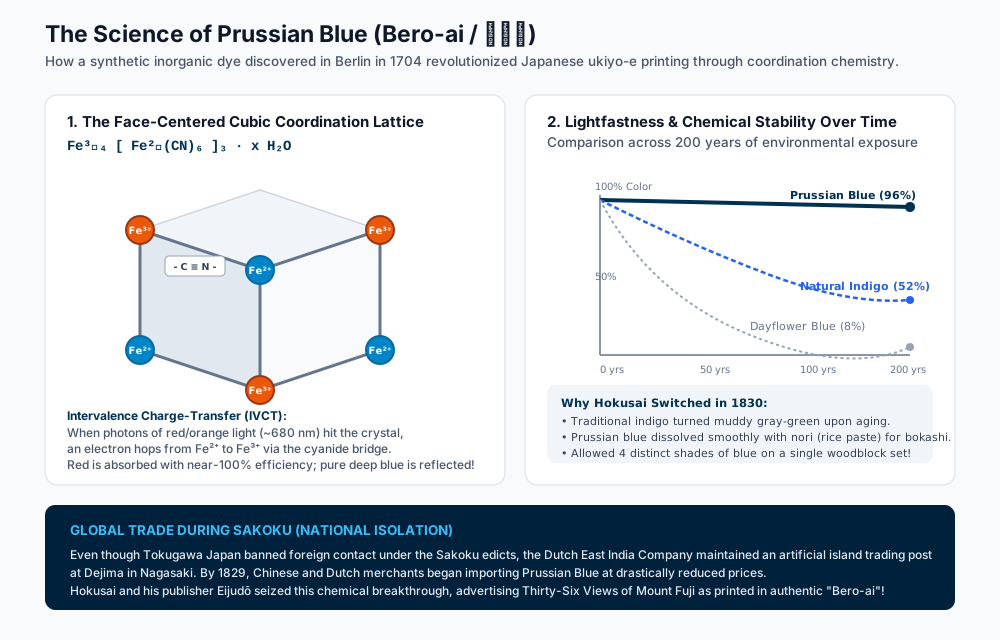
Prussian blue is a synthetic iron-based pigment that became important in Japanese printing around Hokusai’s time. Its intense color expanded printers’ possibilities. Scientific analysis of the Met’s Great Wave impressions identified both Prussian blue and indigo, including mixtures and overlapping impressions. The dark stripes were printed with a mixture of the two blues, then overprinted with Prussian blue: depth comes from carefully layered color and carved marks.
Light can change pigments and paper. Dayflower blue is especially sensitive, and Prussian blue is not immune to fading. Preservation depends on exposure, materials, and storage—not simply the number of years since printing.
Look closer: pigment chemistry
Make a museum display decision
You want students to study an original print. Which plan helps preserve it?
Choose a plan, then explain the tradeoff between access and preservation.
Compare three ways of seeing
Compare three works: how does Hokusai change mood with color, scale, and subject? Click any artwork to enlarge it in the classroom lightbox.
The definitive masterwork of ukiyo-e. Notice how the three narrow cargo boats (oshiokuri-bune) lean into the ocean swell, their rowers braced flat against the thwarts.
Katsushika Hokusai · Public domain / CC0 · The Met, JP1847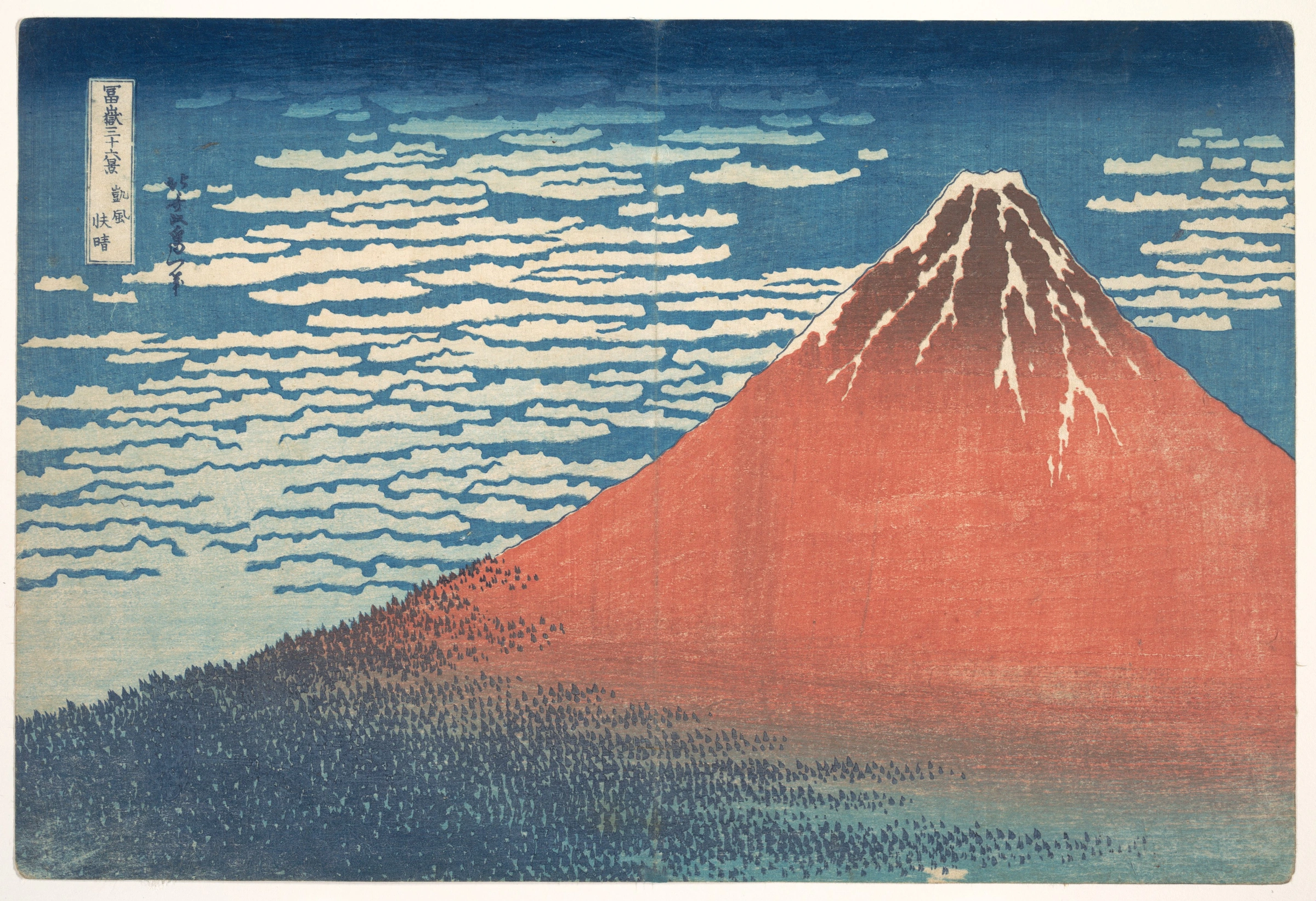
In late summer, the early dawn sun turns Mount Fuji a radiant copper red. Compare the broad mountain silhouette with the delicate pattern of clouds.
Katsushika Hokusai · Public domain / CC0 · The Met, JP2960Compare the spare fish outline with the striped finished fish. Hokusai uses simple forms to organize detailed observation. How does this instructional page differ from the landscape prints?
Katsushika Hokusai · Public domain · BnF, RESERVE 4-DD-527 · Original scan via Wikimedia CommonsA design that traveled
Japanese prints influenced European artists during the nineteenth-century enthusiasm called Japonisme. Their cropping, asymmetry, and areas of flat color offered new approaches to composition. Hokusai’s influence continues in contemporary art and design.
Make your own view · 10 minutes
Draw a familiar landmark three times: once large, once tiny behind a foreground object, and once partly hidden. Use two colors and leave some paper blank. Choose the most effective view and explain how scale or framing changes the mood.
Check your understanding
Test your knowledge of Hokusai's art, printmaking engineering, mathematics, and chemistry.
Easy1. In Japanese ukiyo-e woodblock printing, what were the permanent reference notches carved into the cherry wood blocks called to ensure multi-color alignment?
Easy2. What synthetic inorganic pigment, imported through Dutch traders, enabled Hokusai to produce the deep, lightfast blues in Thirty-Six Views of Mount Fuji?
Medium3. Which spiral in our classroom overlay has a radius that grows exponentially with angle?
Medium4. How old was Hokusai when he published his masterpiece series Thirty-Six Views of Mount Fuji around 1830–1832?
Challenge5. Which two tools could you use to make the circles and straight lines in our drawing exercise?
Medium6. What was the bamboo-skin pad called that printers pressed and rubbed by hand against the back of washi paper to transfer ink from the woodblock?
Challenge7. What 19th-century European artistic movement was sparked when French Impressionists and Post-Impressionists encountered Hokusai's prints?
Exit ticket: evidence beats guessing
Your writing stays on this page only. Copy it before leaving.
Look further · museum sources
- The Met: The Great Wave—Anatomy of an Icon · pigment and printing evidence
- British Museum: The Great Wave—spot the difference · compare impressions
- British Museum: conserving Hokusai prints · light and preservation